Back in September I had the chance to get a detailed tour of the
Fred Lawrence Whipple Observatory on Mt. Hopkins near Amado, AZ (south of Tucson).
The observatory is operated by the
Smithsonian Institution and hosts a wide-range of telescopes. Located at the base of the mountain, near the observatory's
visitor center is the
VERITAS array.
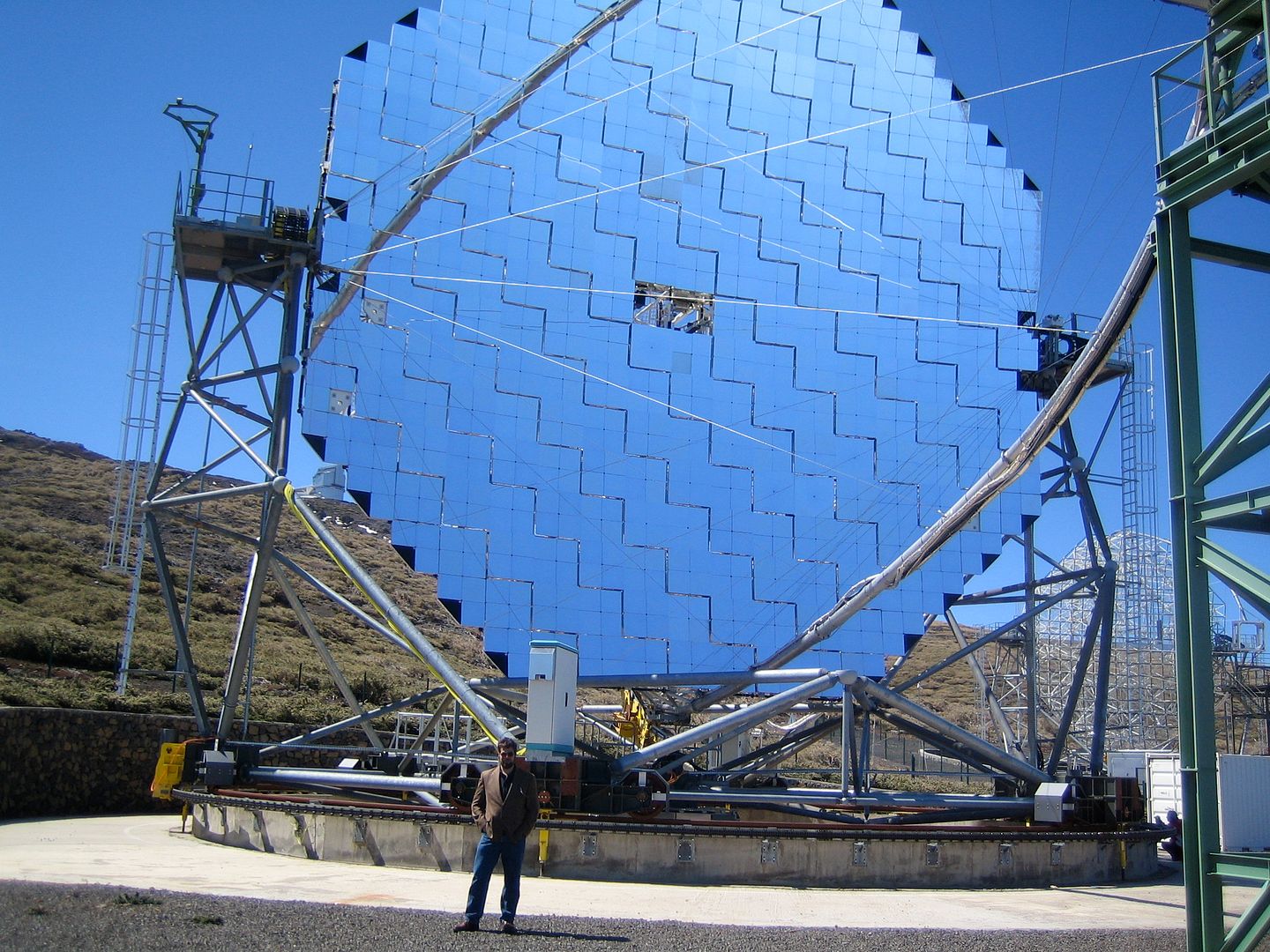
VERITAS (Very Energetic Radiation Imaging Telescope Array System) is an array of four 12-meter telescopes that were built to study gamma rays. Gamma rays do not penetrate Earth's atmosphere, but the telescope can still study them because the gamma rays collide with particles in our atmosphere which in turn starts a cascade effect that produces Cherenkov radiation that the telescopes can detect. There are two pairs of two telescopes in the array. Cosmic rays can generate the same kind of radiation, but over a much smaller footprint. So any detection of Cherenkov radiation that is measured by both telescopes in a pair is confirmed to be a gamma-ray source.
These telescopes are very sensitive to faint light, making them the best of their kind in the world. Be sure to check out their
recent results on the Crab Nebula.
Before heading up the mountain I had the chance to check out the visitors center. Inside there are some great displays including a sample of some of the astronomical ties that used to belong to Fred Whipple.
On the mountain is a varied collection of telescopes including the 10-meter predecessor to VERITAS. It is no longer used, but there is the opportunity to stand in the focal plane to see your reflection.
Most of the telescopes are located on a ridge that is below the summit. The collection here includes the 1.5-meter (60")
Tillinghast telescope.
The night of my visit the Tillinghast was being used to study Type Ia supernovae.
Located right next to the 1.5 meter is a
1.2-meter (48") telescope (above). The
HAT (Hungarian-made Automated Telescope), which is really a collection of small telescopes looking for transiting exoplanets, is also located on this ridge.
Moving up to the summit of Mt. Hopkins it was finally time to visit the
MMT Observatory. The MMT, as you may recall, began as the Multiple Mirror Telescope, a telescope that was made up of six 1.8-m (72-inch) mirrors with an effective light gathering power of a 4.5-meter (177 inch) telescope. It looked like this:
In the 1990s it was decided to upgrade the telescope by replacing the six smaller mirrors with a single 6.5 meter primary mirror. This mirror was one of the giant mirrors that are created in the
Steward Observatory Mirror Lab.
MMT Observatory (as it is now called) began operations in 2000 and continues to be one of the most productive research telescopes in the world.
The "dome" that houses the structure was (I believe) the first of its kind. The entire building rotates to accommodate the motion of the telescope.
I had the great fortune to be in the "dome" when it opened. Here is a short video clip of the opening:
Inside, standing next to the telescope is an entirely different feeling from other observatories I have visited. Modern giant telescope mirrors are larger and "faster" than big glass from earlier generations. This allows the newer telescopes to be both bigger (more light gathering power) and smaller. Smaller in the sense that the mirrors are more steeply curved so that light comes to a focus sooner. This allows for a shorter telescope "tube" and a smaller enclosure, which in turn saves money.
The telescope was tipped low for us to see the 6.5 meter primary mirror.
Just before the telescope began operation the lights were dimmed and I could see the stars reflected off of the mirror. It was an impressive and moving sight.
Light pollution is a growing concern for the observatory. The
International Dark-Sky Association has placed sky brightness monitors on the mountain to help study the skies over the observatory. Monitors, located on Mt. Hopkins and elsewhere, will be used to help protect observatories and other dark sky places from light pollution.
Finally, let me thank Dan Brocious for the wonderful tour. Dan has just
retired from Whipple where he will certainly be missed.