Showing posts with label mirror lab. Show all posts

Sunday, February 16, 2014

Telescope Tourist: Mount Graham's Large Binocular Telescope in 3D

A few years ago I had the pleasure of visiting Mount Graham International Observatory (MGIO) to get a guided tour of the Large Binocular Telescope (LBT). MGIO is located 10,470 feet (3,191 meters) above sea level in the mountains of eastern Arizona.
In addition to the LBT, MGIO is home to the Vatican Observatory's Advanced Technology Telescope. It sports a 1.8-meter mirror that was spuncast at the University of Arizona's Steward Observatory Mirror Lab.
The Observatory is also home to the University of Arizona's Heinrich Hertz Submillimeter Telescope. Submillimeter astronomy looks at wavelengths of light that are invisible to human eyes. This portion of the spectrum longer in wavelength than visible light, but shorter than radio or even microwaves (no, not the ovens).
The LBT's "dome" bears some resemblance to the structure that houses the MMT Observatory (they're both rectangular in shape), but it really is quite unique.
The whole upper portion (the part that isn't green) turns with the telescope and has tubes that stick out that look almost like the big guns you might find on a battleship. They are part of the air handling system that helps keep the interior atmosphere at nighttime temperature.

Of course the really unique stuff is on the inside. The telescope has two 8.4-meter mirrors on one altitude-azimuth mount. This gives it the optical collecting area equivalent to an 11.8-meter telescope and theoretically the resolving power of a 22.8-meter telescope. In other words it is big. You might even say gigantic (Yes, there even bigger scopes coming in the future, but this really is huge.) It was big enough that I wished I had had a wider angle lens with me.
During my visit the telescope was tipped all the way down so as to be pointed at the horizon. We came in from behind and walked around its left side. The circular red area with the silver struts attached to it is the cell that holds the left-hand primary mirror. The red area at right (with all the holes in it) is one of the telescope's two semicircular bearings that move the telescope in altitude. When they want to move in azimuth the telescope is brought along for the ride as the whole upper part of the building is rotated.
Stepping in a little further, looking at the telescope almost from the side, gives a much better view of the telescope's bearing. The mirror in it's cell is top center and you can see a secondary mirror to the left (there's a red cable hanging down that almost blocks the view).
  Here's a better view of one of the secondary mirrors. It is 0.91 meters (36 inches) across.
Looking up at the left-hand primary mirror you can see the depth of its curvature. The mirror is 35.2 inches thick at the edge and just 17.2 at the center hole. The primary mirrors are "fast" with an f/ratio of 1.142. They were also made at the University of Arizona's Steward Observatory Mirror Lab.
Here's nearly face on shot of the left side primary mirror. That's a tertiary mirror in front of it.
Here's the whole telescope as seen from the front. Both primary mirrors are visible. There's a silver support structure that runs across bridging the two sides. Look at the lower right side of that where it meets the red part. Do you see the little white tube there?
That's a small Meade refracting telescope that was used (and maybe still is) to verify where the main telescope is pointing.
This is me (left) standing with LBTO Instrument Support Astronomer Dave Thompson under the telescope's other primary mirror. Dave kind enough to give us the tour of LBT. I first met Dave when he was observing at Palomar as a Caltech postdoc.
Every so often one of the telescope's primary mirrors need to get a new reflective coating of aluminum. When this happens the mirror remains in place on the telescope and the the giant re-aluminumizing chamber is brought to it. Here's what the aluminumizing chamber looks like. It is stored down on the ground floor when not in use.
Rounding to the back of the telescope here's a view showing the mirror cell for the right-hand mirror (upper right) and the telescope's two bearings for moving it in altitude. 

If you want to keep up with everything related to the LBT, be sure to check out the It's happening at LBT blog. There's great stuff there that you wont find on the official website. The color quality isn't the best, but you might want to check out the webcam from the VATT pointed at LBT.

I took a number of stereo pairs while I was there that I converted into red-blue anaglyphs. If you've got the red-blue glasses the next three photos should give you 3-D views of the telescope. I hope you enjoy them.
LBT in 3D, from the front
LBT in 3D from the front but off center
LBT in 3D the back end of the telescope


Monday, January 16, 2012

Casting the 2nd GMT Mirror

Early reports confirm that Saturday's casting at the University of Arizona's Mirror Lab of the second mirror for the Giant Magellan Telescope was successful.

Here is a short video of the rotating oven in action:


 Recall that inside the rotating oven was placed some 21 tons of chunks of borosilicate glass onto a mold. Here is a shot taken by one of the cameras inside the oven from early in the process:


 Compare it with this recent photo:

 The glass has melted into into the honeycombed structure of the mold.  It is not really evident here, but the rapid rotation of the oven has introduced a curve to the liquid glass.

Upon cooling the mirror will eventually be removed and inspected.  If all is will it will be placed in line for polishing.  The first mirror cast for the GMT is still being polished in the lab and here is a timelapsevideo of it being polished that was cast for this project:


This video comes from Dean Ketelsen. Be sure to check out his great blog.

Thursday, January 12, 2012

Watch the GMT's 2nd Mirror be Cast this Saturday

Back in November I posted about a tour I received of the University of Arizona Steward Observatory Mirror Lab.

On Saturday, January 14th the Mirror Lab will be casting the second of seven 8.4 meter mirrors for the Giant Magellan Telescope.  See the press release for the event here.

They have placed 21 tons of borosilicate glass into a mold that is sitting within a giant rotating oven. As the temperature increases, the glass will melt, and the rotation will evenly spread the molten glass over the mirror's honeycomb skeleton.

The Mirror Lab has set up live webcams inside the oven, will relay oven temperature and rotation speeds telemetry for the mirror casting. You will be able to watch the event as it unfolds here:

http://abell.as.arizona.edu/~hill/GMT2/

Times have changed and the methods of casting telescope mirrors has too. Here's how Corning Glass Works cast the mirror for the 200-inch telescope back in 1934:


Times have changed.

Wednesday, November 16, 2011

Where Big Glass is Born

I recently had the opportunity to tour the University of Arizona's Steward Observatory Mirror Lab. For those not aware the Mirror Lab has cast some truly giant pieces of glass including the primary mirrors for the 3.5-meter WIYN Telescope on Kitt Peak, the 6.5-meter of the MMT Observatory on Mt. Hopkins, the 6.5-meter for each of the two Magellan Telescopes located at Las Campanas Observatory in Chile, and the two 8.4 meter primary mirrors for the Large Binocular Telescope on Mt. Graham.

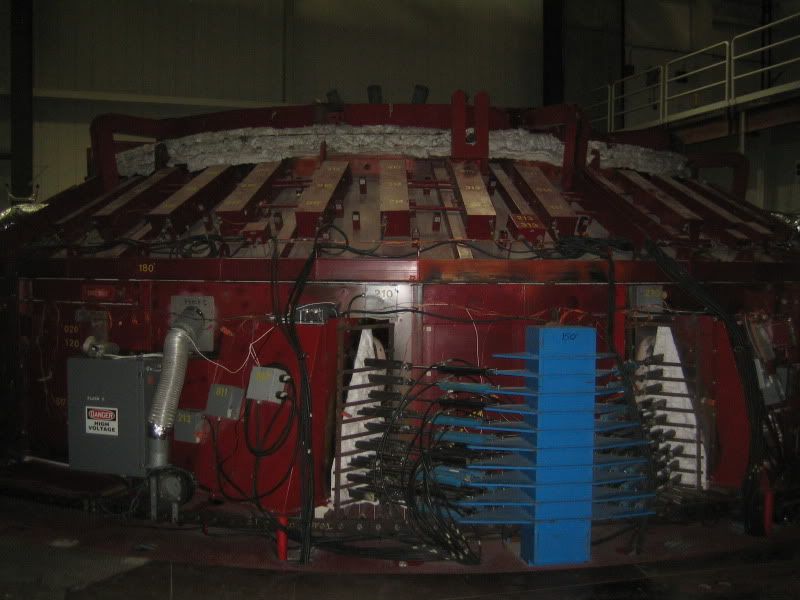
Each of these large, fast (short focal ratio) mirrors is a product of the Lab's unique strategy of spin-casting glass. A mold is built into the base of a giant oven, glass is then carefully weighed and placed into the mold.  The top to the oven is brought over the mold and the entire oven rotates as the glass is melted in place.  The oven spins at the proper rate so as to bring the liquid glass into very nearly the curve needed for the telescope's mirror.  It continues to spin while the glass slowly cools and anneals.

The Mirror Lab's rotating oven.
This is in stark contrast to the old school method to cast the 200-inch (5.1-meter) Palomar mirror back in 1934.  There molten glass was ladled into the giant mold (Check out the video here).  Once cooled the opticians were given a large, flat disc that then had to have tons of glass removed to produce the necessary curve.

There are currently three mirrors sitting in the lab. The smallest of them is the 6.5 meter that was cast for the San Pedro Mártir Observatory in Baja California, Mexico.  As you can see from the short video clip below it is literally hanging around waiting for its chance to get polished.


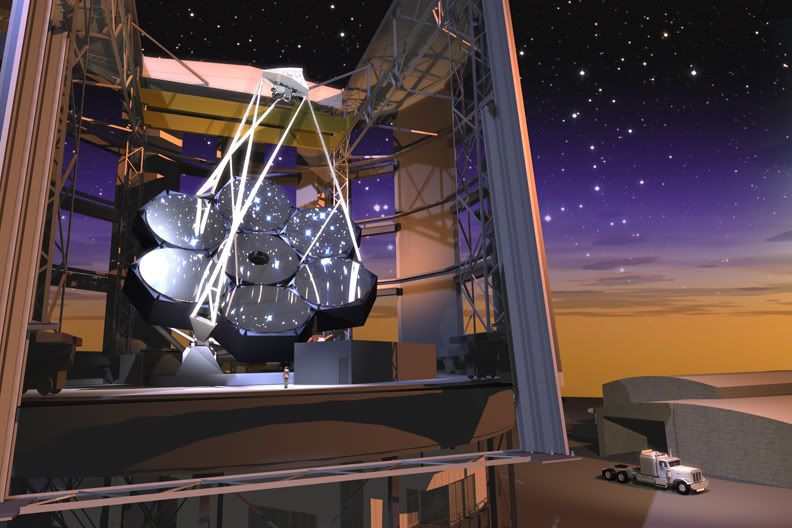
There are two mirrors already on deck part way through the polishing process in the lab. The first is one of the seven (yes, SEVEN!) mirrors that will make up the Giant Magellan Telescope. The people behind the GMT hope that when it is completed the it will be the first of the next generation of epically large telescopes - a telescope so big that will make the Palomar 200" and even the 10-meter Keck telescopes look small.  Here is a visualization of how it will end up looking:

Credit: GMT, Todd Mason
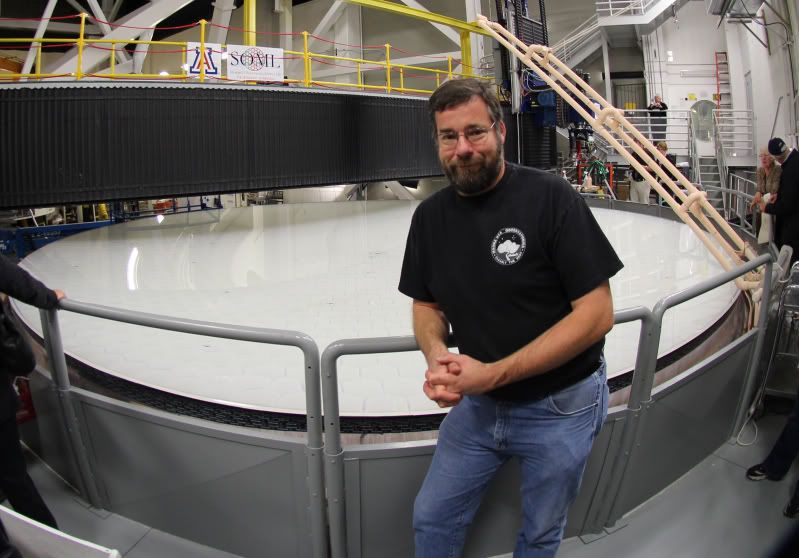
Can you spot the person standing in front of the telescope? That should give you a sense of scale. To bring us back to reality (instead of just concept art) here's a fish-eye shot of me standing in front of the first of the GMT's 8.4 meter mirrors:

Photo by Mark Lane
Remember, this is just the first of seven 8.4-meter diameter mirrors that will be cast for the project. Here is a short video I shot panning across the span of the mirror:


The second of the seven mirrors will be cast early next year. Between now and then technicians will begin the process of building the mold. They will then weigh and place hunks of glass like this one into the mold:


Here's a video from the University of Arizona featuring Roger Angel, the brains behind the whole spin-casting method, explaining a little bit about the process and the GMT:


Also currently being polished in the Mirror Lab is the 8.4-meter primary mirror for the Large Synoptic Survey Telescope. The LSST will be the world's first wide-angle survey telescope.  I believe that the LSST will do more to revolutionize astronomy than any other telescope in existence, under construction or on the drawing boards. From the LSST website:
The 8.4-meter LSST will survey the entire visible sky deeply in multiple colors every week with its three-billion pixel digital camera, probing the mysteries of Dark Matter and Dark Energy, and opening a movie-like window on objects that change or move rapidly: exploding supernovae, potentially hazardous near-Earth asteroids, and distant Kuiper Belt Objects.
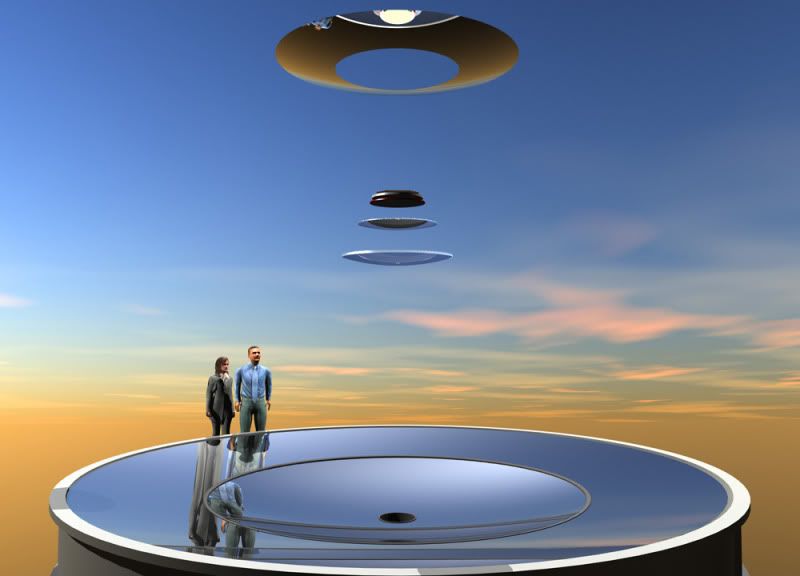
In order to have such a wide-field telescope that can produce sharp images across its field of view, it needs to have a rather complex set of optics. As you can see from the visualization below, even the telescope's primary mirror needs to be fashioned to an unusual shape:
Credit: LSST, Todd Mason
The mirror was cast to the curve show in the outer portion. To achieve the more steeply curved inner portion of the glass the opticians in the Mirror Lab had to grind it out. I believe to do so, the opticians removed some 5 tons of glass in around 5 weeks.

The unusual shape of the glass proved to be difficult to photograph, but this short video I shot hopefully shows it off:


The tour of the Mirror Lab that I was on was expertly given by Dean Ketelsen (be sure to check out the cool blog that he and his wife write: here).  Public tours are available.  I recommend them for anyone interested in telescopes or astronomy.  After all, the Mirror Lab is the birth place of some of the most productive telescopes working today and coming tomorrow.