Showing posts with label science fiction. Show all posts

Tuesday, January 1, 2019

My Top Books of 2018

2018 was a bad year for blogging, but another good year for reading. Like last year I managed to read 60 books, though not quite as many pages as I hit in 2017.

I use Goodreads to keep track of what I've read, so if you are interested here's the full list of what I read in 2018. My "best books of the year" are drawn from titles that I read that also came out this year. I read a lot of science fiction and science books, so my list comes from a pretty narrow spectrum of books.

In the realm of science books my top two were We Have No Idea: A Guide to the Unknown Universe by cartoonist Jorge Cham and physicist Daniel Whiteson. It's a very friendly look at the big mysteries of modern science and I enjoyed the heck out of it.  Even better though is Alan Stern and David Grinspoon's Chasing New Horizons: Inside the Epic First Mission to Pluto. It is the inspiring story of how the New Horizons mission was created, funded, cancelled, re-born and eventually sent for its 2015 flyby of Pluto, giving us our only look at the most famous of dwarf planets.

By the way, New Horizons just completed a successful flyby of another and more distant object, but as of this writing the data is only now being returned to Earth.

I also very much enjoyed Adam Frank's Light of the Stars: Alien Worlds and the Fate of the Earth.

Another non-fiction book that I very much enjoyed was Michael Benson's Space Odyssey, which looks at the making of the classic film 2001: A Space Odyssey. 

There were so many good science fiction books out in 2018. John Scalzi gave us two (Head On and The Consuming Fire). Becky Chambers Record of a Spaceborn Few was very enjoyable, but my favorites were How to Stop Time by Matt Haig and Mary Robinette Kowal's two Lady Astronaut books: The Calculating Stars and The Fated Sky.

How to Stop Time is wonderful, quotable and profound, while MRK's two Lady Astronaut books are adventurous, tragic, inspiring and important. They tackle head on issues of inclusion, race and discrimination. I highly recommend them.

2019 should be another good year for reading. I got a nice pile of books for Christmas that is getting me off to a good start.

Monday, January 1, 2018

My Top Books of 2017

2017 wasn't much of a good year for blogging, but I did read a lot of books--60, which is the most I have ever read as an adult. My trend has been going upward as I read 46 books in 2016, 24 the year before and just 18 in 2014.

I use Goodreads to keep track of what I've read and to collect the titles of the books that I want to read. For anyone who might care, here is the full list of what I read this year.

As I look to my "best books of the year" I'm going to include titles from 2016 as well. My reading tastes tend to focus primarily on science fiction, science (including history of science), and a bit of history and politics too.

In Science Fiction, Artemis by Andy Weir and The Collapsing Empire by John Scalzi were both good and fun books, but I especially liked All Our Wrong Todays by Elan Mastai and Death's End (the third and final book in the series begun with The Three Body Problem) by Liu Cixin. Liu Cixin always takes me to unexpected places. Also of note (but published in 2014, so it's a bit "old" to be considered here) was Becky Chambers The Long Way To A Small, Angry Planet which I really loved. It's sequel was good too, but not as awesome.
In the realm of non-fiction I read two astronaut biographies: Mike Massimino's Spaceman and Leland Melvin's Chasing Space. I enjoyed both of them, but I much preferred Spaceman, though Leland Melvin's book is a good read.

I really enjoyed Al Franken's Al Franken, Giant of the Senate, but I suspect the recent sexual harassment charges made against him are going to kill both the paperback edition of the book and his political career. 

Other good science titles (some of which are a bit historical) are Margot Lee Shetterly's Hidden Figures which was made into a wonderful motion picture. The film got essentially every historical fact wrong, but appropriately gets the message right. Paul Bogard's The Ground Beneath Us looks at just what it says-the ground, focusing on our essentially ignored relationship with it. It is a book that should be getting more attention than I think it has gotten as it highlights some of the big environmental problems that are coming (nope, it's not just global warming).

I read six books on topics related to the Search for Extraterrestrial Intelligence (SETI) and probably to the best of them was a biography: Sarah Scoles's Making Contact: Jill Tarter and the Search for Extraterrestrial Intelligence.
I also enjoyed The Pope of Physics, a look a the life of physicist Enrico Fermi by Gino Segrè and Bettina Hoerlin, but Bonnie Burratti's Worlds Fantastic, Worlds Familiar was another standout as it shows off many interesting planets and moons of our solar system, while also giving a personal look at how science is done as these places are explored.

I like to end these posts with a look at my to-be-read pile of books. Here's my pile from a year ago:
I read all of the books on the pile except for The Big Book of Science Fiction.  That one continues to task me, but I did read a few of the stories in it. Perhaps I'll get it done in 2018. Aside from The Big Book of Science Fiction, here's my to-be-read pile as it stands now:
I'm currently reading Friends Divided at left. The pile is pretty evenly split with four science fiction novels and five non-fiction science books. With these to start with 2018 should be a good year for reading.

Friday, December 30, 2016

My Top Books of 2016

2016 gave me more time to read than I have had in quite a while. I managed to read 46 books, which far exceeded the 24 books I read in 2015 and the 18 I read in 2014.

As I've done in the past, here are my thoughts on some of what I read this year, focusing mostly on books published in the last few years.

I teach astronomy, so it is no surprise that I like books about astronomy and space exploration.  I read a lot of them this year. Back in March I blogged about two of them: Infinity Beckoned by Jay Gallentine and The New Cosmos by David Eicher, but I also very much enjoyed Thomas Levenson's The Hunt for Vulcan, Marcia Bartusiak's Black Hole* and Tyler Nordgren's Sun, Moon, Earth: The History of Solar Eclipses, from Omens of Doom to Einstein and Exoplanets.
On the space exploration front there's Into the Black, Roland White's wonderful history of the Space Shuttle program's origins and first two flights. Also, while Hidden Figures is getting a lot of attention right now (they've made a movie of it), Nathalia Holt's Rise of the Rocket Girls also tells the story of human woman 'computers'. Rocket Girls is an enjoyable and informative history of the women computers at JPL, while Margot Lee Shetterly's Hidden Figures profiles the black women computers who worked on NASA's human spaceflight program. Hidden Figures is on my to-read pile (see below), I just haven't read it yet.

In science fiction, I recently finished Babylon's Ashes, the sixth book in The Expanse series by James S.A. Corey. It's a great series of "space opera" novels that's also become a series on SyFy that's worth watching. I also enjoyed Solar Express by L.E. Modesitt, Jr. It tells the tale of an alien artifact that makes way through the solar system, the astronomer that discovered it, and someone that gets sent to visit it.

I bought Liu Cixin's The Three Body Problem mostly because of its interesting title (Okay, the fact that it won the 2015 Hugo Award for best novel may have had something to do with it too). It was a fantastic read. When I started it I didn't realize that it was the first of three books. The second book, The Dark Forest was just as amazing. I'll soon be starting Death's End, the third book in series. I can't wait.
Somewhat related to science fiction are some other books I should mention. William Shatner's Leonard, a biography of Leonard Nimoy. It was far more moving than I expected and well worth reading for any one who is a fan of Star Trek and Nimoy's work. Speaking of Star Trek, I also very much enjoyed both volumes of The Fifty Year Mission by Mark Altman and Edward Gross. They are oral histories that look at the 50 years of Star Trek (surprise!). The first book covers the original series and the movies made by that cast, while the second book looks at The Next Generation, Deep Space Nine, Voyager, Enterprise and the JJ Abrams Trek movies. I preferred the second book, as it had much more in it that I had never heard of, but both were good reads.

The book that I perhaps enjoyed the most was an unexpected choice for me. It is one that I picked up on on a whim that then sat in my to-read pile. It was there at the end of both 2014 and 2015. This year I decided that I should really give it a try and I'm glad I did.

In the Kingdom of Ice: The Grand and Terrible Polar Voyage of the USS Jeannette by Hampton Sides was riveting. The title really says it all, it really was a grand and terrible expedition. Hampton Sides did a wonderful job in telling the tragic tale of this doomed expedition that set sail for the arctic in the late 1870s. It is a gripping history that I highly recommend.

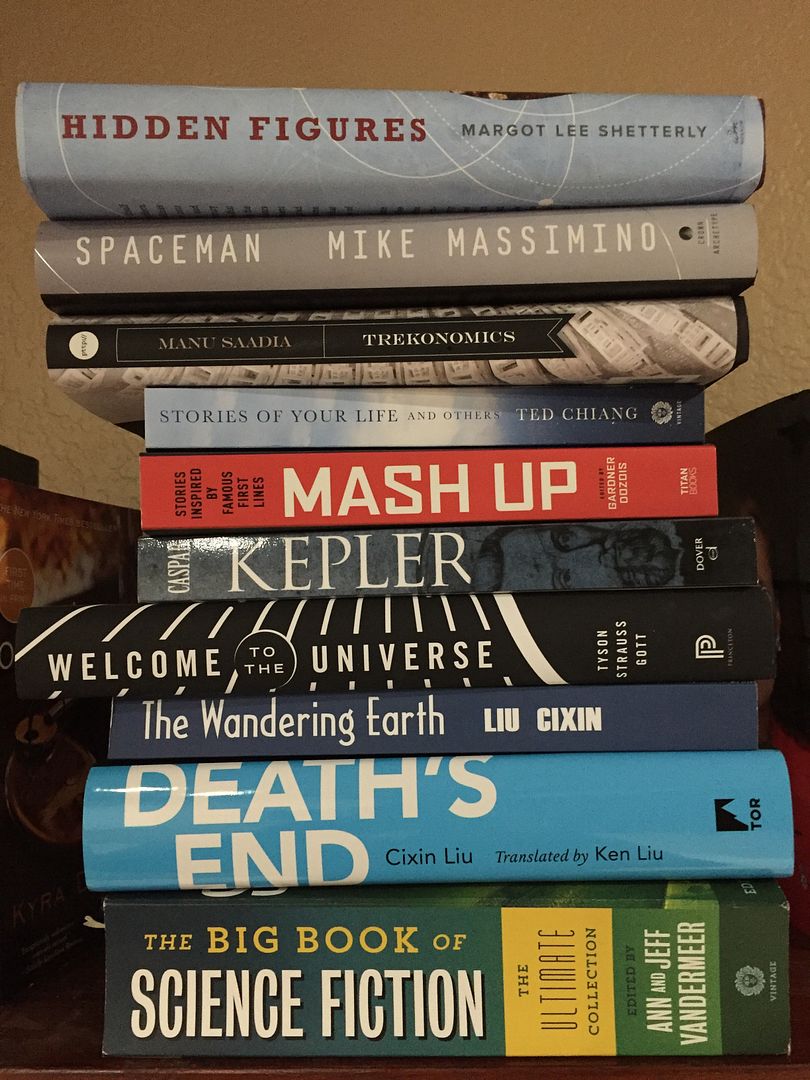
Finally, as I like to do, here is a photo of my to-read pile as we head into 2017. I've actually already started The Big Book Of Science Fiction, but it is such a big book of short stories that I am only occasionally reading that it might very well be somewhere in the pile next year. Hopefully 2017 will bring even more good books to read.

*The full title is Black Hole: How an Idea Abandoned by Newtonians, Hated by Einstein, and Gambled On by Hawking Became Loved, but that's just too long to put into a sentence with other book titles that also have really long titles, such as this one: The Hunt for Vulcan: . . . And How Albert Einstein Destroyed a Planet, Discovered Relativity, and Deciphered the Universe. I don't know about you, but we seem to be living in a period of book title inflation.

Sunday, March 13, 2016

The Asteroids of Science Fiction

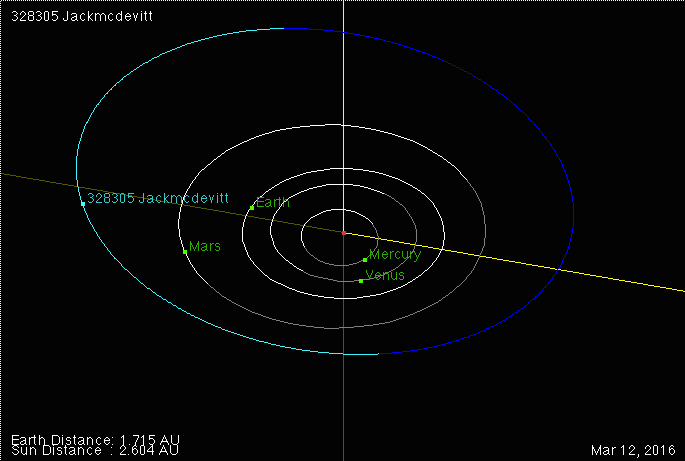
Jack McDevitt, one of my favorite science fiction writers, was recently honored by having an asteroid named for him.
328305 JackMcDevitt is a main-belt asteroid (located between Mars and Jupiter) that on average lies 2.55 astronomical units (237 million miles) from the Sun and has an orbital period of 4.08 years.

Note the number 328305. Asteroids are named by their order of discovery. The first one found was 1 Ceres (back in 1801) and now we are up to more than 328,305 of them that have been discovered. That's a lot of asteroids!

The naming of this asteroid for Jack McDevitt got me to wondering what other science fiction authors have asteroids named for them. I decided to find out which authors from my science collection have asteroids. So this isn't a comprehensive list, but rather one that reflects my reading preferences:

230765 Alfbester
5020 Asimov
9766 Bradbury
4923 Clarke
5748 DaveBrin
25924 DouglasAdams
10177 Ellison
115561 FrankHerbert
196772 FritzLeiber
6371 Heinlein
328305 JackMcDevitt
12284 Pohl
127005 Pratchett
2675 Tolkien
5231 Verne

Yes, I included a few fantasy writers (Terry Pratchett and J.R.R. Tolkien) too. The list is much smaller than I thought it would be and I was surprised to find that other giants of the field, such as Gregory Benford, Philip K. Dick, Larry Niven or H.G. Wells*, do not have asteroids named for them. I left 21811 Burroughs off of the list because I don't think that I've ever actually read anything by Edgar Rice Burroughs.

There are of course other names from science fiction that could have been added such as 4659 Roddenberry and 9777 Enterprise, but I decided for now to focus on science fiction writers (Maybe asteroids of Star Trek will be a future post here).
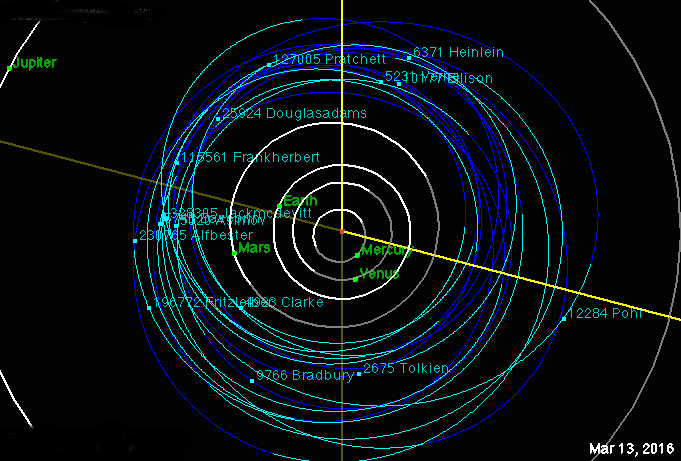
Here are the orbits of the asteroids that are on my list as seen from directly above the solar system. The orbital planes of the major planets are all very nearly aligned, but that's not true for the asteroids. The parts of their orbits that lie below the plane of Earth's orbit (known the ecliptic) are shown in dark blue while the lighter color shows where in their orbits they are above this plane.

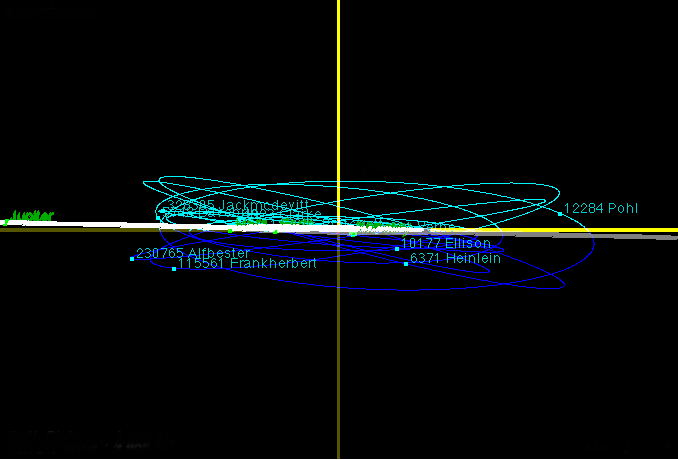
A view from the side shows this more clearly:
In this case I didn't include all the asteroids on the list. Instead, it only shows the ones with orbits that have a significant tilt with respect to Earth's orbit.

There are a few astronomers who have written science fiction that have asteroids named for them, but the main reason for their having been honored with an asteroid was due to their work in astronomy rather than for their work in literature. Those include:

2709 Sagan which was named for the late, great astronomer Carl Sagan author of the wonderful science fiction novel Contact; 3341 Hartmann for planetary scientist and artist William K. Hartmann who wrote the under appreciated Mars Underground; and 8077 Hoyle for astronomer Fred Hoyle who wrote or co-wrote more than a dozen (mostly not-so-great) science fiction novels.

I assembled these images from the plots available at the JPL Small-Body Database Browser and I used various sources (including the books on my bookshelves and the Minor Planet Center's Minor Planet Names: Alphabetical List ) to compile the list of science fiction authors who have had asteroids named for them.

*Note: 17458 Dick is named for an astronomer, 12513 Niven was named for a mathematician and 1721 Wells was named for a university administrator.

Tuesday, December 31, 2013

My Top Books of 2013

Alas, I didn't get to read as much as I wanted to in 2013. (Although, now that I think about it, it is possible that I might make this statement every year.) Still, there were some books published this year that I enjoyed very much, so much so, that wanted to list my favorite ones here.

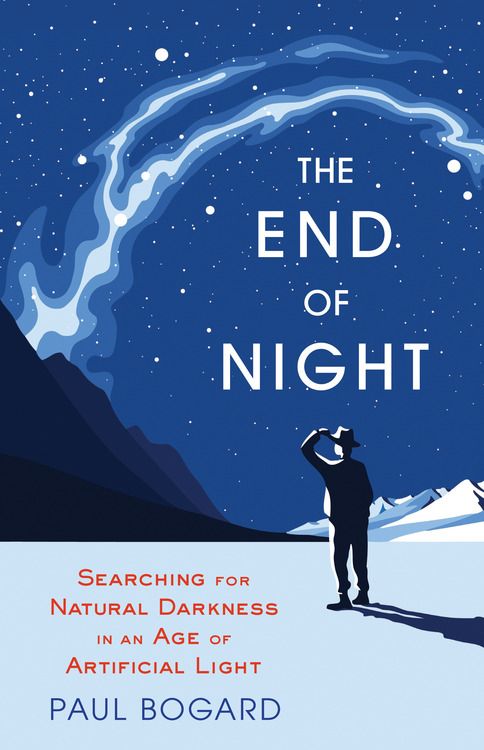
In the category of non-fiction I have three titles to recommend that couldn't be more different from each other. First off is, The End of Night: Searching for Darkness in an Age of Artificial Light by Paul Bogard.
The End of Night is an in-depth, thought-provoking, personal look at the problems of light pollution. Author Paul Bogard explores just about every angle of the issue in an engaging, thoughtful way. You can hear Paul read a bit from the book by clicking on this link (it was from his appearance last November at the Annual General Meeting of the International Dark-Sky Association). I highly recommend this book for everyone interested in learning more about light pollution.

Another non-fiction title to make my list is These Are the Voyages TOS Season One by Marc Cushman. It is the authoritative look at the creation of the Star Trek television series.
These Are The Voyages masterfully explores, in vivid detail, the genesis of the series and each episode of the first season of Trek. There have been many behind-the-scenes books written about Trek, but none of them had access to so much original source material. From script drafts to production memos, it's all here. I should note that there have already been two versions of the book. The first edition got out the door with some uncorrected errors (mostly typos) and then some new source material was brought to light, making the Expanded and Revised Edition the one to get. I should note that there remains an error about the music in The City on the Edge of Forever, but it is easily overlooked as the book is a must read for all fans of Star Trek.  

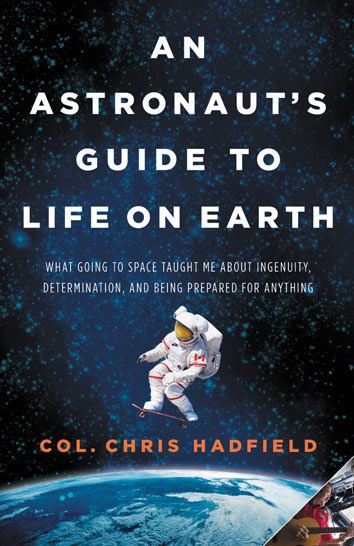
I should also mention An Astronaut's Guide to Life on Earth by Chris Hadfield even though I am not quite done reading it (I just started it yesterday).
While in space, Commander Hadfield owned social media, well, at least the portion of social media that appeals to space geeks. The video of his cover of David Bowie's Space Oddity has had nearly 20 million views on YouTube, while the trailer for his book has had over 1.1 million views, which isn't bad either. The book is an engaging, inside look at the life of an astronaut. It not only chronicles his career (with some amazing, jaw dropping stories) but gives some life lessons for all of us. It is a fun read that I recommend for anyone even casually interested in space travel.

In the world of fiction, I have two books to recommend. The first is The Human Division by John Scalzi.
The Human Division is just plain fun. The book is a series of science fiction short stories (which were originally sold separately) that together form a cohesive tale. It is set in the same universe as his Old Man's War series, but no prior knowledge of that series is really needed. If you enjoy space opera science fiction and don't mind actually having fun while reading, you can't go wrong here.

I don't read much fantasy. I'm pretty much limited to the works of J.R.R. Tolkien and Stephen R. Donaldson (and I guess J.K. Rowling too). As far as I am concerned, Tolkien pretty much invented fantasy and Donaldson perfected it. Donaldson's latest work is The Last Dark. It is the final book in a series of 10 books known as The Chronicles of Thomas Covenant, the Unbeliever.
Donaldson's work is epic. The first book in the series, Lord Foul's Bane was published in 1977 (after the author had 47 rejections!) and followed soon by two more books that completed the tale. Donaldson returned in the 1980 with a second trilogy and 2004 saw the first in a four-book set (over 2,200 pages!) that, with The Last Dark, completes The Last Chronicles of Thomas Covenant. I wont give away any story elements here other than to to say that the works are richly detailed works of fantasy that will enthrall and frustrate the reader. Donaldson's writing is very, very good. If you've not read any of his fantasy and are looking to try something shorter first, consider picking up The Mirror of Her Dreams.

I am sure I missed a lot of good titles this year. I haven't yet had the chance to read Jack McDevitt's latest, Starhawk (it will be next), but feel free to recommend anything in the comments that you enjoyed.

Happy New Year!

Saturday, May 25, 2013

In Which I Blog about Meeting Authors at Cons and Star Trek Continues

Until recently it had been quite sometime since I had been to a science fiction convention. That has changed as I have now attended two of them in just the last couple of weeks.

In early May I attended the very small LepreCon in Mesa, AZ. I went specifically to meet the author guest of honor, Jack McDevitt. He's one of my favorite sci fi authors writing today. Jack was kind enough to sign a book and pose for a pic with me. He's one of the few authors where I pretty much want to read everything he is writing. His varied career has convinced me that it isn't too late for me to try my hand at writing. After starts and stops, he took up writing at age 45. So maybe it is okay for me to give writing fiction a shot at 50. (I'll let you know if things work out.)

This weekend I attended the much, much larger Phoenix Comic Con (PCC). I was part of one of their science panels--presenting with Lowell Observatory's Gerard van Belle and Ray Sanders of CosmoQuest. The session went very well (You should have been there!).

While at the con I had to do some geeky things. First up was to catch author John Scalzi. John signed a copy of his new novel, The Human Division and pose for pics with me.
I attended one of his sessions where he proved that he knows how to work a crowd and have a good time doing it.

As you can see I was wearing a Star Trek shirt. Speaking of Trek, PCC turned out to be a good con for those who like classic Trek, as it saw the debut of the first episode of Star Trek Continues.
Star Trek Continues debuted before a full house at Phoenix Comic Con
Their first episode is called Pilgrim of Eternity and it amazingly takes up right where TOS left off. In the guest role stars Michael Forest,  returning to the role of Apollo that he played all those years ago in Who Mourns for Adonais?
Michael Forest (right) is Apollo
Michael Forest owns the role of Apollo (even after all these years) and the new cast and crew has done and amazing job of making this new show look and feel like the Star Trek of old. It is an amateur project, done out of love for Trek, but there is nothing amateurish about it. I liked it much better than Into Darkness. You should watch it for yourself. 

Of course, being a comic con, there was lots and lots of cosplay on display. Lately, I have finally been watching Doctor Who (to slightly broaden my horizons). It is interesting that clean cut and well dressed counts as looking like the Doctor. There were many at the con dressed as the Doctor and as Companions. This was perhaps the youngest person at the con dressed as the Doctor:
It was nice to see so many people, young and old, having such a good time at the con.

Friday, December 14, 2012

Boldly Going

It is time for me to start posting more often on this blog and expand its content a bit. Two of my interests beyond astronomy are reading/watching science fiction and listening to movie soundtracks.

My interest in music started somewhere around the time that Flandrau Planetarium opened to the public in 1975. They used to give out a list of what music was used in their shows and I started tracking down the various pieces of classical music that had been incorporated into the shows. By 1977 the soundtrack to Star Wars by John Williams came on the scene and for me there was no turning back.

Early influences in getting me into science fiction were the Apollo Moon landings; my 5th grade teacher, who read aloud Robert Heinlein's Red Planet and Have Spacesuit--Will Travel; and the original Star Trek TV series. I have been watching Star Trek for so long, that I have no memory of seeing any of the 79 episodes for the first time. They have just always been there.


Given my interest in movie soundtracks, I guess it should be of no surprise that I had to order this massive 15-cd box set of music from the original Star Trek released by La-La Land Records that just came out. The limited edition set contains all of the music recorded for the series - some of it was never even used.

The set arrived here at Visible Suns earlier this week and I thought that it might be fun to work my way through both re-watching the episodes and listening to the music while posting reviews of each here on the blog.


I will still be posting cool things about astronomy, the war on light pollution and the like, but I hope that this expansion will be enjoyable for those that visit the blog.

Look for a review of the first pilot for Star Trek, The Cage, to appear sometime this weekend.

Saturday, July 14, 2012

Arthur C. Clarke on Light Pollution

I can't tell you how many of Arthur C. Clarke's books I have read. I have a dozen or so in my collection today, but have read many times that. His words took me far across the universe and back again many times. He was certainly one of the authors who helped to cement my love of astronomy, space and science fiction.

Back in 2001 Clarke recorded a short message of support for the International Dark-Sky Association (IDA) and its efforts to fight light pollution. I remember seeing a quote from it in an IDA newsletter when Clarke passed away in 2008.

Flash forward to 2012 where I am now working for the IDA. I was going through some old junk at the office, deciding what should be tossed and what should be kept when I ran across the Clarke video tape. After some effort finding a working VCR I confirmed that this indeed was the message that Clarke had recorded for IDA back in 2001 (a good year for it, don't you think?).

I didn't know if other copies of the tape had been made or not, but I knew that it had to be preserved and seen. I got it digitized and just recently had the chance to put it together and post it up for the world to see. So here it is:


I am happy to have found the tape and that I could help to get Sir Arthur's message out to the world.