Saturday, September 23, 2023

Here Comes the Sun

The most viewed post on my blog from last year was Observing the Sun with an eVscope. Everything about that post is now completely out of date thanks to some recent and exciting updates from Unistellar with the new release of version 2.5 of their app.

What's in version 2.5? The ability to have one of their telescopes to automatically find and guide on the Sun. Of course, to observe the Sun you need a safe solar filter that goes on the front end the telescope. 

a telescope with a solar filter on it

Above is my eVscope 2 outfitted with the new solar filter available from Unistellar. 

The new version of the app includes the Sun in the catalog (see below), though it strangely describes it as a planet. When you choose the Sun it will remind you that you need to have a solar filter in place before pointing the telescope at the Sun. Pointing at the Sun without having a filter on it will ruin your telescope.

a screen grab from the Unistellar app

Pointing at the Sun is automatic, unlike previously where the telescope had to be manually pointed by looking at the shadow of the telescope. Once the telescope is pointed at the Sun it now automatically tracks on the Sun, which is also a major improvement, as the old version had no tracking. That made focusing very difficult as the Sun was always drifting across the field of view. Now, focusing is much easier, especially with the Sun having so many sunspots.

So how does it look?

image of the Sun showing sunspots
Image of the Sun taken September 23, 2023

Great! Unistellar seems to be applying a color shift to the image to give it a pleasing look. Images taken prior to the app update made the Sun look very un-Sun like (see image below taken last year). I used to always convert them to grayscale because I couldn't stand the color. 

image of the Sun


Also, I suspect that the Unistellar app is now applying a sharpening routine to the images of the Sun when you save them, but that's okay, as they look great. 

All of this is perfect timing as there is a solar eclipse happening in 3 weeks, another one in April and solar maximum is just around the corner! Expect to see more solar image posted here soon.

Sunday, August 6, 2023

Saturn With Five Moons

The Unistellar telescopes are not exactly known for being great telescopes for imaging planets. But that's okay, as they deliver much better images of deep sky objects. But there are times when you want to look at the planets. Thankfully, last fall they implemented a software update that greatly improves planetary imaging for Venus, Mars, Jupiter & Saturn (see my post A Harvest of Planets for more). 

Last night I used my eVscope to look at Saturn:

The view isn't quite the same as what you get in a traditional telescope. When you look through a normal telescope you can see Saturn, its rings and its brightest moons too. But here the view is optimized to show just the planet, so the moons sort of drop out of view. 

If instead you point the telescope at Saturn's brightest moon, Titan, then the view is completely different. 

The optimization used for planets is no longer in place and you can use Enhanced Vision to see farinter objects. I intentionally didn't center things here, but the big bright thing is Saturn, which is completely over exposed. Also visible are many stars and some of Saturn's gazillion moons. How do you tell the moons from the stars? Consulting an app like SkySafari helps, but a surefire way to find them is to photograph them again to see what moves. 

The animated gif below is cropped a bit from the image above. It was made from two images taken 22 minutes apart that were then aligned on the stars. Everything that is moving is part of the Saturn system.


I've got an annotated version below, but can you spot all five of them? Two of them are close to the glare of Saturn itself. Titan is just to the upper right of Saturn and Rhea is in the seven o'clock position, looking here like it is touching Saturn. Along that same line (Titan-Saturn-Rhea), but much fainter and further out is Hyperion. It is basically in the middle of the image. Extend that line further and you come to the much brighter Iapetus. The left of Iapetus is a star of similar brightness and a much brighter star below that. In between those two stars is faint Phoebe. SkySafari plots Phoebe in the wrong location but lists its magnitude at 16.8. 

Finding Phoebe was my main goal here. The best time to catch it is when Saturn is closest to Earth, which it will be later this month. Phoebe is a small (132 miles across) irregular moon in that it isn't completely round. It is far enough from Saturn (8 million miles!) that it takes 550 days (one and a half years!) to make a full orbit around Saturn. 

Here's the annotated version of Saturn and its moons. It's full sized so that you can actually spot Phoebe:

I am happy to have tracked down another faint moon of the outer Solar System.


Saturday, July 29, 2023

On Top of the World - A Visit to Mauna Kea

Earlier this year I was one of 18 educators selected for 2023 to be in the NASA/SETI Institute Astronomy Activation Ambassadors program. It focuses on teaching hands-on methods for teaching about multi-wavelength and especially infrared astronomy. Along the way we've had lots of training which included an online course to complete, a bunch of Zoom meetings and lots of emails. All of this culminated in an intense week of curriculum training and a visit to the Mauna Kea Observatories, specifically to get a first-hand look at NASA's Infrared Telescope Facility (IRTF). 

I'm not going to focus on the curriculum training here (that's for my students to experience), but instead on the visit to Mauna Kea Observatory. I've been to Mauna Kea before (and blogged about it here!), but it was many years ago and this visit offered so much more. I made this return trip with great reverence and a profound appreciation for what this special place means both to the Hawaiian people and the world of astronomy.  

That's me on Mauna Kea with the domes for the Subaru (left) and Keck Telescopes in the background.

After first spending time at the headquarters for the Gemini Observatory and the Institute for Astronomy in Hilo we prepared for our visits to the observatories by spending time at Hale Pohaku, the astronomers quarters, at the 9,300 foot level of Mauna Kea. This allowed us not only to acclimate to the elevation, but to take in its breathtaking night sky. 

The Milky Was so brilliant that you didn't need to be dark adapted at all to see it. Here's a photo of it that I captured with my iPhone:

The summer Milky Way as seen from Hale Pohaku, Mauna Kea

The Milky Way and its spectacular dust clouds were beautiful. It is a shame that because of light pollution most people in the world never get to see it (even fewer see it from such an amazing site as this one!). Of special interest to me are the two stars near the bottom of the image.  The one on the left is Alpha Centauri, the famous Sun-like star that's just 4.3 light years from Earth. To its lower right is Beta Centauri, also known as Hadar, a blue giant star located 90 times further away. Both of these bright stars are too far south to see from my home in Southern California, so catching them was a special treat.

The next day we made a daytime visit to the summit and got our first close look at NASA's IRTF. Fun Fact: the IRTF was built to help support NASA's Voyager missions and made its first infrared observations of Jupiter just before Voyager's first flyby.

Here's the dome of the IRTF:

Behind the IRTF is the Pacific Ocean and the island of Maui. Inside is a 3.0-meter reflecting telescope:

The view above looks up to the telescope's secondary mirror. Most infrared telescopes have an undersized secondary mirror to avoid reflecting any of the heat of the telescope itself to the science instruments. 

When the telescope points at the astronomical object being studied infrared light reflects off of its primary mirror, to the secondary mirror and then down to the Cassegrain focus underneath the main mirror where one of the science instruments collects the light.
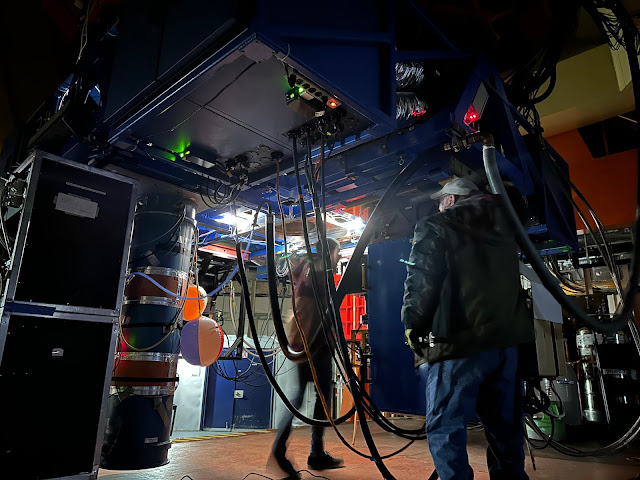
Science instruments in the IRTF's Cassegrain focus.
After our daytime visit we returned to the IRTF that night to sit in on some observing. The targets: debris disks around young stars where planetary systems are forming, then studies of the atmospheres of Saturn's moon Titan and Jupiter's volcanic moon Io. These were all studied using spectroscopy, which provides astronomers with a detailed look at the composition of objects.

We got to the telescope before sunset and what a sunset it was.

Mauna Kea sunset with the Keck telescopes.

Here's the open dome of the IRTF during the 'golden hour':

The view was spectacular looking across the mountain, away from the sunset:

From left to right that's the shadows of the IRTF, Keck I & II and the Subaru Telescope domes. Behind the shadows are the domes of the Canada France Hawai'i Telescope, Gemini North, the 2.2-meter University of Hawai'i telescope and the 3.8-meter United Kingdom Infrared Telescope (UKIRT). Note: the UK no longer operates UKIRT. 

Nature put on its own show after sunset as the Moon, Mars (left of the Moon) and Venus (just above the dome) were out in the western sky:

After it got dark and the scientific observations were underway at the IRTF I captured its dome against the starry backdrop of the summer Milky Way:

Looking the other way, the Keck Observatory was making use of its adaptive optics laser guide star:

While we were there the observing program using the laser guide star at Keck was headed up by Andrea Ghez, who won the 2020 Nobel Prize in Physics for her studies of the stars orbiting the supermassive black hole at the center of the Milky Way Galaxy. The observing here was a continuation of that research and we could see that the laser was indeed pointed toward the center of the Milky Way:

All-in-all it was an amazing night that culminated in our having some conversations with the astronomers who used IRTF. They needed to be focused on the work at hand while they were observing, so speaking with them afterwards was the way to go so as to not get in the way of their limited telescope time.

The next day we were given a daytime tour of the James Clerk Maxwell Telescope (JCMT). The Observatory is also on Facebook. Find it here.

The JCMT observes at wavelengths that are longer than infrared, but shorter than radio waves in the submillimeter part of the electromagnetic spectrum. As such, it looks a lot like a big radio dish antenna:

The JCMT is one of the telescopes that make up the Event Horizon Telescope that was used to produce the first image of a supermassive black hole (in the galaxy known as M87). It has also been used to detect phosphine in the atmosphere of Venus, which *may* suggest the possibility of bacterial life in its atmosphere (at very best its presence is unexplained).

Daniel Chase, me, project P.I. Dana Backman, Mark Lenfestey, and Vikini Santhanakrishnan underneath the JCMT. Photo by Callie Matulonis.
A big thank you to Callie Matulonis for giving us such a great tour that served as a wonderful capstone to an amazing week of astronomy that has had a huge impact on me personally and will carry over into my teaching in many ways.


Saturday, June 24, 2023

Observing High Proper Motion Stars

Everything in the universe is in constant motion, even the stars themselves. Yet the stars are so far away that the constellations of the night sky seem to be essentially unchanging. But, everything is moving. 

The various motions of the stars and our own Sun through space can make the nearby stars appear to change their positions relative to more distant background stars. Alas, none of these are the stars that shine brightly in our sky. 

61 Cygni is a binary star that is 11.4 light years distant and can faintly be seen under dark skies. The two stars of the 61 Cygni system are a little smaller and cooler than the Sun. They take over 600 years to orbit about each other. 

I used my Unistellar eVscope to take an image of this system in September 2021 and again earlier this week. As you can see in the image below, this system of two stars is indeed moving relative to the more distant background stars:

This is motion known as 'proper motion' and, I confess, wasn't something that I thought I would be able to see, because I hadn't actually given it much thought and I am happy to know that for the right stars this is pretty easy to observe. The main thing needed (other than the telescope & camera) is time.

61 Cygni isn't alone in having a high proper motion. Other stars have it too. One of them is known as Lalande 21185. It is a red dwarf star located just 8.3 light years from Earth, but it is too faint to be seen without a telescope. Here's an image from June 2021 blinked with one from earlier this week:

Finally, here's the star with the highest proper motion: Barnard's Star:

Like Lalande 21185, Barnard's Star is a cool red dwarf star that is too faint to be see without a telescope. It is located just six light years from Earth.

There are other stars that are near to us that have high proper motions and I'll be spending some of my evenings looking to see if I can catch them as they move through the skies.


Tuesday, June 20, 2023

A Supernova and Two Comets

We've had a wet and rainy winter and early spring. That gave way to an intense "May Gray" and a solid "June Gloom" during the first half of this month, so there hasn't been much time for astronomy this year. 

Thankfully, I had a short and fortuitous break in the clouds early in the evening of May 20th. Just one day earlier a new supernova had been discovered in M101, the Pinwheel Galaxy. I had imaged the Pinwheel last year, so I had an appropriate image to blink with the new one to show the appearance of the supernova.

That's the supernova blinking on and off on the right side of the galaxy. It is a Type II supernova, which marks the collapse and explosion of a massive star. M101 is located 21 million light years from our Milky Way Galaxy, meaning that the star exploded 21 million years ago and its light has only now just reached us. 

The rest of May remained cloudy and I wasn't able to see it again until June 15th. It's still visible. This type of supernova stays bright for many weeks, so it will be quite some time before it fades completely away.

Two faint comets have captured my attention recently. One of this is known as C/2023 E1 (ATLAS).

E1 ATLAS is a short period comet, with an orbit of 85 years. It is currently in the inner Solar System and crossing the orbit of Venus, but if you look at its orbit from the side (below) you can see that it is highly inclined (tipped) relative to the orbits of the planets.

It is a relatively faint comet, but has had an outburst recently which has made it an interesting target to observe. Below I have animated two images of the comet to show its motion against the background of the stars:


I captured the all  of images here with my Unistellar eVscope, which nicely reveals the comet's blue-green color. 

I recently targeted an even fainter comet, that *may*, in the fall of 2024, become one that will be very bright. It is known as Comet C/2023 A3 (Tsuchinshan–ATLAS). 

Here's where it currently is:

Yes, it is out past the orbit of Jupiter. Usually comets aren't observed until they get much closer to the Sun. Since A3 is at a much greater distance from the Sun than where comets can normally be observed that means that is it brighter than normal, which might mean that is will become a spectacular, dare I say, Great Comet --but not until it gets closer to both the Sun and Earth and that will not happen until the fall of 2024. 

However, it is faintly observable with a telescope right now. It's small and faint so I cropped and annotated the image so that it could be seen here:

That little dot is chunk of ice that is coming in from the Oort cloud and in about 16 months it will make a pass through the inner Solar System. As it gets closer to the Sun heating will vaporize parts of the comet which likely will give the comet a temporary atmosphere (known as a coma) and a tail or two. If it follows expectations the comet will become brighter than Venus and be easily seen without any optical aide, but comets are famously unpredictable, so only time will tell how it will really look. In the meantime, I'll be looking at it as often as I can.


Saturday, March 18, 2023

How to Get Started Using a Unistellar Telescope

I am a moderator Facebook group for users of Unistellar telescopes and recently there have a lot of new users asking questions, so I decided to make a short video on how to get started using them. Here it is:


Sunday, January 29, 2023

It's Not Easy Being Green

The internet has been all a buzz about the "green comet" and falsely raising expectations of how it will appear in the sky.

So why are they calling it a "green comet"? That is a bit odd as all comets have a green glow about them as they get close to the Sun. I suspect that the real reason they are calling it the "green comet" is that its real name, C/2022 E3 (ZTF), is just too much of a mouthful to use and explain.

The comet has risen in brightness to the point where it can barely be seen without optical aid from a very dark sky. This is about as bright as it was expected to be, so all the hoopla about it being "bright" doesn't make much sense. Still, it looks pretty nice when photographed with a telescope.

The comet was discovered at Palomar Observatory in March of 2022. I first saw the comet August 30, 2022 when it was still more than two astronomical units from both Earth and the Sun. Here's how it looked then:

Comet C/2022 E3 (ZTF) 30 August 2022, taken with a Unistellar eVscope

 The comet and its tail are visible at the center of the image. 

I didn't observe it again until earlier this month when the comet was much closer to both Earth and the Sun. Here's a photo from early in the morning on January 12, 2023:

Comet C/2022 E3 (ZTF) 12 January 2023, taken with a Unistellar eVscope

That green color, which comes from ionized diatomic Carbon molecules, is now visible along with the whitish dust tail and a faint narrow ion tail. It is maybe easier to see the details in this animation which shows the comet's motion against the background stars:

 It has been a rainy and cloudy January and I didn't get a chance to observe the comet again until January 21st. 

Comet C/2022 E3 (ZTF) 21 January 2023, taken with a Unistellar eVscope

Again, the green glow of the comet's coma, the dust tail and ion tail are all visible, but with everything looking better than it did on the 12th. Here's an animated gif from images taken the morning of the 21st:


By January 26th the comet had moved far enough north that it was a circumpolar object, which meant that I didn't have to get up before sunrise to see it. Also, because the comet's position is changing relative to Earth, our view of the comet and its tails had changed. Below is a two-frame mosaic of the comet:

Mosaic image of comet C/2022 E3 (ZTF) 26 January 2023, taken with a Unistellar eVscope

I shot this mosaic to capture more of the comet's thin ion tail which was too long to fit in a single frame.

The comet will be closest to Earth in just a few days and when the weather clears I will try to catch it again.