Showing posts with label Saturn. Show all posts

Sunday, August 6, 2023

Saturn With Five Moons

The Unistellar telescopes are not exactly known for being great telescopes for imaging planets. But that's okay, as they deliver much better images of deep sky objects. But there are times when you want to look at the planets. Thankfully, last fall they implemented a software update that greatly improves planetary imaging for Venus, Mars, Jupiter & Saturn (see my post A Harvest of Planets for more). 

Last night I used my eVscope to look at Saturn:

The view isn't quite the same as what you get in a traditional telescope. When you look through a normal telescope you can see Saturn, its rings and its brightest moons too. But here the view is optimized to show just the planet, so the moons sort of drop out of view. 

If instead you point the telescope at Saturn's brightest moon, Titan, then the view is completely different. 

The optimization used for planets is no longer in place and you can use Enhanced Vision to see farinter objects. I intentionally didn't center things here, but the big bright thing is Saturn, which is completely over exposed. Also visible are many stars and some of Saturn's gazillion moons. How do you tell the moons from the stars? Consulting an app like SkySafari helps, but a surefire way to find them is to photograph them again to see what moves. 

The animated gif below is cropped a bit from the image above. It was made from two images taken 22 minutes apart that were then aligned on the stars. Everything that is moving is part of the Saturn system.


I've got an annotated version below, but can you spot all five of them? Two of them are close to the glare of Saturn itself. Titan is just to the upper right of Saturn and Rhea is in the seven o'clock position, looking here like it is touching Saturn. Along that same line (Titan-Saturn-Rhea), but much fainter and further out is Hyperion. It is basically in the middle of the image. Extend that line further and you come to the much brighter Iapetus. The left of Iapetus is a star of similar brightness and a much brighter star below that. In between those two stars is faint Phoebe. SkySafari plots Phoebe in the wrong location but lists its magnitude at 16.8. 

Finding Phoebe was my main goal here. The best time to catch it is when Saturn is closest to Earth, which it will be later this month. Phoebe is a small (132 miles across) irregular moon in that it isn't completely round. It is far enough from Saturn (8 million miles!) that it takes 550 days (one and a half years!) to make a full orbit around Saturn. 

Here's the annotated version of Saturn and its moons. It's full sized so that you can actually spot Phoebe:

I am happy to have tracked down another faint moon of the outer Solar System.


Friday, November 25, 2022

A Harvest of Planets

 In my last post (back in August!) I posted this image of Jupiter taken with my Unistellar eVscope. 

Jupiter
Jupiter, with a hint of the Great Red Spot (right)

It's not super great (and it was up-scaled from the original), but it was by far the best image of Jupiter I had ever taken with an eVscope. Of course, an eVscope wasn't designed with planets in mind. Instead, it is a wide-field telescope. That means that the telescope is great at capturing large objects like nebulae, but not for planets. 

 At least that was true until a few days ago when Unistellar released verson 2.2.0 of their app. The update is specifically to improve the telescope's ability to image planets. It does this (presumably) in the same way that many planetary imagers do, by capturing video, tossing out the bad frames that have been blurred by Earth's atmosphere and then keeping and stacking the best ones. I had looked in to doing this and it seemed to involve multiple software packages to handle the various steps and, frankly, it seemed like kind of a lot of work --so much so that I likely wasn't going to go down that road. The good news is now I don't have to, as the app now does it all for me and the results are stunning. 

Have a look. Here's how Jupiter looks without and then with the new app running:

Okay, that blink is pretty fast, so here's a still of how Jupiter looks with the new imaging:

Yes, the image doesn't compete with the greats like Damian Peach, but it is a vast improvement on what was possible before. Jupiter's Great Red Spot (GRS) was easily visible, along with its North and South Equatorial Belts. 

The GRS was so prominently displayed that I decided to shoot Jupiter every 5 minutes for an hour to see if I could capture Jupiter's fast rotation. Here's the result:

I aligned the images by hand (so the alignments aren't perfect), but the result makes me happy. Jupiter spins once in just about 10 hours, so one hour of Earth time nicely reveals its rotation. 

The resolution here is just barely good enough that shadows of Jupiter's four major moons should be visible when they land on Jupiter's cloud tops and as the moons themselves should be visible when they transit across the face of Jupiter.

Look just below the middle of the South Equatorial Belt. See the little white spot? That's likely Jupiter's moon Europa as it was passing in front of Jupiter.

This technique works on Mars and Saturn too. Of course, Mars and Saturn are smaller in apparent size than Jupiter is, so there's less detail to see, but again, the improvement is really stellar. Previously Mars was nothing more than a reddish-orange dot, with no detail visible at all. 


On the left is the view of Mars that was facing Earth as shown in the SkySafari app on the right is my image of Mars. It is still quite small (and enlarged here), but surface detail are clearly visible. I'm no Mars expert, but I believe that the dark area near the middle is Meridiani Planum. The Mars Opportunity rover landed there in 2004. I'll be back to capture other features of Mars soon while it is close to Earth.

Finally, here's Saturn:

Again, this isn't an award-winning image, but it is nice to be able to see details pop on these planets. The ability to show them greatly improves the use of the eVscope, especially as a tool for public outreach and that is a win for everybody.


Saturday, August 6, 2016

Alien Moons

I gave a talk, Alien Moons of the Solar System, last night at Wavelength Brewing Company. You can watch it here:

Saturday, September 27, 2014

Take A Look Out There, Planets Everywhere

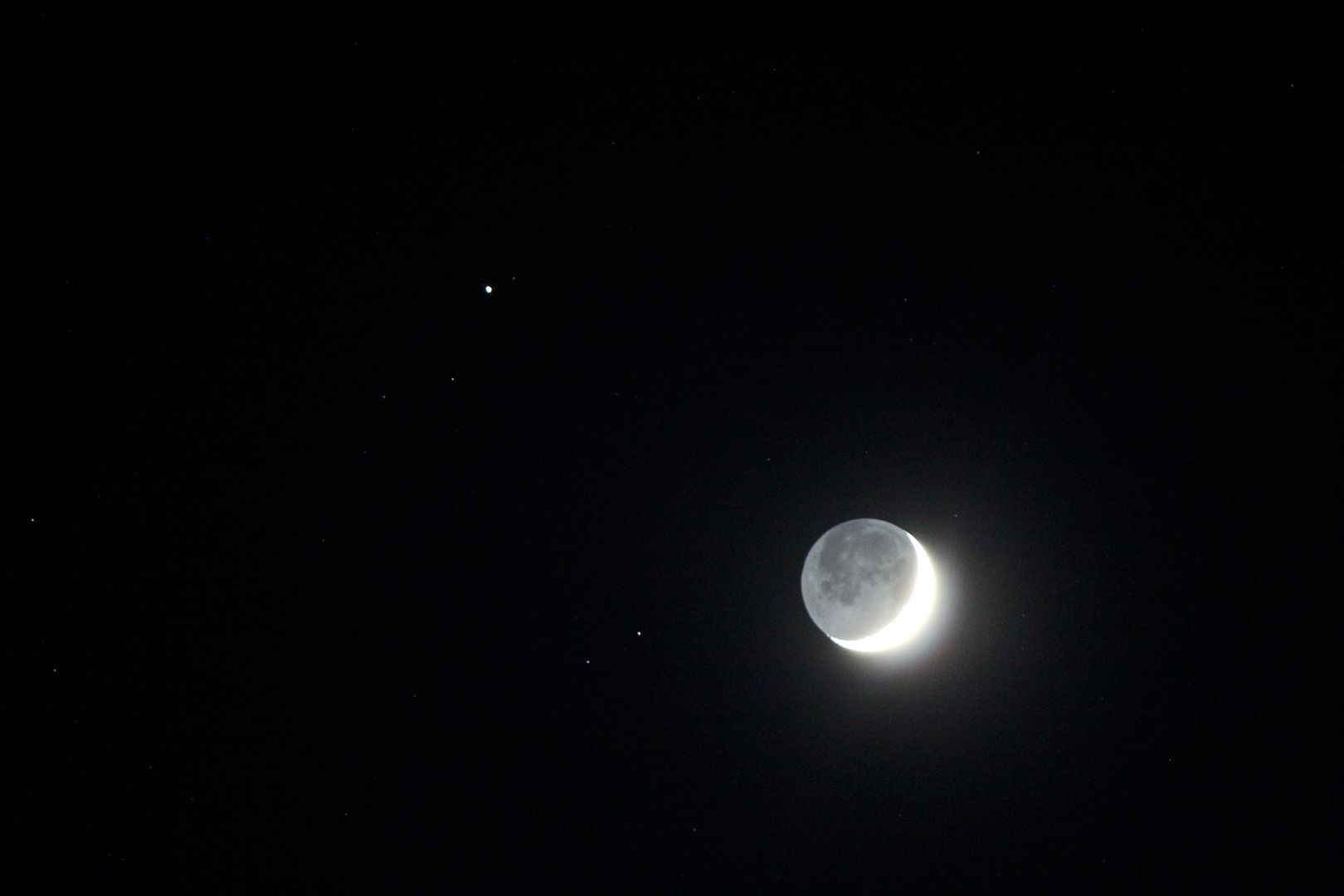
The Moon has returned to the evening sky. Tonight it is close to the planet Saturn. Here's how they looked to my camera:
Canon 3Ti 1 second, 250mm ISO 3200 f/5.6
That's Saturn to the upper left. The fainter Nu Librae is just left of the Moon. The exposure here was long enough to bring out the earthshine - where the reflected light of the daytime Earth illuminates the portion of the moon where the sun has not yet risen.

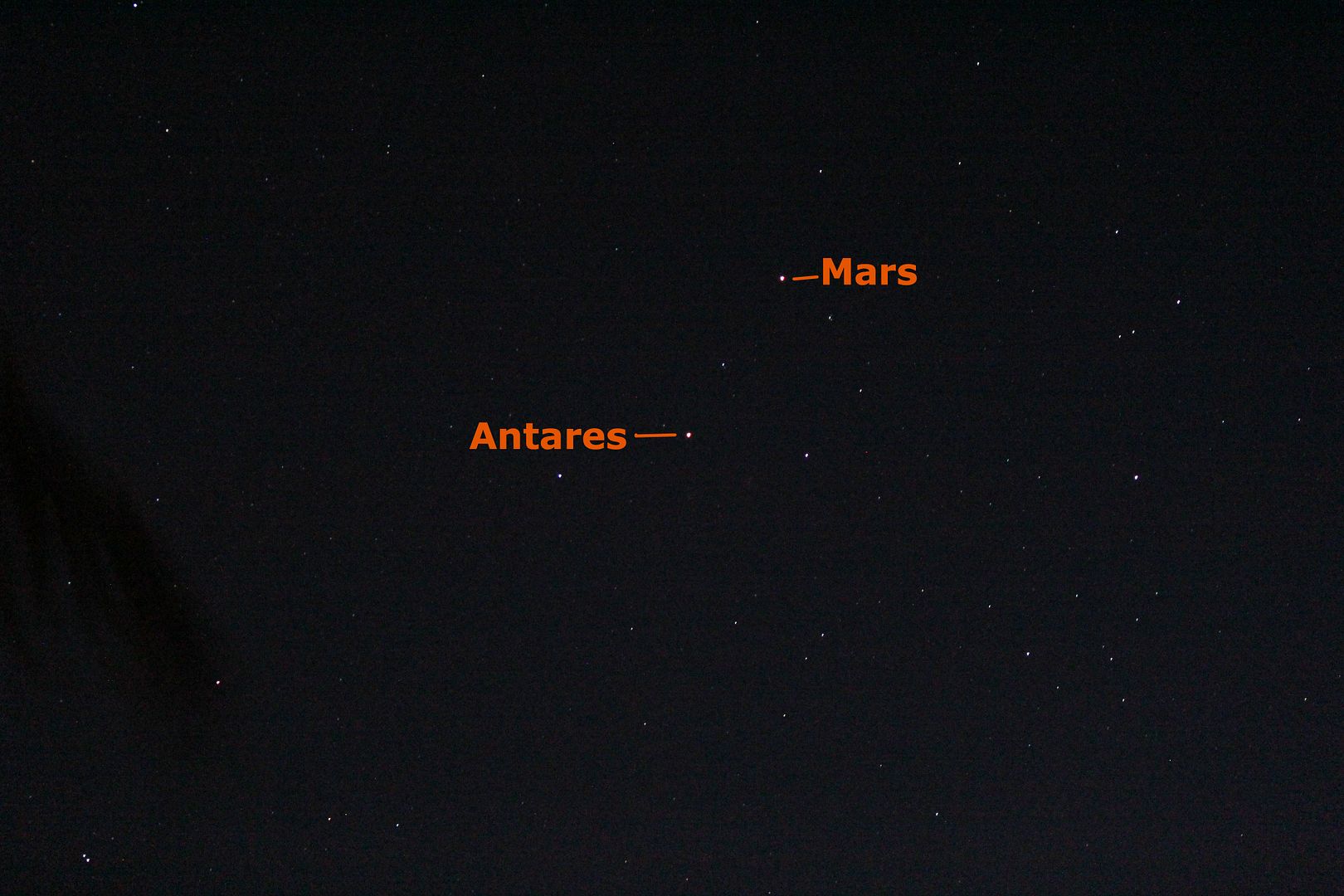
By tomorrow night the moon will be on the other side of Saturn and heading towards the red planet Mars. Mars is currently is close in the sky to the red supergiant star Antares.
Mars and Antares are of similar brightness and color, so much so that the name Antares means 'rival of Mars'. In the sky Mars is now moving gradually eastward relative to Antares. They are in the southwest sky in the early evening. Take a look and see if you can notice them getting farther apart as the nights advance.

The moon will swing to the other side of them by the 29th.

Bright Jupiter doesn't rise in the east until just after 2 am, but if you want to catch another planet you might consider waiting until the early morning hours of October 8th. There will be a total lunar eclipse that night and the planet Uranus will be relatively close to the moon. Uranus is almost as bright as Nu Librae and should be visible during the total phase of the eclipse. You'll need dark skies that are relatively free from light pollution to see Uranus, but if you are heading out to enjoy the lunar eclipse, it is worth seeing if you can spot our solar system's seventh planet.

I'll have more on the October 8 total lunar eclipse and the partial solar eclipse that will follow 2 weeks after that in a future blog post.

Tuesday, December 18, 2012

Celestial Holiday Treats!

The solstice is almost here and it is time for some holiday treats.

First up is this amazing image of Saturn from the Cassini imaging team:


The image was taken from within Saturn's shadow looking back toward the sun. This does not show Saturn in "true color", but rather the color is enhanced here.  Read all about the image here.

The next treat comes from the Spitzer Space Telescope:


It is an infrared image showing the star known as Zeta Ophiuchi and a cloud of dust. Stellar winds are creating a sort of bow shock in the dust cloud as the star moves through space. Like all infrared images, this one is false color too as we can't see infrared light.  Read more about it here.

Beautiful, aren't they?

Thursday, June 2, 2011

Saturn in the Raw

The Cassini mission to Saturn is revolutionizing our understanding of the planet, its moons, rings and more. You can see wonderfully processed images on their website and on the CICLOPS, the website of the imaging team.

One of the nice things about the mission is the ability to see raw, unprocessed images before they get cleaned up for mass consumption. Here is a wonderful film of Cassini's raw images. They are chalk full of cosmic ray streaks, out of focus dust specks and other things.  In spite of all that, it is beautiful.


CASSINI MISSION from cabbas on Vimeo.

Tuesday, March 8, 2011

Outside In

With any luck Outside In will soon be an IMAX film. Watch and be amazed by Cassini's view of Saturn along with its rings and moons.  Then read about this film project below.


5.6k Saturn Cassini Photographic Animation from stephen v2 on Vimeo.

From their website:
Composed entirely of still photographs using innovative visual techniques developed by the filmmaker, Outside In stretches the boundaries of the motion picture form. The film will feature powerful music by Ferry Corsten, William Orbit, Samuel Barber and melds non-narrative visual poetry & science documentary into a rich experience for audiences.

Outside In is a film that’s both personal and universal, experimental and sincere, science and spirit , non-narrative and documentary. The goal is to use large screen imagery, synchronized to powerful but moving music, to create an experience for those who see it, hear it and feel it.

Using hundreds of thousands of still images manipulated to create full motion, using “2.75D” photographic fly-through technology. The film will be presented in IMAX quality 5.6K resolution on massive screens and concert-level surround systems with a synchronized light show to audiences in planetariums, museums, galleries and limited IMAX release.

Friday, February 11, 2011

A Comet Encounter & A Storm on Saturn

We live in amazing times with access to more astronomical information than you can easily digest available to us almost instantly on our computers or smart phones.

NASA has done a fine job of making images from the missions to other worlds visible to the public (as they should since the public is footing the bill) pretty much as they come into to scientists. You will get the chance to see some brand-new imagery on Monday evening as NASA’s Stardust-NExT spacecraft makes a flyby of comet Tempel 1 at 8:37 p.m. PST.

This will be the second time that Tempel 1 has been visited by a spacecraft. You may recall that the Deep Impact mission crashed a big hunk of copper into the comet on July 4, 2005. The resulting impact as captured by the flyby probe was spectacular. (Why was the impact probe made of copper? Comets are not made of copper. Everything ejected by the impact what wasn’t made of copper was part of the comet)

The Deep Impact spacecraft did not see the crater that was produced from the crash. As the Stardust-NExT spacecraft makes its flyby on Valentine’s evening the team hopes to image the new crater. They are also hoping to see any changes that have may taken place to the comet as it has made one orbit around the sun since the last flyby. So if you don't have a Valentine's Day encounter of your own lined up, you may wish to visit the Stardust-NExT website to see theirs.

Another probe that is returning amazing results is the Cassini mission to Saturn. The Cassini imaging team posts their raw images on their website as they come in. Here and there among the calibration images of star fields are space-art like views of Saturn with its rings and moons. Here is a representative raw image that I grabbed earlier today:


This image of Saturn was taken one week ago (February 4, 2011). Cassini was almost 2 million kilometers (1.2 million miles) from Saturn when the photo was captured. It shows a partially illuminated Saturn with its rings appearing as a thin line running from the upper left to the lower right. The shadows of the rings can be seen on Saturn’s cloud tops just to the right of the rings.

Much more interesting is the amazing weather disturbance to the left of the rings. It is called the “northern electrostatic disturbance”  after its location in Saturn’s northern hemisphere & its frequent lightning discharges observed by Cassini.

This naturally occurring, but rare weather outburst is visible to anyone armed with a decent-sized amateur telescope.  Saturn is currently in the constellation of Virgo and doesn’t rise until 10 pm or so. As such it is best seen after midnight when it is higher in the sky.

There is no telling how long the storm will last or when such an event will next be seen, so look now while it lasts. I confess I have not had the time to go out and have a look (too much time at work), but I encourage everyone with a telescope to give it a shot.