Showing posts with label Spitzer Space Telescope. Show all posts

Tuesday, December 18, 2012

Celestial Holiday Treats!

The solstice is almost here and it is time for some holiday treats.

First up is this amazing image of Saturn from the Cassini imaging team:
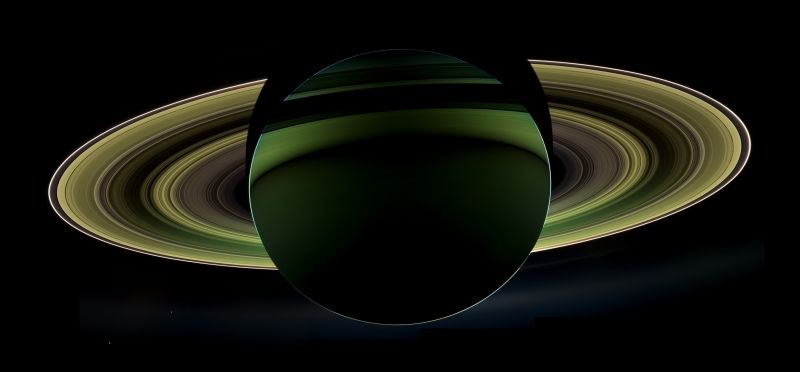

The image was taken from within Saturn's shadow looking back toward the sun. This does not show Saturn in "true color", but rather the color is enhanced here.  Read all about the image here.

The next treat comes from the Spitzer Space Telescope:
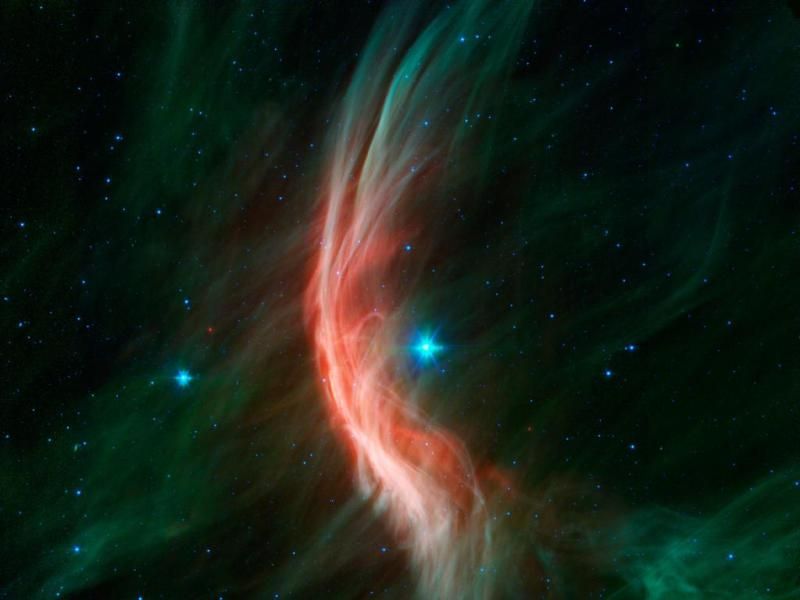

It is an infrared image showing the star known as Zeta Ophiuchi and a cloud of dust. Stellar winds are creating a sort of bow shock in the dust cloud as the star moves through space. Like all infrared images, this one is false color too as we can't see infrared light.  Read more about it here.

Beautiful, aren't they?

Saturday, March 5, 2011

Spitzer's View of the Sunflower Galaxy

Earlier this week the Spitzer Space Telescope team released this image of the spiral galaxy known as the Sunflower Galaxy (M63):

Here is the image caption from the Spitzer team:

The various spiral arm segments of the Sunflower galaxy, also known as Messier 63, show up vividly in this image taken in infrared light by NASA's Spitzer Space Telescope. Infrared light is sensitive to the dust lanes in spiral galaxies, which appear dark in visible-light images. Spitzer's view reveals complex structures that trace the galaxy's spiral arm pattern.

Messier 63 is 37 million light years away -- not far from the well-known Whirlpool galaxy and the associated Messier 51 group of galaxies.

The dust, glowing red in this image, can be traced all the way down into the galaxy's nucleus, forming a ring around the densest region of stars at its center. The dusty patches are where new stars are being born.

The short diagonal line seen on the lower right side of the galaxy's disk is actually a much more distant galaxy, oriented with its edge facing toward us.

Blue shows infrared light with wavelengths of 3.6 and 4.5 microns, green represents 8.0-micron light and red, 24-micron light.

Friday, February 18, 2011

Destroyer of Worlds

For any who may have missed this, the good folks over at the Spitzer Science Center have been producing wonderful, informative & humorous videos on infrared astronomy. This one, Destroyer of Worlds, features the voice of none other than Wil Wheaton.

It is certainly worth ten minutes of your time.