Well, it's Labor Day. Summer is officially over and the fall semester has begun. I got in a lot of telescope time over the summer, so I thought I would post a few of my favorite images taken during my break.
Comet 3I/ATLAS, the third ever interstellar object known to pass through our Solar System was discovered in early July. It is faint, but the Unistellar / SETI Institute citizen science program was interested in seeing if people could detect it with their telescopes.
The image above shows 3I/ATLAS (circled). The individual frames were aligned on the comet, which means that the stars in the image appear as streaks. At that time the comet was about 17th magnitude, (translation: very faint!) but detectable. I am happy to be contributing to the science being collected on this mysterious visitor which, despite some claims, is indeed just a comet.
Of course, I continue to image some celestial objects just because they look pretty. Probably my favorite of the summer was this beautiful mix of stars, gas and dust known as the Elephant Trunk Nebula.
It is located some 2,400 light years away in the direction of the constellation of Cepheus, the King. Like many nebulae, it is a region of space where new stars are forming. This was a 2-hour exposure taken with my Celestron Origin telescope. I honestly never imagined that I would someday be able to take images like this one and the others below, but I am happy to be living in the age of the smart telescope.
Much farther afield is the spiral galaxy known as Messier 33.
This is a 2-hour exposure of M33 which, at a distance of 2.7 million light years, is the second closest spiral galaxy to our Milky Way Galaxy. It is a galaxy that always challenged me when I tried to see it visually with a traditional telescope, so being able to capture it this way is wonderful.
Earlier in the summer I posted images of other nebulae, one of which was the fabulous Lagoon Nebula in Sagittarius. After further review, I thought that maybe the image I posted there, which was a 1-hour exposure, was perhaps overexposed. So, I decided to try something much shorter and I am even happier with the result.
This image was just a 2-minute exposure! Even with this short exposure the nebula still reveals brilliant color, dark globules of dust and the young star cluster that has formed from the nebula.
Just last night I pointed my Origin telescope at NGC 6729, a target that was new to me. It is located so far south that it never gets even 20-degrees above my horizon. Still, I managed to get a 70-minute exposure and am happy with how it came out.
What you are seeing here are some stars that are embedded within opaque clouds of gas and just. A pair of bright, young stars are shining forth just above center while other fainter ones struggle to be seen at all. The nebula very much reminds me of the much more famous Messier 78.
At practically the other end of the sky is the more famous Bubble Nebula (NGC 7635):
The bubble at the center of the image is not a thin film of soapy water but rather of gas that has been blown off a massive supergiant star located thousands of light years away in the direction of the constellation of Cassiopeia, the Queen. Some day this star will explode forming a supernova.
Ten to twenty thousand of years ago there was a supernova explosion in the constellation of Cygnus, the Swan. It produced the Veil Nebula (a part of which is in my nebula post linked above), which is just a piece of the much larger supernova remnant known as the Cygnus Loop.
The Cygnus Loop is about five full moons across, which means it is much, much larger than the field of view in my Origin telescope. Yet, I decided I wanted to capture it all. To do so I had to make a mosaic of 15 images. Here it is:
To me, it resembles a bubble that has just burst, but it is an expanding cloud of 'star guts' from the supernova explosion.
I mentioned the size of the nebula above, but wanted to illustrate that with a correctly scaled image of the full Moon, so here it is:
These were just a few of the many objects observed this summer. There's a whole lot of sky still to observe and I'll be back later with more.
It's no secret that I am a big fan of smart telescopes, so I was quite interested when Celestron introduced their new Origin smart telescope last year. I was able to get one in November and I thought I would use this post to show off some of the images that I have taken with it. This post will focus just on images of galaxies.
Most of the images here are less than an hour of observing time and have minimal post processing by me, showing off how impressive the Origin is at capturing the cosmos.
One of my first targets was Messier 31, the Andromeda Galaxy.
Two of its satellite galaxies are visible. M32 on the right and M110 in the upper left.
The Origin has a wider field of view than the Unistellar telescopes that I have been using, but its not big enough to catch all of M31. Later this year I'll try a mosaic to try to capture the full view.
Also located within the constellation of Andromeda is the edge-on spiral galaxy NGC 891. At a distance of 32 million light years its 14.5 times farther away than M31, so it looks somewhat lonely in space.
NGC 891 has a nice dust lane that cuts across it and may be somewhat similar to our own Milky Way galaxy.
NGC 253, the Sculptor Galaxy, is located 12 million light years away and is a nice target:
Located at about the same distance, but in different part of the sky is a great pair of galaxies Messier 82 and Messier 81 in Ursa Major.
That's M82 on the left. M82 is classified as a "starburst" galaxy due to a period of rapid star formation, which is likely the result gravitational interactions with M81 at right.
Two galaxies at once is nice, but how about three?
Here are the three galaxies of the Leo Triplet.
That's NGC 3628 (the Hamburger Galaxy) at left, Messier 66 in the lower right and Messier 65 is above that. At a distance of 42 million light years M65 is the furthest of the three, while NGC 3628 is the closest with a distance of "only" 35 million light years.
Looking further out into space and you can take in many galaxies at once. Here's a portion of the Virgo Cluster of galaxies known as Markarian's Chain.
The view is dominated by two giant elliptical galaxies: Messier 84 near the top right and Messier 86 near the center. Respectively they are 66 and 57 million light years away. Numerous other galaxies of the Virgo Cluster can be seen as well.
I have yet to shoot even more distant galaxy clusters, so I'll end with two galaxies that just look good.
That's Messier 51, the Whirlpool Galaxy, at right. Its spiral arms spin out to the left to a smaller galaxy, NGC 5195. The two galaxies are interacting and located some 28 and 25 million light years away respectively. M51 was the first galaxy discovered to have a spiral shape is a beautiful target.
My next post will show off some of the nebulae I have photographed using the Celestron Origin.
Our galaxy the Milky Way is one of several dozen galaxies that make up the Local Group of galaxies, which itself is on the outskirts of the much larger Virgo Cluster of galaxies. The largest and most dominant member of the Local Group is the famous Andromeda Galaxy (M31). M31 is thought to be bigger than our Milky Way in just about every way.
It is physically larger, more massive and has more stars than the Milky
Way.
If you have dark skies and know where to look on these fall evenings you can see M31 with your own eyes as a fuzzy smudge. It is worth making the effort to see it, especially knowing that this galaxy is far enough away that its light travels for 2.5 million years to reach us, making it the farthest thing that humans can usually see without a telescope (Some have claimed to see galaxy M33, which is farther, but spotting that is much more rare and difficult).
A telescope will reveal M31 as a much larger and brighter fuzzy smudge
that more than fills up the field of view. It is only through
photography that details such as its dark dust lanes become visible.
The image above is a partial mosaic (that I really need to finish) of the Andromeda Galaxy that I made with my Unistellar eVscope. It reveals two of Andromeda's many companion galaxies. The round, fuzzy object to the upper left of the central portion of M31 is the dwarf elliptical galaxy known as M32 and in the lower right is M110, another dwarf elliptical galaxy that orbits M31.
To give you a sense of depth, M32 is about 110,000 light years farther from us than M31 is, while M110 is around 400,000 light years past M31.
But M31 has more companions that can be photographed with the eVscope. One of them is NGC 147, the faint smudge at the center of the image below:
It's not immediately obvious the NGC 147 is a companion to M31, especially since it lies some seven and a half degrees from it in our sky, but they are together in space separated by some 300,000 light years.
NGC 147's nearest neighbor in the sky is NGC 185, another satellite galaxy of M31 (below, center).
These two galaxies are both found in the constellation of Cassiopeia nearly one degree apart from each other. Of the two, NGC 185 is closer to us by some 500,000 light years, which helps to explain why it is the brightest of the two.
Wikipedia lists more than two dozen other galaxies that are companions of M31 and I believe that all of them are out of reach from my 4.5" telescope, except possibly for one of them. Aside from M31 and the Milky Way Galaxy there is one other spiral galaxy in the Local Group, M33 in the constellation of Triangulum. It's the smallest of the three and might be in orbit around M31, we aren't certain.
At a distance of 2.73 million light years M33 is farther away than M31 and it has a much lower surface brightness too, but it has some interesting structure to it, with both star clusters and nebulae visible within it making it possibly a fine attendant of the princess Andromeda.
After a break of just over a year and a half it is time for me to start blogging again.
Since mid November of 2020 I have been spending a lot more time under the night sky imaging astronomical objects from my backyard (also while I sit comfortably inside too). The main reason for my change in behavior has been because I decided to purchase an eVscope from Unistellar Optics.
The telescope, pictured at left with the constellation Orion in the background, is a 4.5" telescope with an imaging system fully integrated into it. It is controlled by an app from a smartphone or tablet and it is amazingly easy to use. It is every easy to set up and its low weight makes it extremely portable (though I pretty much never go anywhere except my backyard).
My yard is small and there are many tall trees nearby which can block large portions of the sky. This means that some parts of my yard have a good view of the east, others the south and there's one particular spot that has a limited view of the west. For any traditional backyard observing this would be a huge challenge, but not for the eVscope. It is not uncommon for me to finish looking/imaging at one part of the sky and then pick up my telescope to move it to another part of the yard. It is then a simple matter for the telescope to figure out where I've moved it to (an operation that takes less than a minute) and then we're off to the next target.
With this telescope I have been able to successfully image the Moon, stars, galaxies, asteroids (including making citizen science observations of an asteroid occultation), comets, Kuiper Belt Objects, supernovae and more.
I post a lot of my pics on social media, but I'll be using this space to put some of them here where I've got the room to talk about whatever moves me.
So I figure I can't get away from this post without leaving at least one astrophoto here, so have a look at the galaxy known as Centaurus A:
Centaurus A is a peculiar galaxy which lies over 10 million light years away. It is possibly a giant elliptical galaxy, but it has a major dust lane cutting across it, which is not a thing that giant elliptical galaxies usually have. Like most big galaxies Centaurus A has a supermassive black hole at its center (this one has a mass 55 million times greater than our Sun!), but this one is quite active emitting radio waves, X-rays and jets of gas moving at relativistic speeds (none of which are visible here).
I had only seen this galaxy though a telescope just once before and I was a little worried that I might not be able to pick this up with my new telescope as it is a southern object that never gets very high in the sky for northern observers. I looked the best possible time, but even so it less than 15 degrees above the horizon and just over a big hill (some might call it a small mountain) that almost blocked my view. I am happy that my eVscope delivered a nice view of this mysterious galaxy though its electronic eyepiece and I was able to capture the image above.
I've taken a great many images of astronomical objects in the eight months that I've owned this telescope, so expect to see more of them here soon.
2015 is rapidly drawing to a close and I haven't had much time for blogging this year. I had more than twice as many posts in 2014 (87) than I've had so far in 2015 (this is # 41). Of course there are reasons for that - I moved to a new state, started a new job and then moved again (into a wonderful home in the country!).
I've got some free time here at the end of the year, so that means I've also got some blogging time too.
This week saw the first teaser trailer release for next summer's Star Trek Beyond, making this is a good time to ignore that awful looking Trek and instead talk about everything that's wonderful about the classic Star Trek series. I've been blogging about each episode (in production order), and have only covered seven episodes this year, so it's well past time to do another.
The next one in line is the second season episode (and 50th over all) known as:
By Any Other Name has got a going for it and I like it much more now than I did when I was younger. The episode takes a look at what it means to be human and what it would be like to have to deal with experiencing emotions and physical sensations for the very first time.
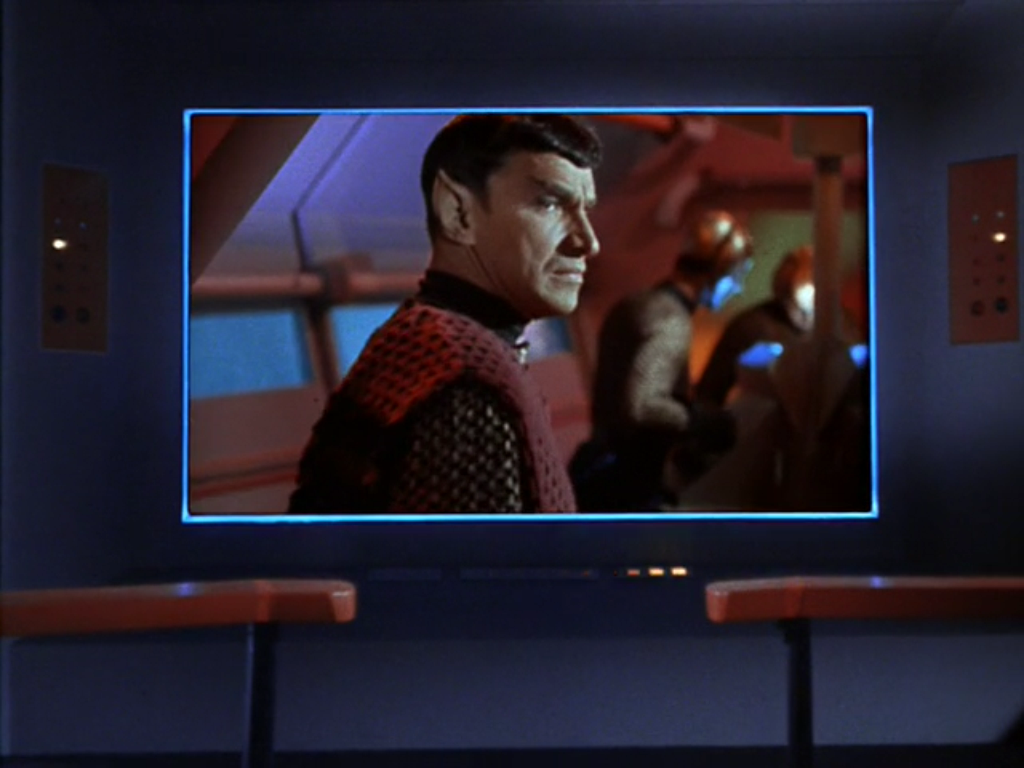
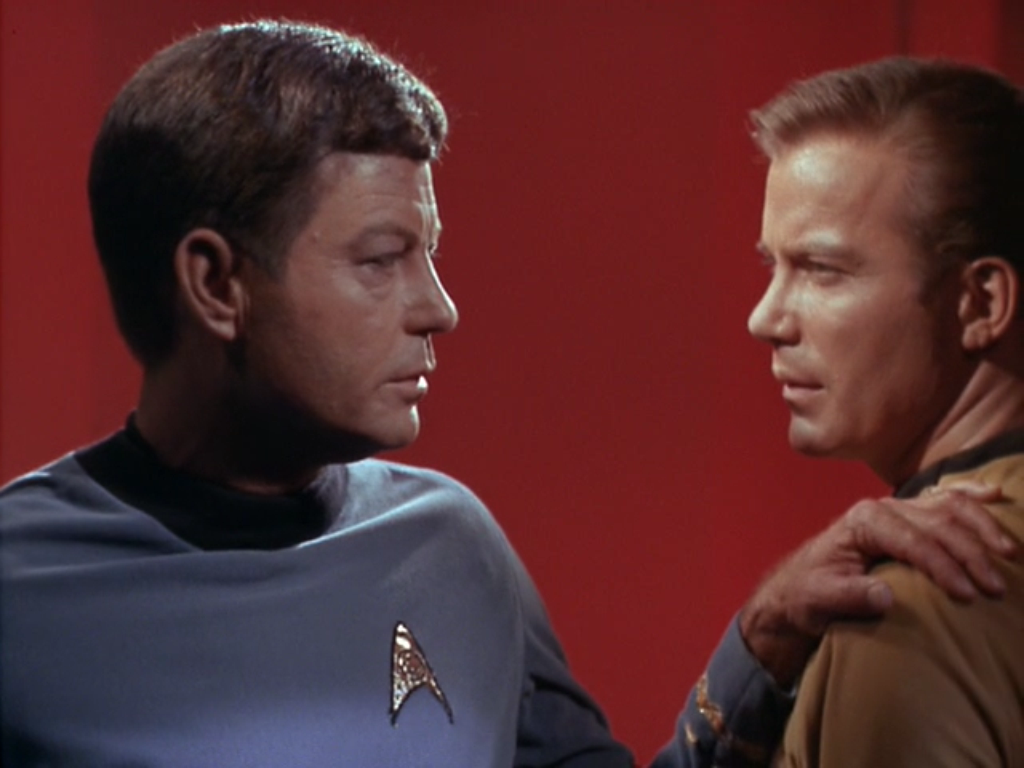
We begin with Kirk and a landing party beaming down to respond to a distress call. Alas, it is a trap and everyone is quickly paralyzed by Rojan of Kelva (center, above), who tells them basically that he's the new sheriff in town: "Any efforts to resist us or to escape will be severely punished. Soon we, and you, will leave this galaxy forever. You humans must face the end of your existence as you have known it."
Bummer.
The Kelvans intend to steal the Enterprise and use it to take them back to their home in the Andromeda Galaxy (aka M31). As Rojan explains, "Within ten millennia, high radiation levels in our galaxy will make life there impossible. So the Kelvan Empire sent forth ships to explore other galaxies, to search for one which our race could conquer and occupy." They've decided that the Milky Way will do nicely, so they've got to head home & let everyone know.
For me, the concept of the high radiation levels in M31 is a very interesting idea, one that mirrors some of the writing in Larry Niven's Known Space series (see his 1966 story At The Core), in which an alien race is fleeing the Milky Way because of radiation from an outward-spreading wave of supernova explosions taking place in our galaxy's core.
A modern image of starburst galaxy M82 from the Hubble Space Telescope
These similar ideas likely owe their genesis in the real life astronomical research of Allan Sandage, who in the early 1960s was studying a galaxy known as M82 with the then biggest telescope on the planet, the 200-inch Hale Telescope at Palomar Observatory. We now refer to M82 as a starburst galaxy (nothing to do with candy), but seeing gas rushing outward from the galaxy itself, Sandage interpreted the observations as M82 being a galaxy that was exploding. It was a popular idea that likely influenced both Niven and Jerome Bixby who gave us the initial story for By Any Other Name. But I digress...
Just after the opening credits roll Rojan's lackeys make quick work of taking over the Enterprise and they are making preparations for heading back to M31. They plan on modifying the engines to make the 2.5 million light year journey in just 300 years. It will be a multi generational trip for them, which is odd, since we never see more than maybe a dozen Kelvans in all.
The Kelvans need the Enterprise because their ship was destroyed crossing the Milky Way's energy barrier, which was a plot device in Trek's second pilot, Where No Man Has Gone Before. By the way, the energy barrier turns up again (!) in the third season episode Is There In Truth No Beauty?
Spock asks Rojan, why don't they just send a message back home instead of stealing the Enterprise and Rojan explains that "No form of transmission can penetrate the barrier," which is odd since, you know, we can see the Andromeda galaxy. Spock should know that light in all its forms (visible, radio waves, etc.) penetrate the barrier just fine. Maybe the barrier just blocks "subspace," whatever that is.
Oh, well. Rojan and the other Kelvans imprison the landing party and then explain how eager they'll be to get off of the planet and back into space.
While behind bars, Spock offers some instant metallurgy, describing the metal bars "Fascinating material. Similar to diburnium, but considerably more dense. I doubt even phaser fire could disturb its molecular structure." I'm not really sure how he can tell all that from just pinging on the bars, but then I'm not a Vulcan science officer, am I.
While they're imprisoned, Kirk makes a reference to an earlier episode (A Taste of Armageddon) - something that is just about unheard of in classic Trek. It's where Spock used his mental abilities to try to persuade a guard to open the door. Maybe he could try it again here...
Spock makes the attempt and then is thrown backward. Spock later explains what he sensed during his brief mental contact with a Kelvan:
"A series of bizarre and exotic images bursting on my mind and consciousness. Colors, shapes, mathematical equations fused and blurred. I've been attempting to isolate them, but so far I've been able to recall clearly only one. Immense beings, a hundred limbs which resemble tentacles. Minds of such control and capacity that each limb is capable of performing a different function."
Because of their escape attempt Rojan demonstrates another of his somewhat magical abilities, by reducing two members of the landing party into little 10-sided sponges. He explains, "This is the essence of what they were. The flesh and brain and what you call the personality, distilled down into these compact shapes."
To further demonstrate, Rojan crushes one of them (killing the yeoman) and then restores the other one.
Realizing that he's not getting anywhere here, Kirk asks Spock to fake an illness so that he and McCoy can be beamed aboard the Enterprise. Spock puts himself into a trance, which Vulcans find to be "more restful to the body than your so-called vacation." Clearly Vulcans need to get out more often.
The whole effort is a bit of a waste, as the Kelvins soon want them aboard the starship anyway, as they make their way through the energy barrier at the edge of the galaxy.
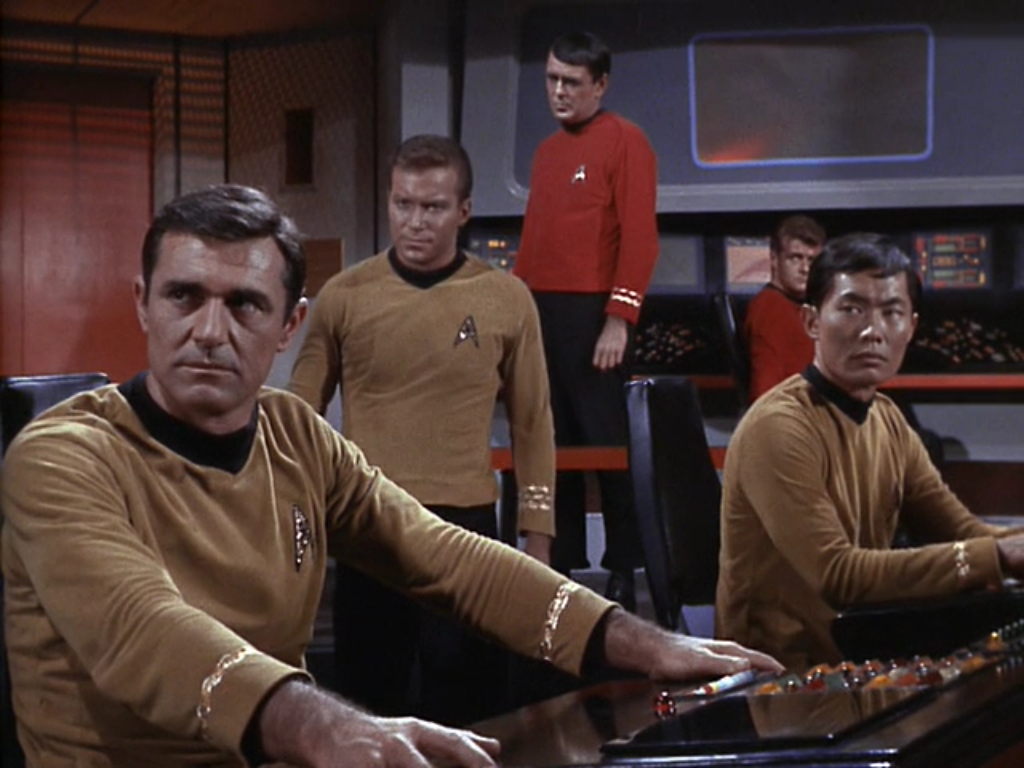
Spock and Scotty have cooked up a way to stop the Kelvans by destroying the Enterprise when they cross the energy barrier. Kirk calls them "Mad."
Nevertheless, Scotty's ready and has his finger on the button as they recycle old footage from Where No Man Has Gone Before on their way out of the Milky Way.
The above shot in particular is embarrassingly bad. I know they were on a budget.
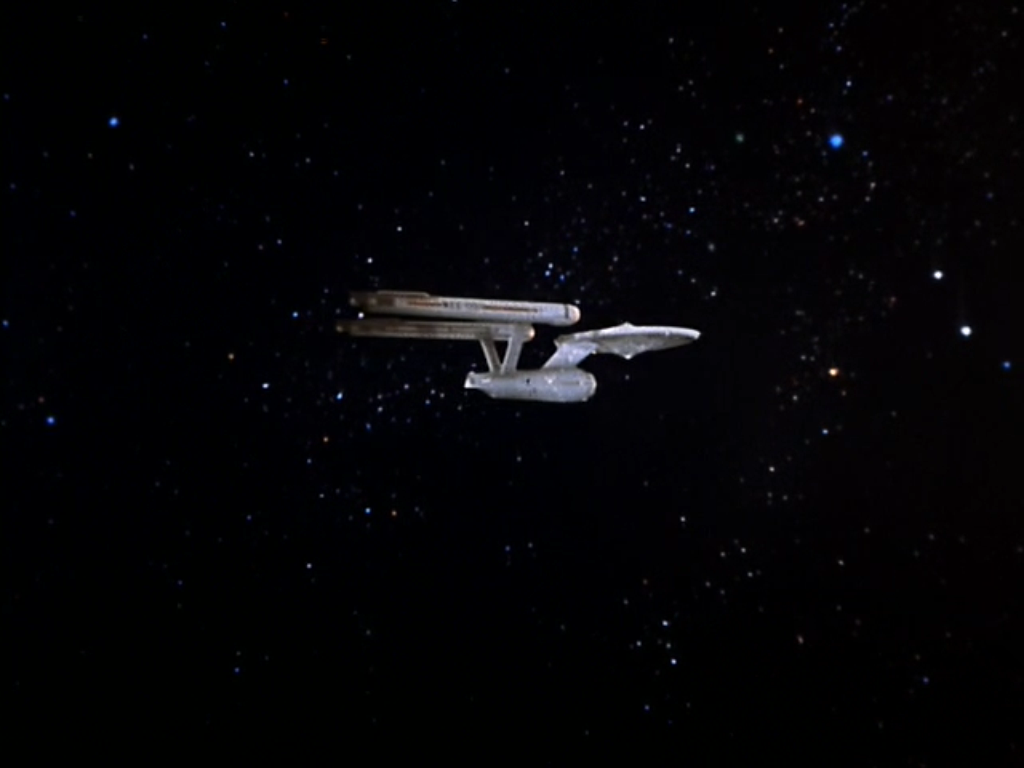
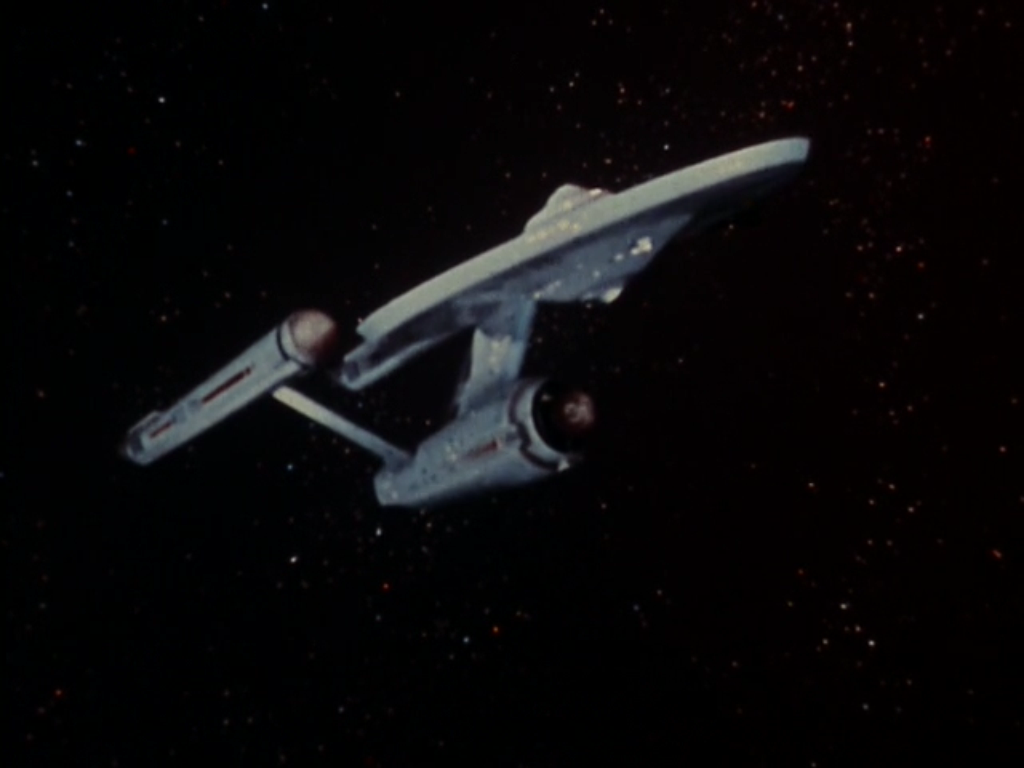
As a reward for sitting through that, we do get to see the Enterprise swooshing off towards the Andromeda Galaxy, which almost makes it all okay. I am happy that the effects crew (or somebody giving them direction) was smart enough to know that there aren't really stars between galaxies and they left the rest of the sky appropriately empty. Nice.
The real downer is that once they've crossed the energy barrier, to save on consumables, the crew gets reduced to 10-sided sponges with just Kirk, Spock, McCoy & Scotty left behind to save the day.
The gang is having a bite of colored food cubes (Yum!) when when of the Kelvans (Tomar) approaches wanting to know what all the fuss is about, saying "I do not understand why you take the trouble to consume this bulk material to sustain yourselves." McCoy suggests that he give it a try and he likes it.
Spock tells us that "The Kelvans have superior intellectual capacity. To achieve it, they have apparently sacrificed anything which would tend to distract them. Perceptive senses such as taste, touch, smell, and, of course, emotions...
they have taken human form and are therefore having human reactions."
So maybe they can use that as an advantage and get the Kelvans to lower their guard.
It's Green.
This leads to Scotty suggesting that Tomar will need something to wash his food down and a classic drinking match ensues. Scotty starts him off in the Rec Hall with Saurian Brandy and then they move to his quarters for more.
Later, when Scotty fetches a new bottle and when Tomar asks what is it, Scotty gives a classic reply:
The line was good enough that when James Doohan appeared as Scotty on an episode of Star Trek: The Next Generation (Relics) they used it again.
Scotty finally drinks Tomar under the table with his "very, very, very old Scotch whisky." It's really quite wonderful.
Meanwhile, in an effort to make Rojan jealous, Kirk is putting the moves on Kelinda. She clearly likes it and, as expected, Rojan doesn't like her kissing Kirk.
Kirk explains it all to Rojan: "Look what's happened in the short time you've been exposed to us. What do you think will happen in three centuries? When this ship gets to Kelva, the people on it will be human. They'll be aliens. Enemies!"
Rojan goes on about his mission, but Kirk offers that the Federation can help them find new worlds to live on. Rojan counters with "You would really do that? You would extend welcome to invaders?"
Kirk's reply: "No. But we would welcome friends." And that's what Star Trek is all about, Charlie Brown.
Kalinda and Rojan kiss, Kirk explains that there are certain advantages in being human, like "being able to appreciate the beauty of a flower and a beautiful woman." Wink. Wink.
Rojan turns command back over to Kirk and they head back home.
Composer Fred Steiner wrote about 12 and a half minutes of music for this episode, which included a theme for the Kelvans and a short motif used whenever they activated their Neutralizers. It all works nicely in the episode.
Its a cat and mouse game across the stars as the Enterprise becomes the first ship to meet the Romulans in a century. But first, it is time for a wedding.
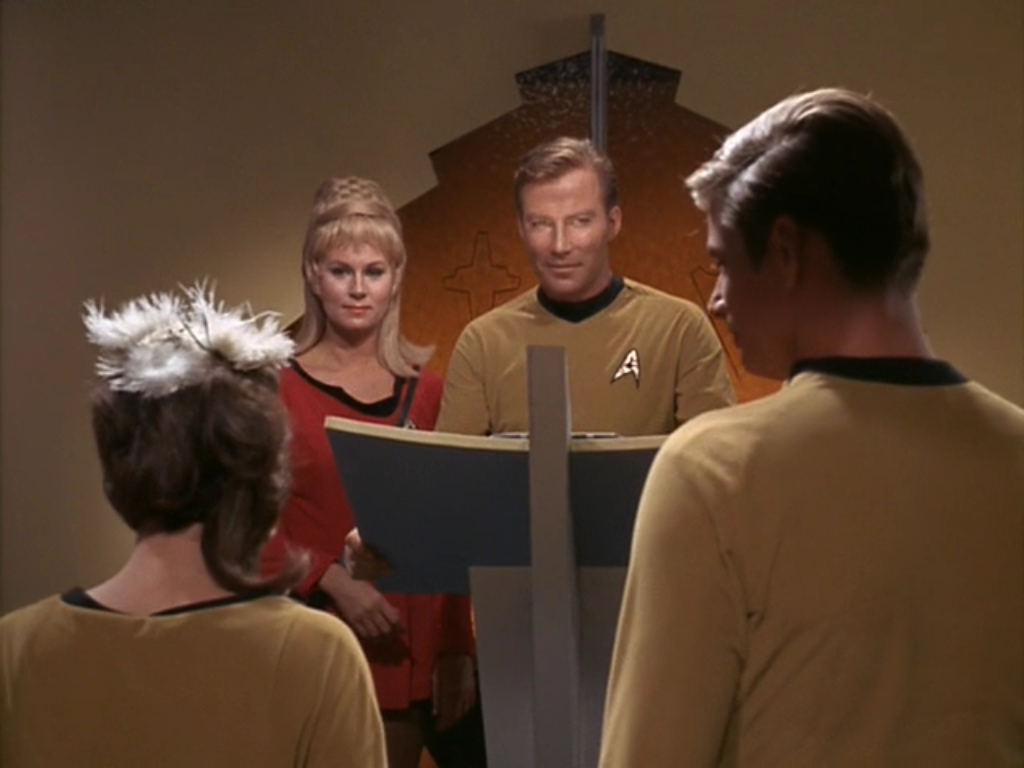
Angela Martine and Robert Tomlinson are getting married aboard the Enterprise as it is patrolling the Earth outposts that guard the Romulan Neutral Zone. Kids, marriage can be a wonderful thing, but this isn't the best way to get one started.
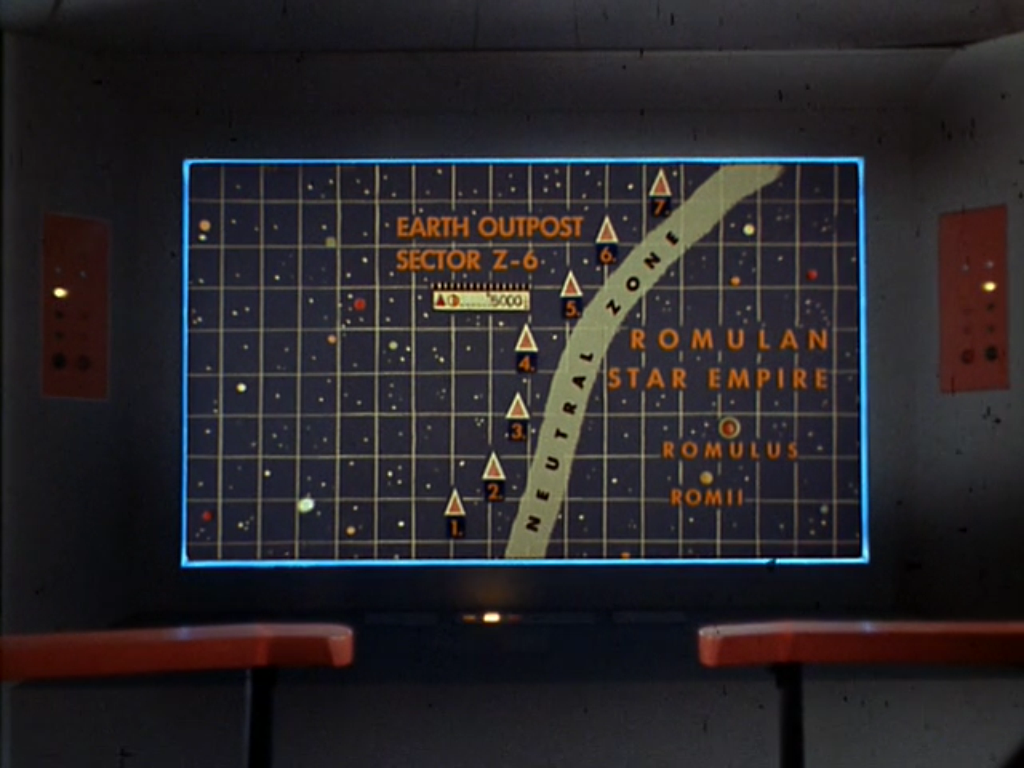
Outposts Two and Three have gone silent and the wedding is stopped as we learn that Outpost Four is under attack.
A dandy map of the Outposts along the Romulan Neutral Zone.
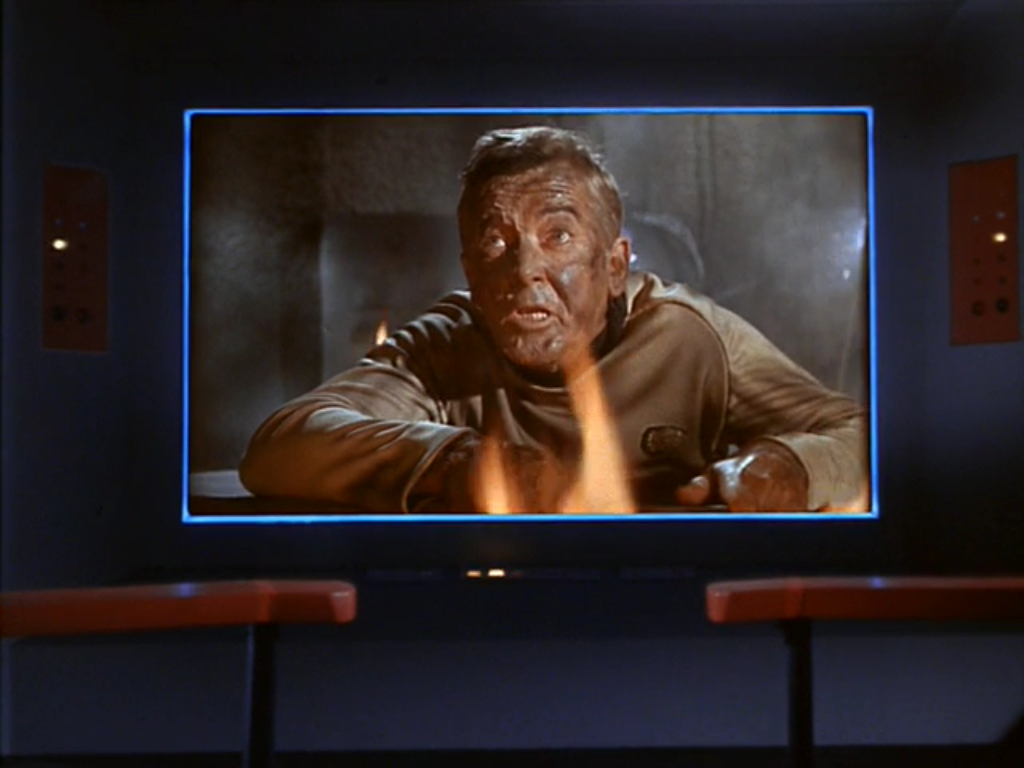
The Enterprise establishes communications with Commander Hansen on Outpost Four. He is not having a good day.
"We're a mile deep on an asteroid. Almost solid iron. And even through our deflectors, it did this."
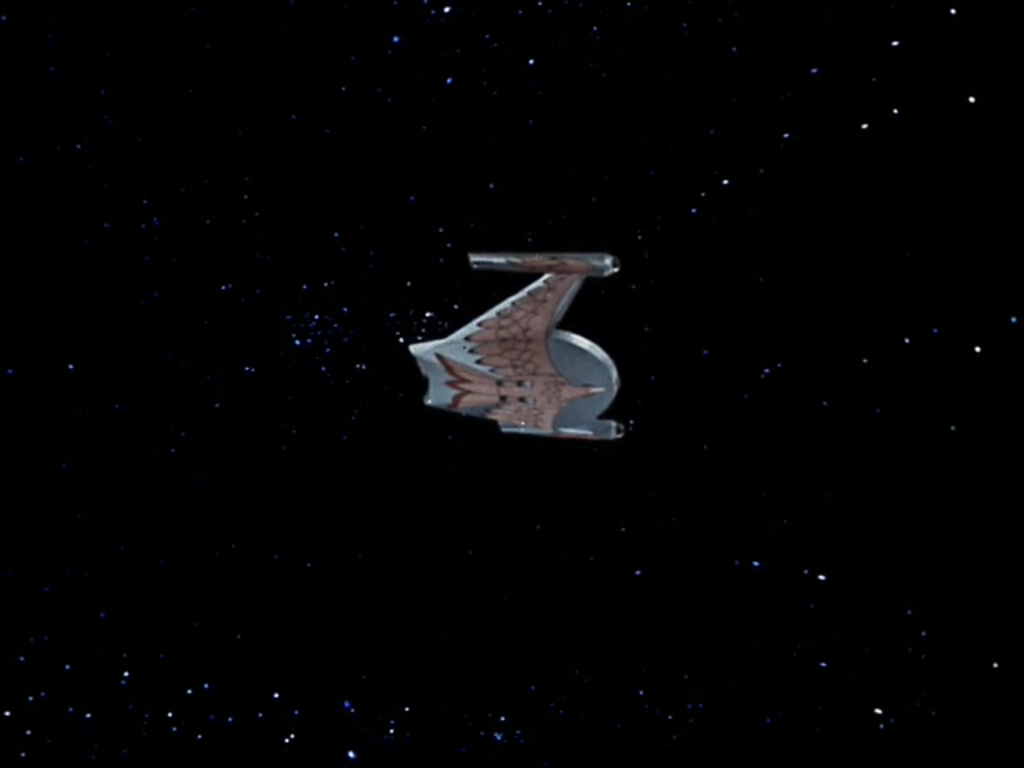
A ship appears, fires another shot and disappears again.
Outpost Four is destroyed.
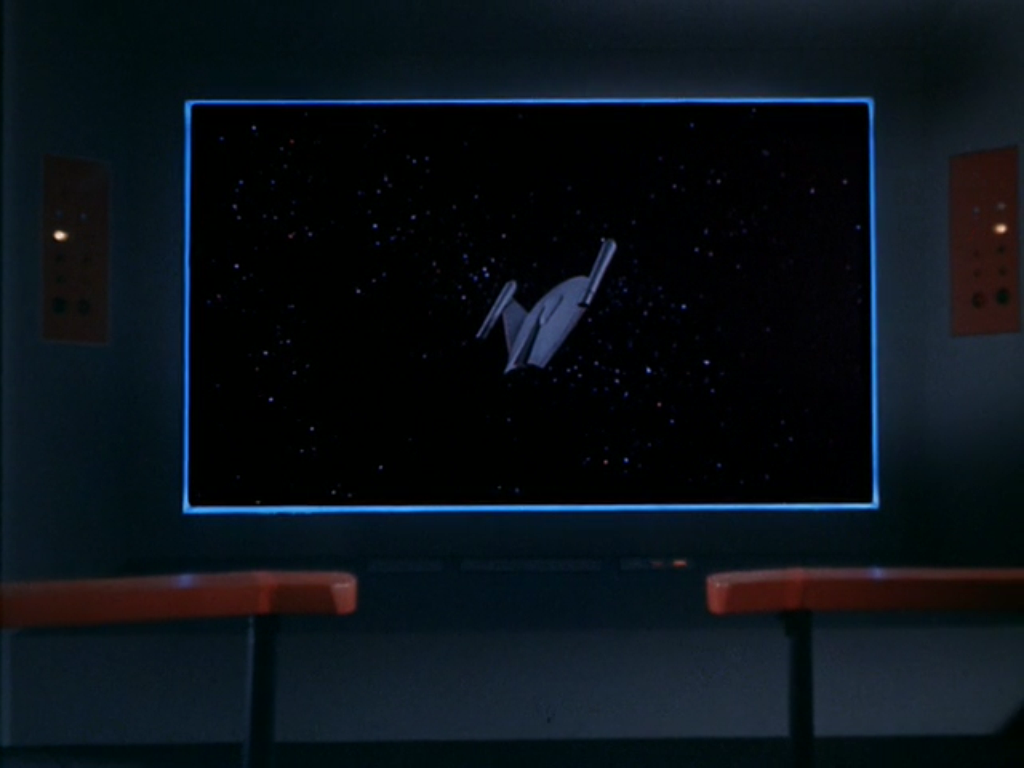
Who did it? The Romulans, of course. Lt. Stiles had relatives in the last conflict with the Romulans and knows that their ships are painted with a Bird of Prey.
A message is intercepted and we get our first look at Romulans.
Who do they remind you of?
Kirk makes it clear to Stiles that there is no place for bigotry here. Too bad Stiles doesn't get it.
Should the Enterprise retaliate and risk galactic war? Spock thinks that they should because Romulans are related to Vulcans:
Spock: And if Romulans are an offshoot of my Vulcan blood, and I think this likely, then attack becomes even more imperative. McCoy: War is never imperative, Mister Spock. Spock: It is for them, Doctor. Vulcan, like Earth, had its aggressive colonizing period. Savage, even by Earth standards. And if Romulans retain this martial philosophy, then weakness is something we dare not show.
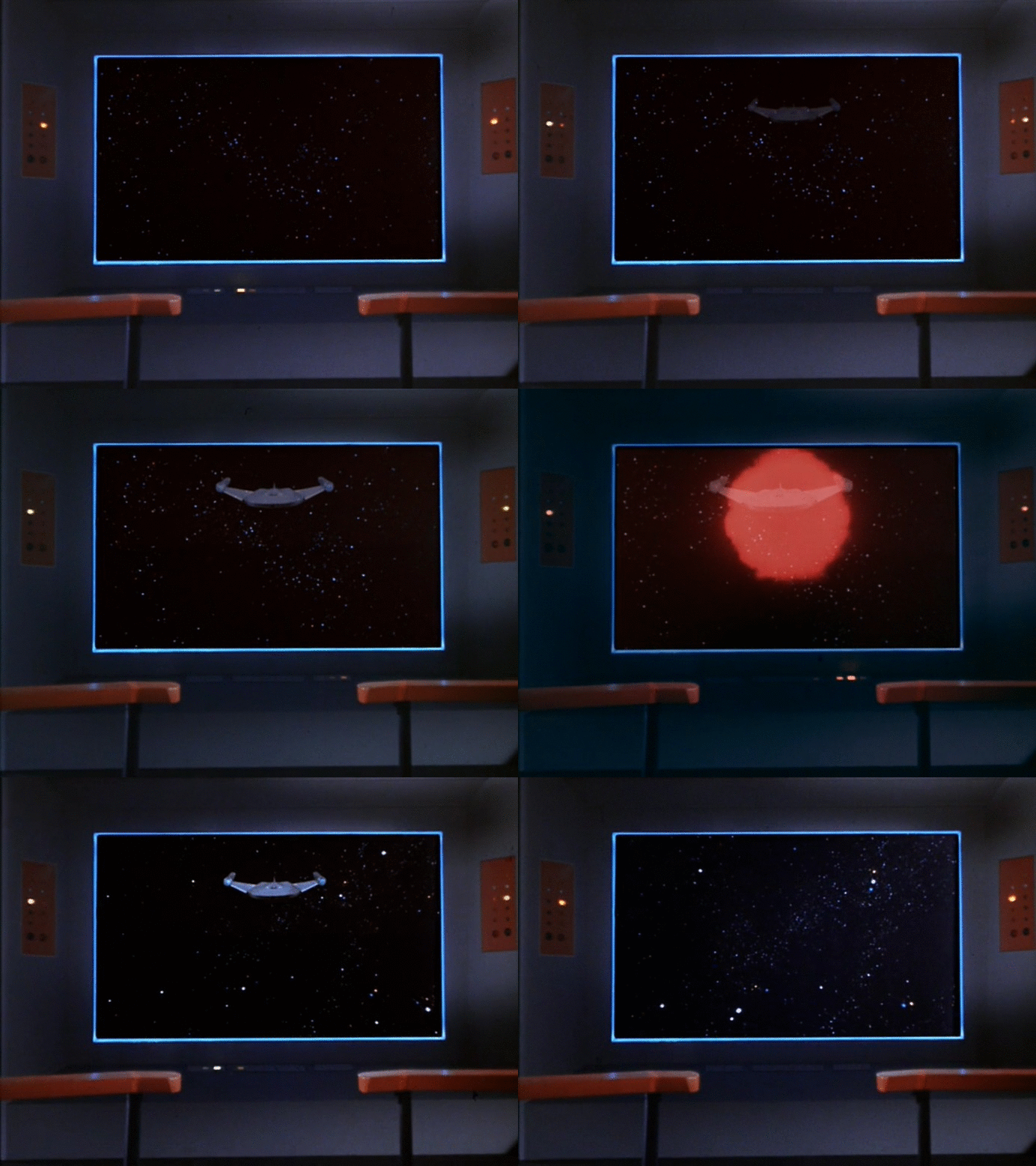
And even though the Romulans have a cloaking device, the chase is on!
Astronomy Interlude #1
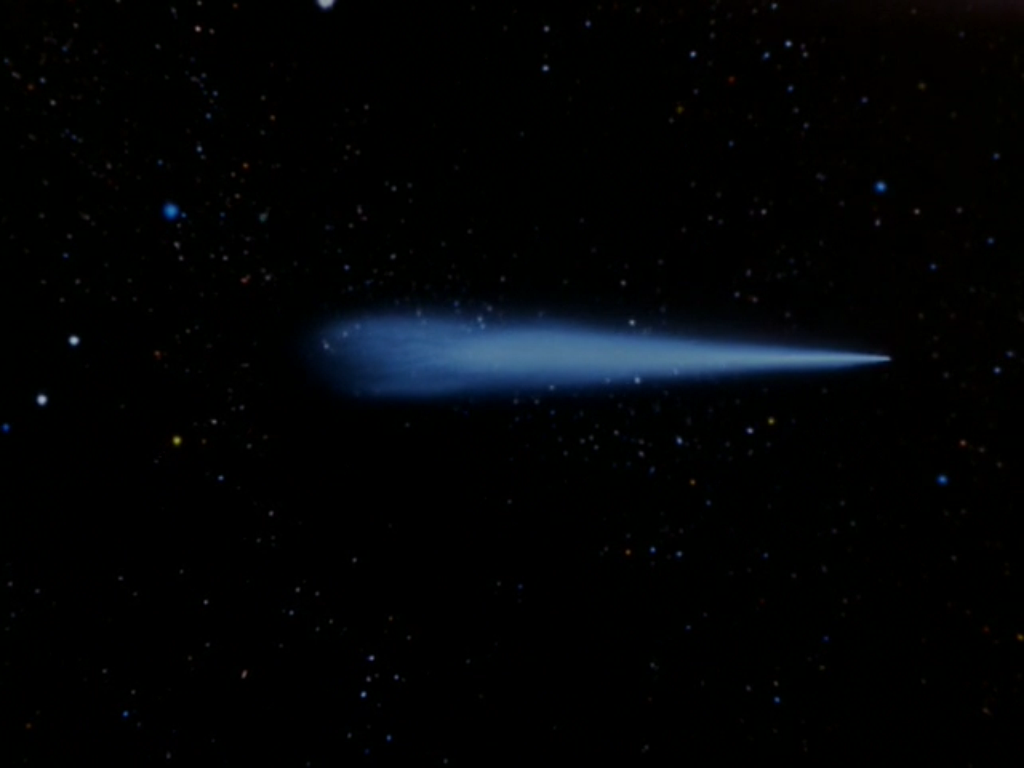
Comet Icarus Four: "Behold a marvel in the darkness."
In the depths of deep space comets are frozen solid with no atmosphere (called a coma) or tail. When the Enterprise and the Romulans encounter this comet, it shouldn't look as cool as it does with a nice tail, but I guess that would ruin the plot point.
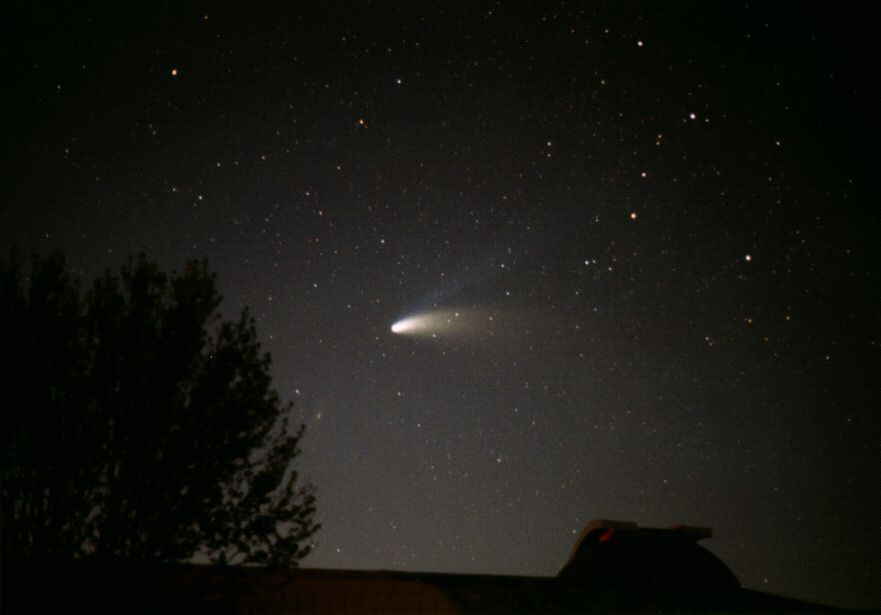
Still, when real comets enter our inner solar system the Sun heats the ices and they can put on a nice show in the sky. Those of us in the Northern Hemisphere haven't had much to see in the way of comets since the late 90s. Below is a photo I took of Comet Hale-Bopp in March 1997 at Lake Afton Pubilc Observatory in Wichita, Kansas. (By the way, Lake Afton Public Observatory is a cool place. If you are ever in the area be sure to check it out. Check out more pics of Comet Hale-Bopp from LAPO here.)
Hale-Bopp was indeed an awesome comet. Note that it had 2 tails. This is pretty normal. The photo above shows a bluish straight tail above a brighter, curved tail. The blue tail is composed of ionized gases, while the white one is primarily dust. Hale-Bopp's dust tail was bright enough that it was easily seen in light polluted areas. Ion tails are pretty much washed out by light pollution.
For more on comets check out How Comets Work. There are pictures there from the 1910 passage of Comet Halley that remind me of the comet that was used in this episode of Star Trek.
A final point about comets. 2013 may bring three comets to our skies: Comet Lemmon and Comet PANSTARRS in March. Comet ISON may be the brightest of the three, by far, and possibly greatly outshine even Comet Hale-Bopp. I'll be posting comet updates here on the blog in the future.
Back to Trek, mostly.
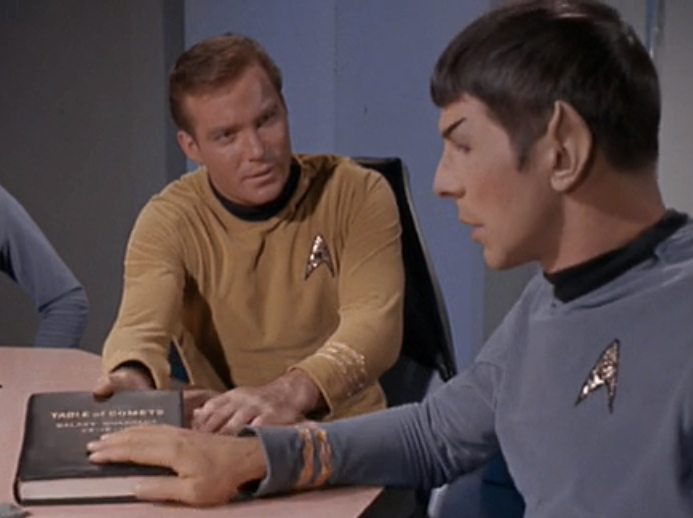
When Kirk asks about the comet, Spock does not need to consult their "Table of Comets" to know that this one is ordinary, an "ionized mass, a trail of frozen vapor particles." A printed volume of comets is pretty old school, even for vintage Trek, wouldn't you agree?
Astronomy Interlude #2
At one point Kirk expresses doubts about what he is doing and McCoy tells him this:
Jim. In this galaxy, there's a mathematical probability of three million Earth-type planets. And in all of the universe, three million million galaxies like this. And in all of that, and perhaps more, only one of each of us. Don't destroy the one named Kirk.
Our perception of the universe has changed quite a bit since the writers penned McCoy's little speech. How does it hold up today? Back in the 60s the number of confirmed "exoplanets" - planets beyond our own solar system was zero. Today the number is in the thousands, and growing rapidly. Thankfully, the number of known planets has grown to the point where actual statistics can be done. While we cannot travel at warp speed across the galaxy, we can estimate the total number of Earth-type planets in the Milky Way. Numbers released earlier this week estimate that there might be 4.5 billion planets like our Earth in our galaxy. McCoy certainly got that way wrong, didn't he?
How did he do on galaxies? McCoy said that there was "three million million galaxies". That's 3,000,000,000,000 or 3 trillion galaxies. This post from Discover, suggests that the actual number should be about 176 billion galaxies in the universe, but also that the Hubble data may actually under estimate the number and that with future instruments, like the James Webb Space Telescope the estimated number of galaxies in the universe may jump to a trillion. If so, then McCoy's estimate is only off by a factor of three, which in astronomy is often pretty good. I should also point out that the estimate of galaxies above is for the observable universe. The entirety of the universe is bigger than we can see, so the count really is likely several times larger than 176 billion, even without speculating what we might learn with the James Webb Space Telescope.
Back to Trek.
The ships maneuver and battle. At one point they each lay still and, strangely enough, everyone must keep quiet to avoid detection by each other. Details like this are horribly wrong (sound doesn't travel through space you know), but help to give this episode a feel as if the starships were two submarines in battle.
Rant: Why is it that ships in space, when damaged, are tilted? Are they taking on water? Is there some galactic frame of reference with a preferred direction for "up" that they must follow?
Anyway, shots are exchanged. Both ships are damaged and in the big conclusion there is a phaser coolant leak aboard the Enterprise that incapacitates Stiles and Tomlinson who are manning Phaser Control. Spock has to rush into the room to fire off the shots that cripple the Romulan ship. He rescues Stiles (in spite of his feelings toward Spock) but Tomlinson will never be getting married as Spock was unable to save him. I am not sure why his bride to be wasn't in the room too, as earlier in the episode they both worked there. Shouldn't she be dead too? Maybe the Romeo and Juliet ending would have worked better (I know, there was no suicide here.)
All-in-all it this is a solid episode of Trek. Guest star Mark Lenard does a great job as the Romulan Commander. He is given some great lines:
"Danger and I are old companions." and, speaking to Kirk at the end, "I regret that we meet in this way. You and I are of a kind. In a different reality, I could have called you friend."
And at least one line that doesn't make any sense at all:
"Centurion, I find myself wishing for destruction before we can return." Wait. What?
That aside, it is a fine episode. Composer Fred Steiner wrote only about five and a half minutes of music for this episode (the rest is tracked from other episodes), but it is good stuff and includes a menacing theme for the Romulans: hear it here from La-La Land Records.