Showing posts with label exoplanets. Show all posts

Thursday, June 26, 2025

Exoplanets!

 I did a lot of citizen science observations during my sabbatical last fall. I was especially interested in trying to use my time to make observations of exoplanets.

My exoplanet observations were all made using the transit method. These planets are impossible to see directly but they can still be detected. As an orbiting exoplanet passes directly in front of (transits) across the face of its star it makes a mini-eclipse and blocks a small percentage of the star’s light. This can be measured even with small telescopes, making this technique the most successful method for studying exoplanets. A typical exoplanet observation lasts from four to five hours, though some are shorter, and others are longer.

Over the course of the semester, I attempted to observe sixteen exoplanet transits. Due a variety of factors (weather, equipment failure, etc.), not all of them were successful. All of my observations were made with a Unistellar eVscope2. A summary of my exoplanet observations is included below along with other findings about these exoplanets.

A note about exoplanet names. Most of them are terrible acronyms of the survey the first discovered the exoplanet, followed by a letter, which indicates the order of discovery within that particular system (starting with the letter b). As an example WASP stands for Wide Angle Search for Planets. WASP-33b refers to the first planet (b) within the 33rd system discovered by that survey. Some exoplanet names are acronyms within acronyms. TOI is TESS Object of Interest. TESS is the Transiting Exoplanet Survey Satellite.

XO-7b               Observed August 23/24, 2024 & October 5-6, 2024

A graph of relative brightness verses time for an observation of an exoplanet transit

A graph of the science results is generated for each exoplanet observation. The graph for one of my two observations of XO-7b is above. Note that the dates are given in Universal Time (essentially, the time in Greenwich, England) which is why these graphs don’t always agree with the local date.

XO-7b is a gas giant planet that orbits a spectral type F star that is larger and hotter than the Sun. It is located 764 light-years from Earth in the constellation of Draco, the Dragon. It is an example of a “hot Jupiter” type planet, as are the majority of exoplanets that can be observed with a small telescope. It is located very close to its parent star, at a distance that is just 4.421% of the distance Earth is from the Sun. It orbits its parent star every 2.9 Earth days! The planet is smaller than in mass (0.709 times Jupiter’s mass or 225 times Earth’s mass), but larger than Jupiter in size. Its larger size is because the tremendous heat that it receives from its star essentially inflates the planet giving it a radius that is almost 1.4 times that of Jupiter’s. The calculated temperature for the planet is 2,678oF. 

TOI-1518b                     Observed August 27/28, 2024

A graph of brightness versus time for an exoplanet transit for TOI-1518b

Note: there were clouds at the end of the observation.

TOI-1518b is a gas giant planet that orbits a rapidly rotating F-type star, which is larger than the Sun (1.95 times the Sun’s radius) and 2,750oF hotter than the Sun’s surface temperature. It is located 737 light-years from Earth in the constellation of Cepheus, the King. The planet has a mass 2.3 times that of Jupiter and a radius that is 1.9 times that of Jupiter. More massive gas planets tend to be smaller as the extra mass causes more compression from gravity. The fact that TOI-1518b is so large indicates that it is inflated due to the temperature caused by how close it is to its star. It orbits its star every 1.9 days in an orbit that is just 3.89% the size of the Earth-Sun distance. The planet is considered to be an ‘ultra-hot’ Jupiter. Its dayside temperature has been measured to be 5,367 oF! It is believed to have ionized iron vapor in its atmosphere.

TOI-1259 Ab                 Observed September 24/25, 2024

A graph of an exoplanet transit for TOI-1259 Ab

The TOI-1259 is a binary star system. The system is located 385 light years from Earth in the direction of the constellation of Draco, the Dragon. TOI-1259 A is a spectral type K star that has a radius 71% of the Sun’s and is about 2,000oF cooler than the Sun. The other star, TOI-1259 B, is a white dwarf. The white dwarf is a distant companion, being 1648 times farther from A than the distance between Earth and the Sun. White dwarfs are essentially dead stars. In this case TOI-1259 B would have begun as a star that was more massive than A (1.59 times the mass of the Sun) and burned through its hydrogen fuel at a faster rate. It now has a mass of 0.56 times the mass of the Sun. Astronomers have determined the age of the white dwarf, and thus the age of the system, which is thought to be 4.8 billion years (Our solar system is 4.6 billion years old.).

The exoplanet is named TOI-1259 Ab. It is a gas giant planet with a mass is 0.44 of Jupiter’s but it is slightly larger than Jupiter in size (1.02x Jupiter’s radius). It orbits star A every 3.5 days at a distance of 4.07% of the Earth-Sun distance.

Observations at Palomar and Keck suggest that the planet receives extreme heating on its dayside which is both causing some of its atmosphere to escape to space and also driving extreme winds that blow from the dayside to the night side of the planet. The equilibrium temperature of the planet is estimated to be 1,190 oF. 

WASP-33b                    Observed September 25/26, 2024
A graph for an exoplanet transit for WASP-33b

WASP-33b is a gas giant exoplanet 398 light years in the direction of the constellation of Andromeda. It orbits a variable star which is larger (1.5 times the Sun’s radius) and nearly 3,000oF hotter than the Sun. It orbits the star every 1.2 Earth days (!) at a distance that is just 2.39% of the distance between the Earth and Sun. Unlike most planets, WASP-33b has a retrograde orbit, meaning that it does not revolve in the same direction that its star rotates. It has a mass that twice that of Jupiter and is about 1.9 Jupiters in radius. The temperature of the exoplanet is 5,790oF. Researchers using the Hubble Space Telescope have detected titanium oxide, a major component of sunscreen, in the atmosphere of this planet. Iron and silicon have also been detected in its atmosphere.

WASP-2b                      Observed September 27, 2024

WASP-2b is a hot Jupiter-type gas giant planet that orbits a K-type star located 500 light years from Earth in the direction of the constellation of Delphinus, the Dolphin. The planet’s host star has a mass that is 85% of the Sun’s, it is 82% of the Sun’s radius. It is 1,154oF cooler than the Sun. The planet has an orbital period of 2.2 Earth days at a distance that is just 3.1% of the distance between the Earth and Sun. Its mass is 93.1% of Jupiter’s and it is slightly larger than Jupiter in size. The planet has a density similar to that of water. The temperature of the exoplanet is 1,855oF. Spectroscopic observations suggest that it has a cloudy atmosphere. 

WASP-93b                    Observed September 28/29, 2024
A graph of an exoplanet transit for WASP-93b

WASP-93b is a hot Jupiter-type gas giant planet that orbits an F-type star located 1,208 light years from Earth in the direction of the constellation of Cassiopeia, the Queen. This star is both larger and hotter than the Sun.

The planet has an orbital period of 2.7 Earth days and orbits at a distance that is just 4.2% of the Earth-Sun distance. It has 1.47 times Jupiter’s mass and is 1.7 times Jupiter’s radius.  The planet’s equilibrium temperature is estimated to be 3,000oF.

HAT-P-32b                    Observed October 4/5, 2024

HAT-P-32b is a gas giant planet that orbits a type F star located 943 lights from Earth in the direction of the constellation of Andromeda, the Princess. The planet has a mass that is just 68% that of Jupiter. It orbits its star at a distance that is just 3.3% of Earth’s distance from the Sun. Its close distance to its star has inflated the size of the planet making it nearly twice Jupiter’s radius. This in turn means that the planet has a low density. All of the “hot Jupiters” observed so far have densities lower than water’s 1 g/cm3, meaning that they are made of light materials (in our Solar System only Saturn, which has a density of 0.69 g/cm3 has density lower than water). HAT-P-32b has a density of just 0.1085 g/cmthis is low enough to almost put it into the category of “super-puff” (yes, that’s a real thing) exoplanets, which have densities less than 0.1 g/cm3.

TIC 362220946.01     Observed October 10/11, 2024

A graph of an observation for a possible exoplanet.
TIC 362220946.01 is a possible exoplanet that was first observed by NASA’s TESS satellite. It was thought that this planet has an orbital period of 8 days and a mass that is 23 times that of Jupiter. I was one of nine observers from the U.S. and Mexico who looked this system in an attempt to confirm its existence and the possible orbital period of the planet. The results were inconclusive but there are suggestions that this could perhaps be a binary star system instead of a planetary system. Further observations may help to solve this puzzle.

WASP-77 Ab                Observed October 24/25, 2024

A graph of an exoplanet transit observation for WASP-77 Ab

WASP-77 Ab is another “hot Jupiter” type gas giant planet. It is located 343 light years from Earth and orbits a Sun-like star in the constellation of Cetus, the Whale. The star is part of a wide binary system, where the other star is a spectral type K star that is smaller and cooler than the Sun.  has a mass 1.67 times that of Jupiter and is 1.23 times Jupiter’s radius. It orbits its star every 1.4 Earth days at a distance of 2.3% that of the Earth-Sun distance. The planet has a calculated temperature of just over 2,600oF.

TOI 6881.01                 Observed October 31, 2024

A graph of an exoplanet transit for TOI 6881.01

The exoplanet known as TOI 6881.01 orbits a star that is 2,559 light years from Earth in the direction of the constellation of Perseus, the Hero. Its star is larger, hotter and more massive than the Sun. The planet orbits its star every 1.9769 days. The planet has a calculated equilibrium temperature of almost 3,100oF. The planet has a mass that is essentially the same a Jupiter’s and a radius 1.44 times that of Jupiter, making it another “hot Jupiter” gas planet that has expanded from the extreme heat from being right next to its star.

TOI-5571.01                 Observed December 4, 2024 & December 18, 2024

A graph of an observation of a possible exoplanet

TOI-5571.01 was initially detected by NASA’s TESS satellite, but its observations were widely spaced in time and so the orbital elements of this exoplanet were highly uncertain. Early observations suggested that the exoplanet could have an orbital period of 731 days (2 years) but was more likely to be something shorter. My observation was part of a campaign by Unistellar to help pin down the exact orbital period of the planet. My observations the night of December 4 (my birthday!) did seem to catch the exoplanet transiting in front of its star (though it was low in the sky), which may indicate that the planet’s orbital period is potentially 66 days, but further observations are needed. 


Saturday, February 9, 2013

Star Trek: Balance of Terror


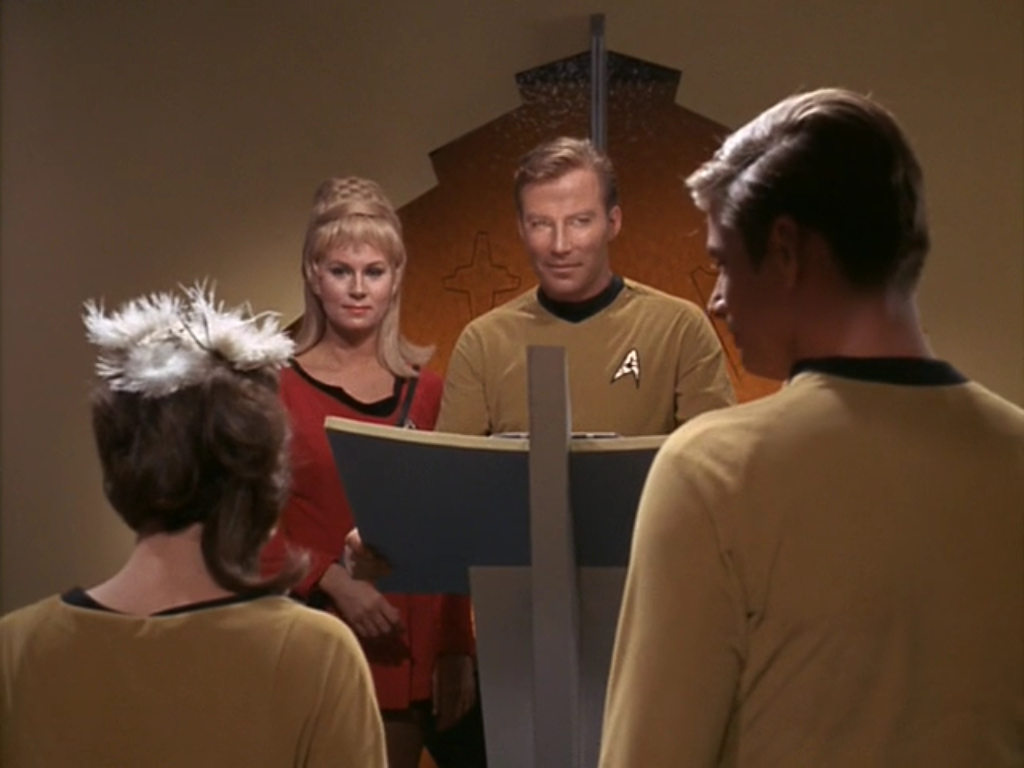
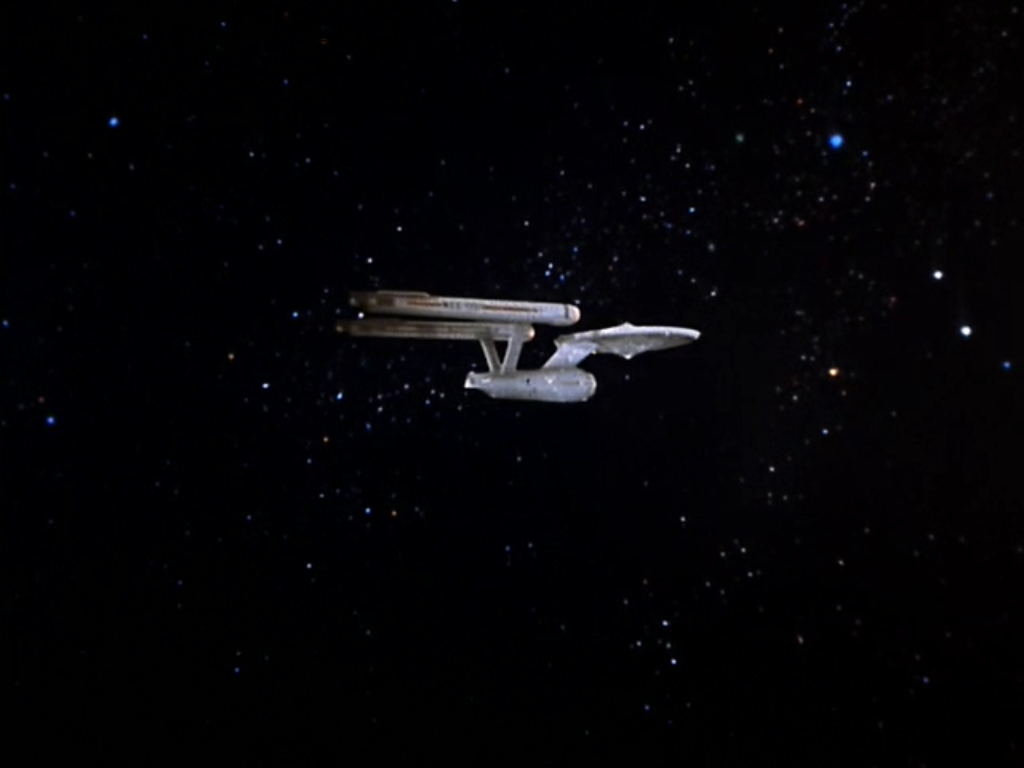
Its a cat and mouse game across the stars as the Enterprise becomes the first ship to meet the Romulans in a century. But first, it is time for a wedding.

Angela Martine and Robert Tomlinson are getting married aboard the Enterprise as it is patrolling the Earth outposts that guard the Romulan Neutral Zone. Kids, marriage can be a wonderful thing, but this isn't the best way to get one started.

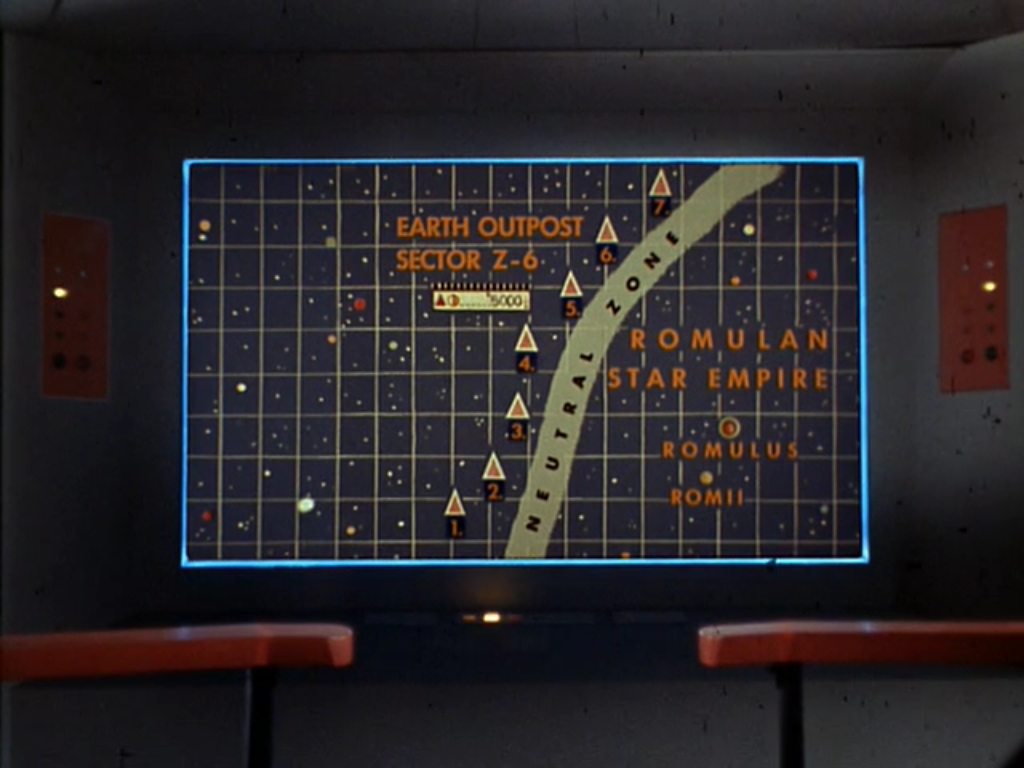
Outposts Two and Three have gone silent and the wedding is stopped as we learn that Outpost Four is under attack.
A dandy map of the Outposts along the Romulan Neutral Zone.
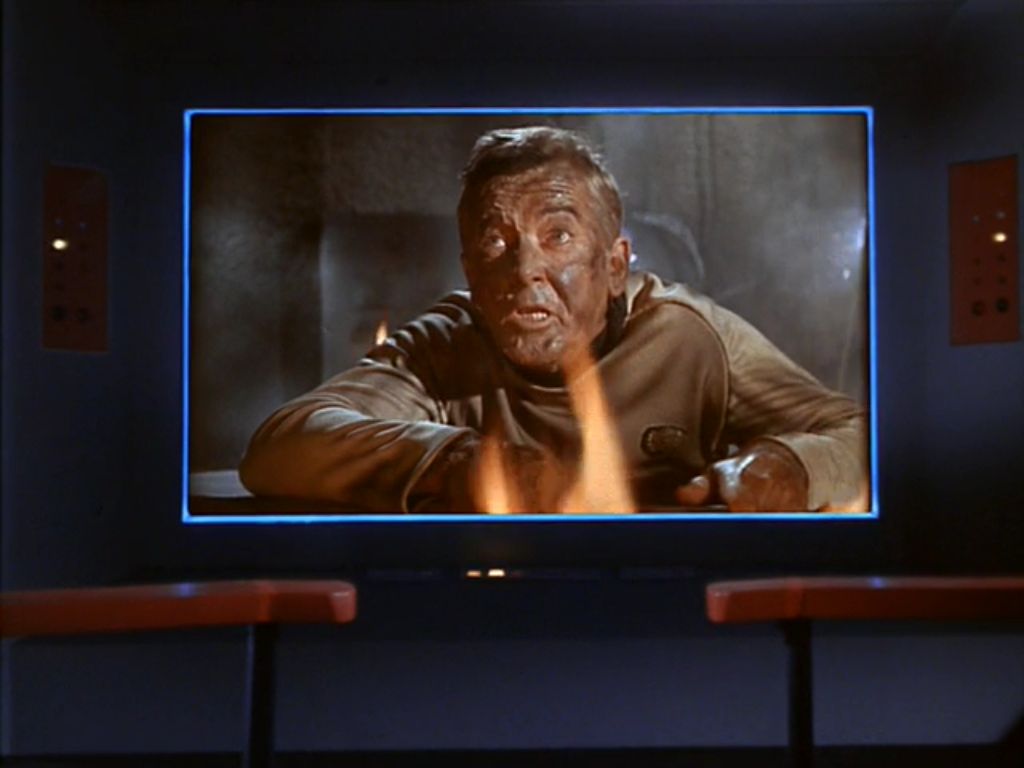
The Enterprise establishes communications with Commander Hansen on Outpost Four. He is not having a good day. 
"We're a mile deep on an asteroid. Almost solid iron. And even through our deflectors, it did this."
A ship appears, fires another shot and disappears again.
Outpost Four is destroyed.
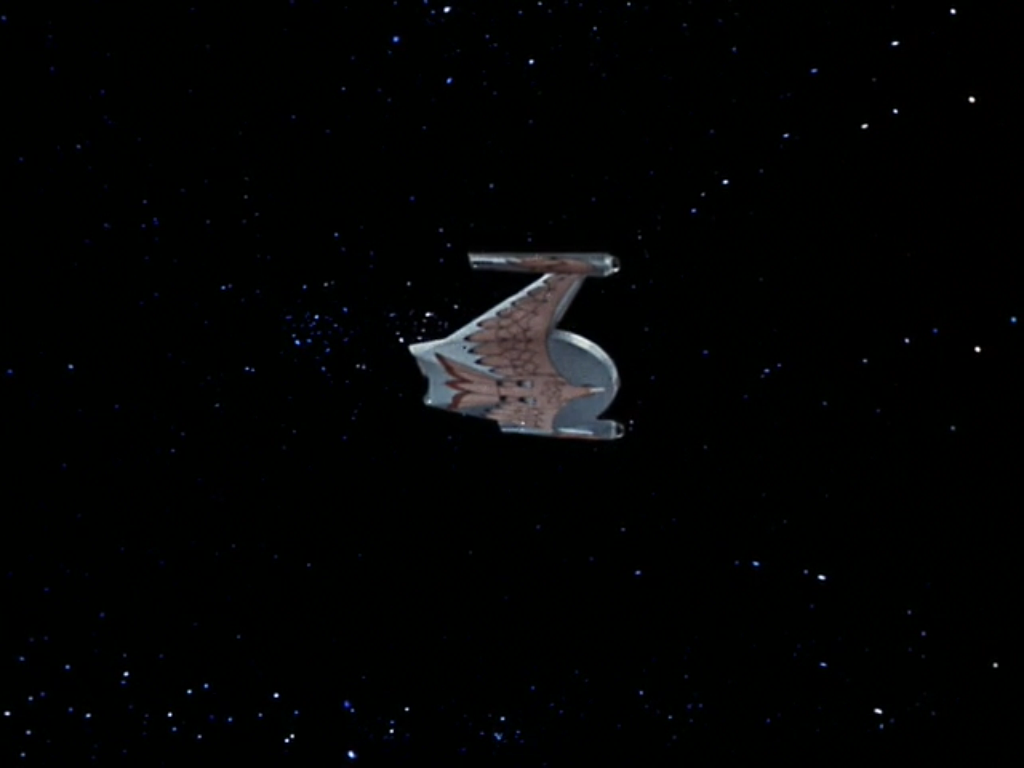
Who did it? The Romulans, of course. Lt. Stiles had relatives in the last conflict with the Romulans and knows that their ships are painted with a Bird of Prey.

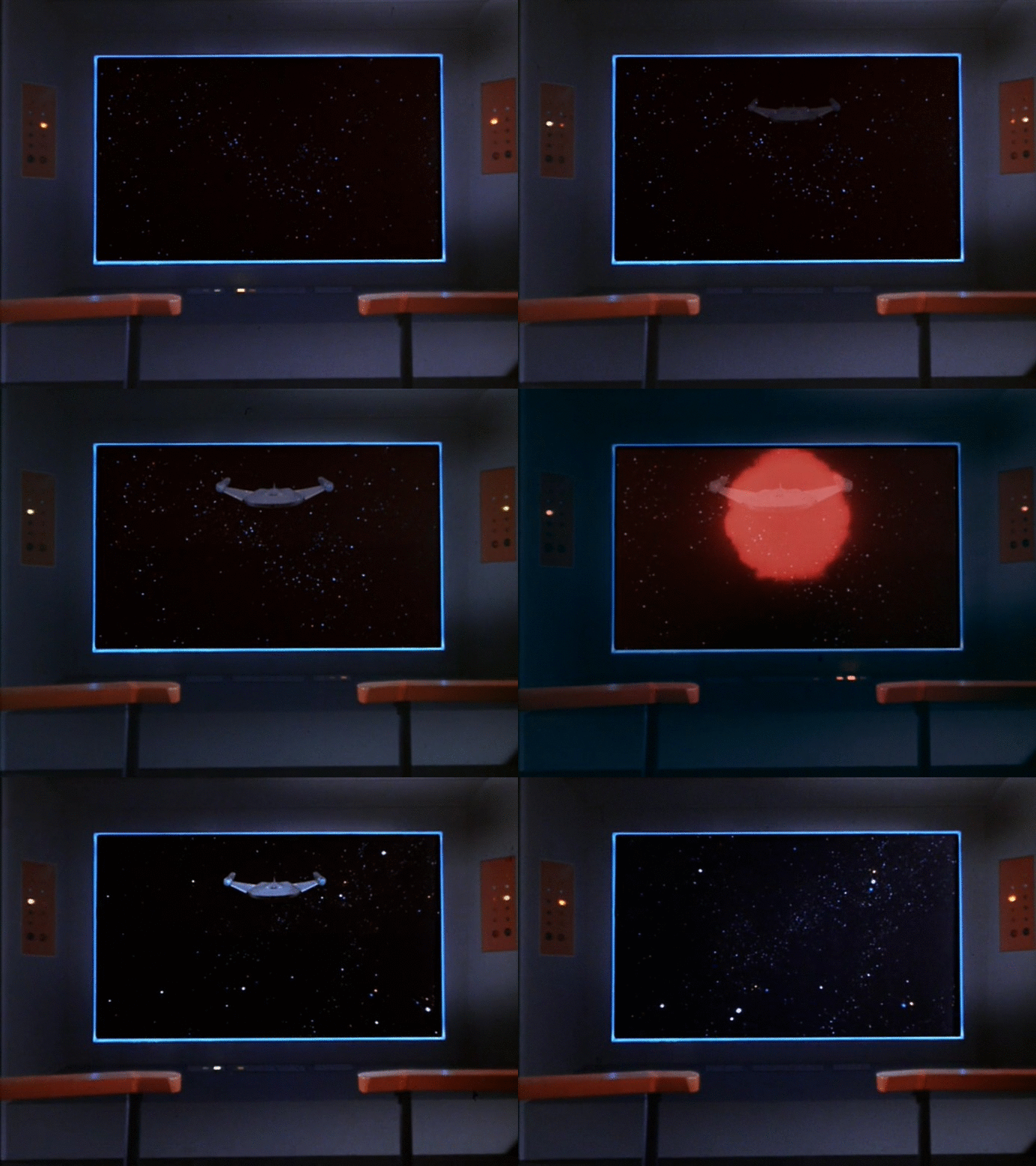
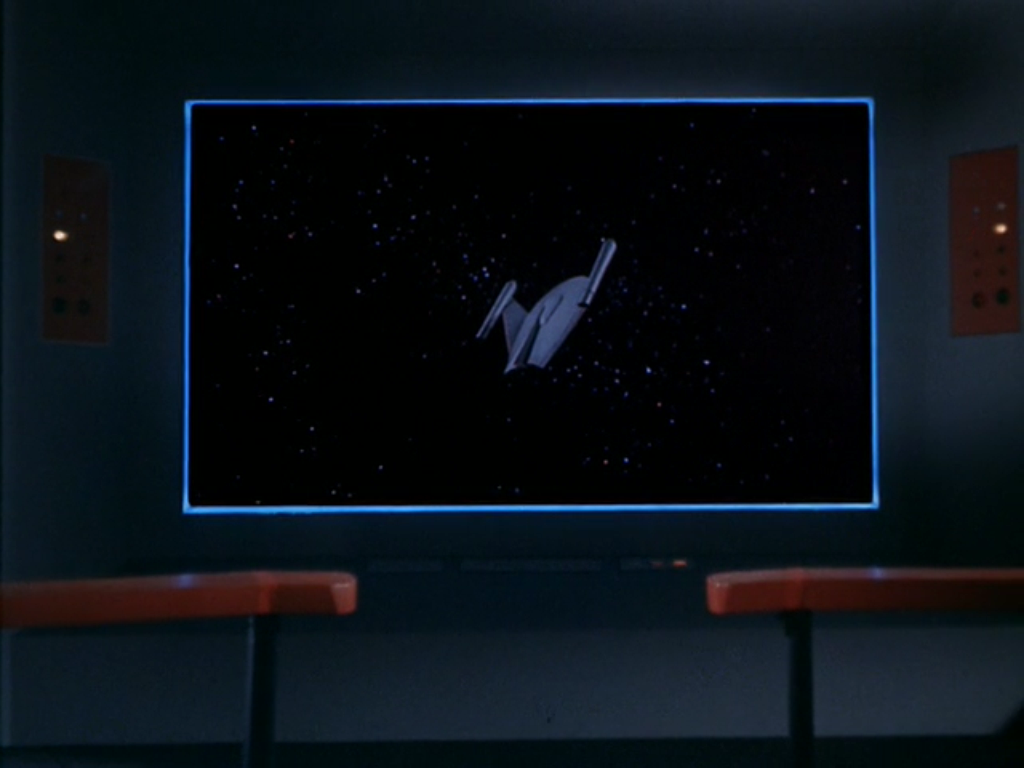
A message is intercepted and we get our first look at Romulans. 
Who do they remind you of?

Kirk makes it clear to Stiles that there is no place for bigotry here. Too bad Stiles doesn't get it.

Should the Enterprise retaliate and risk galactic war? Spock thinks that they should because Romulans are related to Vulcans:
Spock: And if Romulans are an offshoot of my Vulcan blood, and I think this likely, then attack becomes even more imperative. 
McCoy: War is never imperative, Mister Spock. 
Spock: It is for them, Doctor. Vulcan, like Earth, had its aggressive colonizing period. Savage, even by Earth standards. And if Romulans retain this martial philosophy, then weakness is something we dare not show.
And even though the Romulans have a cloaking device, the chase is on!

Astronomy Interlude #1
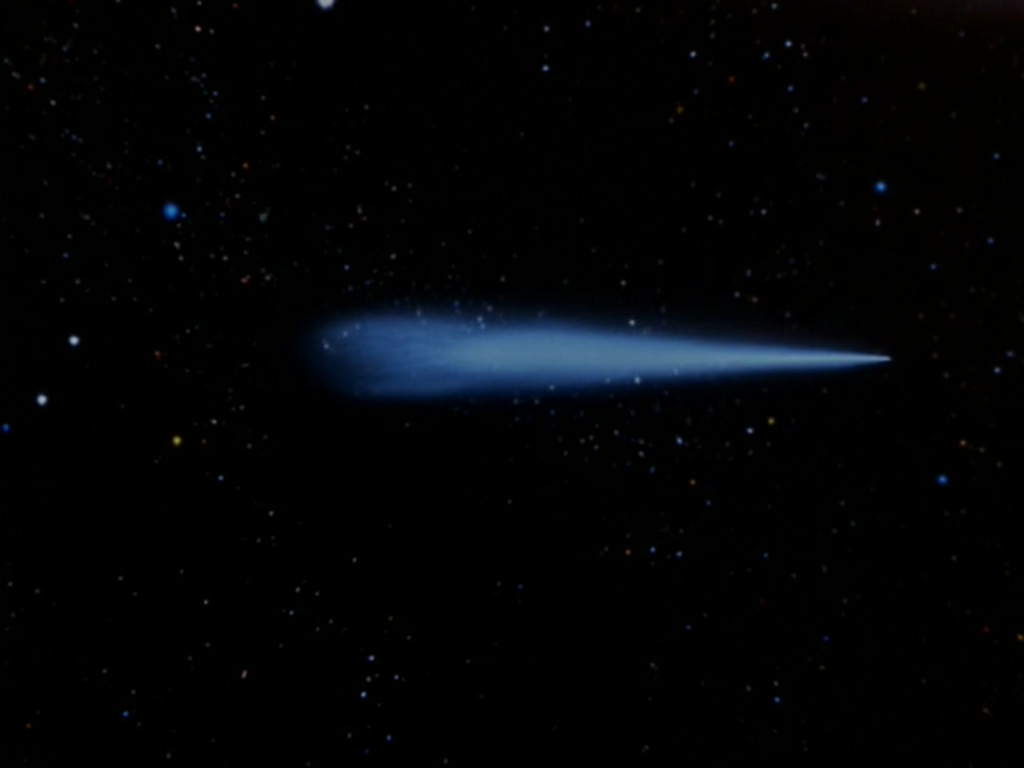
Comet Icarus Four: "Behold a marvel in the darkness."
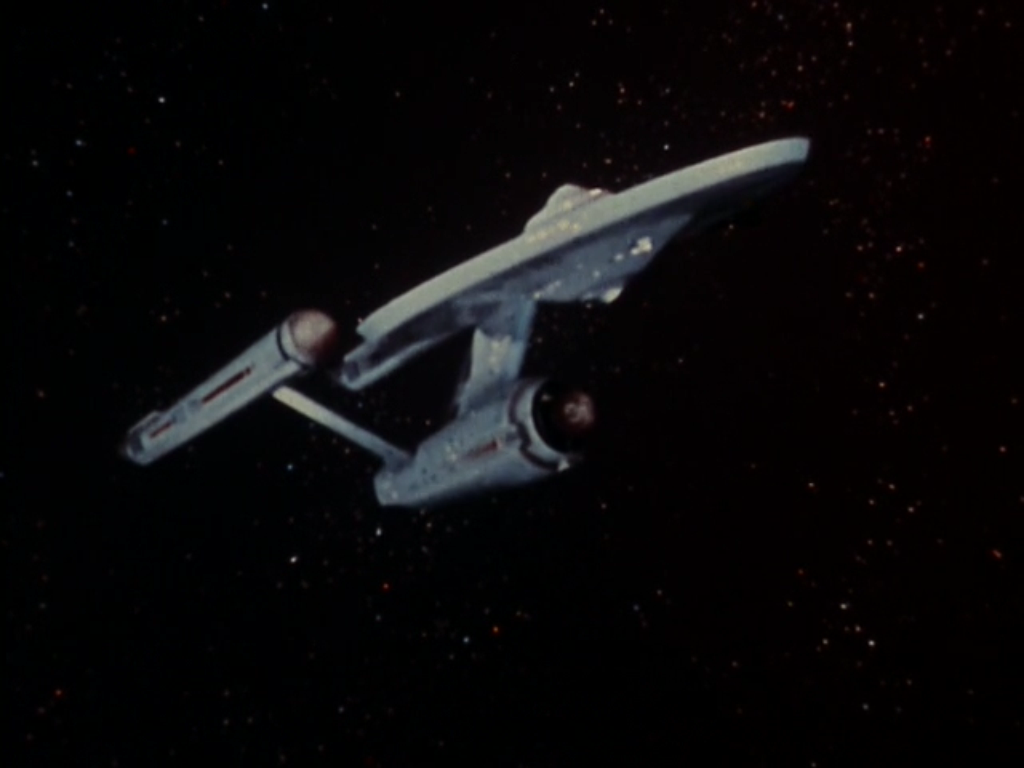
In the depths of deep space comets are frozen solid with no atmosphere (called a coma) or tail. When the Enterprise and the Romulans encounter this comet, it shouldn't look as cool as it does with a nice tail, but I guess that would ruin the plot point.

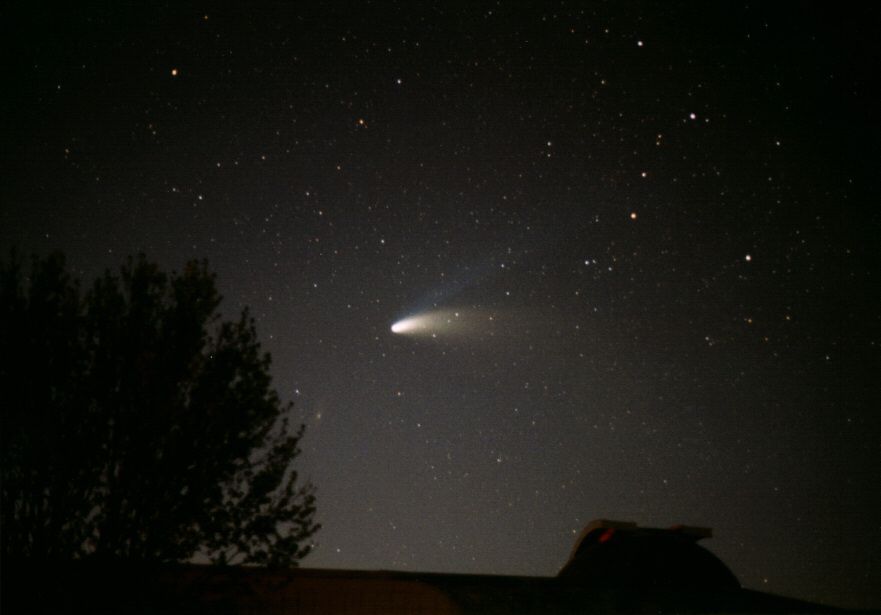
Still, when real comets enter our inner solar system the Sun heats the ices and they can put on a nice show in the sky. Those of us in the Northern Hemisphere haven't had much to see in the way of comets since the late 90s. Below is a photo I took of Comet Hale-Bopp in March 1997 at Lake Afton Pubilc Observatory in Wichita, Kansas. (By the way, Lake Afton Public Observatory is a cool place. If you are ever in the area be sure to check it out. Check out more pics of Comet Hale-Bopp from LAPO here.)
Hale-Bopp was indeed an awesome comet. Note that it had 2 tails. This is pretty normal. The photo above shows a bluish straight tail above a brighter, curved tail. The blue tail is composed of ionized gases, while the white one is primarily dust. Hale-Bopp's dust tail was bright enough that it was easily seen in light polluted areas. Ion tails are pretty much washed out by light pollution.

For more on comets check out How Comets Work. There are pictures there from the 1910 passage of Comet Halley that remind me of the comet that was used in this episode of Star Trek.

A final point about comets. 2013 may bring three comets to our skies: Comet Lemmon and Comet PANSTARRS in March. Comet ISON may be the brightest of the three, by far, and possibly greatly outshine even Comet Hale-Bopp. I'll be posting comet updates here on the blog in the future.

Back to Trek, mostly.
When Kirk asks about the comet, Spock does not need to consult their "Table of Comets" to know that this one is ordinary, an "ionized mass, a trail of frozen vapor particles." A printed volume of comets is pretty old school, even for vintage Trek, wouldn't you agree?

Astronomy Interlude #2

At one point Kirk expresses doubts about what he is doing and McCoy tells him this:
Jim. In this galaxy, there's a mathematical probability of three million Earth-type planets. And in all of the universe, three million million galaxies like this. And in all of that, and perhaps more, only one of each of us. Don't destroy the one named Kirk.
Our perception of the universe has changed quite a bit since the writers penned McCoy's little speech. How does it hold up today? Back in the 60s the number of confirmed "exoplanets" - planets beyond our own solar system was zero. Today the number is in the thousands, and growing rapidly. Thankfully, the number of known planets has grown to the point where actual statistics can be done. While we cannot travel at warp speed across the galaxy, we can estimate the total number of Earth-type planets in the Milky Way. Numbers released earlier this week estimate that there might be 4.5 billion planets like our Earth in our galaxy. McCoy certainly got that way wrong, didn't he?

How did he do on galaxies? McCoy said that there was "three million million galaxies". That's 3,000,000,000,000 or 3 trillion galaxies. This post from Discover, suggests that the actual number should be about 176 billion galaxies in the universe, but also that the Hubble data may actually under estimate the number and that with future instruments, like the James Webb Space Telescope the estimated number of galaxies in the universe may jump to a trillion. If so, then McCoy's estimate is only off by a factor of three, which in astronomy is often pretty good. I should also point out that the estimate of galaxies above is for the observable universe. The entirety of the universe is bigger than we can see, so the count really is likely several times larger than 176 billion, even without speculating what we might learn with the James Webb Space Telescope.

Back to Trek.

The ships maneuver and battle. At one point they each lay still and, strangely enough, everyone must keep quiet to avoid detection by each other. Details like this are horribly wrong (sound doesn't travel through space you know), but help to give this episode a feel as if the starships were two submarines in battle.

Rant: Why is it that ships in space, when damaged, are tilted? Are they taking on water? Is there some galactic frame of reference with a preferred direction for "up" that they must follow?

Anyway, shots are exchanged. Both ships are damaged and in the big conclusion there is a phaser coolant leak aboard the Enterprise that incapacitates Stiles and Tomlinson who are manning Phaser Control. Spock has to rush into the room to fire off the shots that cripple the Romulan ship. He rescues Stiles (in spite of his feelings toward Spock) but Tomlinson will never be getting married as Spock was unable to save him. I am not sure why his bride to be wasn't in the room too, as earlier in the episode they both worked there. Shouldn't she be dead too? Maybe the Romeo and Juliet ending would have worked better (I know, there was no suicide here.)

All-in-all it this is a solid episode of Trek. Guest star Mark Lenard does a great job as the Romulan Commander. He is given some great lines:

"Danger and I are old companions." and, speaking to Kirk at the end, "I regret that we meet in this way. You and I are of a kind. In a different reality, I could have called you friend." 

And at least one line that doesn't make any sense at all: "Centurion, I find myself wishing for destruction before we can return." Wait. What?

That aside, it is a fine episode. Composer Fred Steiner wrote only about five and a half minutes of music for this episode (the rest is tracked from other episodes), but it is good stuff and includes a menacing theme for the Romulans: hear it here from La-La Land Records.

Also, Five Year Mission did another cool song for this episode, it is worth checking out and you can watch the full episode here from Star Trek.com.

Next up is What Are Little Girls Made Of?

Sunday, February 13, 2011

App Review: Exoplanet

These days the branch of astronomy devoted to the discovery and study of exoplanets (planets that orbit stars beyond our sun) is undergoing an explosion of sorts as new worlds are being discovered at a prodigious rate.


Just a couple of weeks ago the team of astronomers using the Kepler space telescope announced the discovery of a solar system with six worlds and that they had over 1,200 more exoplanet candidates awaiting confirmation. Many more exoplanets have yet to be discovered by the Kepler and other teams, but if their early exoplanets are confirmed it implies that their may be well over a million Earth-like worlds in our galaxy alone.

Keeping current with this field is now officially a difficult task.  Fortunately there is a handy, free app called Exoplanet available for the iPhone & iPad that conveniently summarizes just about everything that is known about the exoplanets that have been discovered so far. 


Upon opening the app, you'll be prompted if there is new data waiting to come over to your device. As of the last update to the database there are 528 known exoplanets.The app allows you to see data on the exoplanets and sort this data by any number of characteristics such as orbital period, mass, radius, discovery year and much more.  You can even filter the data and combine search features.  So if you want to sort the list by mass and only see exoplanets around G-class stars (like our own sun), you'll find that the smallest exoplanet discovered so far that orbits around a sun-like star is Kepler-11 f  (one of the member of the six-world system illustrated near the top of this posting).

You can choose the exoplanet with a simple touch and a graphic like the one below (this time for Kepler-10 b) pops up that graphically displays the method of discovery (transit), the size of the world (relative to Earth, Jupiter, Uranus or Neptune), a star chart showing the location of the host star, and an orbital diagram that relates the orbit of the exoplanet to our own solar system.  Touch any one of these and an expanded view slides into view. There is also actual data on the world and links to published scientific papers related to the world you are looking at.


From the main menu you can also find recent exoplanet news, basic information on exoplanets and how they are discovered.  The app also has the ability to generate plots of data which you can then export to a PDF file.  The Milky Way section plots the locations of exoplanets in our galaxy.  You can zoom and tilt the view of the galaxy.  I found the Milky Way plot to be the least useful tool within the app.

If you are interested in exoplanets or possibly looking for data to help draft a science fiction story this app is a worthy tool.  Exoplanet provides current and accurate information on exoplanets. I have been running it for some time on an iPhone 3GS and an iPad. The app is very easy to use and free.  There is some hint in the app that a future update may make it ad supported.  Currently there is a provision to "Remove ads for $0.99" even though there are no ads in the app yet.  $0.99 isn't much of an investment to help support future releases.  Check out the developer's website for more information and a video of the app in use.

I plan on doing more reviews of astronomy apps. As you may have guessed, I am an IOS user so the reviews will be skewed to apps that are available for the iPhone and iPad.