Showing posts with label nebula. Show all posts

Monday, September 1, 2025

Summer's Greatest Hits

Well, it's Labor Day. Summer is officially over and the fall semester has begun. I got in a lot of telescope time over the summer, so I thought I would post a few of my favorite images taken during my break.

Comet 3I/ATLAS, the third ever interstellar object known to pass through our Solar System was discovered in early July. It is faint, but the Unistellar / SETI Institute citizen science program was interested in seeing if people could detect it with their telescopes. 

Stars appear as streake in this image of Comet 3I/ATLAS which looks like a circled dot.
 

The image above shows 3I/ATLAS (circled). The individual frames were aligned on the comet, which means that the stars in the image appear as streaks. At that time the comet was about 17th magnitude, (translation: very faint!) but detectable. I am happy to be contributing to the science being collected on this mysterious visitor which, despite some claims, is indeed just a comet.

Of course, I continue to image some celestial objects just because they look pretty. Probably my favorite of the summer was this beautiful mix of stars, gas and dust known as the Elephant Trunk Nebula. 

An image of the Elephant Trunk Nebula, an elongated dark cloud of gas.
It is located some 2,400 light years away in the direction of the constellation of Cepheus, the King. Like many nebulae, it is a region of space where new stars are forming. This was a 2-hour exposure taken with my Celestron Origin telescope. I honestly never imagined that I would someday be able to take images like this one and the others below, but I am happy to be living in the age of the smart telescope.

Much farther afield is the spiral galaxy known as Messier 33.

An image of a spiral galaxy.
This is a 2-hour exposure of M33 which, at a distance of 2.7 million light years, is the second closest spiral galaxy to our Milky Way Galaxy. It is a galaxy that always challenged me when I tried to see it visually with a traditional telescope, so being able to capture it this way is wonderful.

Earlier in the summer I posted images of other nebulae, one of which was the fabulous Lagoon Nebula in Sagittarius. After further review, I thought that maybe the image I posted there, which was a 1-hour exposure, was perhaps overexposed. So, I decided to try something much shorter and I am even happier with the result. 

This image was just a 2-minute exposure! Even with this short exposure the nebula still reveals brilliant color, dark globules of dust and the young star cluster that has formed from the nebula.  

Just last night I pointed my Origin telescope at NGC 6729, a target that was new to me. It is located so far south that it never gets even 20-degrees above my horizon. Still, I managed to get a 70-minute exposure and am happy with how it came out. 

Dark clouds of dust surround embedded stars.

What you are seeing here are some stars that are embedded within opaque clouds of gas and just. A pair of bright, young stars are shining forth just above center while other fainter ones struggle to be seen at all. The nebula very much reminds me of the much more famous Messier 78.

At practically the other end of the sky is the more famous Bubble Nebula (NGC 7635):

A glowing cloud of red gas with a bubble at the center.
The bubble at the center of the image is not a thin film of soapy water but rather of gas that has been blown off a massive supergiant star located thousands of light years away in the direction of the constellation of Cassiopeia, the Queen. Some day this star will explode forming a supernova.

Ten to twenty thousand of years ago there was a supernova explosion in the constellation of Cygnus, the Swan. It produced the Veil Nebula (a part of which is in my nebula post linked above), which is just a piece of the much larger supernova remnant known as the Cygnus Loop. 

The Cygnus Loop is about five full moons across, which means it is much, much larger than the field of view in my Origin telescope. Yet, I decided I wanted to capture it all. To do so I had to make a mosaic of 15 images. Here it is:

Wispy clouds of red and blue gas in a roughly circular shape, like a burst bubble, against a background of stars.

To me, it resembles a bubble that has just burst, but it is an expanding cloud of 'star guts' from the supernova explosion. 

I mentioned the size of the nebula above, but wanted to illustrate that with a correctly scaled image of the full Moon, so here it is: 

The Cygnus Loop supernova remnant with a full moon to show its size.
These were just a few of the many objects observed this summer. There's a whole lot of sky still to observe and I'll be back later with more.

Sunday, July 13, 2025

The Age of Origin - Nebulae

Here's the second of my three initial posts looking at some of my astrophotograpy from the Celestron Origin smart telescope. Today, its nebulae. Star clusters will be next.

Let's start off with a popular target from the Northern Hemisphere's winter skies: the Horsehead Nebula. 

An astrophoto showing a nebula in the upper right with a bright star next to it. At center is a red nebula with a dark cloud that looks like a horse's head.

That's the Horsehead Nebula, also known as Barnard 33, at center. It's a dark cloud that's in front of a red cloud of hydrogen gas that lies some 1,300 light years from Earth. To the left of it is a blue-white reflection nebula known as NGC 2023. In the upper left is the Flame Nebula (NGC 2024) and immediately to the right of that is the star known as Alnitak. Alnitak is the left-most star of Orion's Belt.  

Almost three degrees to the east of the Horsehead is Messier 78, an amazing complex of both dark and reflection nebulae located at about the same distance from Earth as the Horsehead Nebula.

A telescopic image of stars showing two bright areas that are embedded in blue-white and black clouds.

M78 is at center and NGC 2071 to the left, but clearly they are part of the same region of space. Both have stars embedded within clouds of gas and dust.

The Rosette Nebula in Monoceros is much larger than the Origin's field of view but I shot a series of overlapping images to create this mosaic. 

A cluster of stars surrounded by colorful ring of gas and dust.
This is a region of star formation that has an open star cluster (NGC 2244) at center that's surrounded by a ring of glowing hydrogen gas that's leftover from its formation.

No visit to the winter skies would be complete without a look at Messier 42, the Great Nebula in Orion. 

A fan-shaped cloud of gas and dust.
M42 is almost too bright, but I think that this image captures it nicely. You can see clouds of dark nebulae, blue reflection nebulae and red hydrogen gas. 

Planetary nebulae are created when a Sun-like star that has evolved into a red giant sheds its outer layers into space. 

Messier 27, the Apple Core Nebula is one of the brighter planetary nebulae:

A telescopic image with a blue-green nebula at center that's reddish on its left & right sides.

It's located about 1,200 light years from Earth in the direction of the constellation of Vulpecula, the Fox. 

Unlike any of the previous images in this post, this image was taken using the nebula filter that Celestron sells to go along with the Origin. The remaining images here also make use of the nebula filter, including the Helix Nebula below:

A circle of orange gas with a blue-green center.
The Helix another planetary nebula and is about half as far away as M27, which is why it is larger in the sky. 

Great targets for summer evenings include Messier 16, the famous Eagle Nebula:

A fan-shaped cloud of mostly reddish gas in a field of stars.

At the center of the Eagle nebula lies the famous "Pillars of Creation" that has been photographed by both the Hubble and Webb Space Telescopes. The pillar-shaped dark features at center within this nebula are a part of this nebula which is creating a new cluster of stars.

At the end of their lives massive stars explode as creating supernovae. A supernova is an expanding cloud of star guts. The Veil Nebula is a part of the Cygnus Loop supernova remnant. The western part of the Veil shown here is also sometimes called the Witch's Broom Nebula:

Elongated wisps of blue and red gas near a bright star.
The supernova that created the Veil Nebula exploded between ten and twenty thousand years ago.

A star that has not yet exploded, but someday will, is Wolf-Rayet 136, a massive star that has shed some of its gas creating what is known as the Crescent Nebula (NGC 6888):

An image of a dense field of stars with a red somewhat crescent shaped cloud of gas at center.
That's WR 136 at center. It lies some 5,000 light years from Earth and when it explodes it will be bright enough to be seen in the daytime. Alas, we don't expect this to happen anytime soon.

Finally, here's perhaps my favorite nebula, Messier 8, the Lagoon Nebula in Sagittarius:

Like M42 above, if you are observing in an area free from light pollution the Lagoon Nebula is just visible to the eye. Through a telescope its a grayish cloud associated with an open star cluster. 

There's a famous image of the Lagoon Nebula that was one of the first color images of space. It taken before I was born with the 200-inch Hale Telescope at Palomar Observatory. You can see it on my old Palomar Skies blog from when I worked at the observatory.
 

Wednesday, September 8, 2021

Recent Shots of the Cosmos

I've  got a few projects that I am working on right now that I will eventually blog about, but they're not quite finished, so I thought I would just drop some of my recent astrophotos here instead.

Last weekend I was at Joshua Tree National Park for their Night Sky Festival. I was running a telescope for Unistellar and showing off the coolest astronomical objects of the night sky. I was also on a secret mission to show a few objects that were part of a theme that led up to a successful marriage proposal. The final object just before the question was popped was NGC 6781, the Little Ring Nebula:

The Little Ring Nebula is a planetary nebula which is a bubble of gas that is being given off by a dying star. It is located a few thousand light years from our Solar System in the constellation of Aquila, the Eagle.

Also, located in Aquila is the dark nebula known as Barnard 143, which, along with Barnard 142, makes up what is sometimes called Barnard's E. 

Like with the other dark nebulae I've blogged about it is a dense cloud of cosmic dust that is blocking the light of the stars behind it. 

Our Milky Way galaxy is dusty, which is typical of spiral galaxies. We can see these dust clouds in our own galaxy and we can see them in other galaxies too, such as this one:

NGC 891 is a spiral galaxy that we are seeing from the side, which make its dust lanes easy to spot. It is located nearly 30 million light years away in the direction of the constellation of Andromeda. 

Here's another galaxy located in Andromeda. It is both closer and smaller than NGC 891.

The really bright thing is a red giant star in our own galaxy known as Mirach (aka Beta Andromedae). It's about 200 light years from us. The galaxy in this image is the fuzzy smudge that is up and left from Mirach. It is cataloged as NGC 404 and often referred to as Mirach's Ghost, because it almost looks like a reflection of the brighter star. Mirach's Ghost is a dwarf galaxy that's around 3 times closer to us than NGC 891 is. 

That's all for now. I've got an elusive object to try to hunt down. 


Thursday, August 5, 2021

Going Dark

It all began back in early June when I took a look at the globular star cluster known as Messier 9 in Ophiuchus. I didn’t realize it until I pointed my Unistellar eVscope there, but in the sky very near to M9 is a dark nebula, specifically the dark nebula known as Barnard 64 (The name comes from its entry into a catalog of dark nebulae compiled by Yerkes Observatory astronomer E.E. Barnard in 1919.).

Messier 9 (left) and Barnard 64 (upper right)
Sure, I realized that dark nebulae where out there. You can see them when you look at photos of the Triffid Nebula or the Lagoon Nebula (see my post on Messier Nebulae). The most famous dark nebula of them all is the Horsehead Nebula (Barnard 33)—a dark cloud that is silhouetted against a faintly glowing red emission nebula near the Belt of Orion.

B33, the Horsehead Nebula in Orion

 But to me Barnard 64 is something different than those examples. It’s a dark cloud that is blotting out the light of stars behind it and not a dark cloud seen in front of a bright one. Seeing Barnard 64 started me on a journey to look for more dark nebulae, so I thought I would share a few of the dark things that I’ve recently been looking at.

Also in the constellation of Ophiuchus is Barnard 72, commonly known as The Snake.

The photo above is a mosaic of images that I made with my Unistellar eVscope of The Snake (the big "S"), but also visible in the image are other dark nebulae. To the right of The Snake is Barnard 68 and below that is Barnard 69.

There are plenty of dark nebulae in other constellations too. The center of our Milky Way Galaxy lies in the direction of the constellation of Sagittarius where more members of Barnard's catalog can be found. 

The image above shows dark nebula Barnard 86 next to a small, brilliant open star cluster (NGC 6520). They make a striking contrast. That's a red giant star visible on the upper edge of the nebula. 

Finally, (for now) let me show you three more dark nebulae in Sagittarius.

There's a lot in this image. I made it by taking 11 different exposures to produce this mosaic that covers about 1.3 degrees x 0.9 degrees. 

The amazingly dense field of stars seen here on the left half of the image forms Messier 24, the Sagittarius "Star Cloud."  

In the lower left you'll notice a trio of bright stars. The topmost of those is a red giant star. To the right of the red giant is a hot blue star that is vastly more luminous than our Sun. Above the red giant is the open star cluster known as NGC 6603. Near the center there's another little cluster of stars known as Collinder 469. To the right of Collinder 469 is the dark nebula known as Barnard 92. Up and left from Barnard 92 is the somewhat squid-shaped Barnard 93. In the upper left of the image is the smaller Barnard 307. Barnard 307 is one of the many dark nebulae in Barnard's catalog that were added to an expanded version to the catalog that was published in 1927, several years after his death. 

I've got more dark nebulae on my list. Hopefully in the not too distant future I'll post images of some of them here.


Tuesday, July 13, 2021

The Nebulae of the Messier Catalog: Ranked

Note: All of the images in this post, with the exception of the two star maps and the one image from the Hubble Space Telescope, were taken by me with my 4.5" Unistellar eVscope.

In the 1700s a French comet hunter named Charles Messier compiled a list of things in the night sky that aren’t comets. As someone who was actively looking for comets, this represented his list of things that could be ignored because they aren’t what comet hunters want to find. His list of not-comets is a catalog of more than 100 objects that represent some of the finest objects in the night sky. The list is mostly made up of star clusters and galaxies, but there are 12 nebulae. 

Nebulae (that’s the plural for nebula) are clouds of gas. They come in different types and the 12 that are found on in the Messier nicely represent them. Here are images of the 12 Messier nebulae and I decided to rank them, because, why not?  (Note: there are some other nebulae that are sort of in the catalog. For instance there's a little nebula that can be seen when looking at open star cluster M46, but I decided not to include those here.)

Nebulae of the Messier Catalog
The 12 Nebulae of the Messier Catalog in numerical order.
 

M78
 

Number 12: M78. M78 is dark and moody. It’s the kind of nebula that is okay with the fact that it doesn’t have a widely used proper name. It’s nothing more than a reflection nebula, something that is produced as light from its two central stars passes through the dust. Darker clouds of dust surround the brighter region cloaking M78 in mystery (except when viewed in the infrared. There's an entire cluster of stars there).


M43 is the little luminous blob in the middle.


Number 11: M43, De Mairan’s Nebula. Who was De Mairan? I confess that I had to look him up. Jean-Jacques Dortous de Mairan discovered this nebula (according to Wikipedia “some time before 1731"), but frankly this nebula really shouldn’t be classified as its own thing. I mean it’s right there with the fabulous M42. There’s some dark interstellar dust that makes M43 seem like a separate thing, but they really are connected making M43 somewhat of a poser on the edge of greatness.


Number 10: M76, the Little Dumbbell Nebula. That's "dumbbell", as in barbell and as in M27, the actual (not little) Dumbbell Nebula, which we’ll get to later. M76 is a planetary nebula which, as I tell my students, has nothing to do with planets at all. Many of these nebulae are small and round and blueish green in color, much like the planet Uranus. Sir William Herschel, who discovered Uranus, thought that these looked a bit like his planet, so he gave them the name planetary nebulae. Because of this astronomy students have hated him for years. 

In a planetary nebula gas is being ejected out from a dying star. The hot core of the dying star heats the surrounding gas and makes it glow like the gas of a neon sign. M76 is small, but it has distinct colors that are easily revealed with the eVscope making it a nice target. 


Owl Nebula with a satellite photobombing the image.


 Number 9: M97, the Owl Nebula. The Owl is another planetary nebula and gets its distinctive name from two large dark areas like “eyes” that make it somewhat reminiscent of an owl’s face. It is faint and takes some time to really see it well, but it is a cool thing nonetheless.


M1, the Crab Nebula


Number 8: M1, the Crab Nebula. The Crab gets extra points for being the only supernova remnant in the bunch, but let’s be honest, it looks nothing like a crab. It was produced when a star exploded as seen from Earth on July 4, 1054 A.D. The eVscope reveals it easily, though it takes some time to see much color here. No matter how you slice it, it is cool to observe a hot cloud of expanding star guts.


M20, the Trifid Nebula


Number 7: M20, the Trifid Nebula. Stars. Gas. Dust. The Trifid has it all. The red comes from a glowing cloud of hydrogen gas which is cut across by dark dust lanes, that help to give it its distinctive name (Trifid means tri-lobed). The faint blue color comes from starlight shining through dust (like sunlight shining through a dirty car windshield), similar to what we saw in M78. It’s an all-round good nebula.


 Number 6: M27, the Dumbbell Nebula. Like M76, the name means barbell, though according to Wikipedia it is sometimes known as the Apple Core Nebula, which is a name I like much better than Dumbbell. Alas, I’ve never actually heard anyone use that name and I fear that if I start calling it the Apple Core Nebula no one will know what I am talking about. It’s another planetary nebula. As you can see it is a big (about 1 light year across) bubble of gas seen against a dense field of stars.


Let’s face it, bubbles are cool and this is likely one of the biggest you’ll ever see. Of the planetary nebulae in the Messier catalog, this one is the closest which also makes it the one that has the largest apparent size. 

Number 5: M17, the Omega Nebula (also called the Swan and other names too). This giant cloud of hydrogen gas is a site of active star formation which means that the nebula is converting itself into a cluster of stars. It has already formed many stars, but they are largely hidden by the nebula itself. Some of the younger, hotter stars that have formed shine on the gas cloud and make it glow.
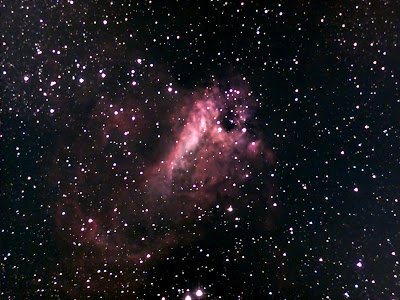
Messier 17
M17, the Omega Nebula

Location of the Ring Nebula. Image from SkySafari Pro.

Number 4: M57, the Ring Nebula. The Ring is awesome. It is another planetary nebula, so we are seeing gas that has been ejected by a dying star. The Ring always impresses people when they see it through a telescope. I remember once years ago (when I was working at Lake Afton Public Observatory in Wichita, Kansas) I was using a 16-inch telescope to show the Ring Nebula to a young lad who then described it as looking like a “dimly-lit Cheerio.” His description was perfect and much better than the “smoke ring” description that most people use. Of course, the eVscope quickly reveals its colors (something you won’t see at the eyepiece of traditional telescopes). This color perhaps makes M57 more like a Froot Loop than a Cheerio. 

Bonus points are given to the ring for being so easy to find in the sky, it is easily found even without using a go-to telescope. It is nestled between two stars in the parallelogram of Lyra, the Harp.

M57, the Ring Nebula

Number 3: M16, the Eagle Nebula. No star death here. Like M17, the Eagle Nebula is a glowing cloud of gas that is actively giving birth to stars. In fact there’s a cluster of baby stars (NGC 6611) that have already emerged from the nebula. This nebula was made famous by the “Pillars of Creation” image from the Hubble Space Telescope. The pillars are easily visible in my image. Here’s a comparison of my image next to the one from Hubble. The Hubble image is presented in a different and not very realistic color palette, but it beats my image in every possible way (as it should). Still it is nice to capture something that famous with my little telescope. The Pillars themselves are 4-5 light years long and are sites of active star formation in the nebula. 

M16, the Eagle Nebula

Number 2: M8, the Lagoon Nebula. While I didn't rank this as number 1, I confess that the Lagoon is perhaps my favorite. It is another star-forming nebula like we saw in M16 & M17, but it has so much more. There's good color, a prominent dark dust lane that cuts across it, a great star cluster (NGC 6530), dark clouds of dust that lurk at the edges of the main nebula, but also dark blobs of dust (called Bok Globules) that are revealed in silhouette. I like everything about this nebula. The region is too big to completely fit into the field of view of the eVscope. Below is a mosaic that I took of the area:

Messier 8, the Lagoon Nebula

And the best Messier nebula is....

Location of Orion Nebula (image from SkySafari Pro)
 

Number 1: M42, the Great Orion Nebula. When you have the word "great" in your name there shouldn't be any doubt as to your status. The Orion Nebula is bright and super easy to find. It sits in a prominent spot in Orion, which is arguably the brightest and most famous constellation of them all. Pretty much everyone can find the three stars that make up the Belt of Orion. The Orion Nebula is the middle "star" of the Sword which hangs down from the Belt. It is easily seen without any optical aid if you are away from light polluted skies. It looks fine in binoculars and good in every telescope. 


Like the Lagoon, this nebula is too big to see all at once, so I took a mosaic of the region:

M42, the Great Orion Nebula


Yes, M43 is hanging on there on the left, but it's really part of M42. The Great Orion Nebula, which like the Lagoon and the others we've seen, is a vast cloud of mostly hydrogen gas that is actively forming stars. The central white area is overexposed here, but it is home to a group of young stars called the Trapezium which are making the gas fluoresce. There's dark dust, blue reflected starlight and red glowing hydrogen. 

It really is a stunning sight to see.

I am working my way through photographing the entire Messier Catalog, with only a few objects left to get. If I feel super energetic about it I might just rank all 110 of them.  

Sunday, June 8, 2014

Star Trek: The Doomsday Machine

I'm back with another look at an episode of the original Star Trek TV series.  Today it's one of my favorites:
As the story begins, there's a shocking revelation -
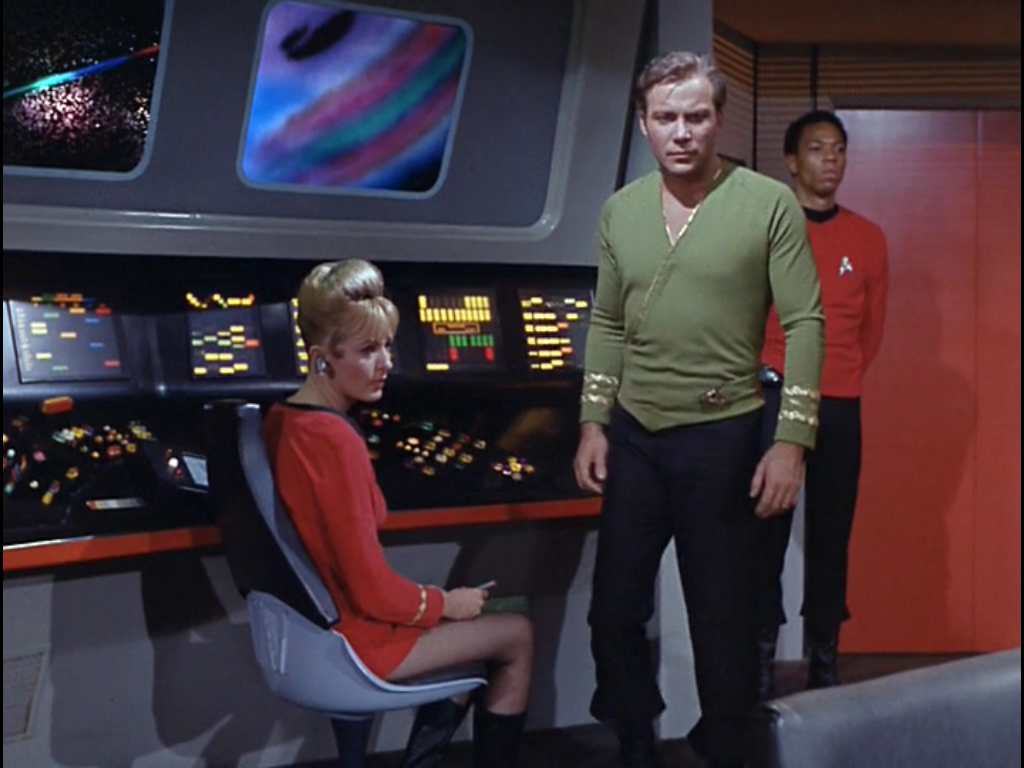
Someone other than Uhrua is staffing the communications station. What's up with that? I thought Uhura worked 24/7 like most of the rest of the bridge crew. It's too bad she wasn't here, as the communications officer got a lot of lines in this episode.

Still, there's a cool looking graphic above Lt. Palmer. It kind of reminds me of a zoomed in false-color image of Jupiter. Maybe something like this shot of Jupiter from the Gemini Observatory (of course taken years later):
The story begins with the Enterprise receiving a distress call and following a path of destroyed solar systems. As they enter System L-374 they find their sister starship, the Constellation (NCC-1017). It's been badly damaged, but parts of it remain habitable.

Kirk leaves Spock in command and beams over with Dr. McCoy, Scotty, and an engineering team. The ship's bridge is destroyed, so they make their way to Auxiliary Control to play back the captain's log.
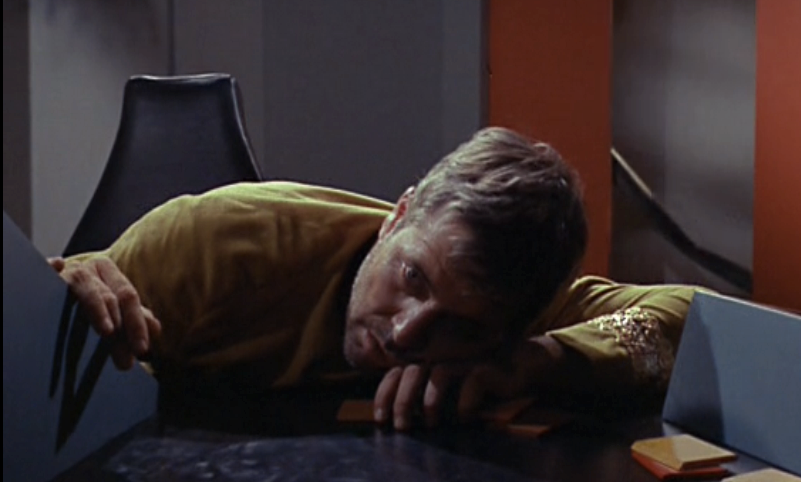
There they find Commodore Matt Decker who has recently made The Worst Command Decision Ever. I mean seriously, it was the worst command decision ever made. He brings in his starship to investigate some destroyed solar systems, only to find a thing that's chopping up the 4th planet in the system. It attacks the Constellation, leaving it dead in space. So what does Decker do? He has his entire crew beamed down to the 3rd planet, only to have destroyed by the planet killer while he watches helplessly from space. Dude, no.

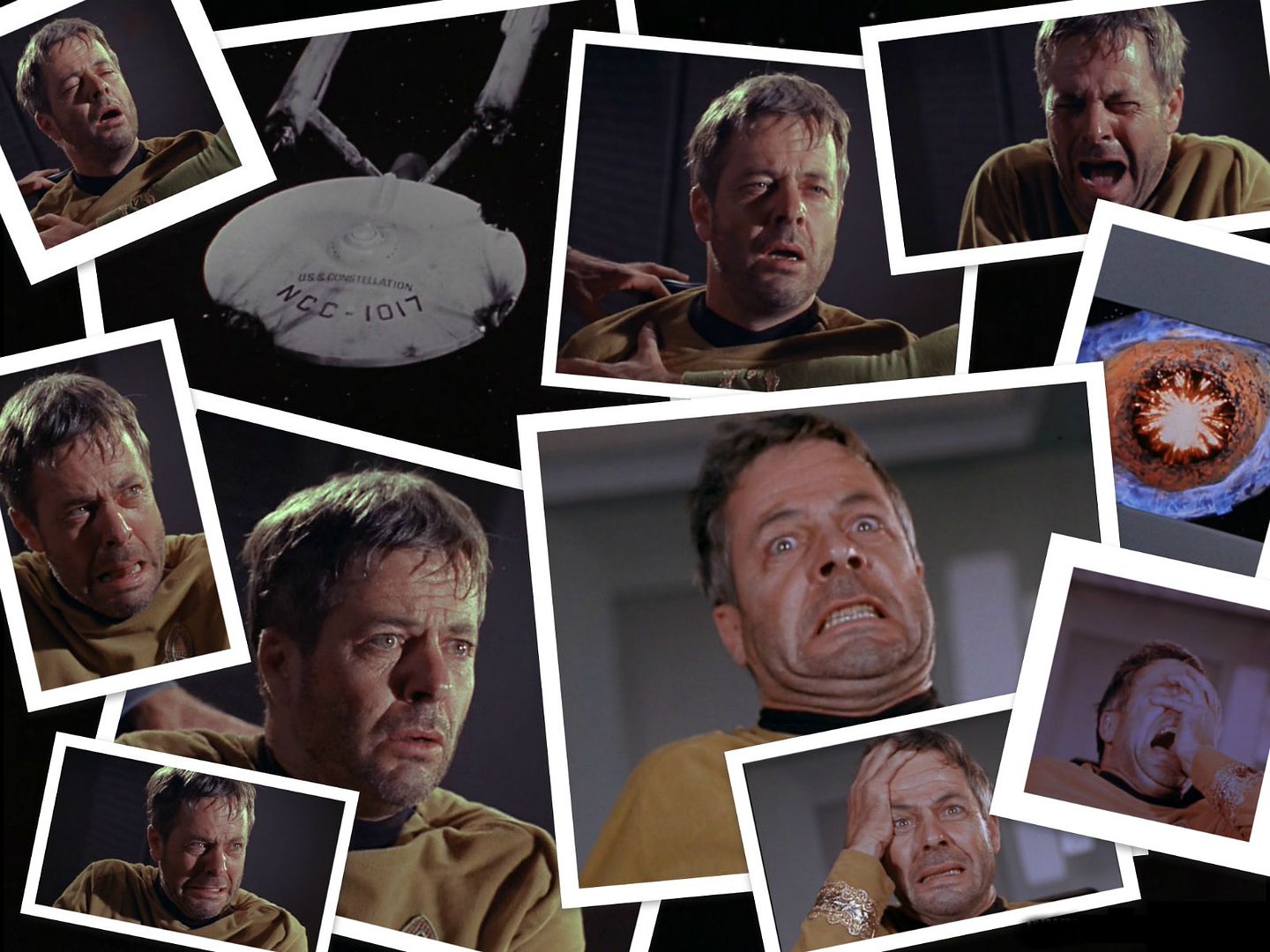
Decker was wonderfully played by William Windom. He gave this character a wide-range of mostly distressed facial expressions. Enough for me to create this Commodore Decker Polaroid synopsis of the episode:
There you have it. William Windom's Decker facial expressions provided better visuals than the actual Doomsday Machine did. Wouldn't you agree?
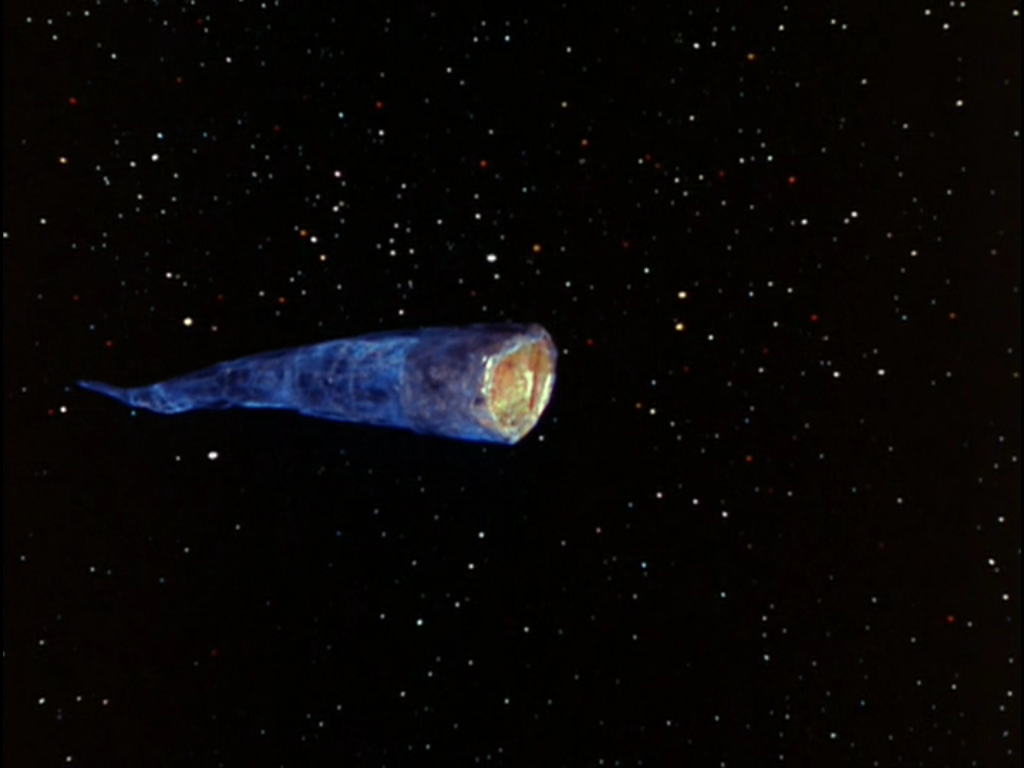
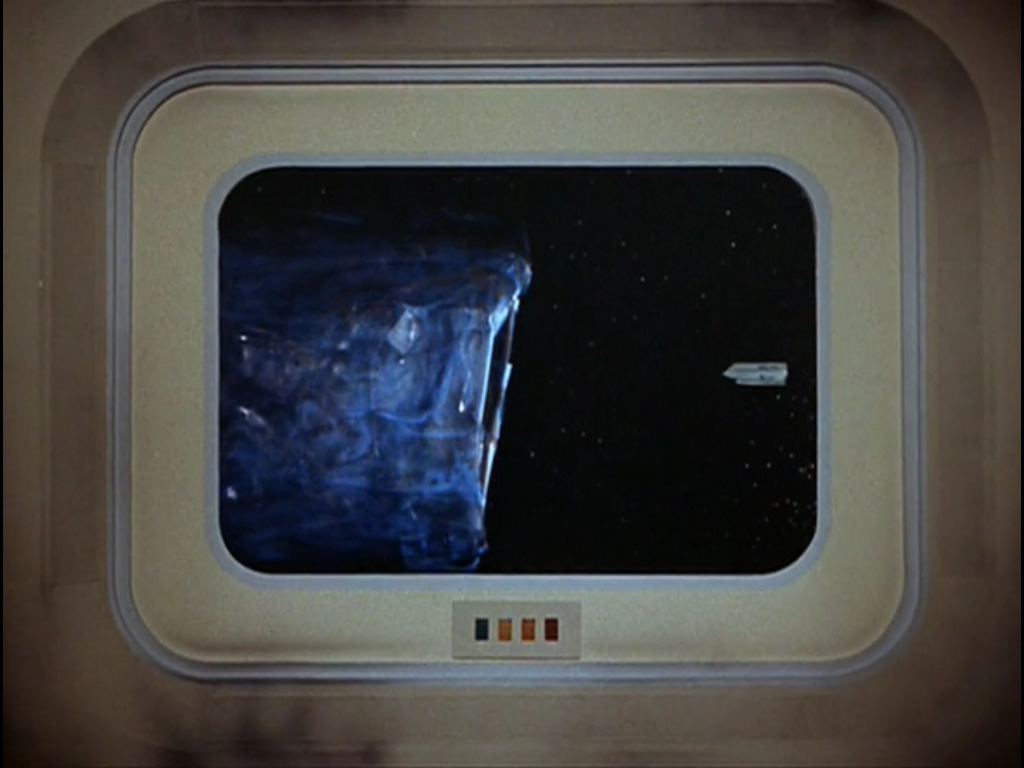
Apparently the "special effects" team created it with a windsock coated in cement. I never minded the look of it too much, but seeing stars pass through it was always a problem for me.

The Doomsday Machine does bear some resemblance to real objects in space. Here's a nebula surrounding a protostar imaged by the Hubble Space Telescope that at least sort of has the same shape:
The cloud is just over a light year in length and is being eroded away by the radiation of hot, massive stars nearby. Follow the link to read about it.

Decker & McCoy beam back to the Enterprise to find that the planet killer has returned. Decker wants it destroyed and isn't too pleased with Spock when he points out, "You tried to destroy it once before, Commodore. The result was a wrecked ship and a dead crew." When Spock refuses to take action, Commodore Decker seizes command of the Enterprise.
Commodore Decker with Pretzel Insignia
Things go from good to bad when Kirk, who had been out of contact, discovers that Decker's actions have been threatening the Enterprise. Protecting his ship is kind of important to Kirk. He orders Spock to take back command.
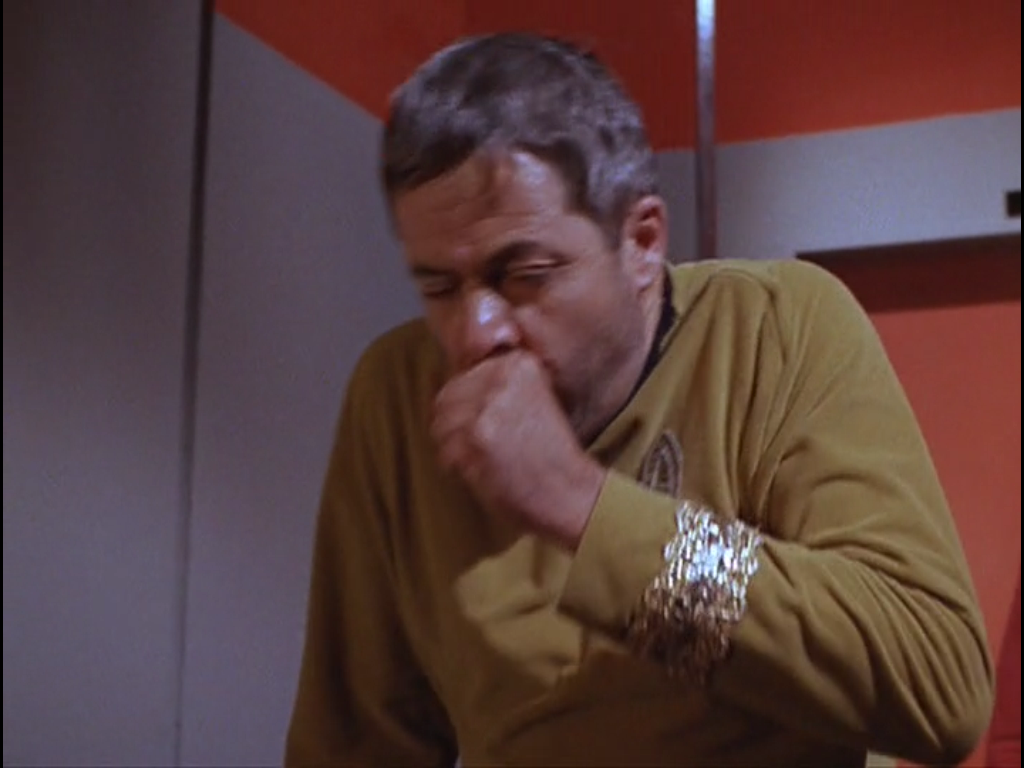
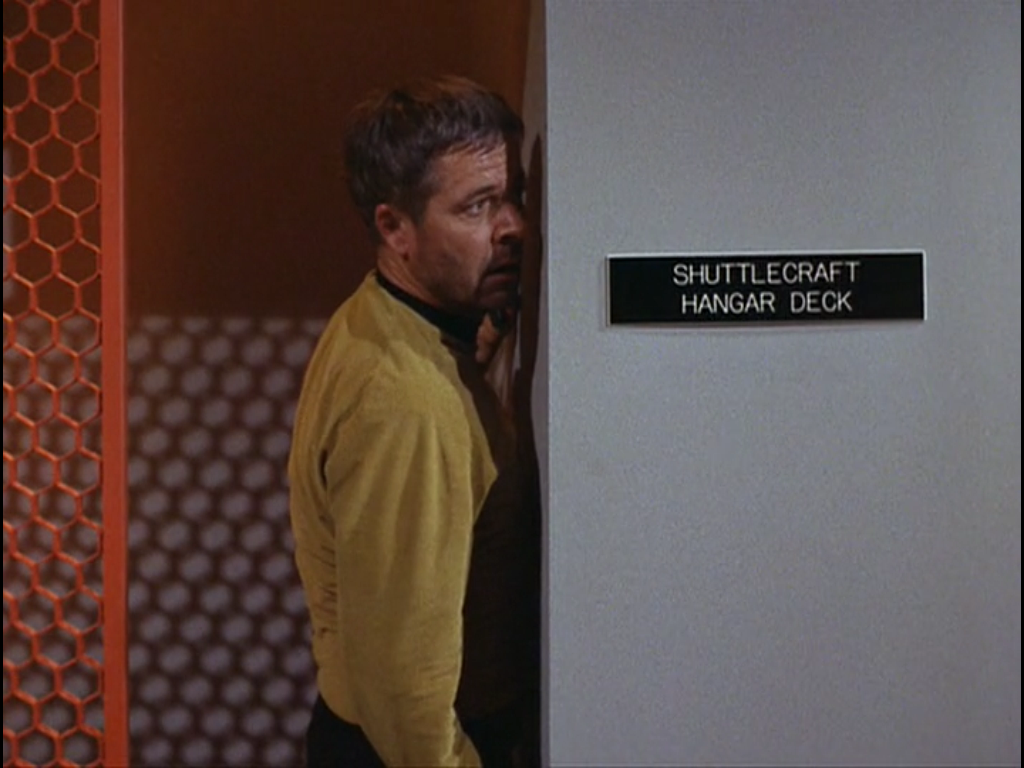
Spock has a security guard escort Decker to Sickbay, when Decker uses the ol' Coughing Commodore Trick to surprise and overpower the guard. He then sneaks off to steal a shuttlecraft, because as a starship captain, he knows those things are never guarded.
Decker was hoping that eating a shuttlecraft might kill the planet killer, it doesn't work, but it does give Kirk the idea that eventually does the trick--overloading the Constellation's impulse engines so that they blow up right as it swallows the shuttlecraft.
At the end, Kirk points out that they used something like an old 20th Century doomsday device, the H-bomb, to destroy the planet killer making it a thinly veiled, but nicely done, commentary on very real issues facing the world of the 1960s.

One thing that really adds to the episode was the musical score provided by composer Sol Kaplan. Tragically Kaplan only scored two episodes for Trek, the other being The Enemy Within, but he really nailed both of them. His score for Doomsday Machine is pretty nearly perfect for the episode, with musical themes for the planet killer, the Constellation and more -- a kind of development not heard in Star Trek. For more on it you'll want to watch this great video that discusses the score.

Don't forget, as I often say in these posts, the whole thing is available in the complete release of Star Trek TOS music available from La-La Land Records. There's nearly 32 minutes of music from this episode. I think I'll listen to it again now.

If you haven't seen The Doomsday Machine in a while, go track it down. It's not up at the official Star Trek website right now. I'm not sure why as it has been there in the past.

Next up for me is Wolf in the Fold.