Showing posts with label Jupiter. Show all posts

Wednesday, December 18, 2024

The Sun and the Moon in Motion and Jupiter too!

 This fall I have been on a sabbatical from my teaching and focusing on lots and lots of backyard astronomy. 

One of my early observing goals was to capture the Sun every day for an extended period to show its rotation. I was able to image it every day for 17 consecutive days - from August 20th through September 5th. I then aligned the images to produce this animation showing the Sun's rotation:

A time-lapse of images of the Sun showing its rotation as sunspots appear on the left side and then rotate out of view on the right.

Another interesting way to look at this is to add the images together, which produces this:

A telescopic image of the Sun showing sunspots arranged in stripes on either side of the Sun's equator.

This nicely shows that sunspots occur in parallel stripes on either side of the Sun's equator.

I have also been able to shoot the Moon on consecutive nights to show its changing phases and the effect of lunar libration (a kind of tilting and rocking). Here's how the Moon looked from October 7th through the 15th, as it went from a waxing crescent to nearly full:

Telescopic images of the Moon showing its changing phases from a waxing crescent to nearly full.

You should be able to see that the Moon looks to be somewhat growing in size - not just the amount illuminated by the Sun, but larger. This is because the Moon's orbit is not a perfect circle and over the nights I shot these the Moon was moving towards Earth.

And then after a few nights of clouds I was able to capture the Moon again from October 18th through the 27th, showing it moving through its waning phases:

Again, I think you can also see here that the Moon appears to be getting smaller. That was because it was moving away from Earth in its orbit.

I don't usually have the opportunity to stay up late (or get up early) enough to shoot the waning phases, so this was a treat.

I had another stretch of clear nights again in November and I was able to capture the Moon from November 6th through the 14th as it moved from a waxing crescent to full.


Finally, here's Jupiter and its moon Europa as they looked the night of December 14th.

This is about an hour and 20 minutes of motion showing Jupiter's Great Red Spot rotating out of view to the right, along with other cloud features in Jupiter's atmosphere. Europa is the spot of light to the left of Jupiter.


Friday, November 10, 2023

Jupiter's Moons: Himalia, Elara and Pasiphae Too

It's no secret that I like to use my Unistellar telescopes to track down obscure things and to create animations of them moving in the sky. Back in August I managed to track down Saturn's faint moon Phoebe (on my blog here). 

Now that Jupiter is in opposition its time once again for me to take a look at it and some of its family of moons. The four Galilean moons are bright and easy to see with any optical magnification - even binoculars will work if you can hold them steady enough. 

Here's a shot of them taken in late October when Jupiter was also near enough to a background star that was almost as bright as one of the moons.

Jupiter has 96 (!) known natural satellites, but most people only ever see the four pictured above. Back in 2021 (when there were only 80 known moons of Jupiter) I first blogged about trying to extend my view to include Jupiter's moon Himalia. I found it, but wasn't very happy with my results, so I revisited finding that moon again last year (on my blog here) and now that I have just seen it again, I suppose that it has become an annual thing for me.

The animated gif below is from two images taken 58 minutes apart on 9 November 2023. Himalia can be seen moving pretty close to dead center and the glow of Jupiter is on the left. I circled it to make it easier to see.

That worked out pretty well. Well enough that I wondered if there were any other Jovian moons that I might be able to catch. 

Moons like Amalthea are bright enough, but far too close to the glare of Jupiter for me to ever be able to see. Some of them are just too small and faint, but Elara is just bright enough and far enough from Jupiter for me to be able to photograph it with my 4.5" telescope.

Elara and Himalia are in the same group (the Himalia group) of Jovian irregular satellites. With a diameter of 105.6 miles Himalia is larger than tiny Elara, which is just 53 miles across. As you can see from the graphic above (which I created using the SkySafari app), Elara is a bit farther away from Jupiter. It takes 260 days (8 1/2 months!) for it to complete an orbit around Jupiter. Himalia orbits just a bit faster, swinging around Jupiter ever 251 days (That's still a long time.).

I was a little worried because I had some cirrus clouds in the way and SkySafari (by far my favorite astronomy app) doesn't always have the best coordinates for these faint irregular moons. I pointed my telescope at the position listed and saw this:

There's a moving object in the lower right corner which at first I thought was Jupiter's satellite Elara. It was only later (after I put up an earlier version of this post) that I realized that I hadn't checked to see if there were any known asteroids in the area. Sure enough, that's the asteroid known as (933) Moultona.

Well, rats. What I needed was more accurate coordinates. Thankfully, JPL's Horizons System is an easy resource for getting accurate coordinates for small solar system objects.

I pointed my 4.5" telescope at the right place and gave it another shot. Was I able to spot a moon that's just 53 miles across from a distance of over 376 million miles?  Yes, though the glare from Jupiter was far worse than it was for Himalia (and strangely red too).

It's pretty tough to spot in the full frame, so I have posted a cropped animated gif version with Elara in a circle.

According to JPL's Horizons System Elara has an apparent magnitude of 16.625, just over half a magnitude fainter than what SkySafari listed. There's one other irregular satellite of Jupiter that is near to that magnitude: Pasiphae, with a magnitude of 16.877, it's only a bit fainter than Elara. With a diameter of 36 miles it is smaller but, thankfully, it is also farther away from the glare of Jupiter. In fact it is a lot farther from Jupiter. 

Here it is: 

Pasiphae has a retrograde orbit (meaning it orbits backward relative to the orbits of all of Jupiter's regular moons) that takes 764 days to complete. Yes, it takes just over two Earth years to circle Jupiter! Since Pasiphae and even Elara and Himalia take so very long to circle Jupiter, what we are seeing here isn't much of any of their orbital motions. Instead, most of their motion in the sky is because Earth itself is a moving object. During the hour or sow between images Earth moved much more in its orbit around the Sun than Jupiter and its family of moons did, allowing them to be seen against the much further background stars.

Friday, November 25, 2022

A Harvest of Planets

 In my last post (back in August!) I posted this image of Jupiter taken with my Unistellar eVscope. 

Jupiter
Jupiter, with a hint of the Great Red Spot (right)

It's not super great (and it was up-scaled from the original), but it was by far the best image of Jupiter I had ever taken with an eVscope. Of course, an eVscope wasn't designed with planets in mind. Instead, it is a wide-field telescope. That means that the telescope is great at capturing large objects like nebulae, but not for planets. 

 At least that was true until a few days ago when Unistellar released verson 2.2.0 of their app. The update is specifically to improve the telescope's ability to image planets. It does this (presumably) in the same way that many planetary imagers do, by capturing video, tossing out the bad frames that have been blurred by Earth's atmosphere and then keeping and stacking the best ones. I had looked in to doing this and it seemed to involve multiple software packages to handle the various steps and, frankly, it seemed like kind of a lot of work --so much so that I likely wasn't going to go down that road. The good news is now I don't have to, as the app now does it all for me and the results are stunning. 

Have a look. Here's how Jupiter looks without and then with the new app running:

Okay, that blink is pretty fast, so here's a still of how Jupiter looks with the new imaging:

Yes, the image doesn't compete with the greats like Damian Peach, but it is a vast improvement on what was possible before. Jupiter's Great Red Spot (GRS) was easily visible, along with its North and South Equatorial Belts. 

The GRS was so prominently displayed that I decided to shoot Jupiter every 5 minutes for an hour to see if I could capture Jupiter's fast rotation. Here's the result:

I aligned the images by hand (so the alignments aren't perfect), but the result makes me happy. Jupiter spins once in just about 10 hours, so one hour of Earth time nicely reveals its rotation. 

The resolution here is just barely good enough that shadows of Jupiter's four major moons should be visible when they land on Jupiter's cloud tops and as the moons themselves should be visible when they transit across the face of Jupiter.

Look just below the middle of the South Equatorial Belt. See the little white spot? That's likely Jupiter's moon Europa as it was passing in front of Jupiter.

This technique works on Mars and Saturn too. Of course, Mars and Saturn are smaller in apparent size than Jupiter is, so there's less detail to see, but again, the improvement is really stellar. Previously Mars was nothing more than a reddish-orange dot, with no detail visible at all. 


On the left is the view of Mars that was facing Earth as shown in the SkySafari app on the right is my image of Mars. It is still quite small (and enlarged here), but surface detail are clearly visible. I'm no Mars expert, but I believe that the dark area near the middle is Meridiani Planum. The Mars Opportunity rover landed there in 2004. I'll be back to capture other features of Mars soon while it is close to Earth.

Finally, here's Saturn:

Again, this isn't an award-winning image, but it is nice to be able to see details pop on these planets. The ability to show them greatly improves the use of the eVscope, especially as a tool for public outreach and that is a win for everybody.


Sunday, August 28, 2022

Finding Himalia - 2022 Edition

Last year I decided to see if I could image Jupiter's Moon Himalia and I blogged about it right here. I ended that blog post by saying that I would try to find it again in 2022. Well, it is 2022 and the time is right, but fading fast.

At magnitude 14.6 Himalia is not especially faint. Targets of that brightness are easy to catch with a Unistellar eVscope. The problem is that it is close to Jupiter in the sky and that Jupiter 17.4 magnitudes brighter than this moon! That means that Jupiter is more than nine million times brighter than Himalia!

To diminish the glare from Jupiter it is best to observe Himalia when our view of its orbit is such that it is both far from Jupiter and when Jupiter is close to Earth, which makes the moon's orbit look larger in the sky. Currently Himala's orbit is about 2 degrees across (4x the diameter of the full Moon).

Himalia's orbit around Jupiter
Himalia's orbit around Jupiter (image from SkySafari Pro).

The peak of both these factors is right now (actually, it was just over a week ago) placing Himalia around 53 arc minutes (almost 1 degree) from Jupiter in the sky.

This year I was observing with an eVscope2. I also had an Optolong L-Pro filter on the telescope which I was hoping might diminish some of Jupiter's intense glare.

I looked for this little moon on August 26 & 27 2022. Thankfully, the glare from Jupiter did not look as bad as it did last when I tried this last year (I think that the filter helped), but the glare still makes the view different from one image to the next. Here are the two frames blinked:

two images showing Jupiter's moon Himalia
Yeah, spotting it here is difficult, but you might notice that there is a galaxy (NGC 132) to the right of center. Himalia is beneath it in one frame (taken August 26) and to the right of it in the next. 

It is much easier to see in this view that has been cropped, zoomed and annotated:

A nice clean detection!

It turns out that Jupiter's moon Elara was likely in the same field of view of my full-frame images, but at magnitude 16.2 it is quite a bit fainter and I'm not convinced that I caught it. 

While I was pointed near Jupiter I decided to go ahead and look at Jupiter too and was pleased to see that the Great Red Spot was visible. Now the eVscope2 has a really wide field of view and Jupiter looks pretty tiny, but with cropping and upscalling you can easily see its belts, zones and even the Great Red Spot.

Jupiter with the Great Red Spot

I've got some other faint moons to try. I will report back here if I have any success.


Monday, September 13, 2021

Finding Himalia

 You probably already know this but Jupiter has a lot of moons. At last count there are 80 of them.

The orbits of Jupiter's moons shown in SkySafari Pro

Four of the 80 are big, famous and easily seen in just about any telescope. Galileo saw them back in 1610 and they are often referred to as the Galilean Moons. 

From left to right: Europa, Jupiter, Callisto, Io and Ganymede.

Those four moons of Jupiter are often viewed by amateur astronomers, but what about the others? Can they be seen? As it turns out, yes they can. They are small, faint and difficult targets because they are also located somewhat close to the glare of Jupiter.

The largest of Jupiter's moons that isn't one of the famous four Galilean ones is Himalia. Himalia has never been seen from close range by spacecraft, but it is thought to be possibly over 100 miles across.

Himalia's orbit is located far outside the orbits of the Galilean Moons

Himalia is so far from Jupiter that it takes about 250 days for it to complete an orbit. Compare that to Earth's Moon which takes 27 1/3 days or Jupiter's Moon Io which circles Jupiter in just 42 hours. 

While Himalia is far from Jupiter it is still a difficult target to see. The best time to catch Himalia is when Jupiter is closest to Earth. This means that Himalia will be somewhat brighter and there will be a larger apparent gap between it and Jupiter.

I took a look for Himalia about a week after Jupiter's most recent closest approach and found two things. 1) SkySafari, which is an otherwise excellent app, doesn't accurately plot Himalia's position. That's okay, there are other ways to get accurate coordinates for a planetary moon. 2) The glare from Jupiter is excessive. Take a look:

That's an image from August 27th taken with my Unistellar eVscope. Himalia is easily bright enough to be seen with the telescope, but the glow of Jupiter complicates things. When I took a close look at the image I found one star-like object that wasn't where a star should be. To make sure I had the right thing I needed to look again to see if it moved. Himalia's distant orbit around Jupiter means that it is moving pretty slowly through space, but Jupiter itself is moving around the Sun, as is Earth, and means that looking again the next night would place the moon in a different location against the background of the sky. 

Here's my image on August 28th:

The glare from Jupiter is different, but I do have overlapping stars. To see if I caught Himalia I just needed to align and blink the images. Here is the result:

Can you spot it? Yeah, it's difficult. Look on the leftmost third of the image, or, better yet just look below where I cropped and zoomed the images and circled Himalia:


I checked its relative location and relative brightness and I'm confident that I actually bagged it, but I confess that it was trickier than I thought it would be. 

I'll give this a shot next year when Jupiter again is in the proper position to find Himalia.


Saturday, August 6, 2016

Alien Moons

I gave a talk, Alien Moons of the Solar System, last night at Wavelength Brewing Company. You can watch it here:

Sunday, June 12, 2016

Jupiter, Pine Tree & Moon

Here's how Jupiter (at top) and the Moon looked Friday night from my back yard as they sort of framed a pine tree:
The Moon was on the other side of Jupiter last night, but clouds blocked the view.

Friday, November 6, 2015

The Moon with 3 Planets

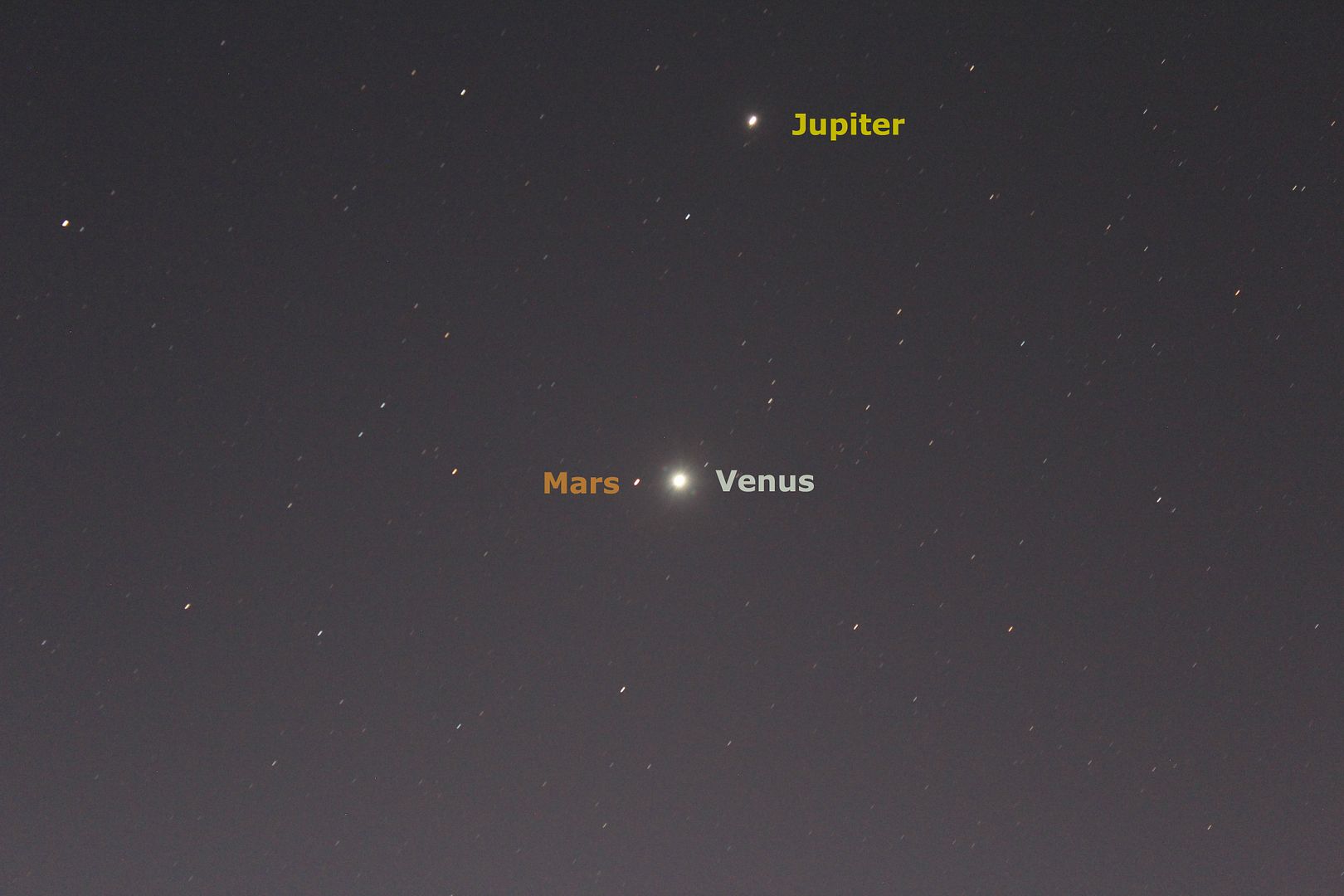
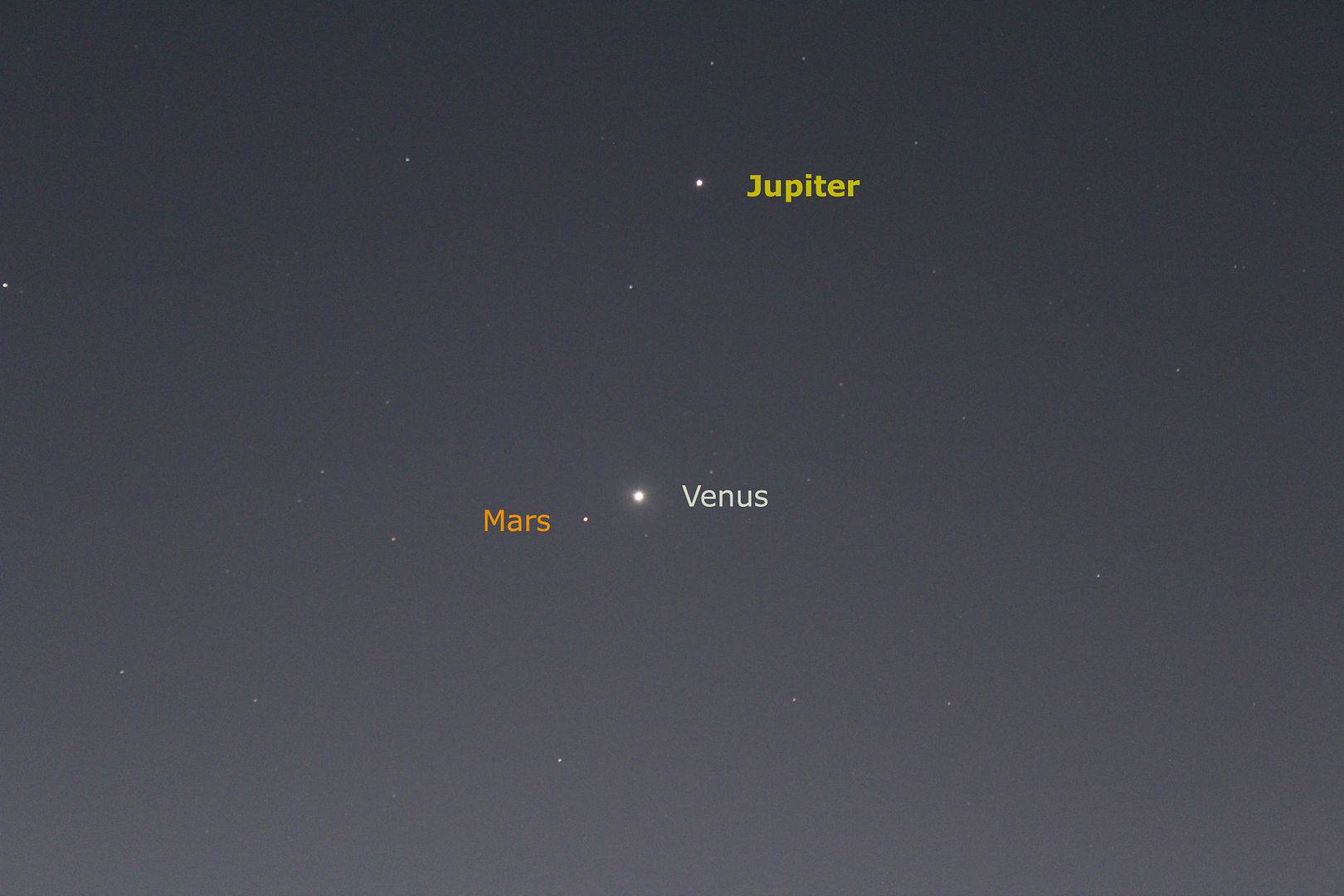
The planetary show continues in the predawn sky. This morning the Moon joined the conjunction of Venus, Mars and Jupiter. Here's how the crescent Moon looked alongside of Jupiter:
A wider view takes in the whole show:
Look for the Moon to be nearer to Venus tomorrow (Saturday) morning - a sight that's worth getting up early to see.

Monday, November 2, 2015

Mars & Venus: Side By Side

The pre-dawn planetary conjunction continues and Mars and Venus are now right next to each other in the sky:
It will be a great show for the rest of the week. Get out there and take a look.

Saturday, October 31, 2015

Planets, Unite!

I've been waaaaaaaay too busy to see much of the recent conjunction of Venus, Jupiter & Mars, but I was able to catch them this morning from my new home.
Not a bad sight at all. If you haven't been up early to take in the sight, be sure to do so. A crescent moon will join them the mornings of November 6th & 7th - a sight not to be missed!

Saturday, July 18, 2015

More from Pluto & Last Night's Moon and Planets

The early returns from the New Horizons flyby of Pluto have been amazing.
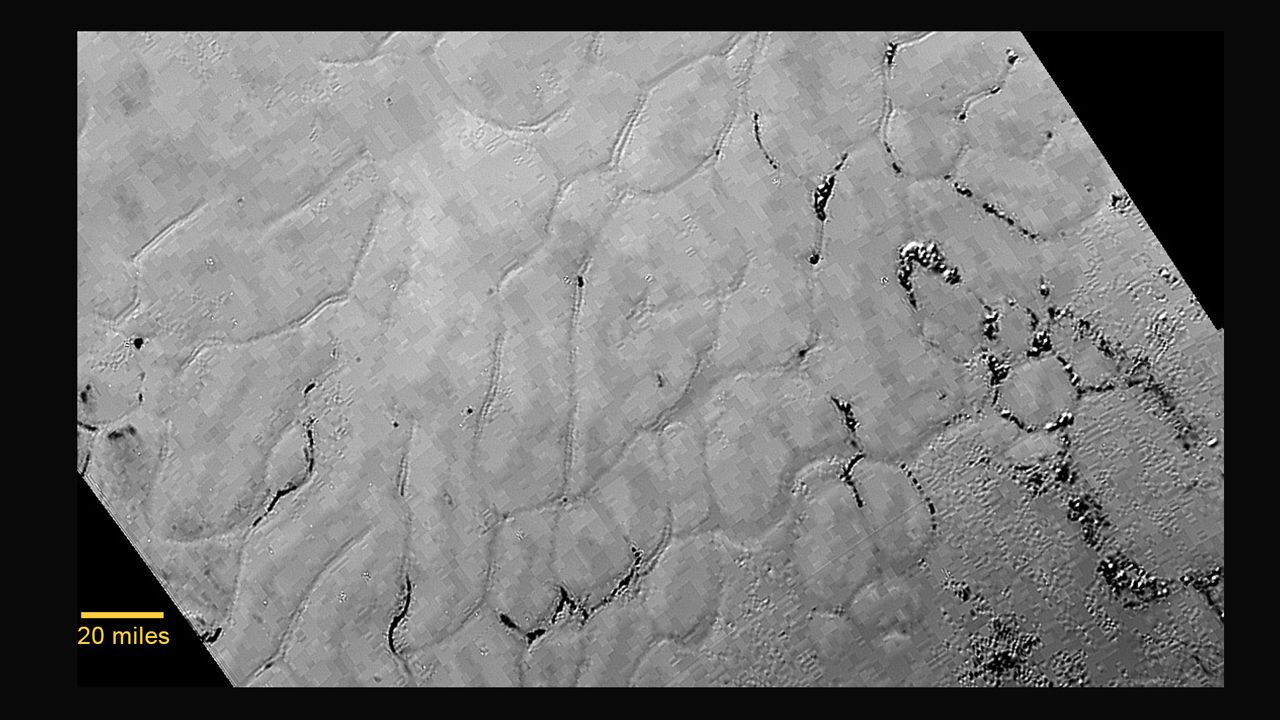
Only a tiny percentage of the data has been returned so far (it will be many months before it's all in), but Pluto is being revealed to be a remarkable world. The images so far indicate a nearly total lack of impact craters, suggesting that Pluto is an active world. There currently is much speculation as to what forms that activity takes (geysers, ice volcanoes, other things), but there's no consensus of any kind yet.

More images are expected to be released on July 24th, so stay tuned for them.

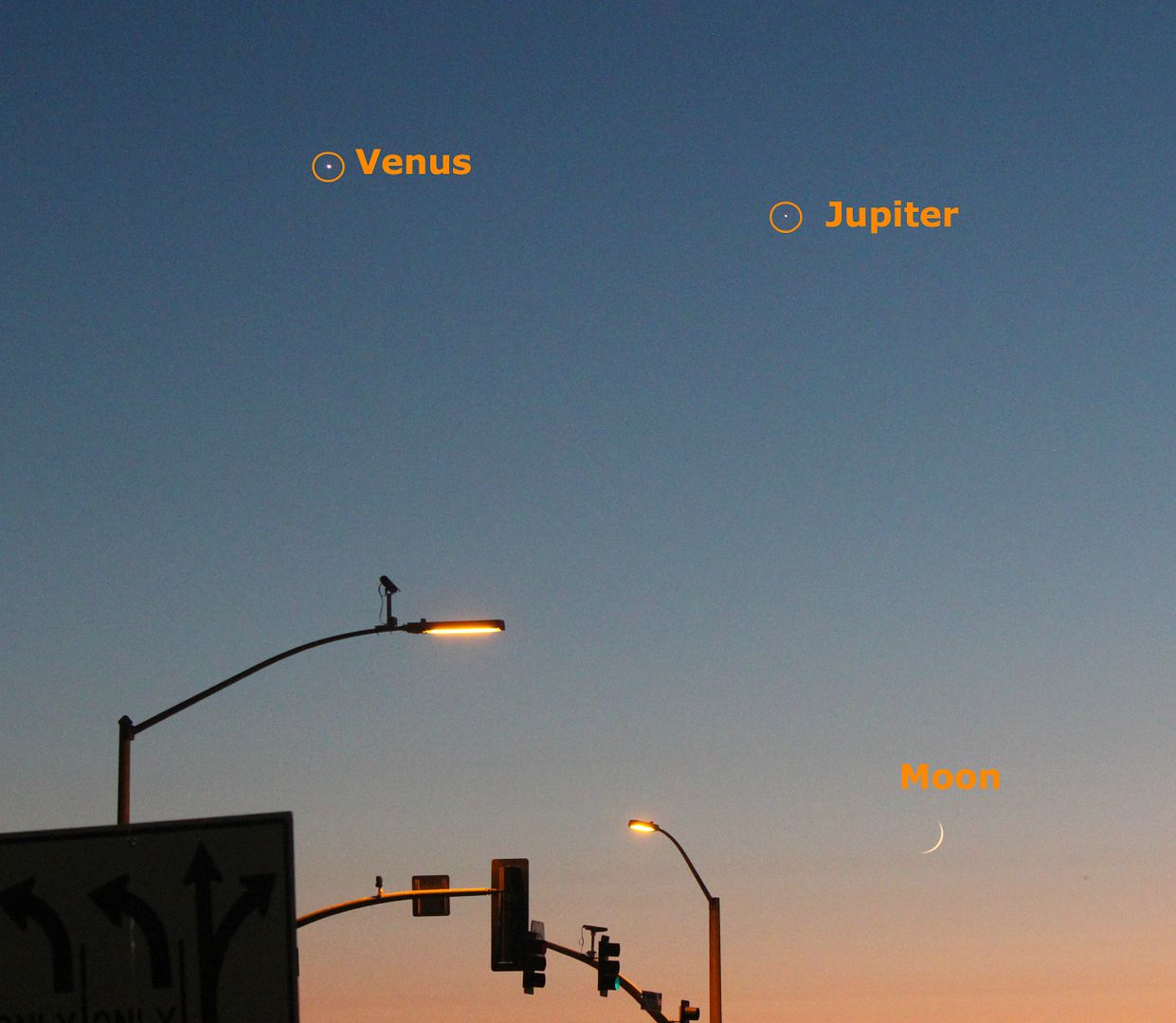
There's a planetary show of another kind still going on out west in the evening skies. Venus and Jupiter are still relatively close together and tonight (Saturday, July 18th) the moon will be especially close to Venus.
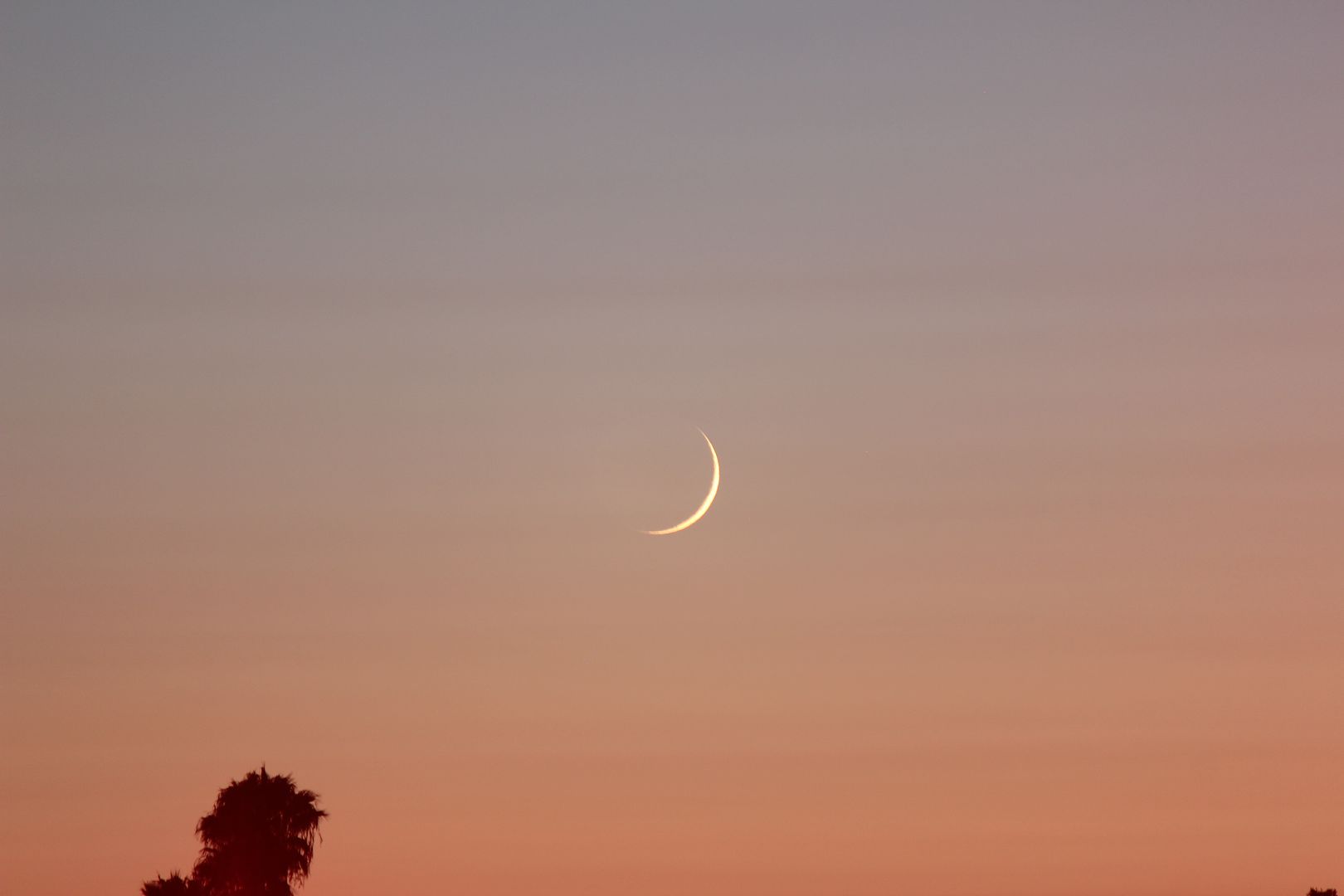
Here's how the scene looked last night, with the thin crescent moon well below Venus and Jupiter. By tonight the moon will have moved close to Venus and should look very nice. If you've got clear skies be sure to go out and look for them tonight as it gets dark.
A closer look at last night's moon.

Tuesday, June 30, 2015

Conjunction!

Jupiter and Venus are at it again.
Tonight is their closest approach in our skies. I returned to the same palm as last night so as to take a comparison shot.
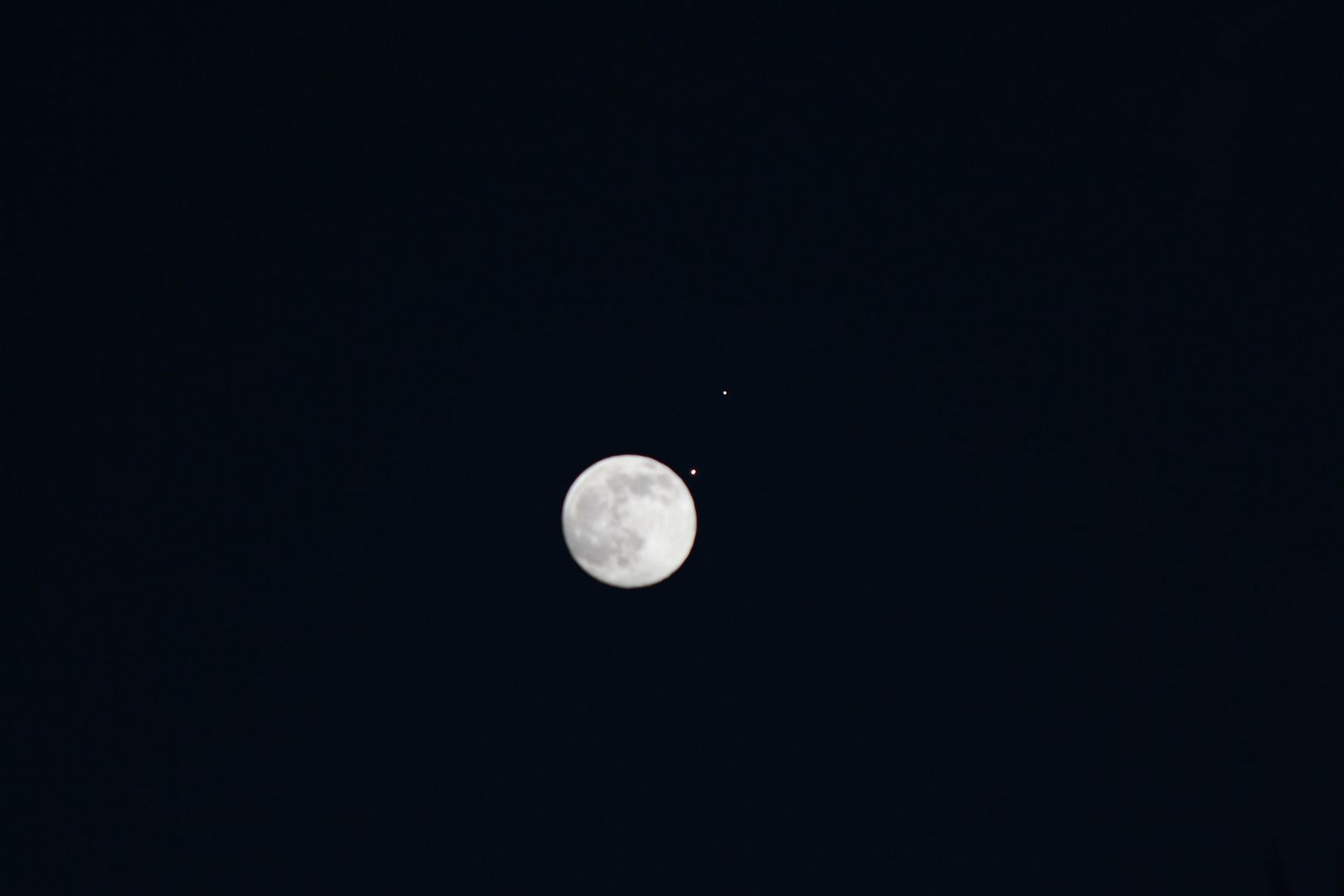
To give you a sense of just how close the two planets are together, I also took photos of moon and the planetary pair fully zoomed and then added the images together. Here's the result:
Because their brightnesses are so different the exposure for the moon was 1/10 that of the shot of Venus and Jupiter.

The planets will still be close for the next few evenings, but they are already pulling apart. Still, if you missed it tonight, it is still worth looking at.

Monday, June 29, 2015

Planets With Palm

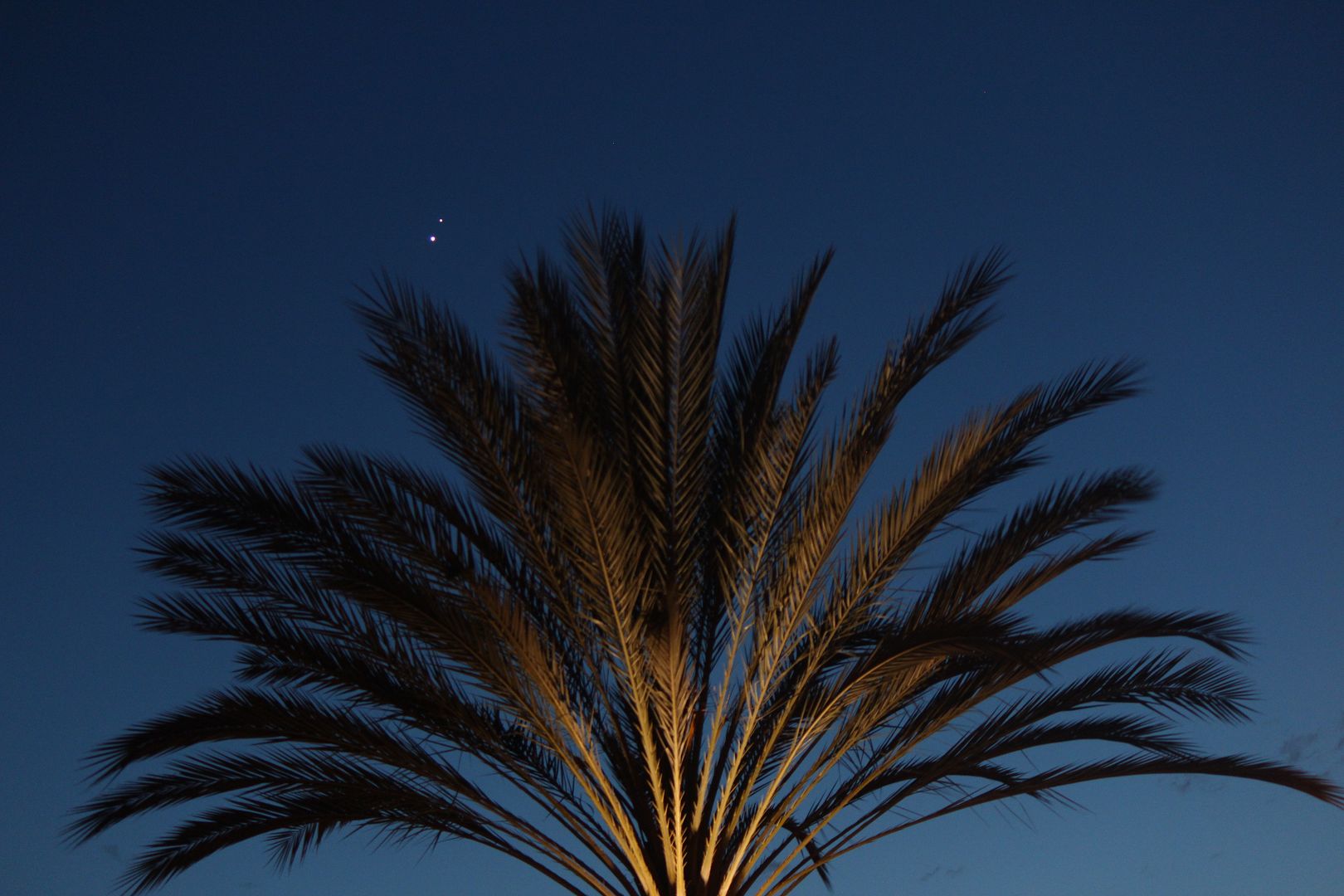
I've been insanely busy of late (more on that likely in a future blog post), but not so busy as to prevent me from enjoying the conjunction of Jupiter and Venus. Here they are as seen tonight, poised above a palm tree located in San Marcos, California (my new home). Venus is the brighter of the two.

The planets will be even closer tomorrow evening (June 30). It is a special sight to see the two brightest planets so close together. Go out and take a look.

Sunday, June 8, 2014

Star Trek: The Doomsday Machine

I'm back with another look at an episode of the original Star Trek TV series.  Today it's one of my favorites:
As the story begins, there's a shocking revelation -
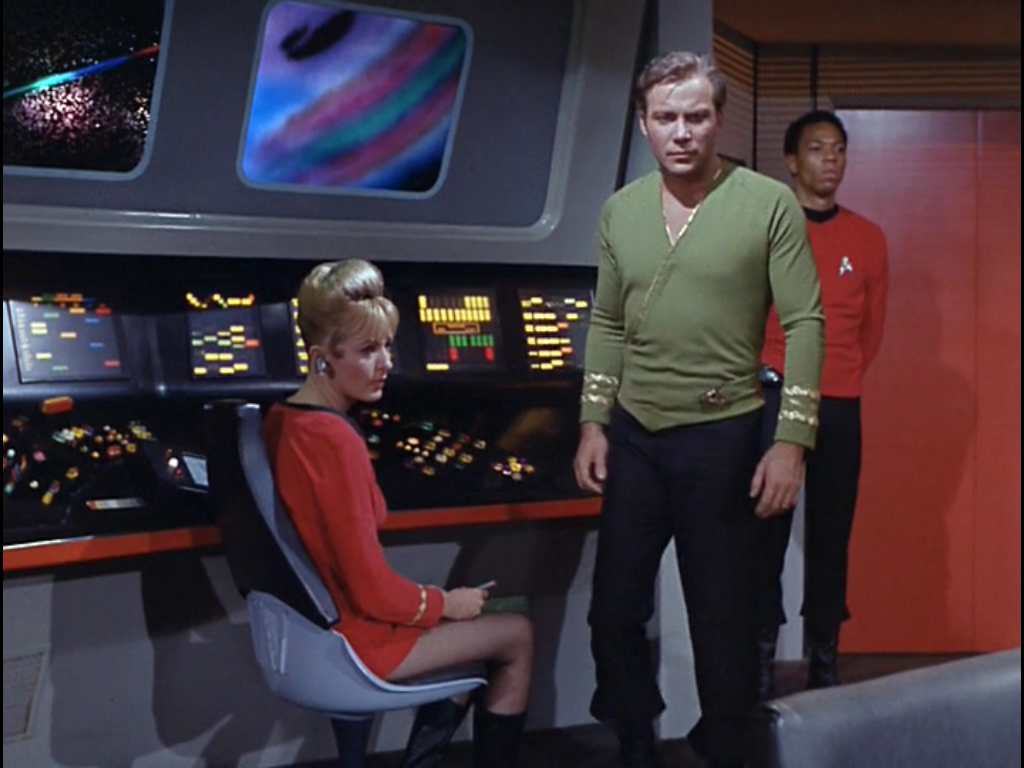
Someone other than Uhrua is staffing the communications station. What's up with that? I thought Uhura worked 24/7 like most of the rest of the bridge crew. It's too bad she wasn't here, as the communications officer got a lot of lines in this episode.

Still, there's a cool looking graphic above Lt. Palmer. It kind of reminds me of a zoomed in false-color image of Jupiter. Maybe something like this shot of Jupiter from the Gemini Observatory (of course taken years later):
The story begins with the Enterprise receiving a distress call and following a path of destroyed solar systems. As they enter System L-374 they find their sister starship, the Constellation (NCC-1017). It's been badly damaged, but parts of it remain habitable.

Kirk leaves Spock in command and beams over with Dr. McCoy, Scotty, and an engineering team. The ship's bridge is destroyed, so they make their way to Auxiliary Control to play back the captain's log.
There they find Commodore Matt Decker who has recently made The Worst Command Decision Ever. I mean seriously, it was the worst command decision ever made. He brings in his starship to investigate some destroyed solar systems, only to find a thing that's chopping up the 4th planet in the system. It attacks the Constellation, leaving it dead in space. So what does Decker do? He has his entire crew beamed down to the 3rd planet, only to have destroyed by the planet killer while he watches helplessly from space. Dude, no.

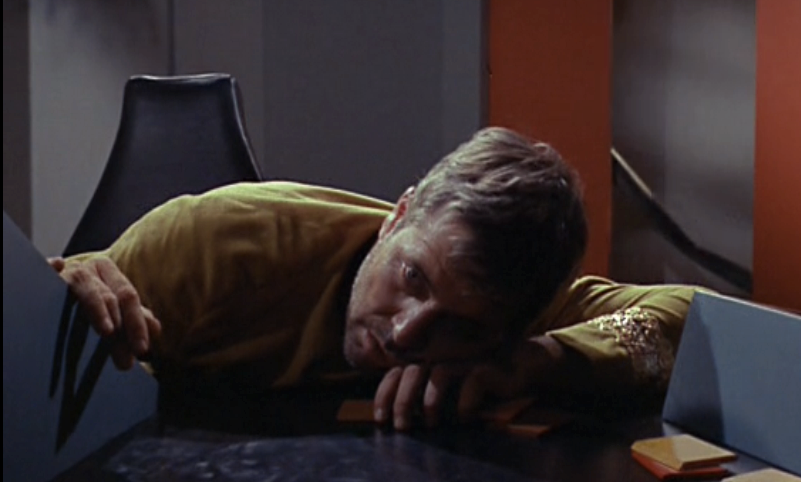
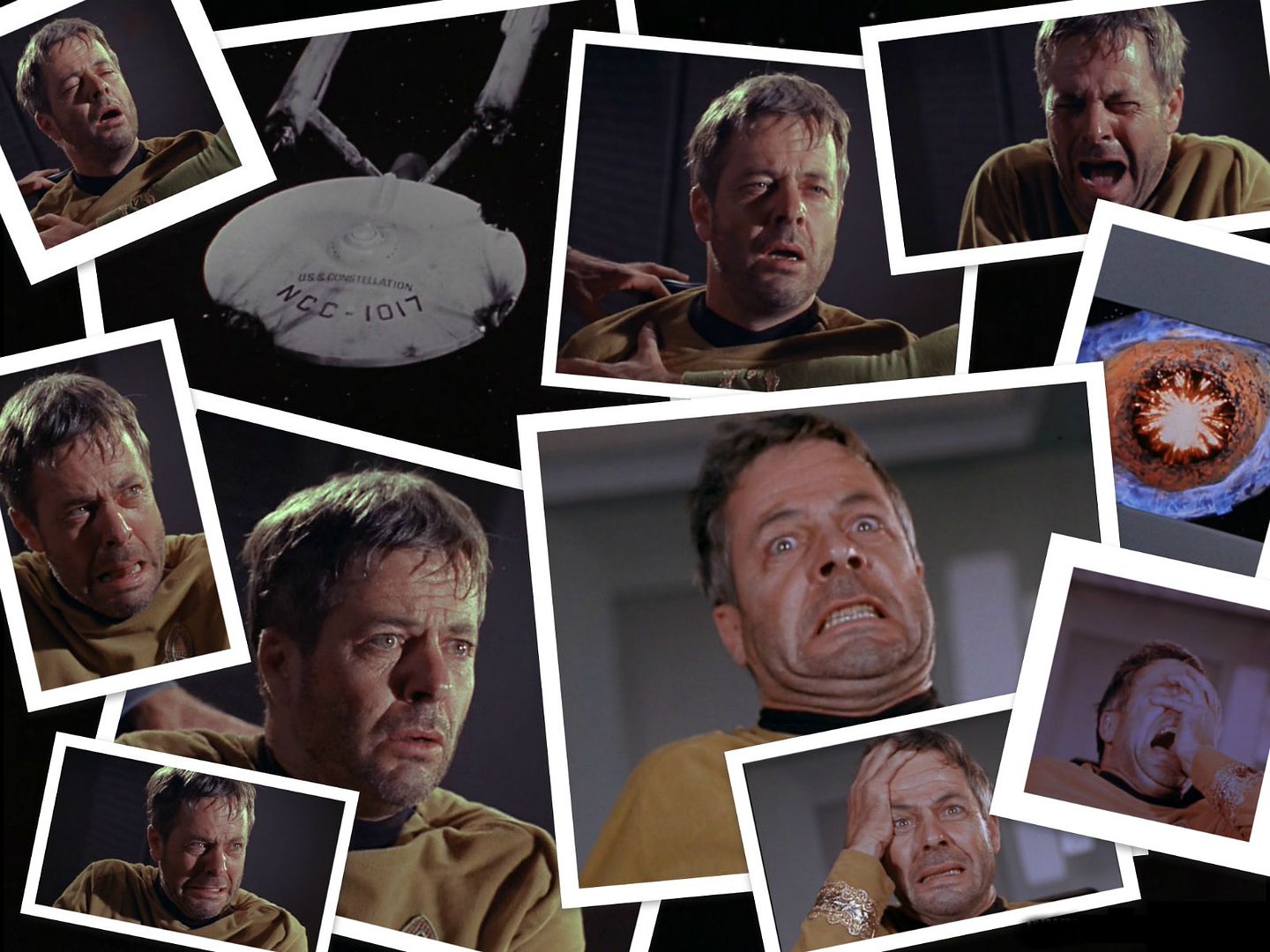
Decker was wonderfully played by William Windom. He gave this character a wide-range of mostly distressed facial expressions. Enough for me to create this Commodore Decker Polaroid synopsis of the episode:
There you have it. William Windom's Decker facial expressions provided better visuals than the actual Doomsday Machine did. Wouldn't you agree?
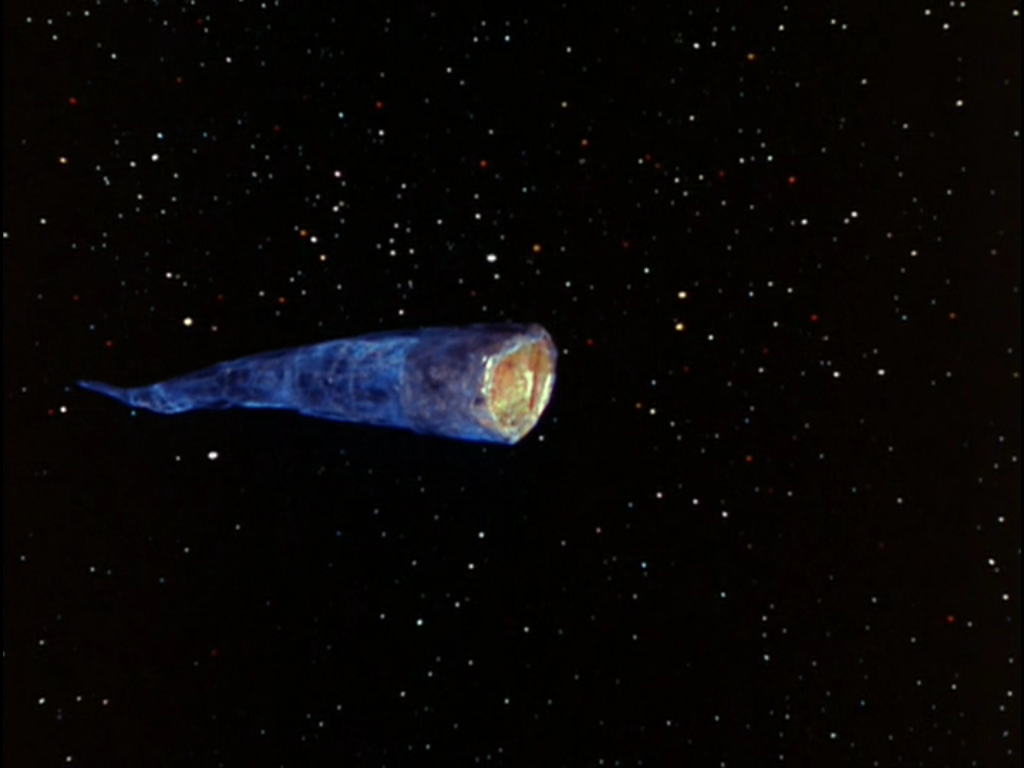
Apparently the "special effects" team created it with a windsock coated in cement. I never minded the look of it too much, but seeing stars pass through it was always a problem for me.

The Doomsday Machine does bear some resemblance to real objects in space. Here's a nebula surrounding a protostar imaged by the Hubble Space Telescope that at least sort of has the same shape:
The cloud is just over a light year in length and is being eroded away by the radiation of hot, massive stars nearby. Follow the link to read about it.

Decker & McCoy beam back to the Enterprise to find that the planet killer has returned. Decker wants it destroyed and isn't too pleased with Spock when he points out, "You tried to destroy it once before, Commodore. The result was a wrecked ship and a dead crew." When Spock refuses to take action, Commodore Decker seizes command of the Enterprise.
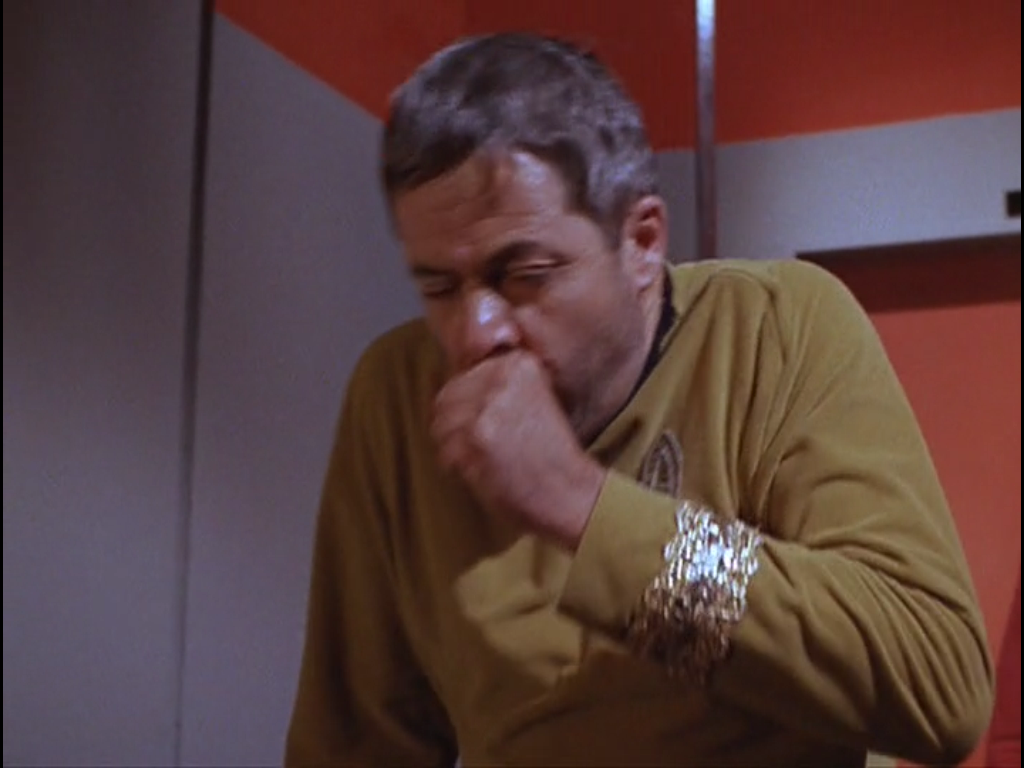
Commodore Decker with Pretzel Insignia
Things go from good to bad when Kirk, who had been out of contact, discovers that Decker's actions have been threatening the Enterprise. Protecting his ship is kind of important to Kirk. He orders Spock to take back command.
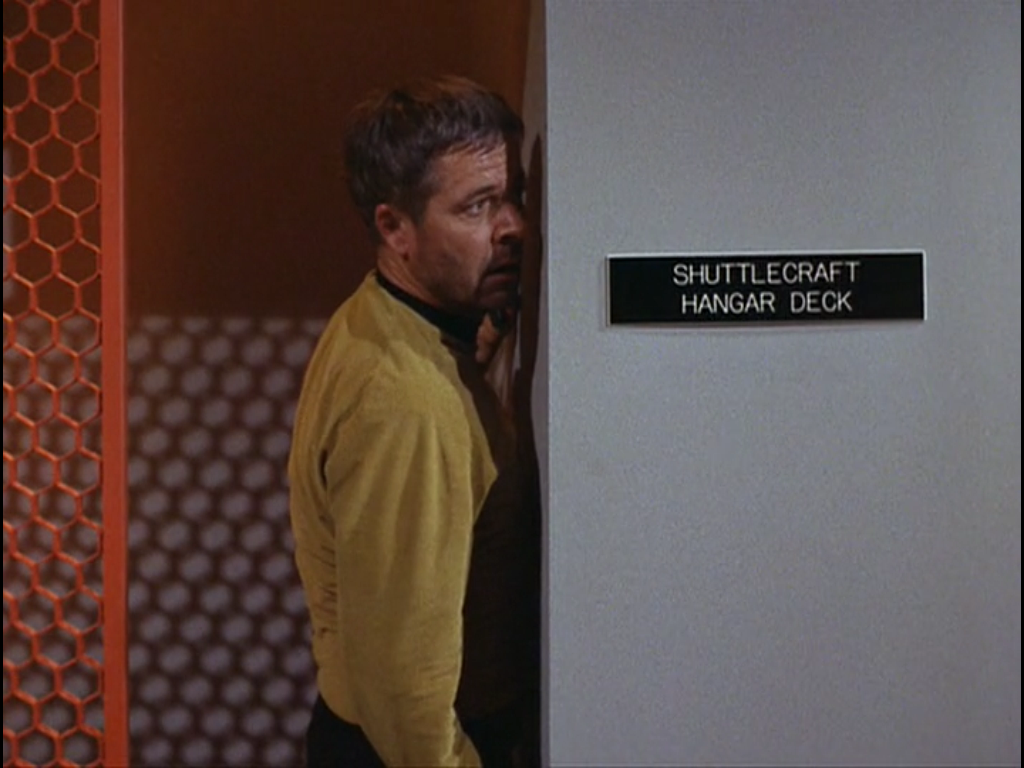
Spock has a security guard escort Decker to Sickbay, when Decker uses the ol' Coughing Commodore Trick to surprise and overpower the guard. He then sneaks off to steal a shuttlecraft, because as a starship captain, he knows those things are never guarded.
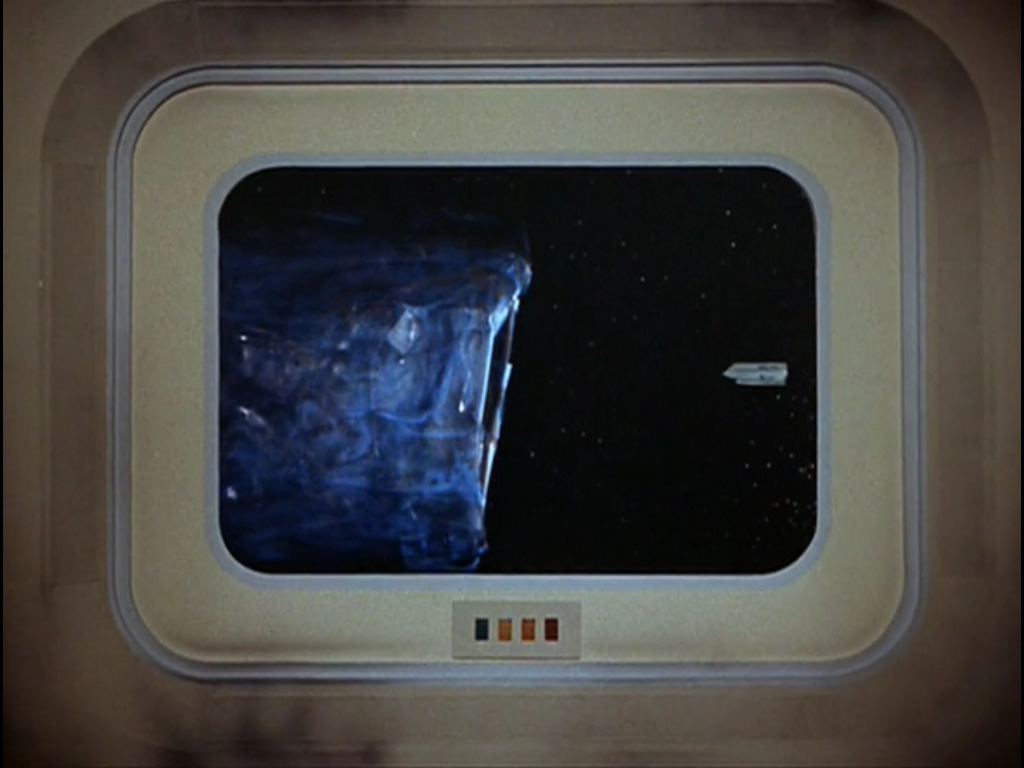
Decker was hoping that eating a shuttlecraft might kill the planet killer, it doesn't work, but it does give Kirk the idea that eventually does the trick--overloading the Constellation's impulse engines so that they blow up right as it swallows the shuttlecraft.
At the end, Kirk points out that they used something like an old 20th Century doomsday device, the H-bomb, to destroy the planet killer making it a thinly veiled, but nicely done, commentary on very real issues facing the world of the 1960s.

One thing that really adds to the episode was the musical score provided by composer Sol Kaplan. Tragically Kaplan only scored two episodes for Trek, the other being The Enemy Within, but he really nailed both of them. His score for Doomsday Machine is pretty nearly perfect for the episode, with musical themes for the planet killer, the Constellation and more -- a kind of development not heard in Star Trek. For more on it you'll want to watch this great video that discusses the score.

Don't forget, as I often say in these posts, the whole thing is available in the complete release of Star Trek TOS music available from La-La Land Records. There's nearly 32 minutes of music from this episode. I think I'll listen to it again now.

If you haven't seen The Doomsday Machine in a while, go track it down. It's not up at the official Star Trek website right now. I'm not sure why as it has been there in the past.

Next up for me is Wolf in the Fold.