It is time for me to start posting more often on this blog and expand its content a bit. Two of my interests beyond astronomy are reading/watching science fiction and listening to movie soundtracks.
My interest in music started somewhere around the time that Flandrau Planetarium
opened to the public in 1975. They used to give out a list of what
music was used in their shows and I started tracking down the various
pieces of classical music that had been incorporated into the shows. By 1977 the soundtrack to Star Wars by John Williams came on the scene and for me there was no turning back.
Early influences in getting me into science fiction were the Apollo Moon landings; my 5th grade teacher, who read aloud Robert Heinlein's Red Planet and Have Spacesuit--Will Travel; and the original Star Trek TV series. I have been watching Star Trek for so long, that I have no memory of seeing any of the 79 episodes for the first time. They have just always been there.
Given my interest in movie soundtracks, I guess it should be of no surprise that I had to order this massive 15-cd box set of music from the original Star Trek released by La-La Land Records that just came out. The limited edition set contains all of the music recorded for the series - some of it was never even used.
The set arrived here at Visible Suns earlier this week and I thought that it might be fun to work my way through both re-watching the episodes and listening to the music while posting reviews of each here on the blog.
I will still be posting cool things about astronomy, the war on light pollution and the like, but I hope that this expansion will be enjoyable for those that visit the blog.
Look for a review of the first pilot for Star Trek, The Cage, to appear sometime this weekend.
Friday, December 14, 2012
Thursday, December 13, 2012
Weather domes
I had the chance to go to Kitt Peak National Observatory today to prepare to install a night sky brightness meter. While on the roof of one of the buildings there I took this shot of the dome of the 84-inch (2.1 meter) telescope:
The view reminded me of one of my favorite old Palomar pics:
I know, my shot doesn't really compare to the vintage one, but that's the best you'll get out of me today.
The view reminded me of one of my favorite old Palomar pics:
I know, my shot doesn't really compare to the vintage one, but that's the best you'll get out of me today.
Sunday, December 9, 2012
The Black Marble and GLOBE at Night
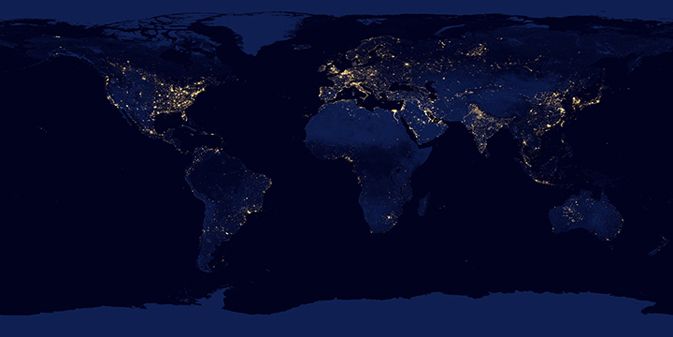
Did you happen to catch the "Black Marble" images that were released last week?
The images came from the Suomi National Polar-orbiting Partnership satellite and they represent our most detailed look at Earth at night. Chances are you'll be able to spot your home town in these new images wherever it happens to be.
Here's a look at the whole globe:
And here is much of North America:
Most of this represents poorly directed, upward pointing light. It is essentially wasted energy.
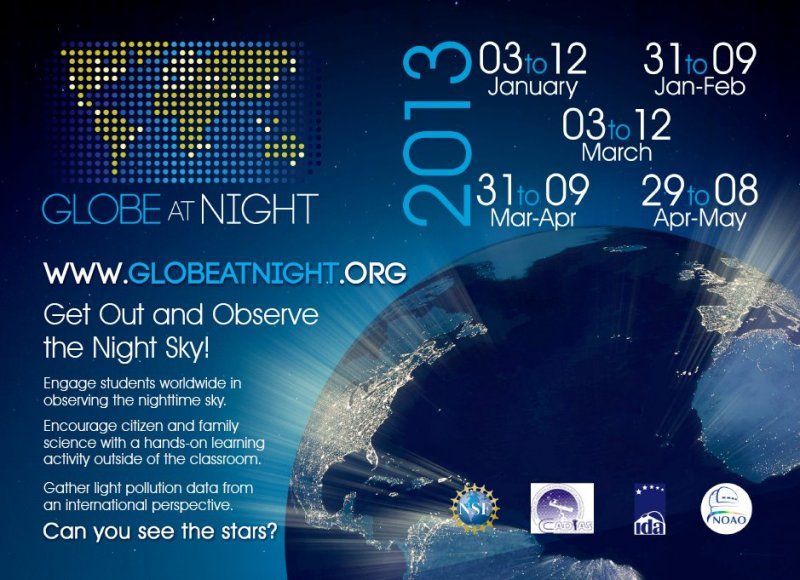
These images do not document sky glow - that brightening of the night sky that keeps most of us from seeing faint stars and other sky phenomena. The best way to study sky glow is to measure it from down here on the ground. Thankfully it is easy to measure and document sky glow. A great and easy way for anyone to do so is to participate in the GLOBE at Night program. Be sure to check out their website to see how to get involved. Their first 2013 campaign begins on January 3rd!
Night sky brightness measurements from GLOBE at Night and other programs are an essential tool in documenting light pollution and I urge you to get out there and make some measurements.
The Black Marble - not so black, is it?
Wednesday, December 5, 2012
Bill Nye Speaks Out Against Light Pollution
In September 2011 along with the IDA executive director I had the chance to meet Bill Nye over at the Planetary Society offices.
It should be no surprise that the night sky has been a source of inspiration for their members. A beautiful, inspiring sky can help make you want to explore the universe. We talked about how the two organizations might work together and it led to my article that was the cover story for last summer's issue of The Planetary Report.
Another eventual result of that meeting what that Bill Nye recorded a short statement on light pollution. Check it out:
It is great to have one of the more famous, dare I say, Science Guys on the planet speak out about this issue.
Of course, before there was Bill Nye there was Carl Sagan (one of the co-founders of the Planetary Society). Sagan had a passage on light pollution in his book Pale Blue Dot. It was moving enough that I used the quote to begin my article and I present it now here:
Well said, don't you agree?
It should be no surprise that the night sky has been a source of inspiration for their members. A beautiful, inspiring sky can help make you want to explore the universe. We talked about how the two organizations might work together and it led to my article that was the cover story for last summer's issue of The Planetary Report.
Another eventual result of that meeting what that Bill Nye recorded a short statement on light pollution. Check it out:
It is great to have one of the more famous, dare I say, Science Guys on the planet speak out about this issue.
Of course, before there was Bill Nye there was Carl Sagan (one of the co-founders of the Planetary Society). Sagan had a passage on light pollution in his book Pale Blue Dot. It was moving enough that I used the quote to begin my article and I present it now here:
Before we invented civilization, our ancestors lived mainly in the open, out under the sky. Before we devised artificial lights and atmospheric pollution and modern forms of nocturnal entertainment, we watched the stars. There were practical calendrical reasons, of course, but there was more to it than that. Even today, the most jaded city dweller can be unexpectedly moved upon encountering a clear night sky studded with thousands of twinkling stars. When it happens to me after all these years, it still takes my breath away.
Well said, don't you agree?
Sunday, December 2, 2012
Dark Sky & Lighitng Videos
If you are looking for a series of short but informative videos on lighting and light pollution, you should follow The Dark Ranger on YouTube. They are the work of Kevin Poe, a ranger in Bryce Canyon National Park.
I have embedded two of his videos below. At the recent annual general meeting of the International Dark-Sky Association, he was presented with a Dark Sky Defender award. In the first video he talks about getting the award and the lighting of a city I know quite well:
Now check out Urgings for a Globe Free Globe:
Coming up in the next post, another video on light pollution from a world-renowned science expert.
I have embedded two of his videos below. At the recent annual general meeting of the International Dark-Sky Association, he was presented with a Dark Sky Defender award. In the first video he talks about getting the award and the lighting of a city I know quite well:
Now check out Urgings for a Globe Free Globe:
Saturday, December 1, 2012
It is another commercial! Okay, most of us have too many commercials in our lives, but I am sharing this one for Bing (I don't even use Bing) because it servers as another reminder that the night sky is an important part of our lives that we are starting to loose. Like in the commercial in the Billy post below, it shows that this message is starting to become a part of mainstream media.
I have a couple of other videos to share over the next few days, so if anyone is reading Visible Suns check back again soon.
Tuesday, November 27, 2012
India from Space at Night
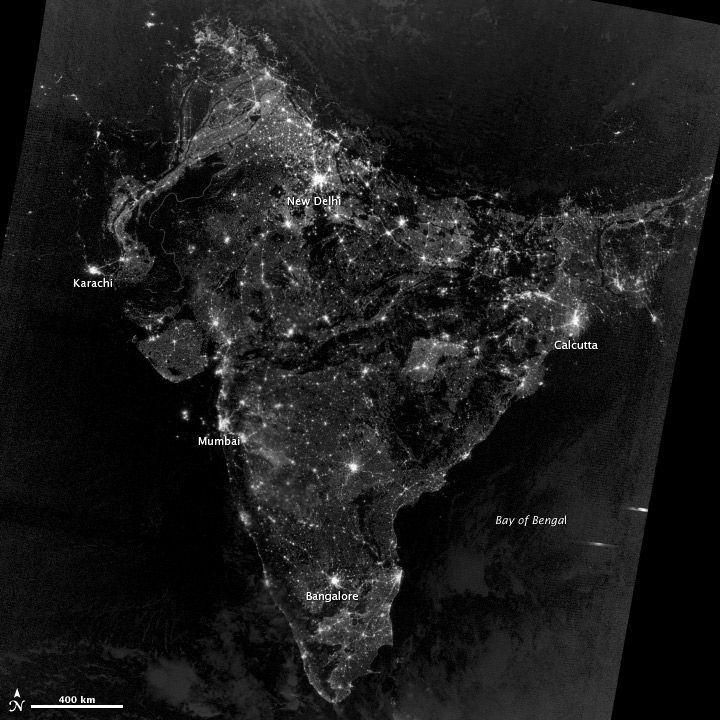
In case you missed it, here is an amazing image of India from space at night.
The image, taken November 12 2012, was published on the NASA Earth Observatory site. The image shows the density of population there. The lights of more than 1.2 billion people are represented here. India has 30 cities with populations over 1 million - imagine how much energy could be conserved if the lights were retrofitted so as to not shine wastefully upward into space.
By the way cities in Bangladesh, Nepal, and Pakistan are also visible near the edges of the image.
There are several high-resolution download options on the NASA site that are worth checking out, including a Google Earth KML file.
Subscribe to:
Posts (Atom)