Showing posts with label Apollo. Show all posts

Sunday, September 25, 2016

Flying Around the Moon

I'm teaching a course this fall on the geology of our solar system. It's my first time teaching it so I've been spending a lot of time looking at imagery of the planets and their moons. We live in an amazing age where there are spacecraft that are currently investigating Saturn, Jupiter, Mars, a comet (until later this week, that is), an asteroid, and our Moon. In addition to all the missions that are happening now, there's a tremendous legacy of imagery from older spacecraft, including fabulous images from the Apollo missions to the Moon.

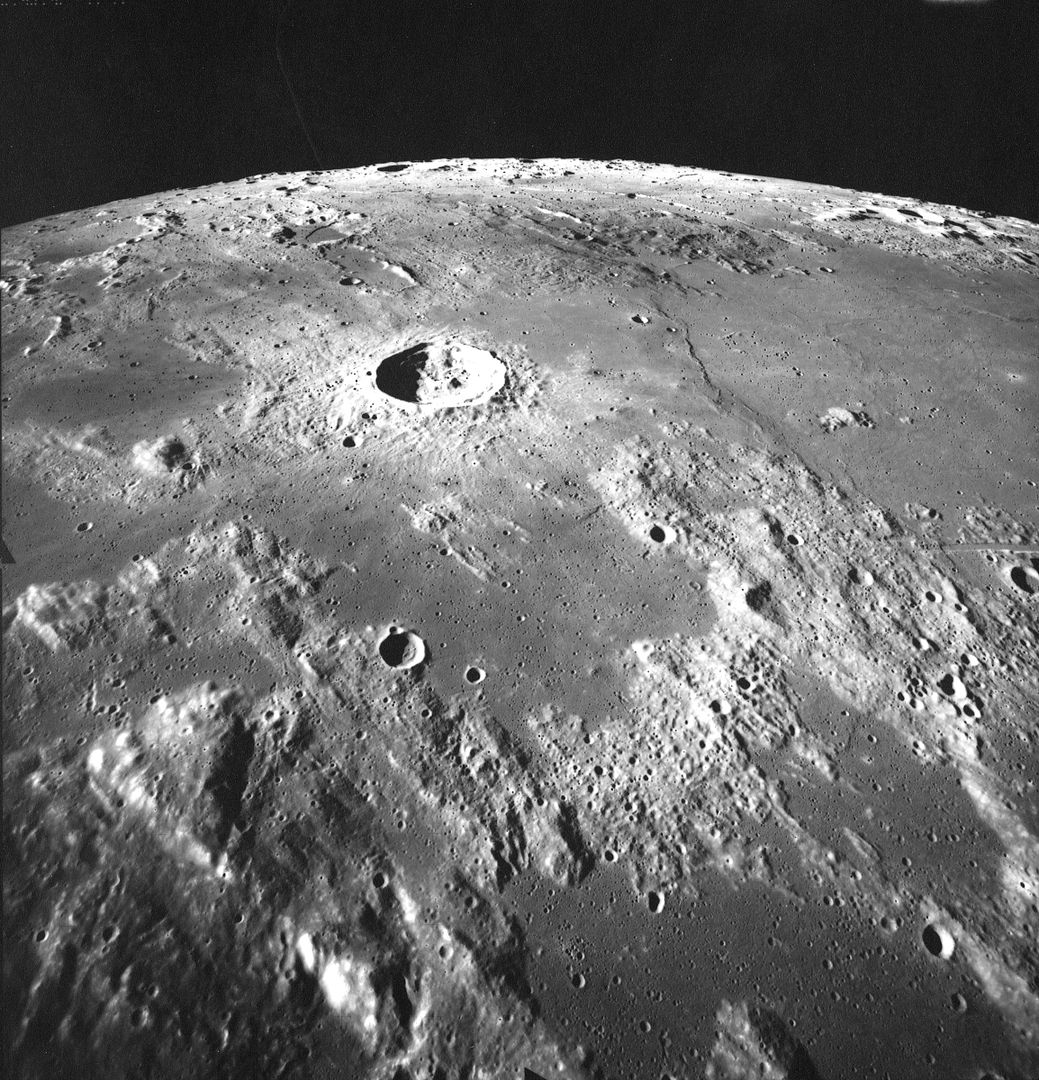
I've just begun to scratch the surface of the thousands of images in the Apollo Image Atlas. This afternoon I was looking at just two orbits of images captured in 1972 by Apollo 17's Mapping (aka Metric) Camera. The camera was located in the Command Service Module's instrument bay and returned images like this one that looked at the Moon's horizon:

This shot was captured during Apollo 17's 36th orbit about the Moon. Thankfully, the website contains maps that show which way the various images are orientated. That's the nearside crater Manilius near the center above and Mare Vaporum (the Sea of Vapors) is the smooth, dark area to its right. Names aside, it is a starkly beautiful view of the Moon.

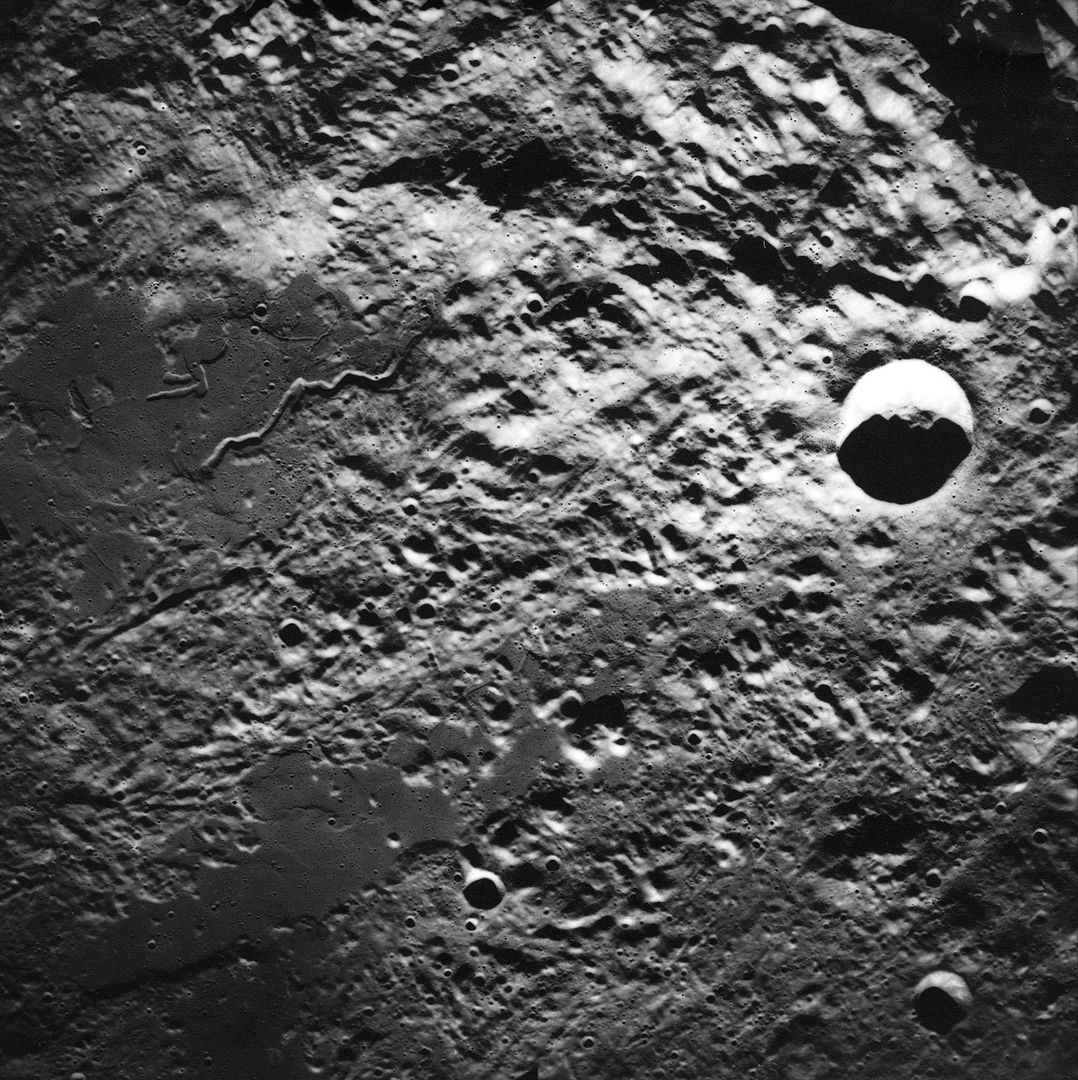
The mapping cameras also took images pointed directly downward. Here's a shot from orbit 38:

This shot contains a curvy rille at left, a prominent crater at right and mountains throughout that are on the edge of the Sea of Serenity. It is an area that's not too far from where the first photo I posted was taken.

I decided to take the images that I downloaded and turn them into two short movies, which I have posted below.

Watching them is not that same as flying to the Moon, but it is an amazing view.

Saturday, February 15, 2014

In The Shadow Of The Moon

I recently finished reading In The Shadow Of The Moon, by Francis French and Colin Burgess.
While it isn't a newly published book (it came out in 2007), it was a really good read and I thought I say something about it here.

The book wonderfully details the exciting times in the U.S. and Soviet space programs from 1965 to 1969. Project Gemini takes center stage early on. It had been quite a while since I had read much of anything about Gemini and I had forgotten how daring the program was. 

Not only was the space program learning how to do all of the tasks (such as spacewalking, rendezvous, and docking) that were needed for missions to the Moon, but NASA was still learning how to be NASA. All of this was happening a breakneck speed. So much so that the lessons of one mission didn't always get transferred to the next.

The book explores this, with many rich behind-the-scenes interviews with the astronauts and other key figures in the program.

As I was reading I found myself going online to look for images from each of the missions. One excellent source, for especially images from Project Gemini, is March to the Moon. I've posted a few of my favorite Gemini mission photos below. The captions are links to where you can download full resolution versions of the images. In some cases I've rotated or cropped the images.
Ed White makes the first U.S. spacewalk on Gemini IV
Gemini VII photographed from Gemini VI during the historic first space rendezvous
Gemini X's Agena Target Vehicle
Gemini XII's Agena Target Vehicle
Of course Gemini was followed by Apollo. The books coverage of the Apollo 1 tragedy, and losses felt in the Soviet space program, was heart wrenching. In reading I had to occasionally put the book down for a while as, even though I knew a lot about the Apollo 1 fire, it was emotional.

From there, the authors take the readers all the way to the first Moon landing, the triumph of Apollo 11. The missions of Apollos 7, 9, and 10 are often glossed over by many but they were key test flights of the hardware that made the Moon landings possible. The coverage of these missions and the men who flew them was inspirational.

I didn't find any particularly good galleries of Apollo mission imagery--even the ones by NASA itself were pretty poor--so I wont share any Apollo images here.

I highly recommend In The Shadow Of The Moon for anyone interested in the history of the space program.

Sunday, January 27, 2013

Remembering Apollo One

Forty six years ago today the crew of Apollo One died in a tragic accident.
Apollo One's Gus Grissom, Ed White and Roger Chaffee
At the time I was just four years old. I was not aware of their sacrifice.

Almost two and a half years later I was still not aware of Apollo One, but I was glued to the TV set as Armstrong, Aldrin and Collins headed off to the Moon in Apollo Eleven. I can still remember watching that first landing and the moonwalk that followed.

As the Moon landings continued my interest grew and I began to read all that I could about the Apollo program. Some years later, when I discovered used book stores, I found this treasure:

Inside the book was a news clipping of an editorial cartoon placed there by the book's previous owner. The cartoon, which I still keep within the book above, shows a depiction of Armstrong lifting the flag into place on the Moon. It is reminiscent of the famous photo of the flag raising over Iwo Jima in World War II. Only here, it is the crew of Apollo One helping Armstrong lift the flag.


They didn't make it to the Moon, but through their efforts and sacrifice we all did. Grissom, White and Chaffee helped to make it all possible.