Showing posts with label Milky Way. Show all posts

Saturday, September 11, 2021

In And Out The Window

Here's a photo I took recently of the Milky Way with the constellations of Sagittarius and Scorpius over the rocks of Joshua Tree National Park:

It was taken with my iPhone using a new, free app for iOS called Nocturne. 

Above those majestic rocks you can see the light of countless stars and the dark silhouettes of cosmic dust clouds. The exact center of the Milky Way is in this general direction, but we can't actually see it. There's so much gas and dust there that the center is invisible to everything except telescopes that can see into the infrared and longer wavelengths (such as radio waves). 

Yet there is an area known as Baade's Window that is somewhat clear of dust and gas allowing us to see objects that are almost as distant as the center of our galaxy. This window is roughly centered on a globular star cluster known as NGC 6522, which is one of two globular star clusters that can be seen in the image below:

This image, which was taken with my Unistellar eVscope, shows globular star cluster NGC 6522 (right of center) and a somewhat smaller globular star cluster known as NGC 6528 (on the left). Even though this view is looking through Baade's Window notice that there are some dark nebulae visible here, especially on the left side of the image.

Determining distances is a somewhat inexact science. Current estimates put the center of the Milky Way at around 26,000 light years from us while NGC 6522 is around 25,000 light years away. That puts it somewhat in the same neighborhood as the center of our galaxy.

Of course within the constellation of Sagittarius we can see things that are farther than the center of the Milky Way, but you have to look in a somewhat different direction. The Milky Way's gas and dust blocks our view across much of Sagittarius which is why astronomers interested in other galaxies have referred to the disk and center of our galaxy as the Zone of Avoidance. 

The image below shows something that is not just on the other side the center of our galaxy, it is actually outside of it.

Can you spot it? It is Barnard's Galaxy (NGC 6822), the large fuzzy area near the middle of the image. Barnard's Galaxy is a dwarf irregular galaxy that's located about 1.6 million light years away. Like the globular star cluster it is also in the constellation of Sagittarius, but it is not seen in the same direction as the plane of our galaxy and the Zone of Avoidance.

 Here's the same image as before, but cropped on the galaxy itself. Notice the two blue regions near the top of the galaxy. Those are vast gas clouds of gas (nebulae) within the galaxy. I am still impressed that I can catch them with a 4.5" telescope.

Sagittarius is a big constellation. This view from SkySafari Pro shows the locations of these objects. The globular star cluster is on the edge of the spout in the Teapot of Sagittarius and very much in the heart of the Milky Way. While Barnard's Galaxy (top, left) is well outside the Zone of Avoidance. If it were in a different part of Sagittarius we might not even know that it was there at all.


Sunday, September 14, 2014

Recent Sky Shots

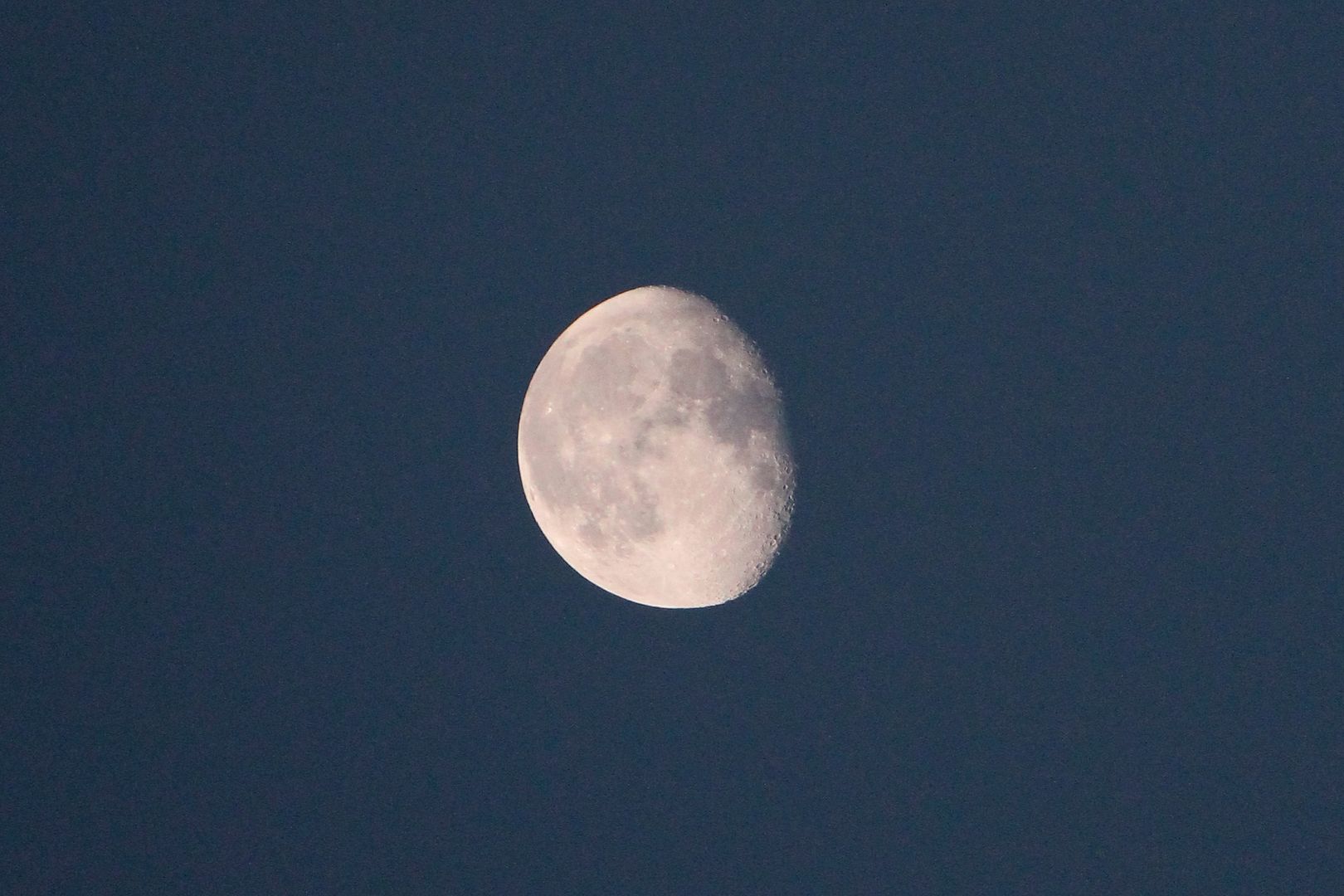
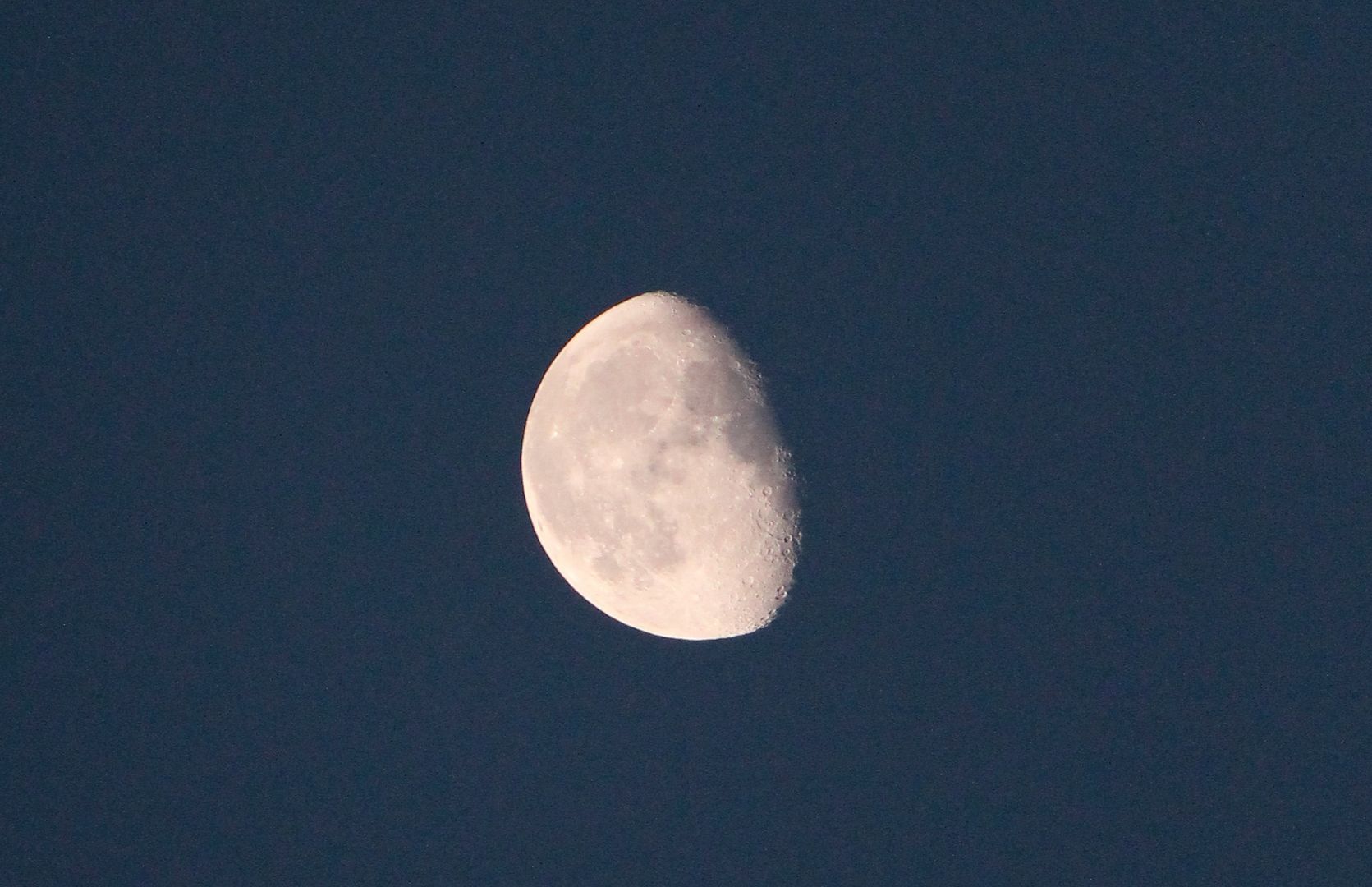
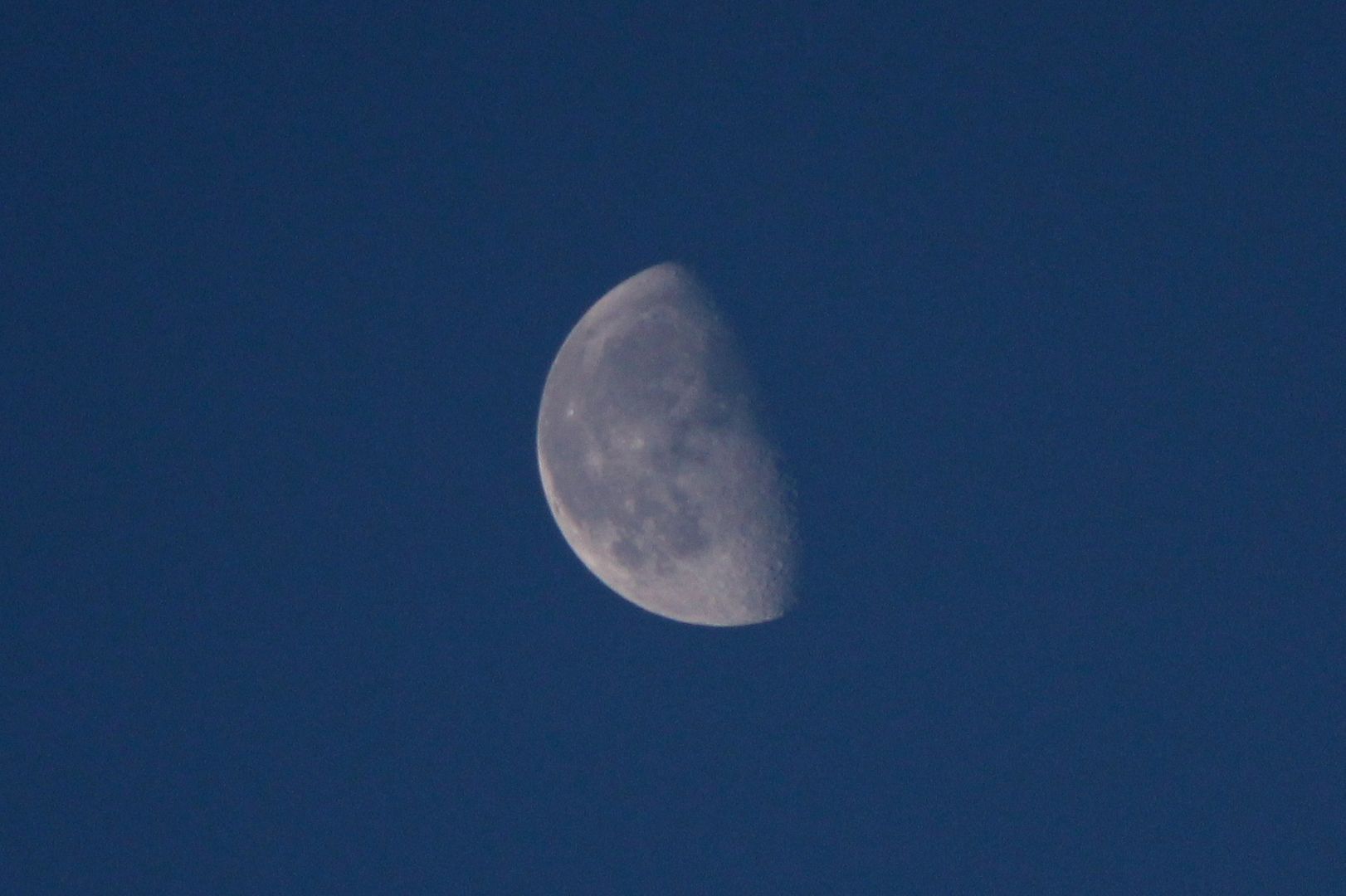
I took some fun shots of lightning Friday night, but that's not been the only thing in the sky to catch my attention lately. I've been photographing the cloud shadows, the Milky Way and for the last several mornings the waning gibbous moon.
Friday September 12
Saturday September 13
Sunday September 14
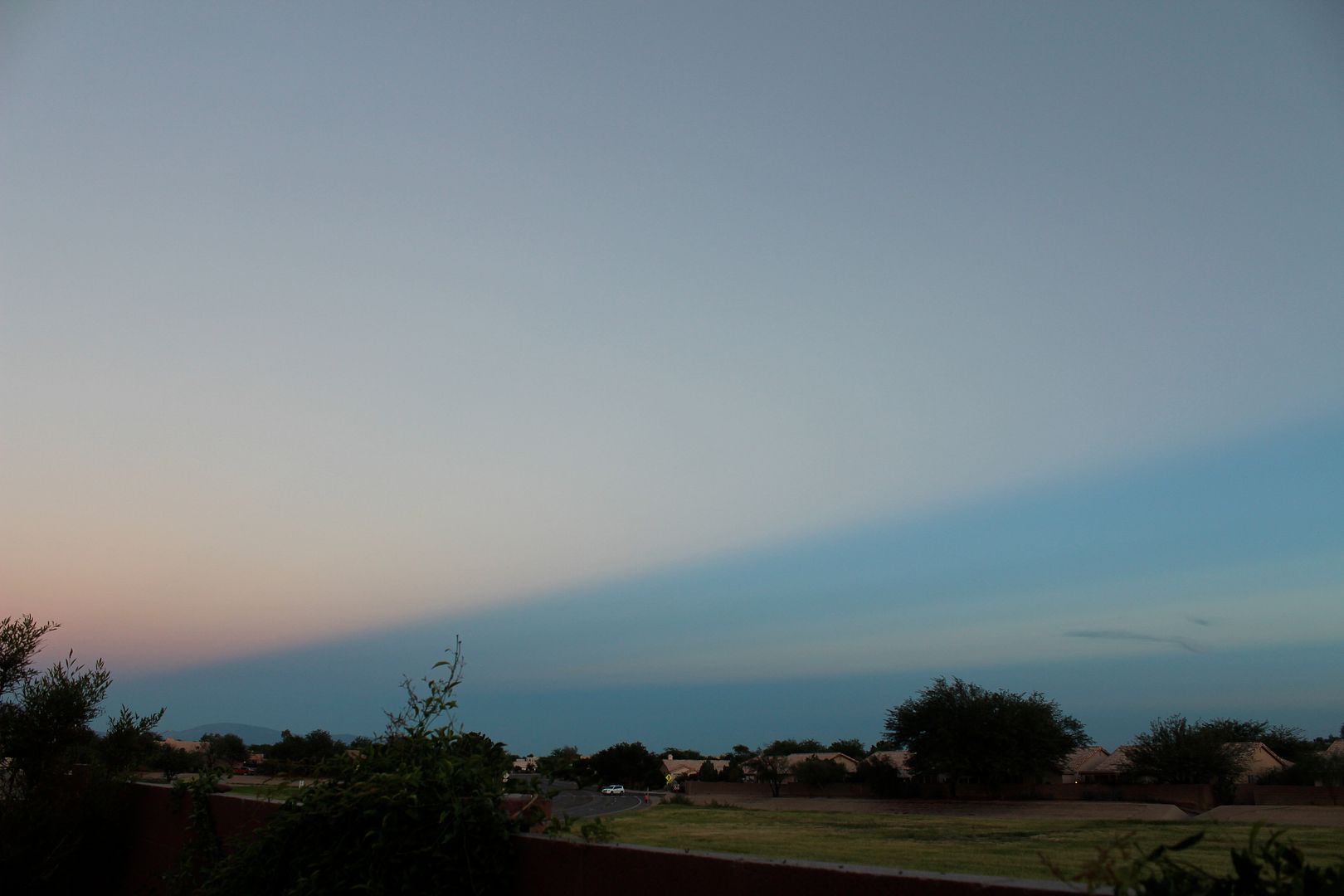
Saturday's sunset was remarkable not for its vivid colors. Instead there was a big thunderstorm near the western horizon. The resulting cloud shadows were cast clear across the sky. Check it out:
That's the view looking east with the darker cloud shadows in the twilight sky.

There's an increasing chance of stormy weather for the next few days, but now that the moon is out of the evening sky, and with the skies clear the Milky Way shines nicely. Not as nice as it was in Hawai'i though. From my vantage point NW of Tucson it is nicely placed in the early evening with the constellation of Sagittarius well away from the light pollution of the city.
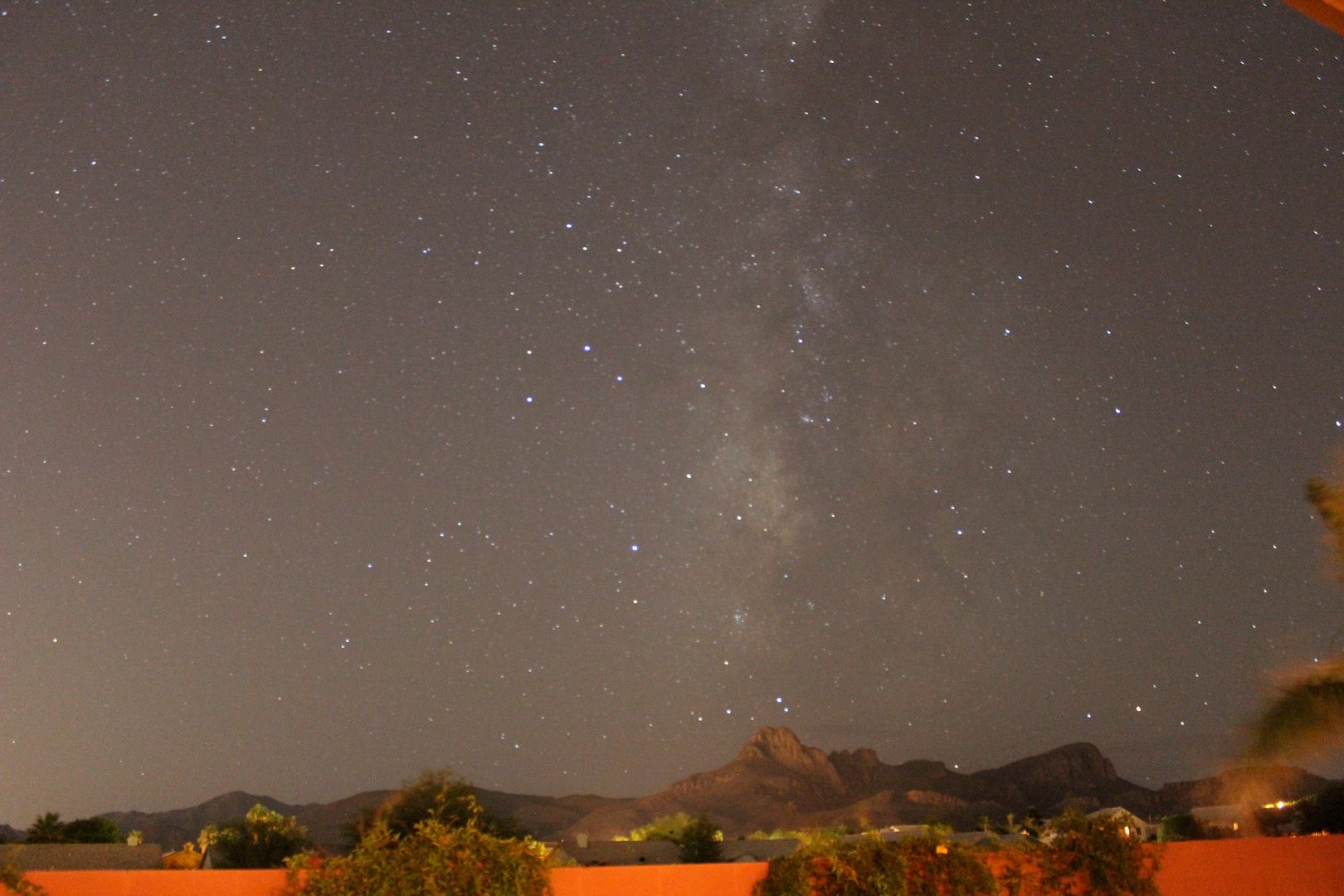
The focus is a bit soft on this one, but here's the view I have from my back yard and the Milky Way extending up over Sombrero Peak. Not too bad. 

Saturday, August 23, 2014

Are Your Clouds at Night Bright or Dark?

My day job is working for the International Dark-Sky Association, where it is our mission to fight light pollution. I didn't need it, but I had a pretty vivid reminder of what we are fighting for on my recent vacation in Hawai'i.

My wife and I rented a place in the Puna District of the Big Island, right on the ocean, where there is very little artificial light. The first night there I hadn't yet adjusted to the time change and woke up hours before sunrise. When I realized that I wasn't going to be able to get back to sleep, I grabbed my binoculars and stepped in the dark to the beach-facing balcony. There the glittering majesty of the night sky was an awesome thing to behold. Ocean waves crashed below but my attention was on the sky. The stars of late fall and early winter filled the sky, all the way down to the horizon.
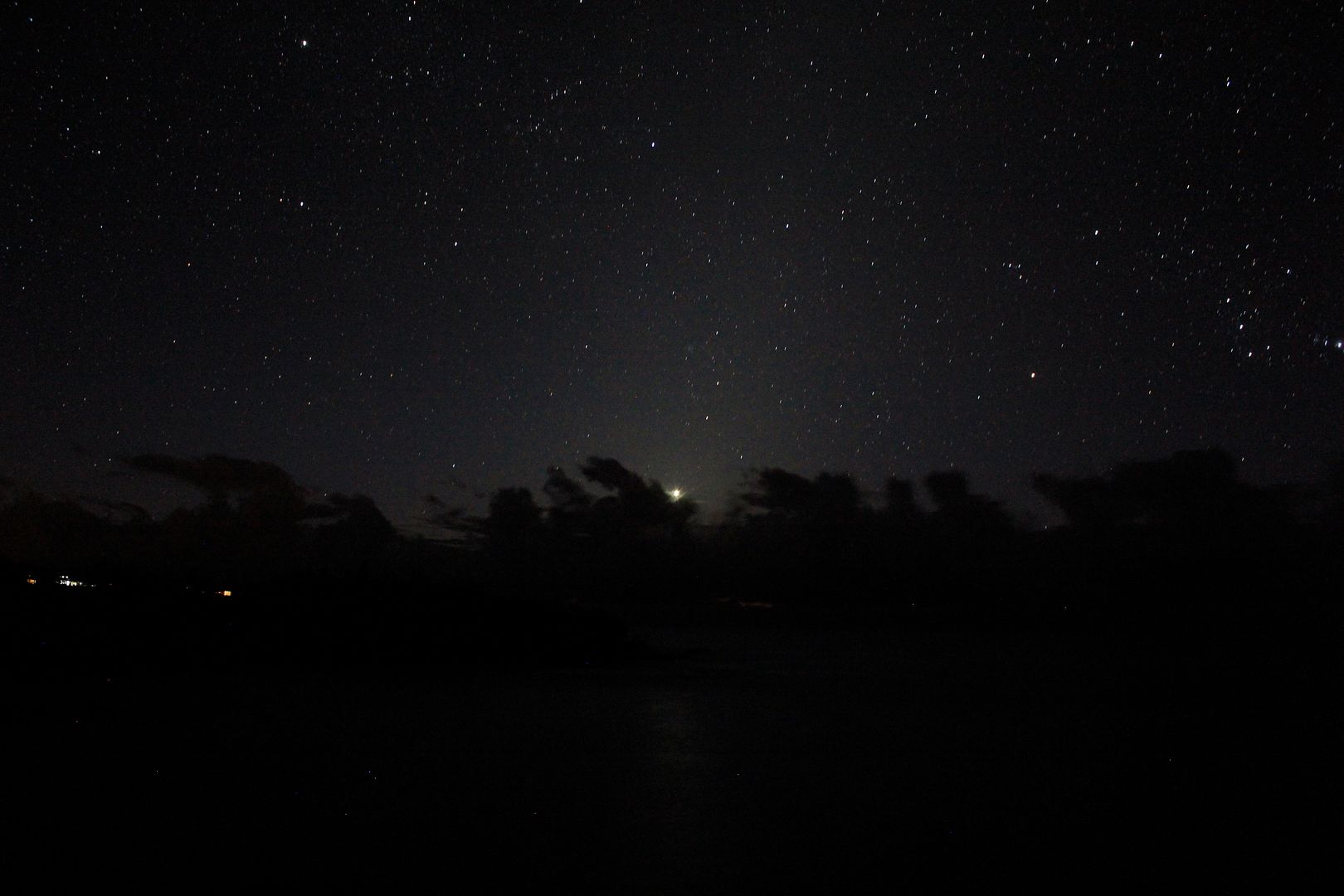
Venus rises, with Orion at right
It has been quite some time since I experienced skies so dark. When Venus finally poked up above the distant clouds its light quite noticeably brightened the deck.
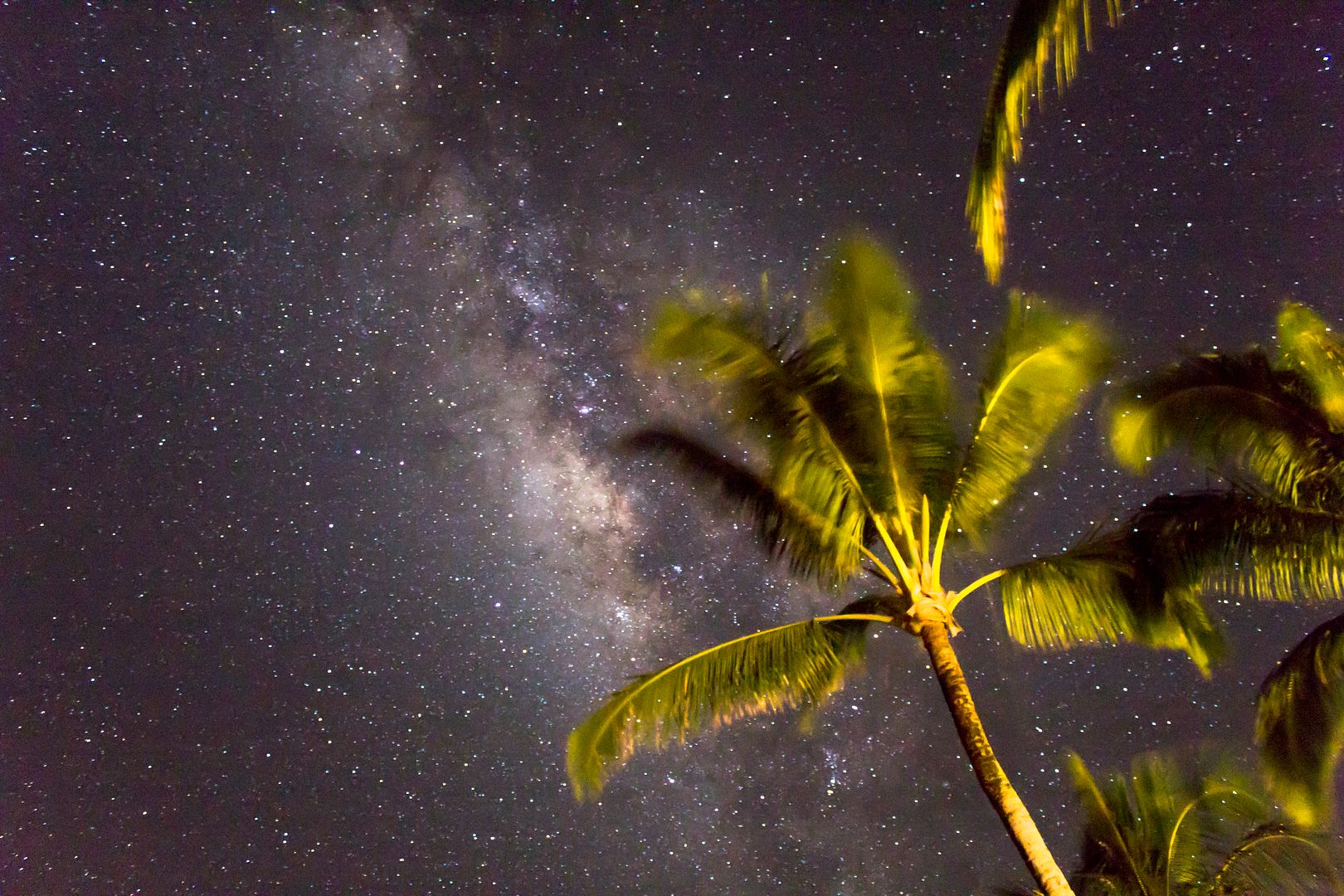
In the evening skies the summer Milky Way (above) was brilliant with its bright 'clouds' of stars and dark lanes of dust instantly visible - no dark adaptation was needed.

Occasionally clouds drifted past and I was reminded of a paper published two years ago, Red is the new black, how the color of urban sky glow varies with cloud cover (pdf). The paper points how how in cities with sky glow clouds actually magnify the problem, but in times before the advent of artificial light skies actually got darker when it was cloudy. There are a lot of implications from this (read the paper), but let me illustrate the phenomenon.
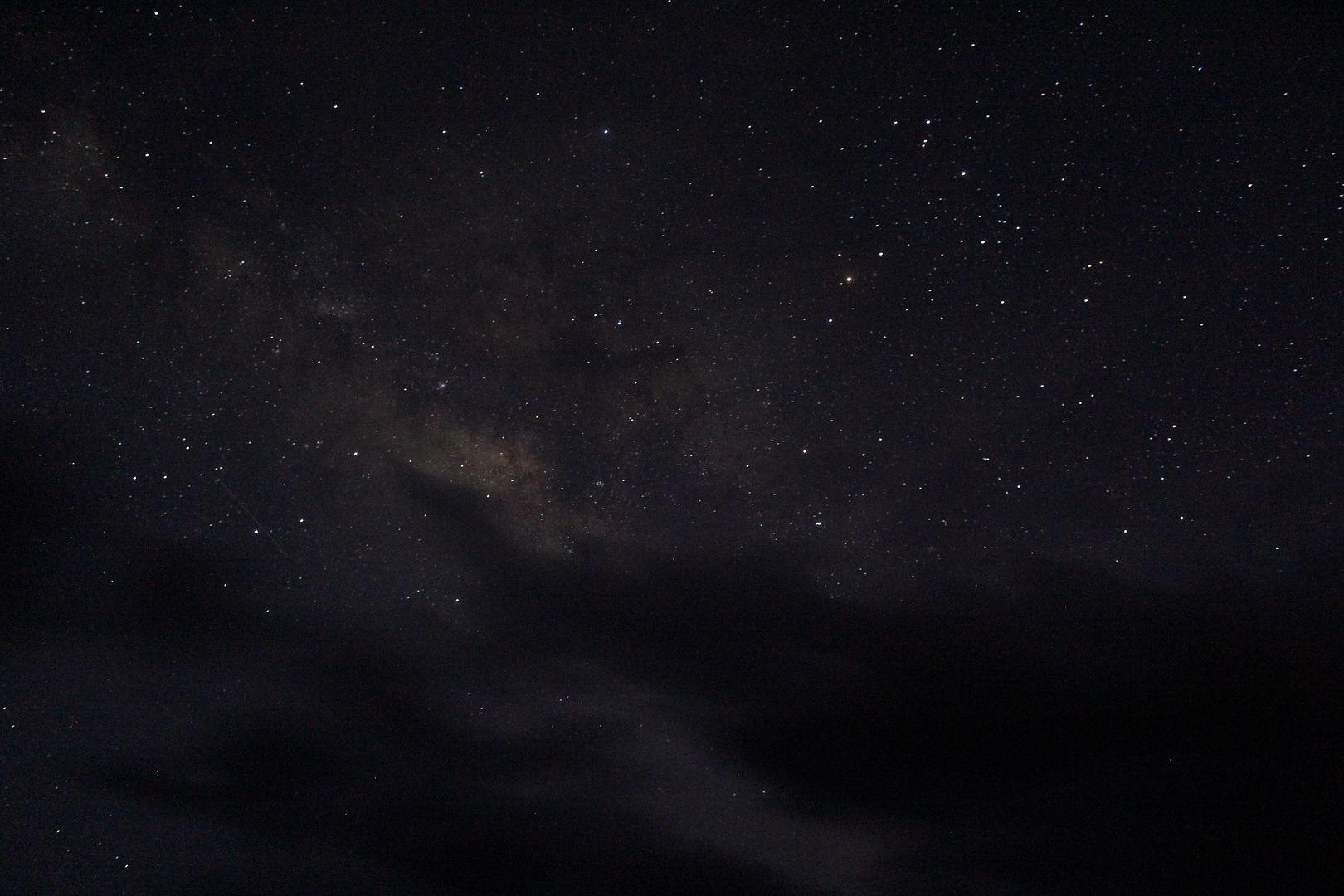
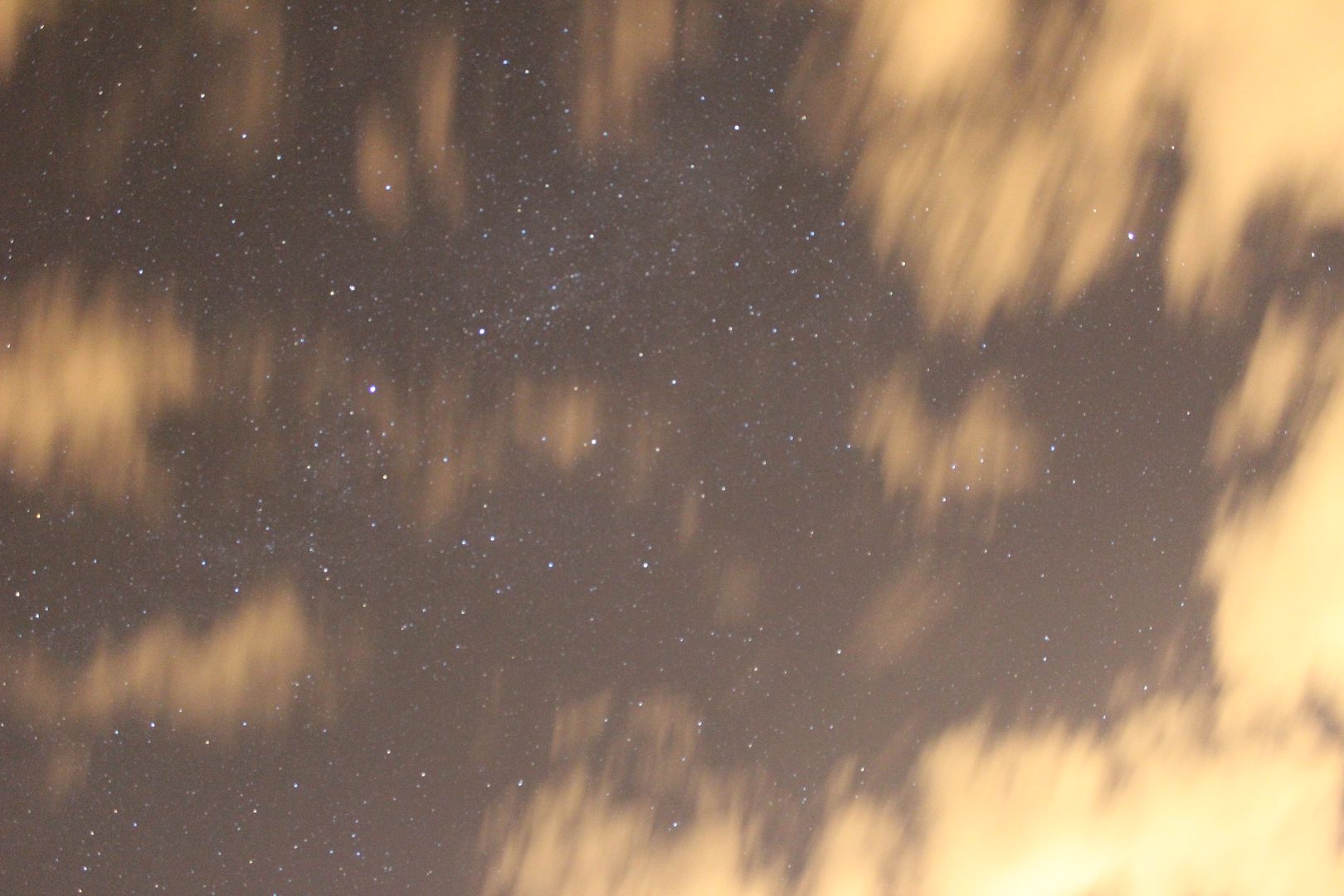
Sagittarius and Scorpius with dark clouds in silhouette
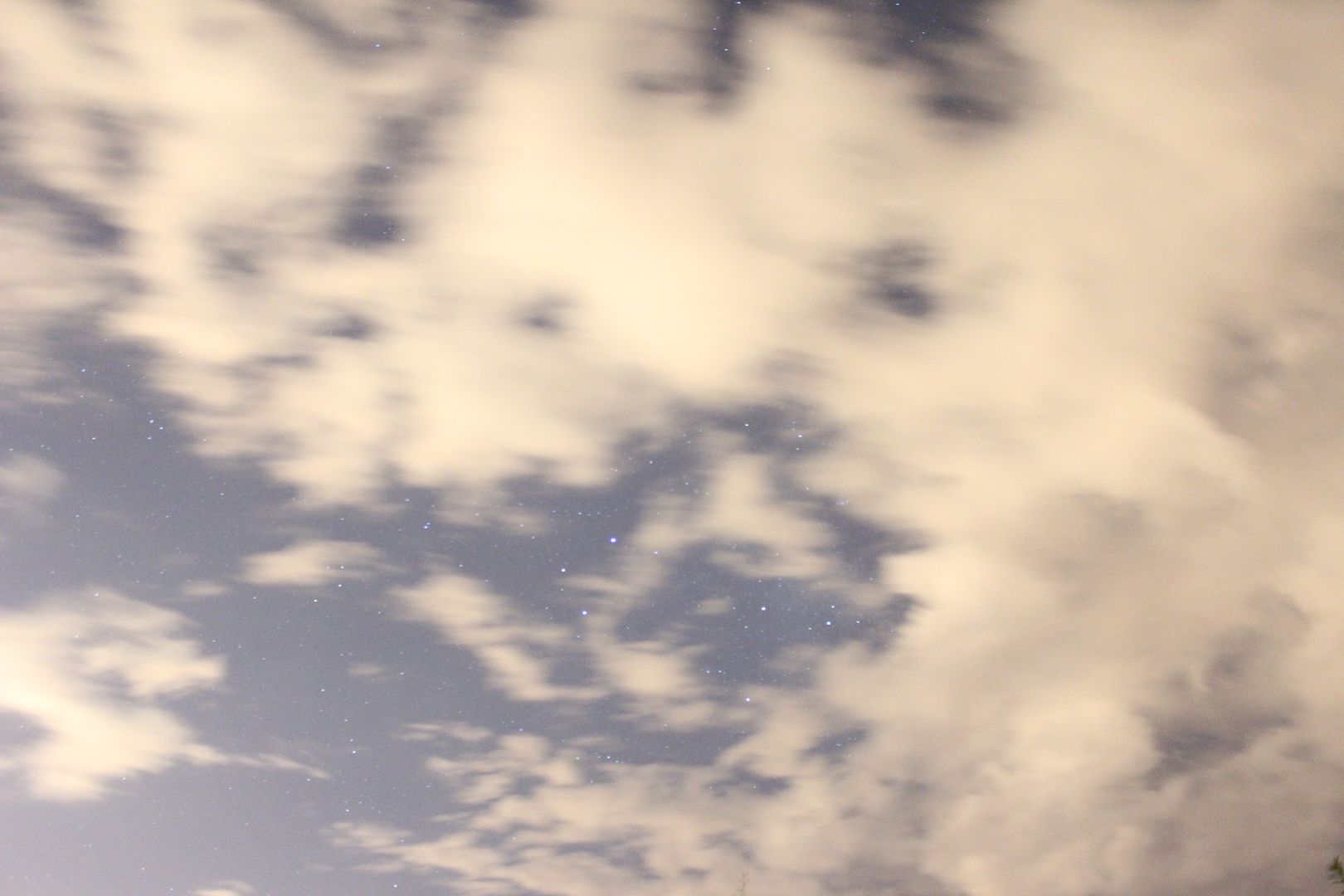
Compare the view (above) that I took last month in Hawai'i with dark clouds silhouetted against the star-filled sky, with this shot (below) that I took last night from my home near Tucson, Arizona.
Sagittarius in cloudy, light polluted skies
The difference is shocking. The two photos were taken on moonless nights, just about 1 month apart with the same camera and settings looking at the same part of the sky.

Even though there are relatively strict outdoor lighting ordinances in Tucson/Pima County, the skies here are awash with light pollution and sky glow. Sadly, many communities have little or no controls of outdoor lighting and there skies there are even worse. The clouds in the photo above are white, almost as if illuminated by moonlight. The likely culprit illuminating the clouds with white light is a sports complex to my south. Clouds in other directions had a more orange hue, as in the photo below:
Cygnus in light polluted, party cloudy skies
The photos show that there is much work to be done in controlling light pollution, even in communities where the effort is underway. Learn more about the problem and what you can do about it at darksky.org.

Saturday, August 9, 2014

Volcano! (Part 1)

My wife and I visited Hawai'i in 2004 and were fortunate enough that we were able to view lava from Puʻu ʻŌʻō, erupting on Kīlauea's East Rift,  flowing into the ocean at night. The experience was one of the most amazing sights in Nature that we'd ever seen.

I didn't have much of a camera then or even a tripod with me, but I did manage to record a few decent photos of the site. Here's one of them:
As we were planning our 2014 trip I knew that I needed to bring my DSLR and a decent tripod to be able to record any nighttime lava action.

Of course Pele does what she wants and there was no lava flowing into the ocean during our recent visit. Lava is still erupting from Puʻu ʻŌʻō, but was not easily accessible during our visit. We later paid a visit to Puʻu ʻŌʻō but that will be in Volcano! Part 2.

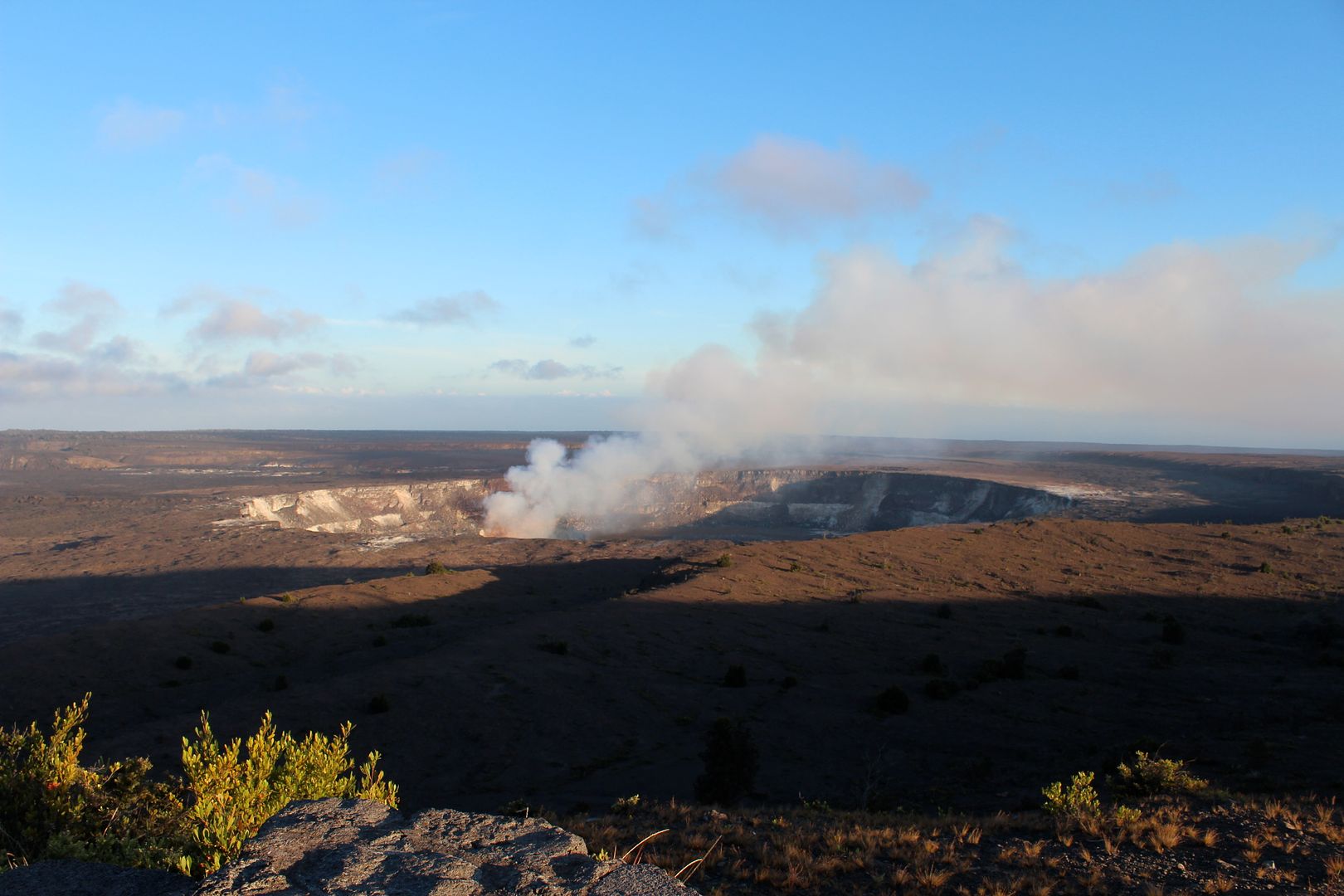
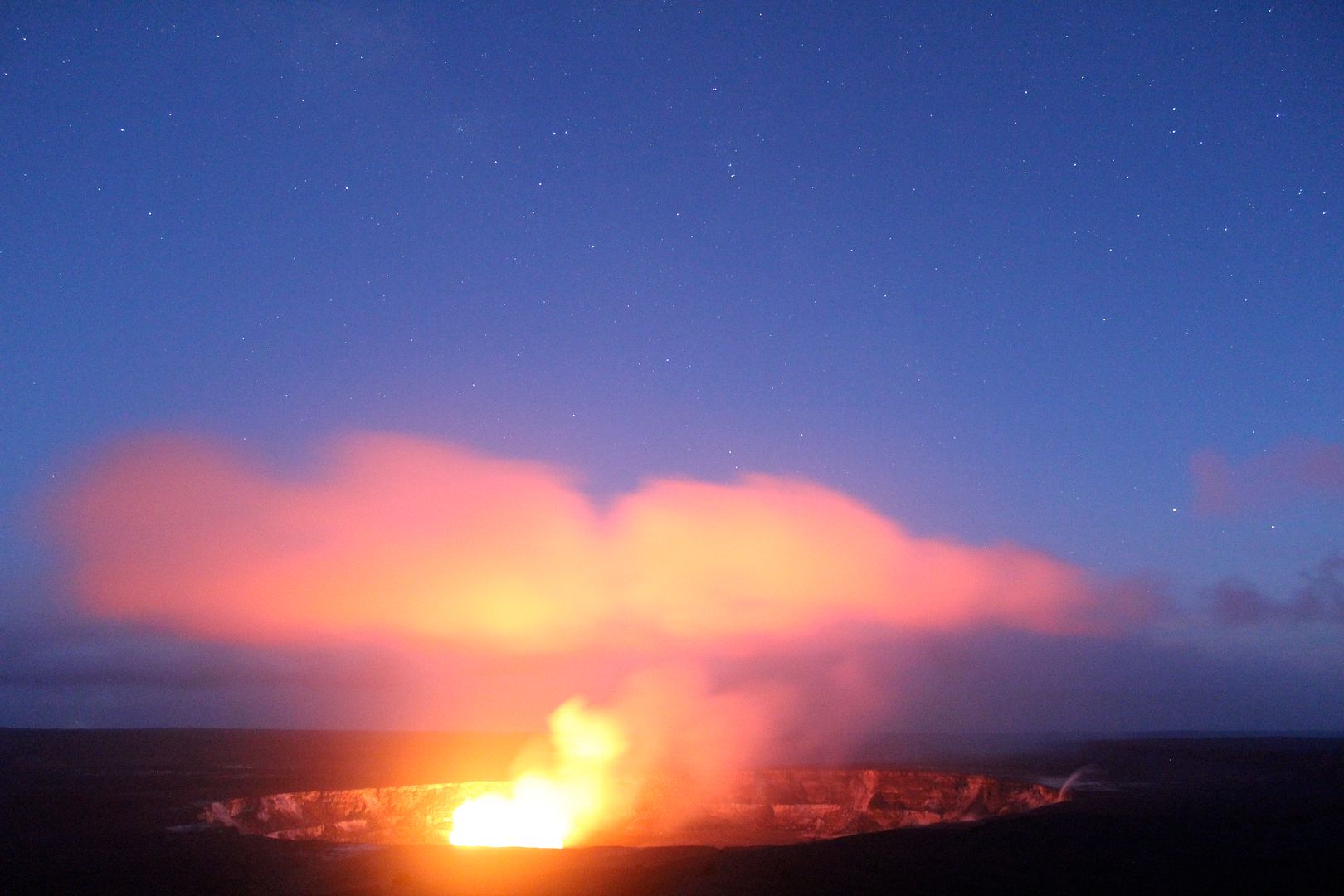
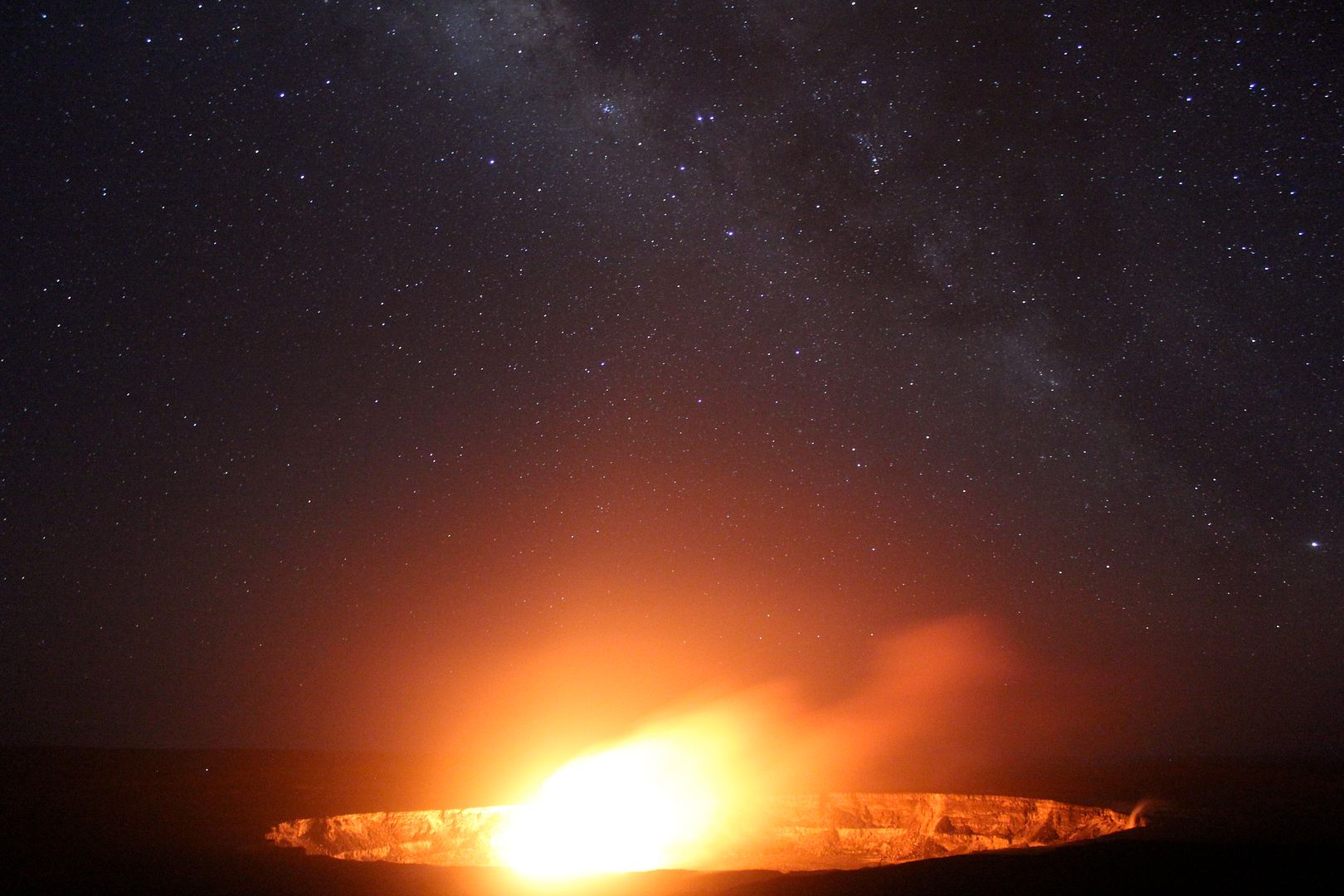
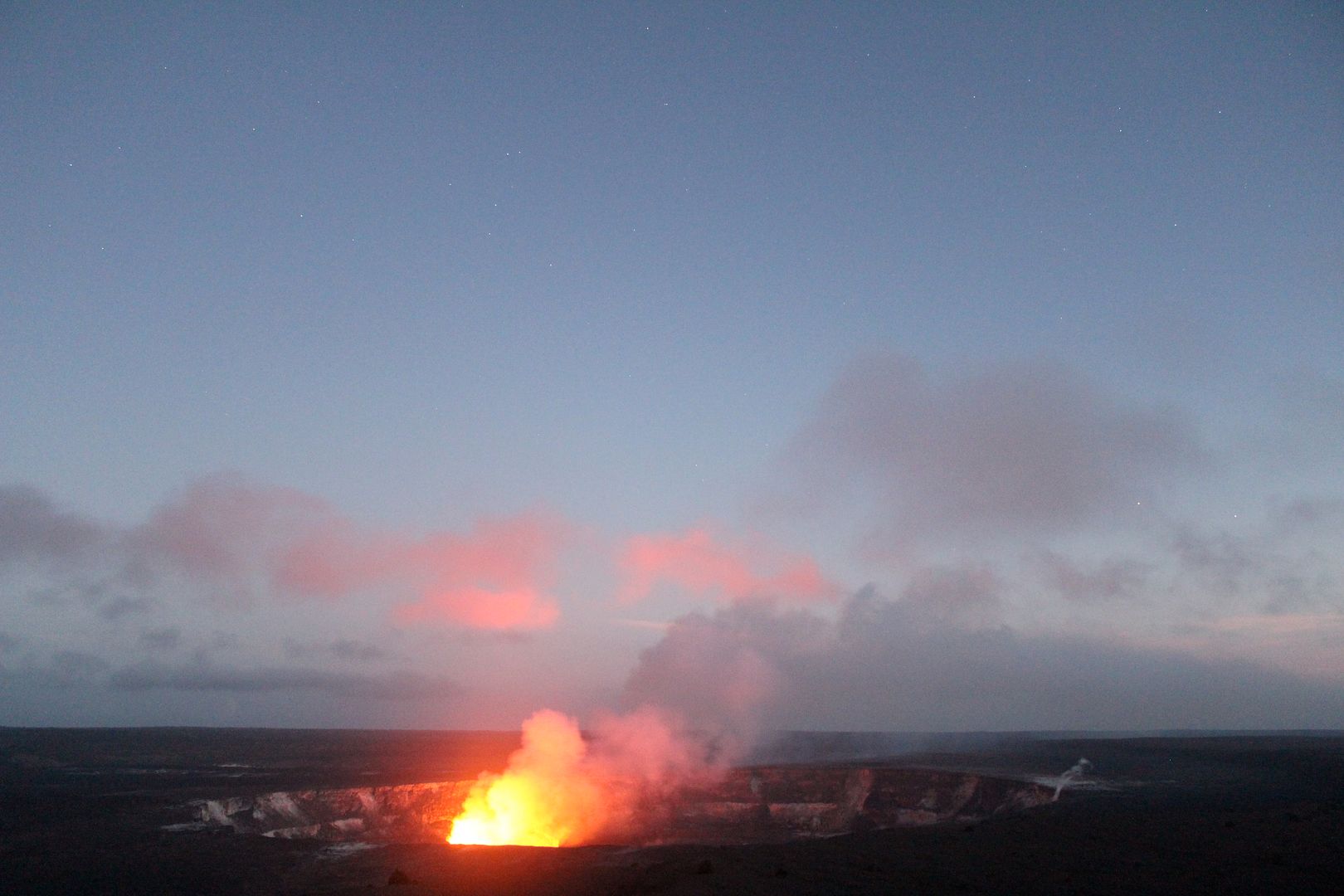
Fortunately, there is Hawai'i Volcanoes National Park.  Within the park is the Kīlauea caldera and within that is Halemaʻumaʻu crater. There's a lava lake in Halemaʻumaʻu and, while the lava isn't directly visible, after dark the glow of the lava illuminates the volcanic gasses. It makes for a wonderful show.

 Even in the daytime the crater is an impressive sight. 

We headed up twice (July 26 & 28) to see Halemaʻumaʻu--both times just before sunset. I did some time-lapse photography. I adjusted the position of the camera a bit now and then, but the results aren't too bad. 
Here are some stills that I shot from the second evening.
There were low clouds streaming just over the crater, adding to the effect of the volcanic glow. 

As darkness fell, I was starting to get pretty worried that we wouldn't end up with clear skies at all.
Look closely and you'll see that there are stars in the photo above. Two in particular were of special interest to me. Look on the right just above the darker clouds. That's Alpha Centauri (the leftmost of the two) and Beta Centauri (to the right). Alpha Centauri is, of course, famous for being the brightest member of the system of stars that is closest to our own solar system. It is too far south to be seen from Arizona, so catching it was a thrill.

As the sky grew darker the low clouds cleared away leaving a magnificent star-filled dark sky, free of all artificial light.
Only the glow of Halema'uma'u itself competed with the stars. Well....the annoying people trying flash photography of the crater were causing their own periodic light pollution too but I digress.

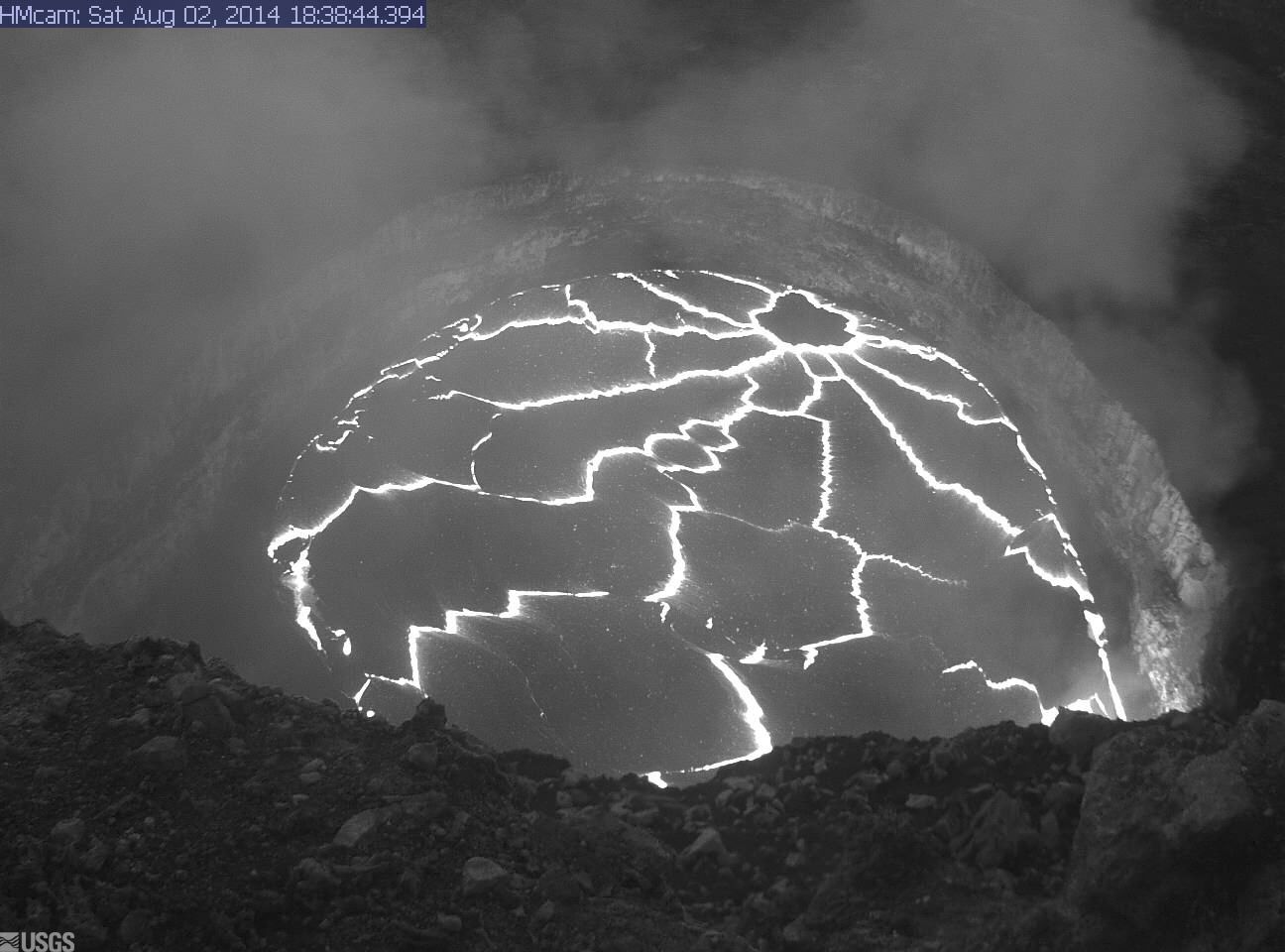
One way to catch the volcanic action without making the trip to Hawai'i is to look at the USGS Hawaiian Volcano Observatory's website. They have a live webcam pointed looking down at the lava lake. Here's a shot I grabbed from last Saturday:
It looks like the recent hurricane has kept the webcam from updating right now but it provides dramatic look into the crater showing the darker crusted over lava sheets floating on the bright molten lava lake. 

While we were in Hawai'i we had another volcano adventure which will be the subject of my next blog post.

Friday, January 17, 2014

Ancients

Wow! Check out this fantastic time-lapse video, Ancients. It was shot from the Atacama Desert in Northern Chile where the skies are amazingly dark and clear.


Ancients from Nicholas Buer on Vimeo.

The perspective of being much farther south brings out parts of the Milky Way Galaxy that aren't visible to those of us who live in the north. It is easy to see from the video that our perspective on our spiral galaxy is from the side. Compare the view to this pic from the Mt. Lemmon Sky Center's Adam Block of edge-on spiral galaxy NGC 4565.

Sunday, November 3, 2013

A Visit to Westhavelland Nature Park

Last week I was in Berlin Germany attending the first International Artificial Light At Night conference. It was an amazing event that brought together over 100 researchers from five continents. One of the conference excursions was a visit to one of the darkest places in Germany - Westhavelland Nature Park. For some time now there has been a concerted effort to engage the communities that surround the park in an effort for them to improve their outdoor lighting and make and also make an application to the International Dark-Sky Association for official status as one of their Dark Sky Places.

It was a long expedition from Berlin (especially since our driver initially headed in the wrong direction) but we had a great visit first to the park's nature center where we were greeted by the mayor of Milow (above, at right with the microphone pointed at him) and the director of the center (to the left of the mayor). 
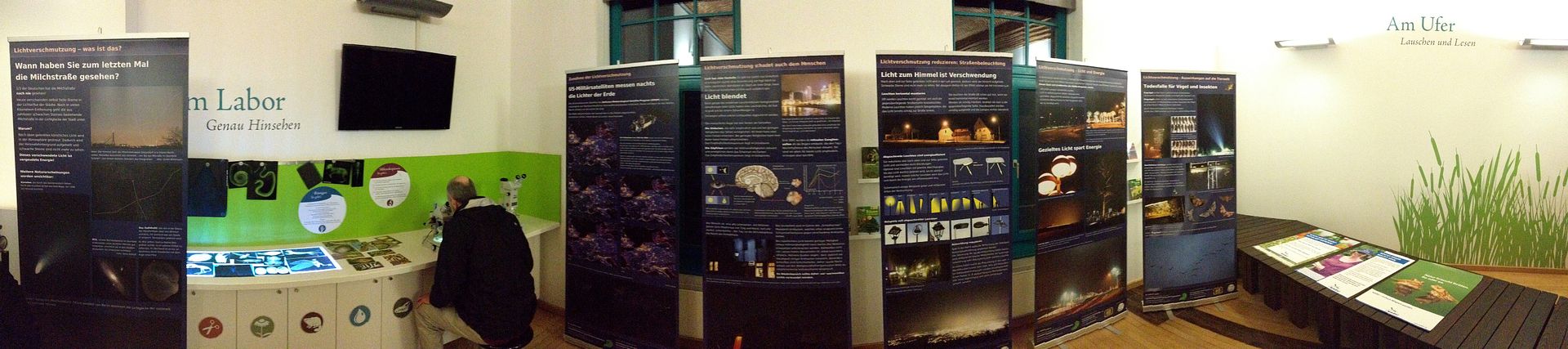
In addition to exhibits on the natural history of the park, the visitor center has several exhibits devoted to light pollution and the night sky. Above is an iPhone panorama that I shot showing off some of the light pollution displays.
Canon 3Ti, 18mm, f/5.6, ISO 6400, 30 sec
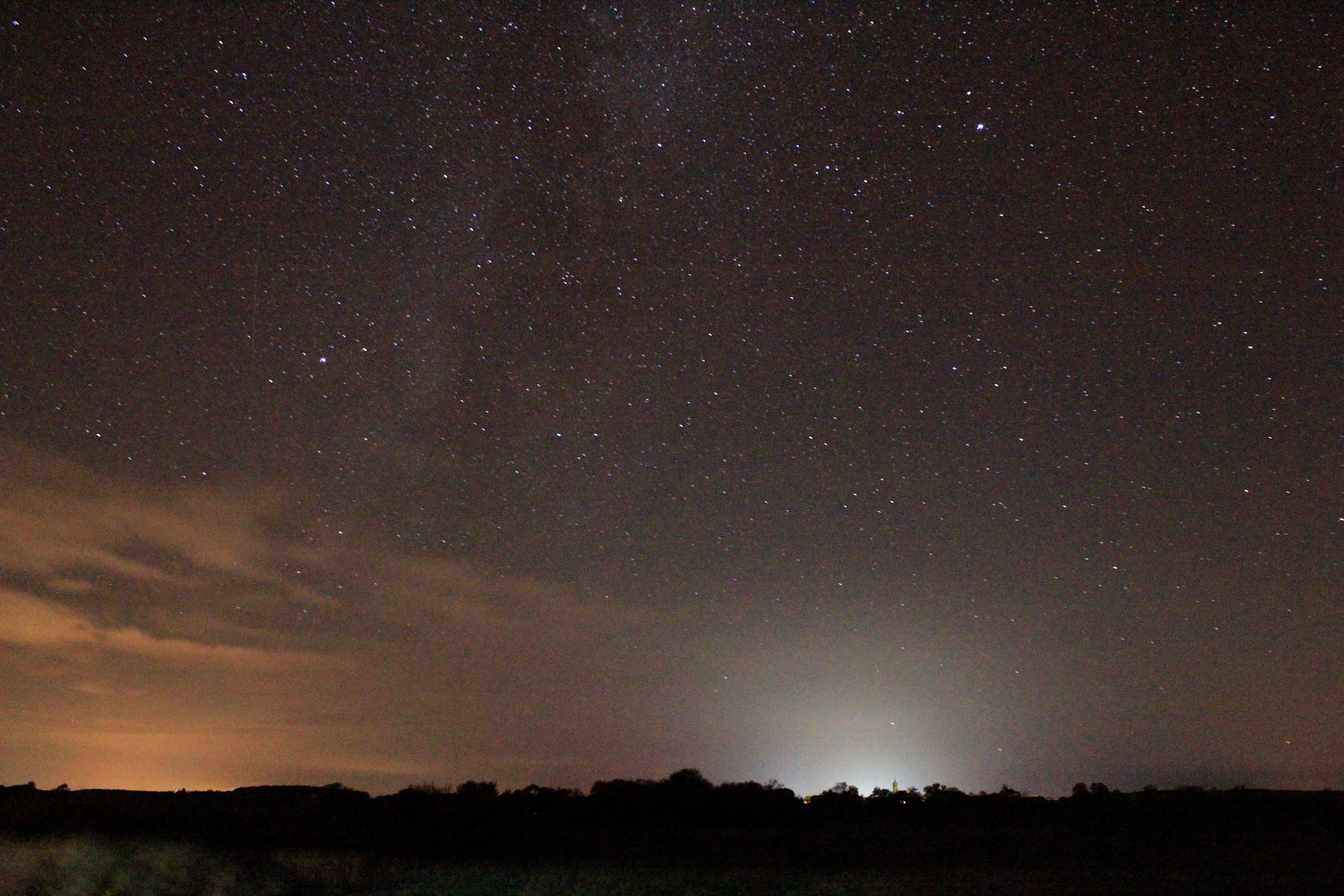
The real treat of the evening came when we ventured into the heart of the park. The shot above is looking west. The white glow just right of center is apparently from a paper mill that clearly needs to improve its outdoor lighting.
Canon 3Ti, 18mm, f/5.6, ISO 6400, 30 sec
This view is looking in the same direction, but with the camera pointed higher. Below is the view to the east. It was taken looking over our bus, which produced the bright glows at the bottom of the frame.
Canon 3Ti, 18mm, f/5.6, ISO 6400, 30 sec
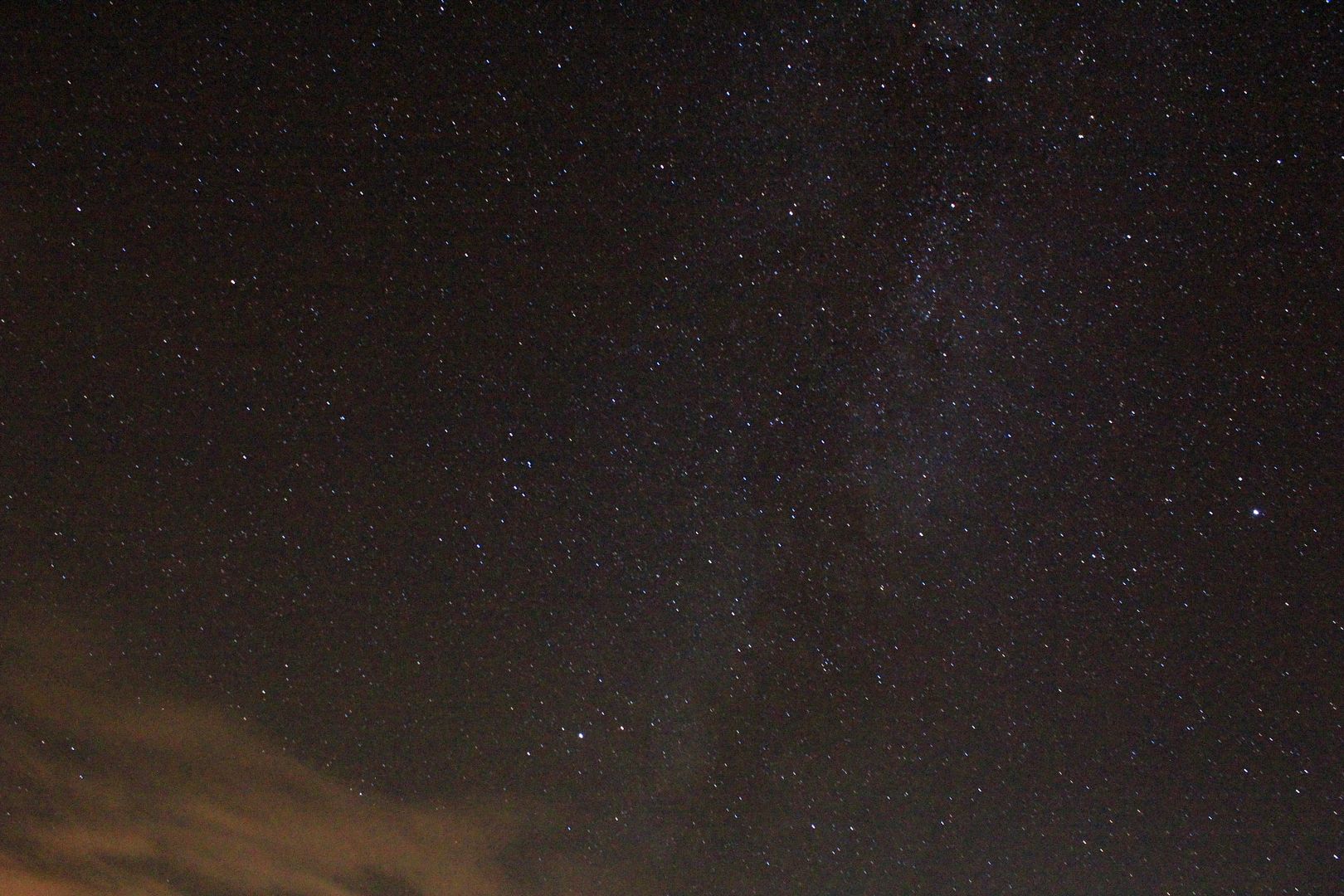
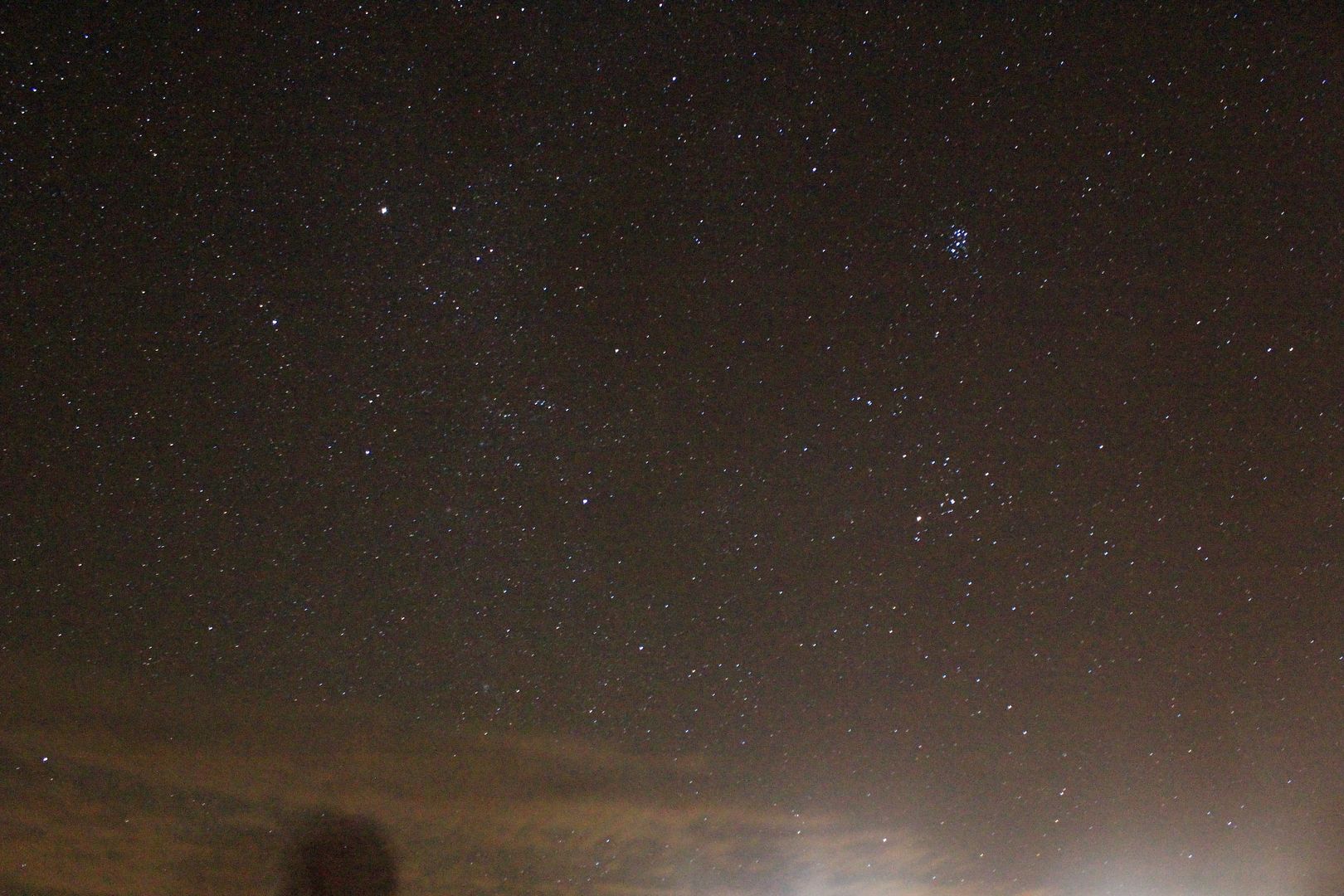
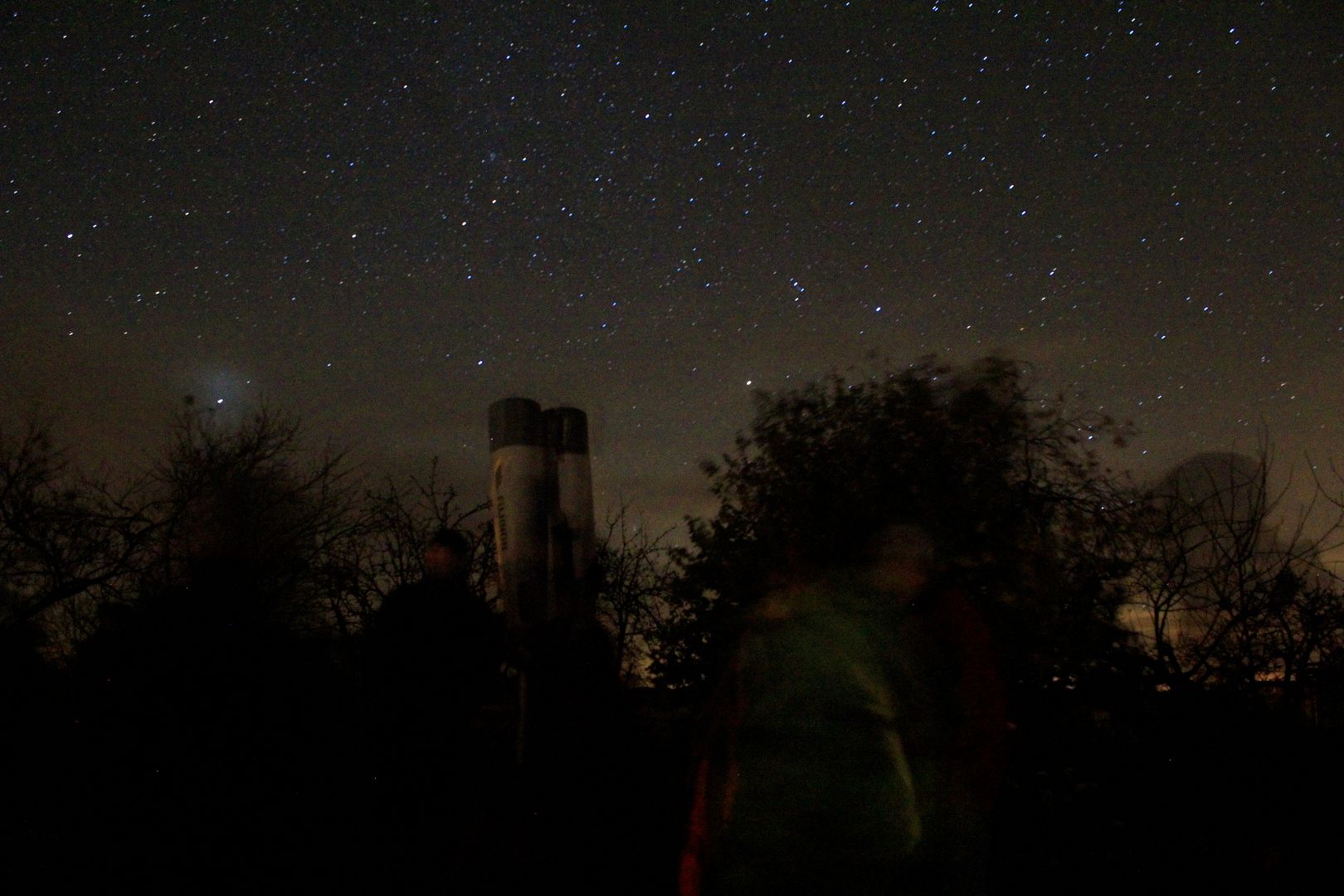
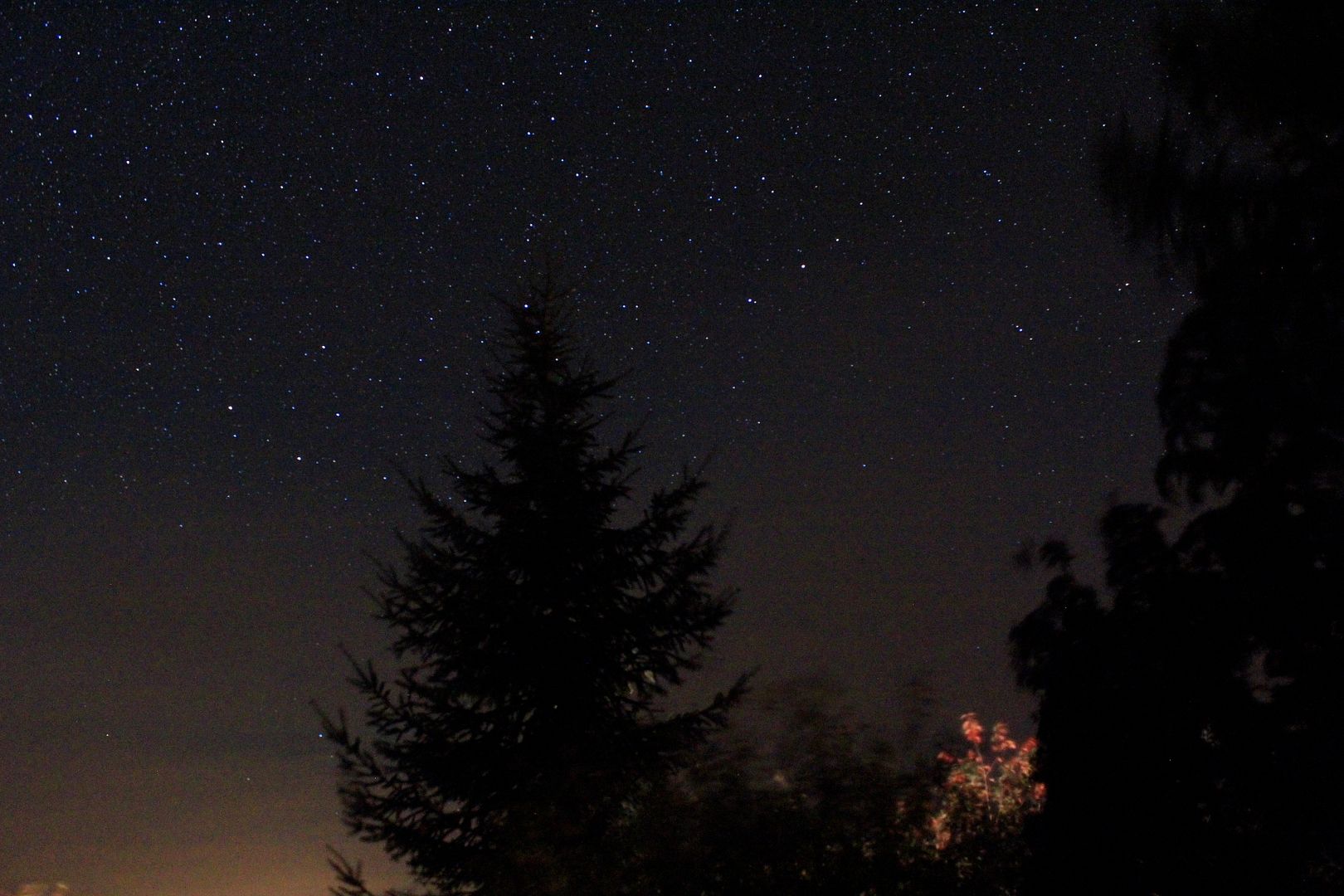
The Milky Way was easily visible even though we were not really given time for our eyes to adapt much at all before we were loaded back into the bus. From there we headed to the village of Gülpe where we were greeted by the chief administrator of the city of Rhinow and treated to some stargazing.
Canon 3Ti, 18mm, f/5.6, ISO 6400, 30 sec
The skies here were not quite as dark and some clouds were drifting through as well, but we had a nice look at the universe.
Canon 3Ti, 18mm, f/5.6, ISO 6400, 30 sec
Be sure to check out this great video of the skies above Westhavelland from Harald Bardenhagen.

Yes, there is light pollution that impacts the park but there has already been significant effort to protect the skies there and the work to bring the surrounding communities in on the dark skies movement are to be commended. 

Westhavelland is just one of several planned dark sky places in Germany and elsewhere in Europe. While attending the conference I had the chance to visit with a few of the  people working on these projects. I certainly wish them much success.

Monday, February 6, 2012

Red Aurora Australis

Here's a beautiful time-lapse video of the southern Milky Way (including the Magellanic Clouds) and the Aurora Australis. Enjoy!

Red Aurora Australis from Alex Cherney on Vimeo.

Saturday, February 4, 2012

An Astronomer's Paradise video

From The World at Night comes this great timelapse video:


An Astronomer's Paradise from Babak Tafreshi on Vimeo.

Cerro Paranal is an astronomers paradise with its stunningly dark, steady, and transparent sky. Located in the barren Atacama Desert of Chile it is home to some of the world's leading telescopes. Operated by the European Southern Observatory (ESO ) the Very Large Telescope (VLT) is located on Paranal, composed of four 8 m telescopes which can combine their light to make a giant telescope by interferometry. Four smaller auxiliary telescopes, each 1.8 m in aperture, are essential elements of the VLT interferometer. The music is composed by Thomas Nordwest and provided by the Ars Electronica (AEC). Babak Tafreshi

Sunday, July 3, 2011

Stars Over Kitt Peak National Observatory

Here is another in our series of time-lapse videos of the night sky. This one is from Dean Ketelsen and it shows the stars of our Milky Way Galaxy over Kitt Peak National Observatory:


Anyone reading this blog can easily see that I have a strong interest in the night sky, so it should be no surprise that I will soon be working to actively protect it. In August I will be joining the staff of the International Dark-Sky Association.  As I move into the new position expect to see much more here on light pollution and what can be done to keep it from spreading.

Monday, May 30, 2011

Amazing Video of the Milky Way Over the VLT

This is some of the most dramatic time-lapse that I have ever seen. It shows off the telescopes of the European Southern Observatory's Very Large Telescope (VLT) under an awe inspiring vista of the heart of our own Milky Way Galaxy.  The VLT is composed of four 8.2-meter telescopes.  During the video you can see an occasional yellowish line of light shining up from one of the domes.  That is the light of a laser guide star system that is employed for adaptive optics, a process that allows astronomers to get super sharp images from ground-based telescopes.


Click here for a direct link, be sure to watch it in HD.

Friday, April 22, 2011

2 Videos for Earth Day

It is Earth Day, so why not celebrate with two videos that help to celebrate Earth's place in space.

First off is an animated version of Carl Sagan's Pale Blue Dot. I think you will like it.


Pale Blue Dot - Animation from Ehdubya on Vimeo.
I think from now on, April 22 should be celebrated as Pale Blue Dot Day.

The second one, a stunning time-lapse video called Walu Ngalindi, shows our Milky Way galaxy and two of our satellite galaxies as seen from the dark skies of the Australian Outback. Watch it embedded below or follow the link above to see it in much higher resolution.


WALU NGALINDI from GRANT WAKEFIELD on Vimeo.