Sunday, January 13, 2013

Fire Threatens Siding Spring Observatory

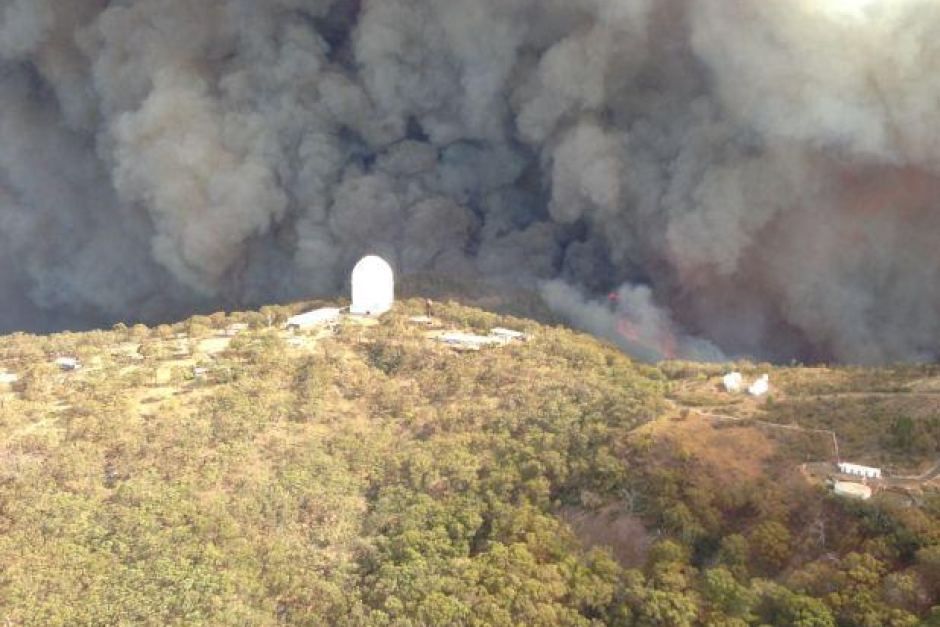
I had this photo and message (below) about the fires near Siding Spring Observatory in my email this morning:
This is a large, fast moving and dangerous bush fire. The fire is burning in a north and north westerly direction away from Timor Road and the Siding Spring Observatory. 

Two properties on Timor Road have been destroyed. Parts of the Siding Spring Observatory have been damaged by fire. There may be other properties destroyed. Fire fighting crews will assess the damage in the morning. 

Police evacuated the area around Siding Spring. All staff of the Siding Spring Observatory were evacuated before the fire impacted and are safe and well in Coonabarabran.
 Read a news account here. The current word is that the Anglo-Australian Telescope has survived, but no reports on damage are in yet. UPDATE: Check out this.

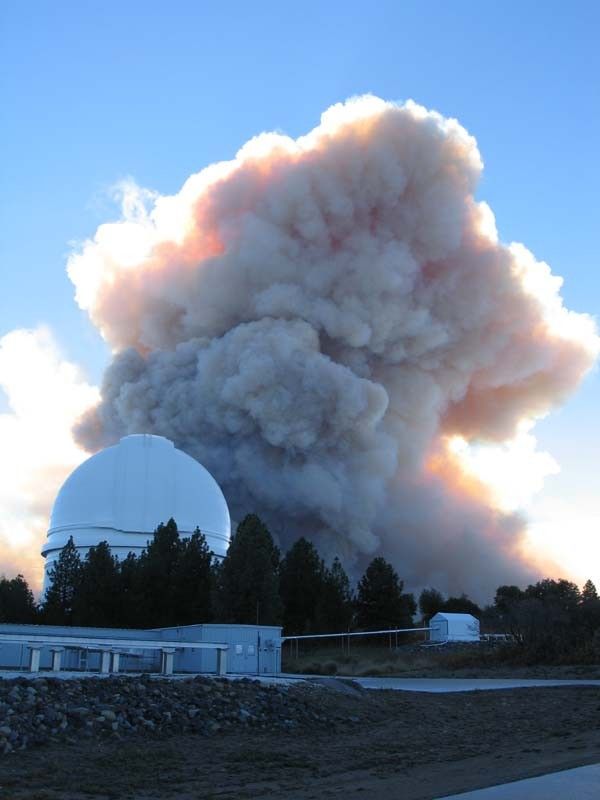
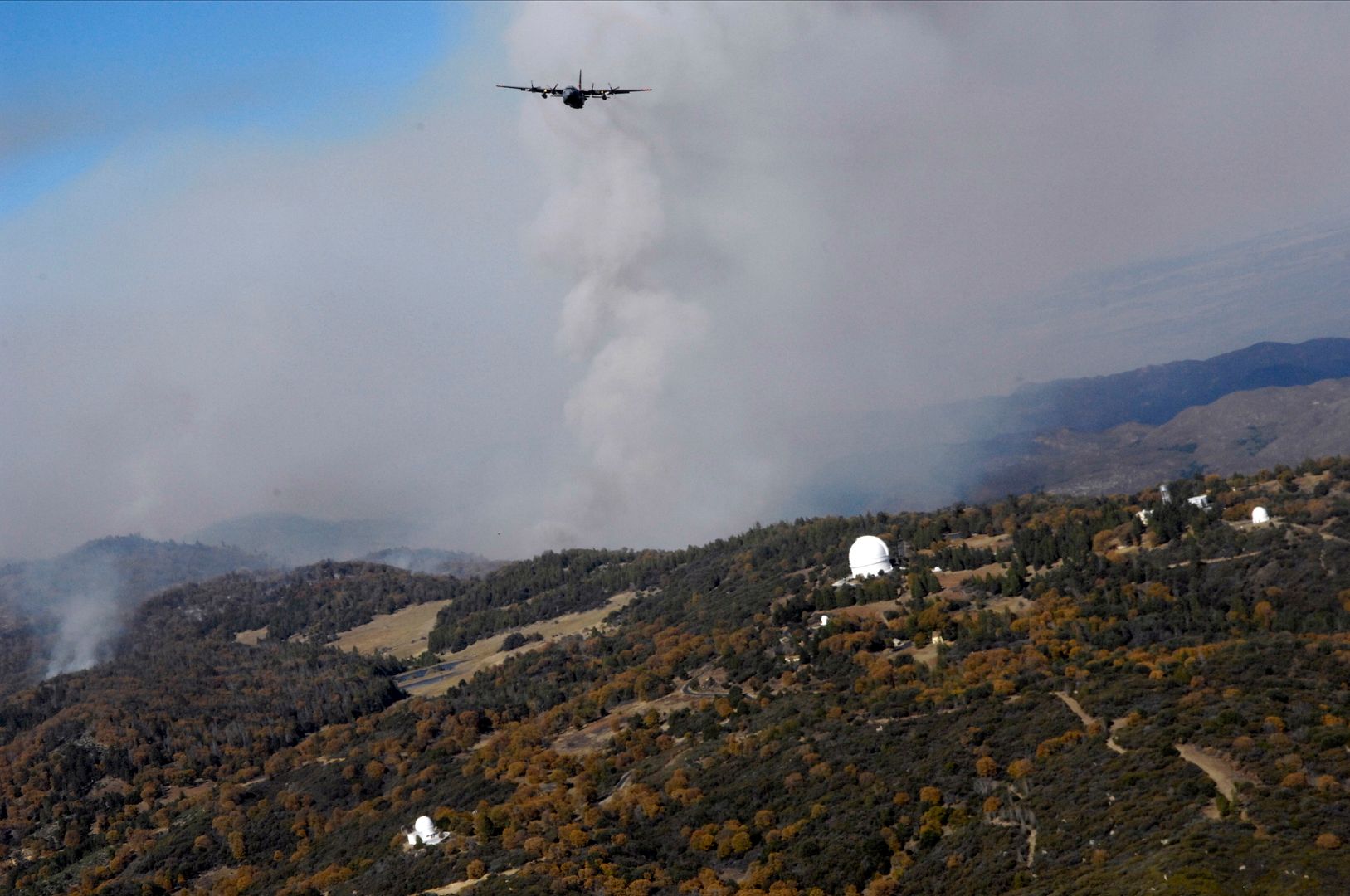
I have been through this kind of thing in 2007 on Palomar Mountain when fire threatened the observatory and my home. Events like this one taking place on the other side of the globe bring me back to the events of 2007. Thankfully both Palomar Observatory and my home survived the 2007 fires (pictured below). I certainly wish nothing but the best for everyone at Siding Spring and the surrounding communities.


Saturday, January 12, 2013

Moon & Venus

I am a few days behind in posting this shot of Thursday morning's beautiful pairing of the Moon with Venus. So here it is:


We are loosing Venus from the morning sky and we will not get pairings like this again until it rounds the back side of the Sun, returning to the evening sky in the spring.

Sunday, January 6, 2013

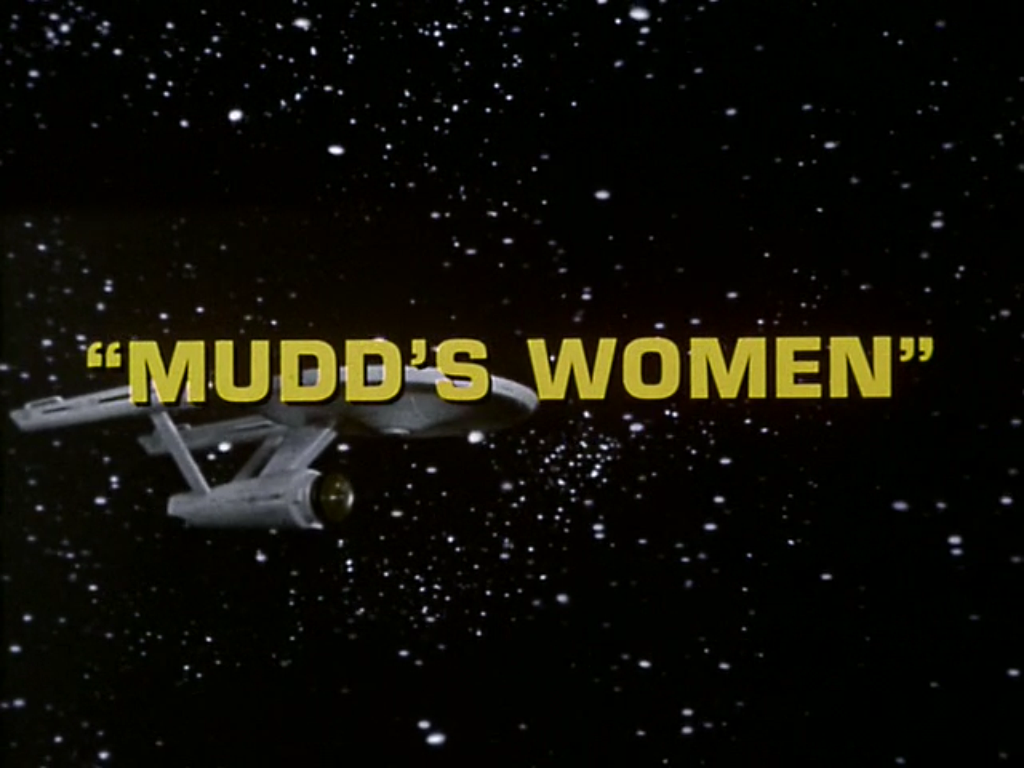
Star Trek: Mudd's Women


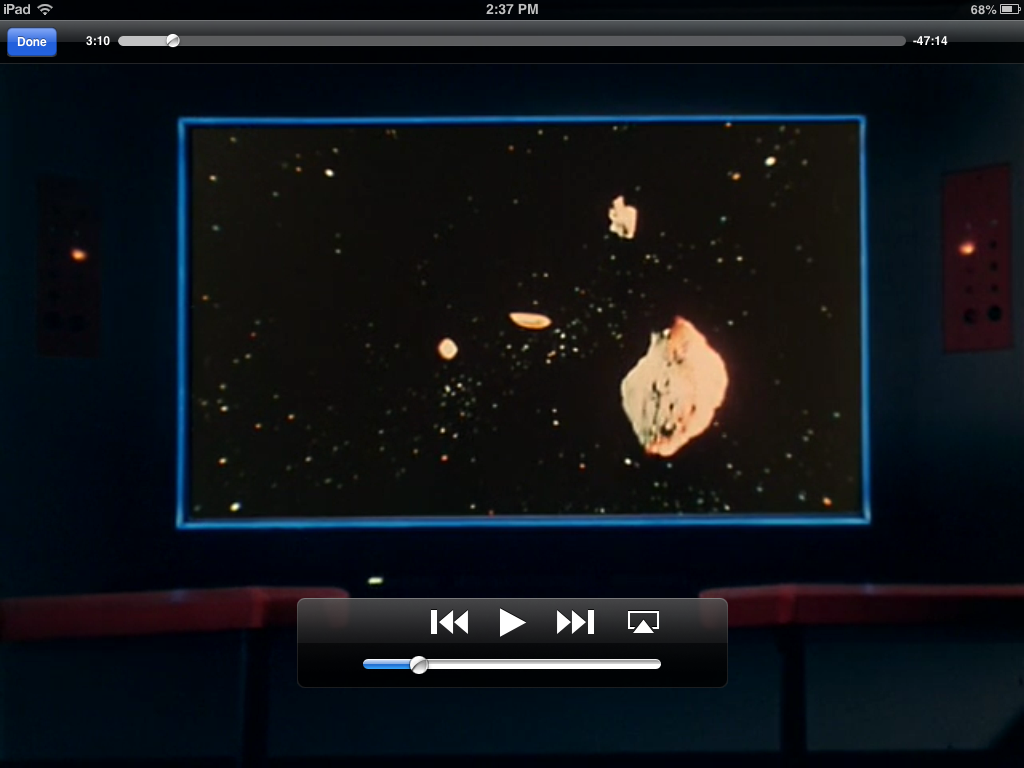
Mudd's Women is the first somewhat lighthearted episode of Trek. It begins with the Enterprise pursuing a cargo ship. It enters an asteroid field in an attempt to evade the Enterprise but overloads its engines. In an attempt to rescue the crew, the Enterprise burns out its lithium crystals. Later in the series they will be called dilithium crystals.
Not so special special effects. The ship (center) with 3 asteroids.
They however are able to beam aboard the ship's captain, "Leo Walsh", and 3 women who have a powerful affect on the men of the Enterprise. Spock seems immune to their power. He seems amused by it, does an impression of Walsh's voice and smiles at the crew's reaction to the women.

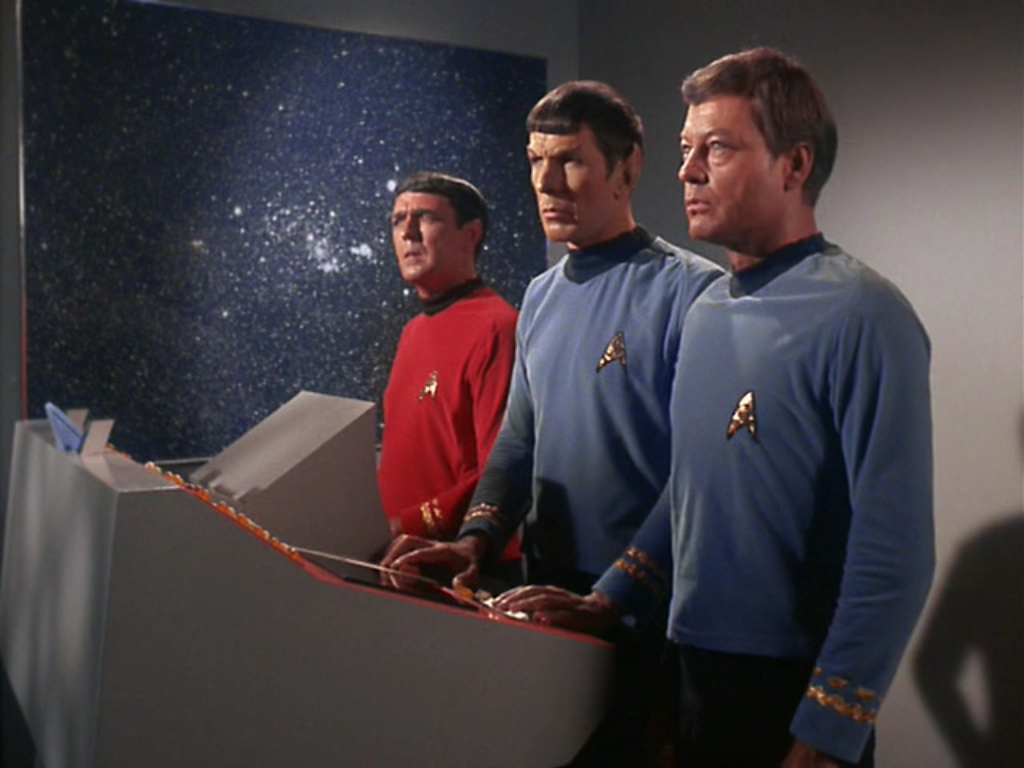
Scotty, Spock and McCoy in the Transporter Room:
What's that on the wall behind them? It is a wide-angle photo of the constellation Orion. The star just above Scotty's hair in the photo on the right is the star Rigel (more on that later).

"Walsh" reveals that the ladies aren't his crew. They are his cargo.

Kirk convenes a hearing where we learn that Walsh is really named Harry Mudd. He has been lying about his name (twice), his past offenses, and just about everything else. When Kirk asks Mudd if he has any defense to offer Mudd, played by Roger Carmel, delivers the best line of the episode: "Only heaven's own truth, which I've just given you. "

With the Enterprise operating on battery power, they head for Rigel 12. There, they will deal with the miners for new dilithium crystals. Mudd realizes that the miners will be lonely for female company and that puts him in a position of power.
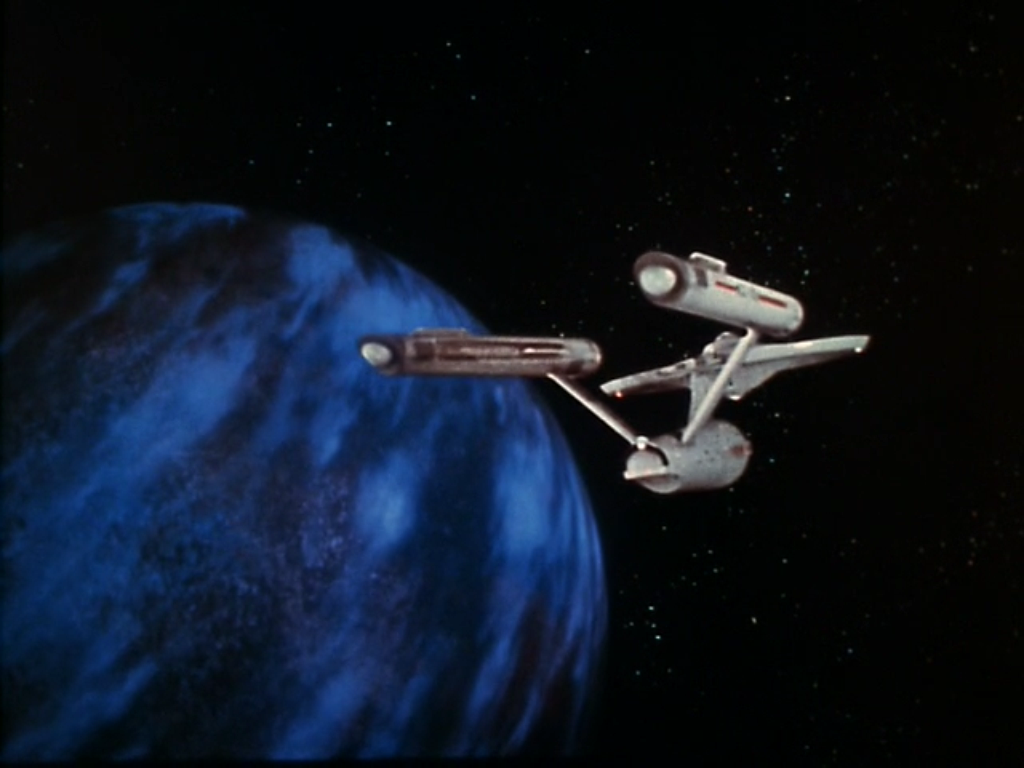
In orbit about Rigel XII.
 I don't know if any thought was given by the writers of the show in naming planets, but I have always assumed that names like Rigel XII meant that the planet was the 12th planet in orbit about the star Rigel. In this particular case, it might actually make sense. The real star Rigel is a blue-white supergiant, meaning that it is much larger, brighter and hotter than our own star, the Sun. One would assume that if there were planets in orbit about it they would need to be much further out in their star system than Earth is in our own. This "Goldilocks Zone", also called the habitable zone, is a real term that astronomers use to describe how far exoplanets need to be from its star to not be too hot or too cold. (Of course, Rigel VII is mentioned in The Cage, so maybe likely I am reading too much into this.)

Back to Trek. The fact that the women are Mudd's "cargo" shows that while Trek is often considered enlightened for its time, it is still rooted in a world where women are not always treated as equals.  As Mudd explains the ladies are "destined for frontier planets to be the companions of lonely men, to supply that warmth of a human touch that's so desperately needed. A wife, a home, a family."

One would hope in the 23rd century that mail-order brides would have been a thing of the distant past. The show isn't known for equality of the genders. Kirk's womanizing became famous and inspired TV spots like this one:


Given the reputation that Kirk would build, it is remarkable that he steered completely clear of this trio.

It is revealed that the women are taking a Venus drug that influences their looks and makes the men so on edge.  The good news here is that when Eve is given a placebo, instead of the Venus drug, she has the same reaction.

As Kirk and Mudd explain:
Kirk: There's only one kind of woman.
Mudd: Or man, for that matter.
Kirk: You either believe in yourself, or you don't.
In the end it works out. The Enterprise gets its dilithium crystals, the miners get wives, the women get a home and Mudd gets a trial. Oh, and in the future, playing cards will be round.

Composer Fred Steiner wrote just over 22 minutes of music for this episode. It is dominated by the Venus theme which you can hear in this sample from La-La Land Records which has released the complete score to the original series of Star Trek.

All-in-all, Mudd's Women isn't even close to my favorite episode of Trek, neither does it rank down at the very bottom. Gender issues come up again in the next episode: The Enemy Within.

Saturday, January 5, 2013

Balloon Alley

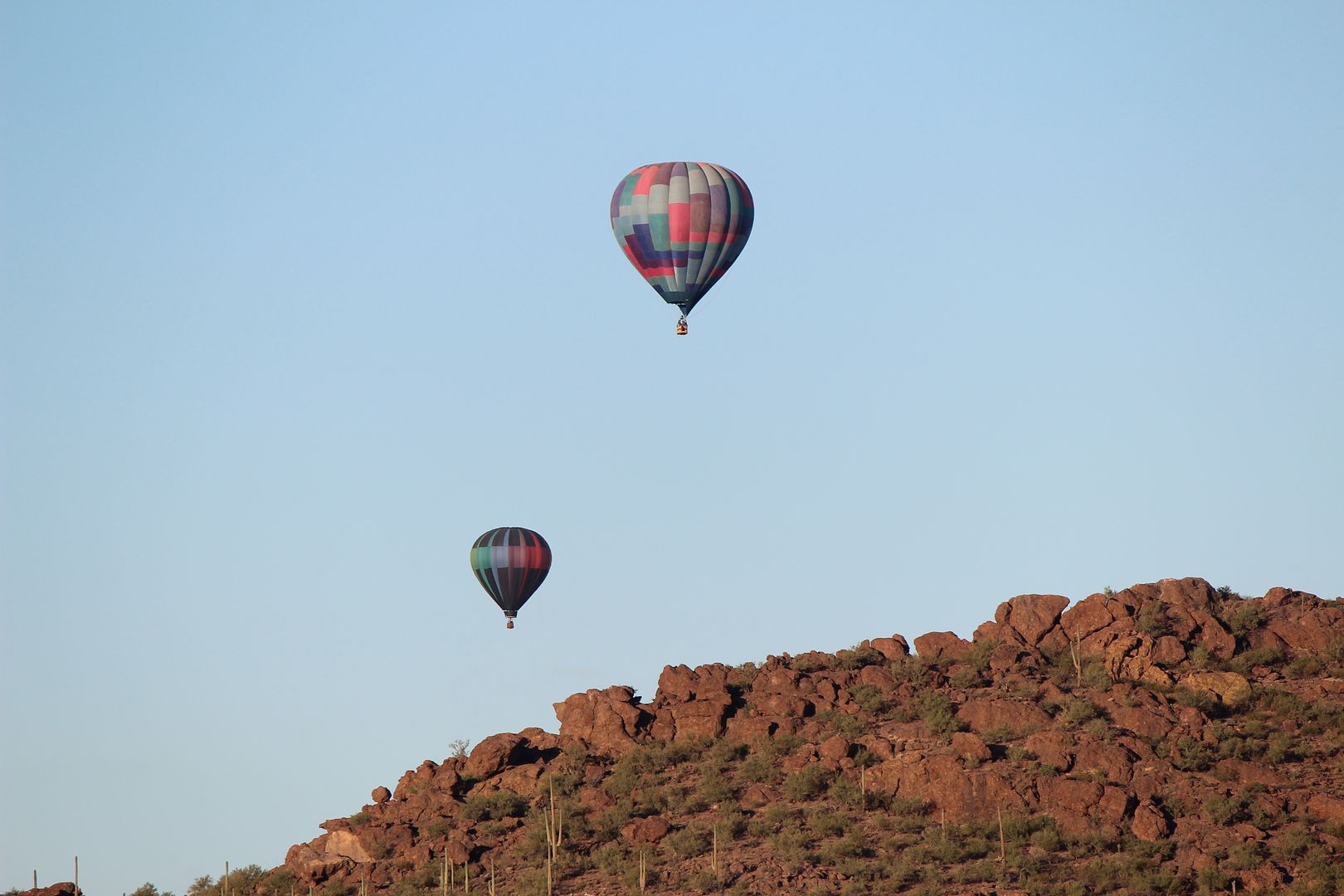
When we returned to the desert a year and a half ago I didn't realize that our new home would be in 'Balloon Alley'. Most mornings from October through March one or more hot air balloon can be seen. Some are from far away, but we do get the occasional close encounter. Here are a few of the shots that I have taken so far this season. All of these were captured from my back yard.

Perhaps one of these days I'll make the trip up, up and away in a beautiful balloon.  If I do, I'll be sure and post the pics here on the blog.  I do occasionally post hot air balloon and other pics on Twitter, so if you are interested you should follow me.

Wednesday, January 2, 2013

The Persian Gulf. At Night. From Space.

Check it out. Here are four separate nighttime images from space looking down at the same place, but taken under differing amounts of moonlight.

Images from NASA's Earth Observatory via the Suomi NPP Satellite
I am not sure what is going on between Riyadh and Doha as there is some apparent motion of the lights, but the overall effect here is that with moonlight it is pretty easy to see the physical features of the Gulf region. The city lights are pretty constant throughout.

For those who haven't noticed, moonlight is indeed pretty bright and the human eye does very nicely under moonlight levels of illumination.  It is a shame that we light our cities at the intensity levels that we do, as in many cases it is much more light than we really need.

Check out the full-resolution of the images and learn more from NASA here.

Sunday, December 30, 2012

Times Square from Space

2012 is nearly over and soon hoards of people (this news account estimates attendance will be a staggering one million people) will gather in Times Square in New York City's Midtown Manhattan to watch the time ball drop at the stroke of midnight as they celebrate the passage of time. It is the world's biggest annual party.
The time ball marks 2012 in Times Square
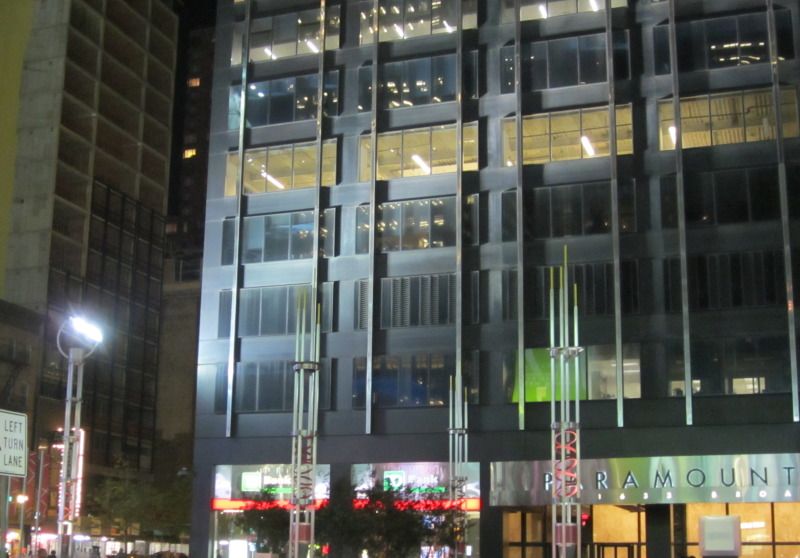
Of course, in Times Square it is a party every night. I had the chance last fall to make my first visit.  I wasn't surprised at how bright it was, but as someone who likes peace and quiet and also advocates for light pollution controls, it was a bit of a shock to my system.

It is a 24/7 display of giant electronic TV's, excessive lighting and more. There certainly is a place for this kind of thing in a few places across the globe but the Times Square ambiance, with over the top lighting and advertising, is a far cry from what most cities need or would want. There currently is a lot of pressure from the billboard industry to bring this kind of advertising to many communities across the U.S. but some groups like Ban Billboard Blight are opposing this.

The lighting in Times Square isn't limited to giant video screens. The buildings themselves are generally illuminated too from within and without. 
Lights like this one at left shine upward to illuminate buildings.
Up light like what is shown above is illegal in communities that have controls on outdoor lighting. I wont argue the "need" for this, but a lot of this light completely misses the target shining up into the sky and not on the buildings at all.

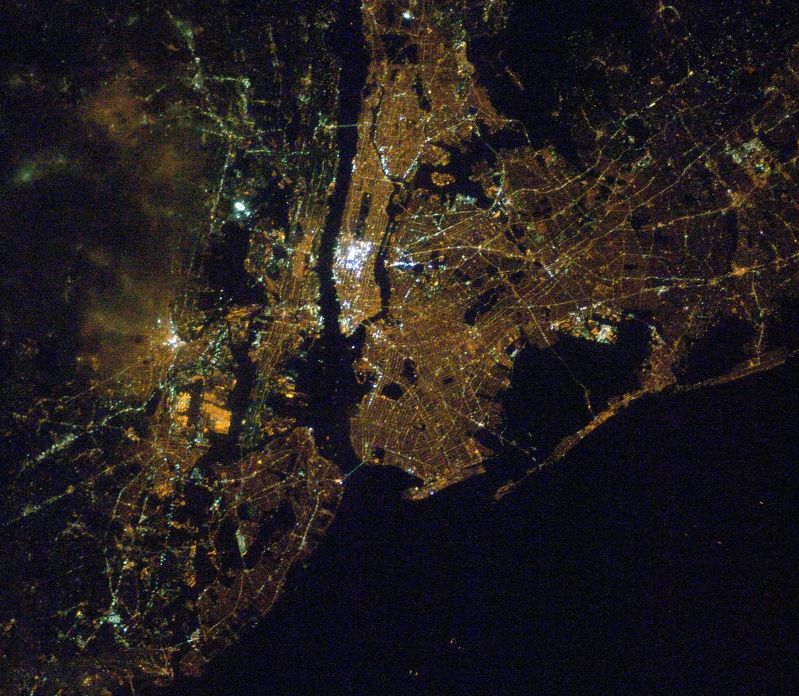
All of this light (from the advertising too) adds up to a lot of light going upwards, which makes Manhattan easy to spot from space at night.
Credit: The Gateway to Astronaut Photography of Earth
The Expedition 16 crew of the International Space Station captured the above image of Manhattan and the surrounding area the night of February 10, 2008. Can you spot it?

Let's zoom in a bit:


The dark area just left of center is the Hudson River and the one at right is the East River.  The dark rectangle near the top is Central Park.  The bright area beneath it is Manhattan and Times Square.  Compare its brightness to just about everything else in the wide image.  Of course, Times Square is all about excess that's why a million people will be there tomorrow night.

Saturday, December 29, 2012

Star Trek: The Corbomite Maneuver

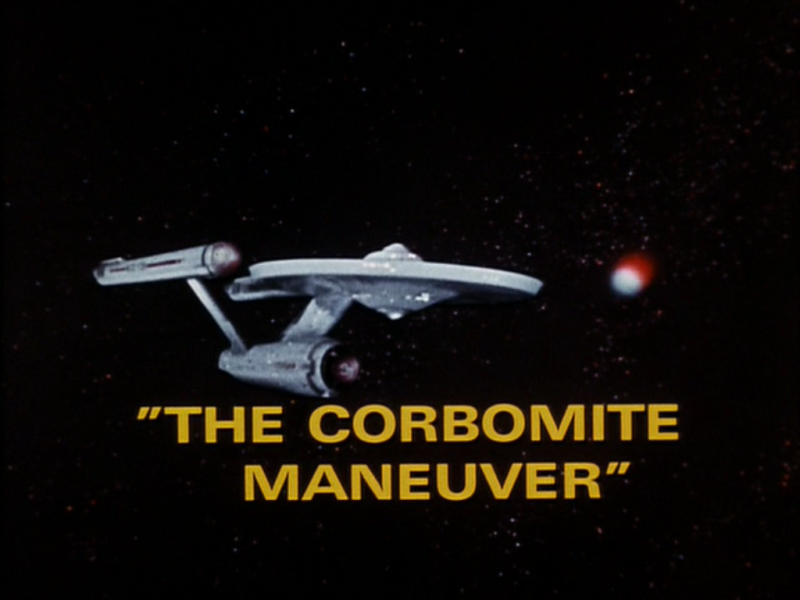
The first episode of the original series of Star Trek produced after the 2 pilot episodes was The Corbomite Maneuver.


Lt. Uhura, Yeoman Rand and Dr. McCoy make their series debut. McCoy's character really makes a mark here as he ignores a red alert to finish a physical on Kirk, is quick to pour drinks with Kirk, challenges Kirk's decisions and more. The writers gave Deforest Kelly some real material to work with here and he did a fine job jumping into the character. While some Trek characters like Spock evolve over time, the audience knows McCoy right away.
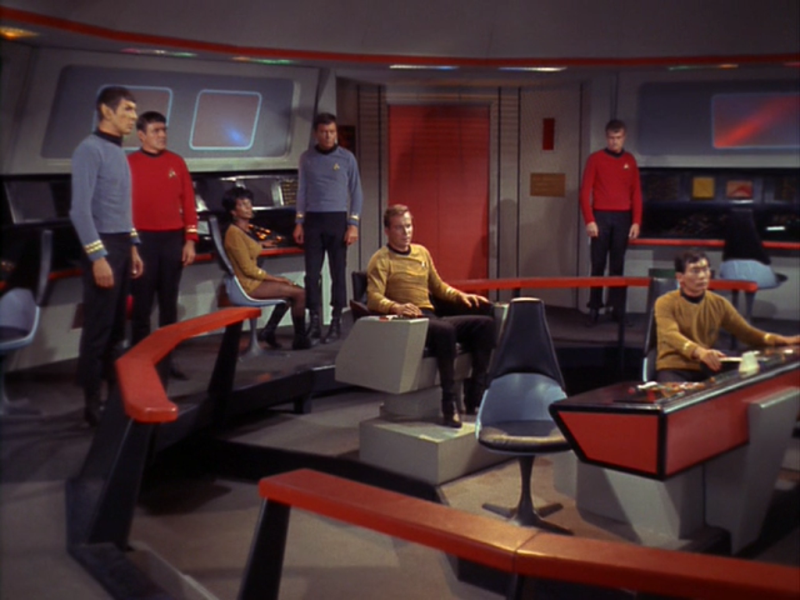
Spock, Scotty, Uhura (in gold!), McCoy, Kirk, a random Red Shirt & Sulu
Just about the only thing that Uhura does is say "Hailing frequencies open, sir." I am guessing here (I didn't actually count them), but she says this nearly dozen times in just this one episode. Perhaps that is why in a future episode she says "sometimes I think if I hear that word frequency once more, I'll cry."

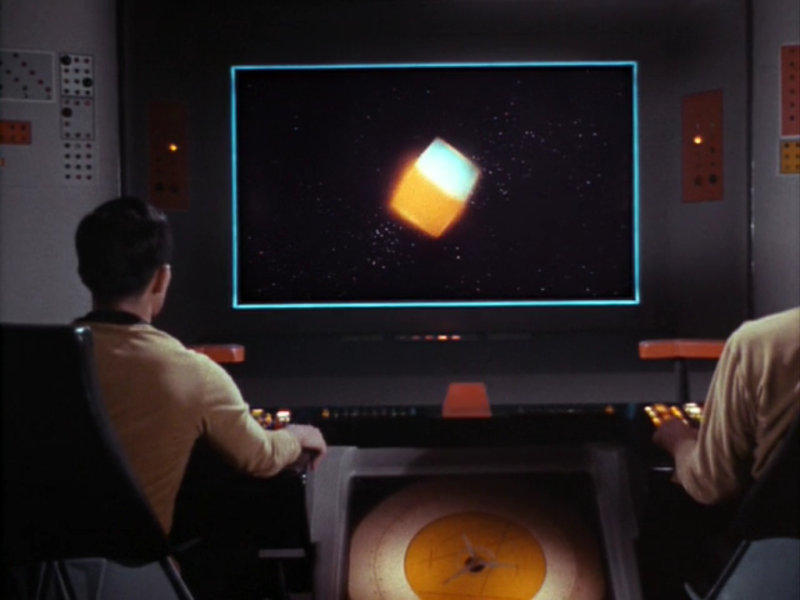
There's plenty here for Kirk, Spock and even Sulu to do react to in the episode. Anthony Call guest stars as the navigator Lt. Bailey, who is overwhelmed by the circumstances. In the episode the Enterprise encounters a rotating Rubik's cube, "some kind of space buoy".


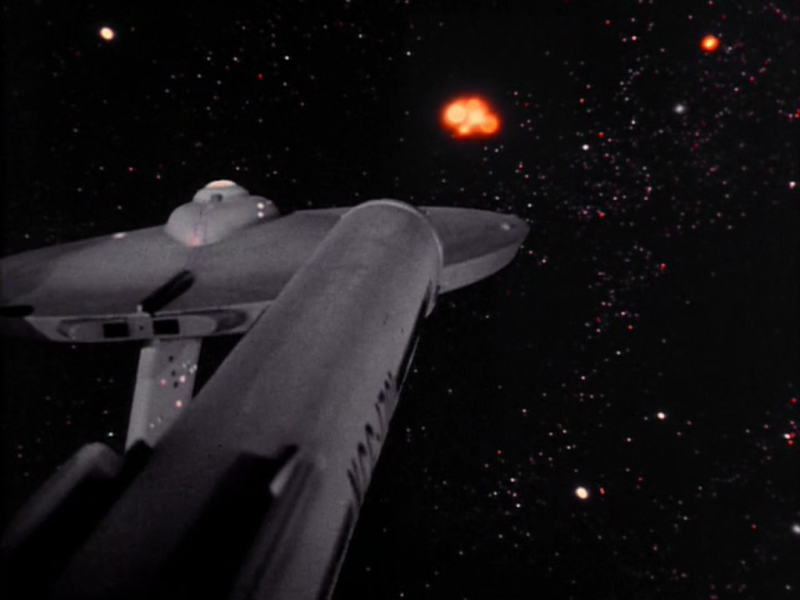
After it blocks their path and emits harmful radiation they destroy the cube only to encounter the Fesarius, a ship that Spock says is nearly a mile in diameter.


The ship's commander, Balok (above, right) threatens to destroy the Enterprise. Kirk counters the threat with a bluff, saying that the Enterprise is carrying Corbomite,  "a material and a device which prevents attack on us. If any destructive energy touches our vessel, a reverse reaction of equal strength is created, destroying the attacker."  He adds, "since the initial use of corbomite more than two of our centuries ago, no attacking vessel has survived the attempt."

The bluff works, Balok backs off in destroying the Enterprise only to launch a small ship that takes it in tow toward a planet of the First Federation.

Naturally, the Enterprise manages to break free, but Balok's ship is damaged in the process.  Everyone (even Spock!) is surprised when Kirk turns the ship around to the damaged vessel and offers aid. Here's how that plays out:
Uhura: A signal, Captain. It's very weak. It's Balok. It's a distress signal to the Fesarius. His engines are out. His life-sustaining system isn't operating. The message is repeating, sir.
Kirk: Any reply?
Uhura: Negative. The signal is growing weak. Sir, I doubt if the mother ship could have heard it.
Kirk: Plot a course for it, Mister Bailey.
Spock: For it, Captain?
Kirk: Dead ahead. [Addressing the crew] This is the Captain speaking. The First Federation vessel is in distress. We're preparing to board it. There are lives at stake. By our standards, alien life but lives nevertheless. Captain out.
Bailey: Course plotted and laid in, sir.
Kirk: Mister Scott, ready the transporter room.
Scott: Aye, sir. (leaves)
Kirk: Mister Sulu, bring us to within one hundred metres. Ahead slow.
Sulu: Ahead slow, sir.
McCoy: Jim, don't you think
Kirk: What's the mission of this vessel, Doctor? To seek out and contact alien life, and an opportunity to demonstrate what our high-sounding words mean. (Addressing everyone on the bridge) Any questions?
This is where Star Trek shines. They stop to render aid to aliens who referred to them as "primitive and savage," who then threatened to kill them. The classic response would be to strike at them while they are down, right? But Kirk and Trek show just what humans of the future are and how we all should be today. It is moments like this one that that make this show special and why I keep going back to Trek.

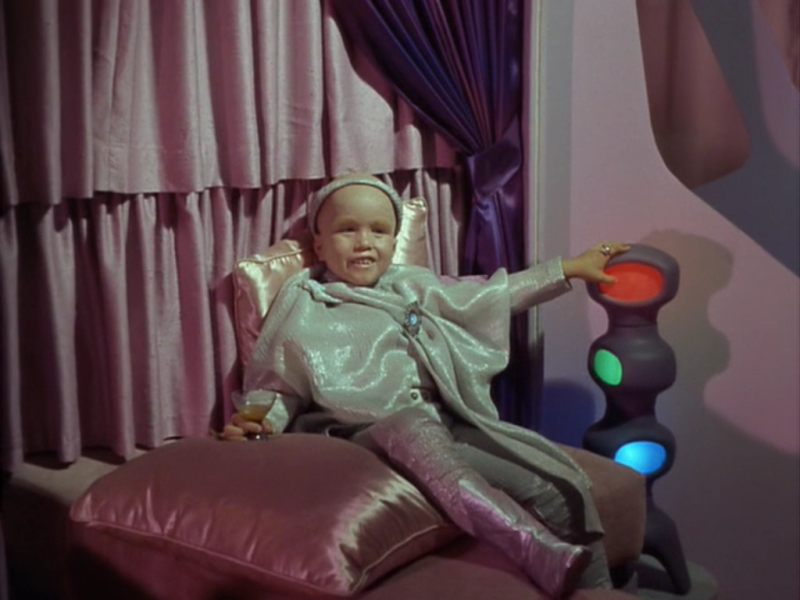
It ultimately turns out the Balok was simply testing them and not at all what anyone suspected. The image of Balok that they saw as no more than a puppet.

It is Clint Howard as the real Balok
Composer Fred Steiner, in his Star Trek debut, wrote just over 7 minutes of music for this episode. The rest was music that was tracked from other episodes. His score first gives a real sense of both the rotation and the danger represented by the space buoy (check out a preview of "Space Cube/Condition Alert"  from La-La Land Records) before then taking on the danger of Balok and the Fesarius. While there isn't much of Fred Steiner's music here, it is good stuff. Fortunately, Steiner returned to provide the music for more episodes.

If you haven't seen The Corbomite Maneuver in a while, track it down and give it another watch. It is worth your time. Next up, Mudd's Women.