Friday, June 10, 2022

Observing Spacecraft

Even though it has been a while since I've updated this blog I've still been doing a lot of backyard astronomy. I've been looking at all the usual stuff (comets, galaxies, asteroids, etc.), but I've also seen a lot of spacecraft. Most of them have been annoying to look at, like this trail from a geostationary satellite crossing into my image of part of the famous Orion Nebula:

Satellites are an ever increasing problem for astronomy as tens of thousands of them are being launched into low-Earth orbit. This is an annoyance for amateur astronomers, but can present serious problems for astronomical observatories both on Earth and in Earth orbit. 

Occasionally it is desirable and even useful to have a look at a satellite or spacecraft. For instance last  November the European Space Agency's (ESA) Solar Orbiter made a close flyby of Earth.


The flyby, which brought the spacecraft less than 300 miles from Earth, was perfectly placed for telescopic observers in North America. Unistellar asked people within their network to observe the event in science mode for ESA and provided an ephemeris which made it easy to know exactly where to point a telescope to observe it. And it was pretty amazing to see.

I observed simultaneously with 2 eVscopes. One was collecting data in science mode, while the other took the image above. The line in the image above is a trailed image of the spacecraft which was visibly moving across the image as the exposure was being taken. The animated gif below shows a speeded up version of the motion of the spacecraft across the field of view (which is rotated from the image above).

The event was a success, I have heard that ESA was happy with the observation campaign and I am glad that I was able to contribute.

About a month later on Christmas day the James Webb Space Telescope finally launched into space and as it moved out to its permanent location in space it was visible to small telescopes here on the ground. 

Here is a sequence of images I took of JWST on January 1st, 2022.

It is visible in the image above as a streak moving from the center towards the upper right. JWST is poised to make significant contributions to astronomy and I was happy to be able to see it. I was one of several observers who contributed science observations of it and we were able to spot changes in brightness as the sunshield unfolded along with other results that will soon be published.

Finally, one other target of note: the International Space Station. The ISS is the largest and brightest of Earth's artificial satellites and it currently has seven people living there. Many amateur astronomers have taken spectacular images of the ISS that show tremendous detail and I was curious to know if I could even spot it at all using a telescope. Thankfully, Unistellar's Ephemeris Generator allows observers to point their telescope at the ISS. The Unistellar telescopes can't track the space station, but instead the telescope it pointed at where it will be at a particular time. 

My first attempt at spotting the station was successful, but the image was pretty terrible:

I was happy that I saw it all, but decided that I could do better and I June 1st I gave it another try. Here's what I saw:

If you blow up one of the frames it looks like this:

Much better. I suspect that I can still improve but the solar arrays, especially on the right, are clearly visible and it is vastly better than my first attempt from May. 

Clear skies!

Sunday, November 7, 2021

Asteroid Encounters

This year I have observed more asteroids than ever before with 29 detected so far. Some them have been as a part of the Unistellar Citizen Science campaigns, but most of them have just been for fun. For instance, earlier this week I looked at the asteroid 626 Notburga which was in the constellation of Cassiopeia.

The image above is an animated gif of two images taken 75 minutes apart showing Notburga's motion though the sky. The individual exposures were short so it wasn't easy spot the nebula that was nearby it in the sky. So in between these two images I took a longer one to try to bring out a part of the Heart Nebula.
 
Here the asteroid appears as a line and there's some hint of the red hydrogen gas of the Heart Nebula across much of the upper right portion of the image. 

Since asteroids look like moving dots or streaks it is sometimes more interesting to catch them when they are near some other astronomical object in the sky. A great resource to find out when as asteroid will be near a bright star, a deep sky object or even another asteroid are the observing guides at MinorPlanet.info. I've used that to find all of the close encounters on this page.

Here are asteroids 712 Boliviana (top right) and 89 Julia (below center) from back in October:

Just this week asteroids 1 Ceres and 1140 Crimea have been passing the bright star Aldebaran.

Aldebaran is the bright star at center. Asteroid (and dwarf planet) 1 Ceres is the bright moving object to its lower right. Much fainter is 1140 Crimea. It is the faint moving dot in the upper left. At the time of the images Crimea was actually 25 million miles closer to Earth than Ceres. That doesn't help it much in brightness though because it is much smaller. 1146 Crimea is just 17 miles across while Ceres is 587 miles across!

In early October asteroid 27 Euterpe passed directly in front of one of my favorite globular star clusters: Messier 22. I caught the event on two nights as the asteroid was near the cluster, but it was cloudy the night it passed in front of it.

Euterpe is to the right of the cluster. At the time it was 21 light minutes from Earth, while the star cluster is some 10.600 light years away.

An even bigger disparity in distance was back in March when asteroid 70 Panopaea passed directly in front of spiral galaxy NGC 3344. 

That night asteroid 70 Panopaea was 17 light minutes from Earth while the spiral galaxy is more than 22 million light years from our Milky Way Galaxy.

In the coming weeks and month I will be looking for more interesting asteroid encounters and posting some of them here.


Friday, October 15, 2021

The Messier Catalog

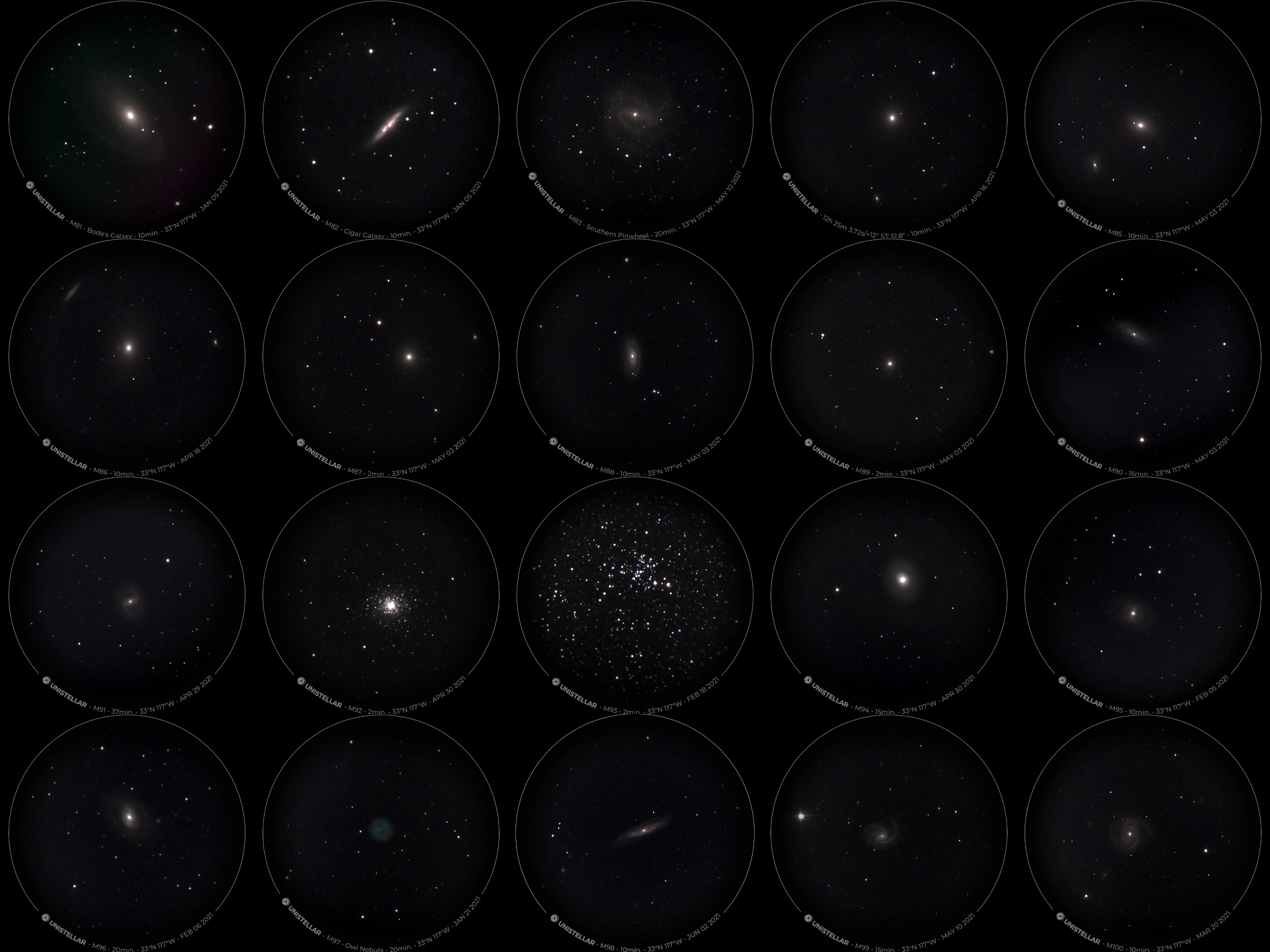
I don't know about you, but I finally kept a New Year's resolution. What was it? To use my Unistellar eVscope to observe and photograph all 110 objects of the Messier Catalog. Yes, I know some people do Messier marathons and catch them all in just one evening, but it takes time if you want to take a photograph each and every one of them. Besides, I do like to sleep. 

I caught my first Messier object this year, the famous Orion Nebula (M42), on January 3rd. The last one that I observed was on October 9th: the galaxy known as M77.

I will certainly be revisiting each and everyone of these objects in the future (especially since I'll will soon have the eVscope2), but for your visual enjoyment here are a few mosaics of the objects of the Messier Catalog.

Messier 1 through 20: 

Messier 21 - 40:

Messier 41 - 60:

Messier 61- 80:

Messier 81 - 100:

 and finally Messier 101 - 110:

I've previously blogged about the globular star clusters and the nebulae of the Messier Catalog and I've still got a few things left to say about the whole thing, but I'll save those thoughts for another time.


Saturday, October 2, 2021

Andromeda and Her Attendants

Our galaxy the Milky Way is one of several dozen galaxies that make up the Local Group of galaxies, which itself is on the outskirts of the much larger Virgo Cluster of galaxies. The largest and most dominant member of the Local Group is the famous Andromeda Galaxy (M31). M31 is thought to be bigger than our Milky Way in just about every way. It is physically larger, more massive and has more stars than the Milky Way.

If you have dark skies and know where to look on these fall evenings you can see M31 with your own eyes as a fuzzy smudge. It is worth making the effort to see it, especially knowing that this galaxy is far enough away that its light travels for 2.5 million years to reach us, making it the farthest thing that humans can usually see without a telescope (Some have claimed to see galaxy M33, which is farther, but spotting that is much more rare and difficult).

A telescope will reveal M31 as a much larger and brighter fuzzy smudge that more than fills up the field of view. It is only through photography that details such as its dark dust lanes become visible. 

The image above is a partial mosaic (that I really need to finish) of the Andromeda Galaxy that I made with my Unistellar eVscope. It reveals two of Andromeda's many companion galaxies. The round, fuzzy object to the upper left of the central portion of M31 is the dwarf elliptical galaxy known as M32 and in the lower right is M110, another dwarf elliptical galaxy that orbits M31. 

To give you a sense of depth, M32 is about 110,000 light years farther from us than M31 is, while M110 is around 400,000 light years past M31.

But M31 has more companions that can be photographed with the eVscope. One of them is NGC 147, the faint smudge at the center of the image below:

 It's not immediately obvious the NGC 147 is a companion to M31, especially since it lies some seven and a half degrees from it in our sky, but they are together in space separated by some 300,000 light years.

NGC 147's nearest neighbor in the sky is NGC 185, another satellite galaxy of M31 (below, center).

These two galaxies are both found in the constellation of Cassiopeia nearly one degree apart from each other. Of the two, NGC 185 is closer to us by some 500,000 light years, which helps to explain why it is the brightest of the two. 

Wikipedia lists more than two dozen other galaxies that are companions of M31 and I believe that all of them are out of reach from my 4.5" telescope, except possibly for one of them. Aside from M31 and the Milky Way Galaxy there is one other spiral galaxy in the Local Group, M33 in the constellation of Triangulum. It's the smallest of the three and might be in orbit around M31, we aren't certain.

At a distance of 2.73 million light years M33 is farther away than M31 and it has a much lower surface brightness too, but it has some interesting structure to it, with both star clusters and nebulae visible within it making it possibly a fine attendant of the princess Andromeda.


Monday, September 13, 2021

Finding Himalia

 You probably already know this but Jupiter has a lot of moons. At last count there are 80 of them.

The orbits of Jupiter's moons shown in SkySafari Pro

Four of the 80 are big, famous and easily seen in just about any telescope. Galileo saw them back in 1610 and they are often referred to as the Galilean Moons. 

From left to right: Europa, Jupiter, Callisto, Io and Ganymede.

Those four moons of Jupiter are often viewed by amateur astronomers, but what about the others? Can they be seen? As it turns out, yes they can. They are small, faint and difficult targets because they are also located somewhat close to the glare of Jupiter.

The largest of Jupiter's moons that isn't one of the famous four Galilean ones is Himalia. Himalia has never been seen from close range by spacecraft, but it is thought to be possibly over 100 miles across.

Himalia's orbit is located far outside the orbits of the Galilean Moons

Himalia is so far from Jupiter that it takes about 250 days for it to complete an orbit. Compare that to Earth's Moon which takes 27 1/3 days or Jupiter's Moon Io which circles Jupiter in just 42 hours. 

While Himalia is far from Jupiter it is still a difficult target to see. The best time to catch Himalia is when Jupiter is closest to Earth. This means that Himalia will be somewhat brighter and there will be a larger apparent gap between it and Jupiter.

I took a look for Himalia about a week after Jupiter's most recent closest approach and found two things. 1) SkySafari, which is an otherwise excellent app, doesn't accurately plot Himalia's position. That's okay, there are other ways to get accurate coordinates for a planetary moon. 2) The glare from Jupiter is excessive. Take a look:

That's an image from August 27th taken with my Unistellar eVscope. Himalia is easily bright enough to be seen with the telescope, but the glow of Jupiter complicates things. When I took a close look at the image I found one star-like object that wasn't where a star should be. To make sure I had the right thing I needed to look again to see if it moved. Himalia's distant orbit around Jupiter means that it is moving pretty slowly through space, but Jupiter itself is moving around the Sun, as is Earth, and means that looking again the next night would place the moon in a different location against the background of the sky. 

Here's my image on August 28th:

The glare from Jupiter is different, but I do have overlapping stars. To see if I caught Himalia I just needed to align and blink the images. Here is the result:

Can you spot it? Yeah, it's difficult. Look on the leftmost third of the image, or, better yet just look below where I cropped and zoomed the images and circled Himalia:


I checked its relative location and relative brightness and I'm confident that I actually bagged it, but I confess that it was trickier than I thought it would be. 

I'll give this a shot next year when Jupiter again is in the proper position to find Himalia.


Saturday, September 11, 2021

In And Out The Window

Here's a photo I took recently of the Milky Way with the constellations of Sagittarius and Scorpius over the rocks of Joshua Tree National Park:

It was taken with my iPhone using a new, free app for iOS called Nocturne

Above those majestic rocks you can see the light of countless stars and the dark silhouettes of cosmic dust clouds. The exact center of the Milky Way is in this general direction, but we can't actually see it. There's so much gas and dust there that the center is invisible to everything except telescopes that can see into the infrared and longer wavelengths (such as radio waves). 

Yet there is an area known as Baade's Window that is somewhat clear of dust and gas allowing us to see objects that are almost as distant as the center of our galaxy. This window is roughly centered on a globular star cluster known as NGC 6522, which is one of two globular star clusters that can be seen in the image below:

This image, which was taken with my Unistellar eVscope, shows globular star cluster NGC 6522 (right of center) and a somewhat smaller globular star cluster known as NGC 6528 (on the left). Even though this view is looking through Baade's Window notice that there are some dark nebulae visible here, especially on the left side of the image.

Determining distances is a somewhat inexact science. Current estimates put the center of the Milky Way at around 26,000 light years from us while NGC 6522 is around 25,000 light years away. That puts it somewhat in the same neighborhood as the center of our galaxy.

Of course within the constellation of Sagittarius we can see things that are farther than the center of the Milky Way, but you have to look in a somewhat different direction. The Milky Way's gas and dust blocks our view across much of Sagittarius which is why astronomers interested in other galaxies have referred to the disk and center of our galaxy as the Zone of Avoidance. 

The image below shows something that is not just on the other side the center of our galaxy, it is actually outside of it.

Can you spot it? It is Barnard's Galaxy (NGC 6822), the large fuzzy area near the middle of the image. Barnard's Galaxy is a dwarf irregular galaxy that's located about 1.6 million light years away. Like the globular star cluster it is also in the constellation of Sagittarius, but it is not seen in the same direction as the plane of our galaxy and the Zone of Avoidance.

 Here's the same image as before, but cropped on the galaxy itself. Notice the two blue regions near the top of the galaxy. Those are vast gas clouds of gas (nebulae) within the galaxy. I am still impressed that I can catch them with a 4.5" telescope.

Sagittarius is a big constellation. This view from SkySafari Pro shows the locations of these objects. The globular star cluster is on the edge of the spout in the Teapot of Sagittarius and very much in the heart of the Milky Way. While Barnard's Galaxy (top, left) is well outside the Zone of Avoidance. If it were in a different part of Sagittarius we might not even know that it was there at all.


Wednesday, September 8, 2021

Recent Shots of the Cosmos

I've  got a few projects that I am working on right now that I will eventually blog about, but they're not quite finished, so I thought I would just drop some of my recent astrophotos here instead.

Last weekend I was at Joshua Tree National Park for their Night Sky Festival. I was running a telescope for Unistellar and showing off the coolest astronomical objects of the night sky. I was also on a secret mission to show a few objects that were part of a theme that led up to a successful marriage proposal. The final object just before the question was popped was NGC 6781, the Little Ring Nebula:

The Little Ring Nebula is a planetary nebula which is a bubble of gas that is being given off by a dying star. It is located a few thousand light years from our Solar System in the constellation of Aquila, the Eagle.

Also, located in Aquila is the dark nebula known as Barnard 143, which, along with Barnard 142, makes up what is sometimes called Barnard's E. 

Like with the other dark nebulae I've blogged about it is a dense cloud of cosmic dust that is blocking the light of the stars behind it. 

Our Milky Way galaxy is dusty, which is typical of spiral galaxies. We can see these dust clouds in our own galaxy and we can see them in other galaxies too, such as this one:

NGC 891 is a spiral galaxy that we are seeing from the side, which make its dust lanes easy to spot. It is located nearly 30 million light years away in the direction of the constellation of Andromeda. 

Here's another galaxy located in Andromeda. It is both closer and smaller than NGC 891.

The really bright thing is a red giant star in our own galaxy known as Mirach (aka Beta Andromedae). It's about 200 light years from us. The galaxy in this image is the fuzzy smudge that is up and left from Mirach. It is cataloged as NGC 404 and often referred to as Mirach's Ghost, because it almost looks like a reflection of the brighter star. Mirach's Ghost is a dwarf galaxy that's around 3 times closer to us than NGC 891 is. 

That's all for now. I've got an elusive object to try to hunt down.