It takes careful work to
wash a telescope mirror, especially one that is 8.1 meters across and still installed in its telescope. Here is a cool video that shows off the process as it is done for the Gemini South telescope.
Friday, May 11, 2012

Wednesday, May 9, 2012
Two Steps Backwards for Dark Skies (and a pretty video)
The electronic billboard bill is now law in Arizona meaning that while the state's astronomical observatories are protected from their bright glow, the central and southwestern part of the state will now be no man's land.
The City of San Diego will now apparently be allowing "brighter outdoor lighting". According to this news report:
In other news the winners of the 2012 Earth and Sky Photo Contest have been announced. Follow the link to check out the beautiful photos of the night sky. A video of them is embedded below. Maybe it will help to push the other news out of your mind.
The City of San Diego will now apparently be allowing "brighter outdoor lighting". According to this news report:
The report says the last changes, made in 2008, were overly influenced by astronomers and "dark sky advocates."Sigh. "Dark sky advocates".
In other news the winners of the 2012 Earth and Sky Photo Contest have been announced. Follow the link to check out the beautiful photos of the night sky. A video of them is embedded below. Maybe it will help to push the other news out of your mind.
Wednesday, April 25, 2012
Electronic Billboards Again Threaten Arizona Skies
Several weeks ago Arizona made the news as Governor Jan Brewer vetoed legislation that would have allowed wide-spread use of electronic billboards in the state. Well, there is a new measure advancing to do the same. This time there are protections in place for the state's astronomical observatories but not for people living in the central and western portions of Arizona.
From Scenic Arizona earlier today:
From Scenic Arizona earlier today:
Dear Billboard Watchers, Preventionists & Friends of Dark Skies:The electronic billboard bill (see attached) came out of the partisan caucuses today in both the Senate and the House. Final votes will likely occur tomorrow. Please contact your senators and representatives and ask them to vote against the bill on Final Read. You should be particularly strident if you live in any of the following counties/areas: Maricopa, Yuma, La Paz or the Apache Junction/Gold Canyon area of Pinal. Electronic billboards would be (lawfully) allowed in these counties/areas for the first time since 1970 and the amended bill does not offer even the most basic protections that other states have enacted when they have rolled over for the billboard industry. For example, in Texas electronic billboard panels facing the same direction on a roadway have to be at least 1500 feet apart for boards on both sides of the street. In contrast, billboards on a state highway inside a municipality in Arizona would only have to be 100 feet apart on the same side of the roadway (e.g., Grand Avenue in Phoenix, Glendale, etc.). Furthermore, the bill now includes an unnecessary emergency clause that would preclude citizens from exercising their constitutional right of referendum (is this even legal?) and would preclude cities and counties from adopting timely moratoria to get their local codes in order prior to the onslaught that is surely coming from the billboard industry (however, since the both ADOT and the Attorney General's Office are (incredibly or not so incredibly) refusing to follow the law and stop issuing permits for electronic billboards, there is a downside risk in opposing the emergency clause).The amended bill is a result of an 11th hour deal between the major observatories and the billboard industry under heavy pressure from the latter. The observatories did at least stick to their guns on keeping the prohibition in place outside of the county areas mentioned above. Preserving that prohibition is at least a partial victory that we all should celebrate. However, Scenic Arizona, the Neighborhood Coalition of Greater Phoenix, the Sierra Club and other active opponents of the bill were precluded from the negotiations and did not and could not endorse any compromise that does not offer at least some limitations on these monstrous and blinding eyesores that will proliferate in the allowed zone. Even for those that live in the still protected zone, travel to and through the Phoenix area occurs often enough and we all must stand behind those that live in the allowed zone who are getting nothing meaningful out of the amended bill.
The House Member Roster is at: http://www.azleg.gov/MemberRoster.asp?Body=H. Senate Members Roster: http://www.azleg.gov/MemberRoster.asp?Body=S Beginning tomorrow morning, telephone calls are preferable to emails for brief communications (for those outside of the Phoenix area, note the toll-free number: 1-800-352-8404). Use email for more detailed messages. Make sure to indentify yourself as a constituent of the district. If you don't know which district you are in, you can refer to http://www.azleg.gov/alisStaticPages/ HowToContactMember.asp .
Sunday, March 18, 2012
Which Cities Have Lighting Controls? You can Spot them from Space.
Yesterday I shared this picture on Facebook & via Twitter:
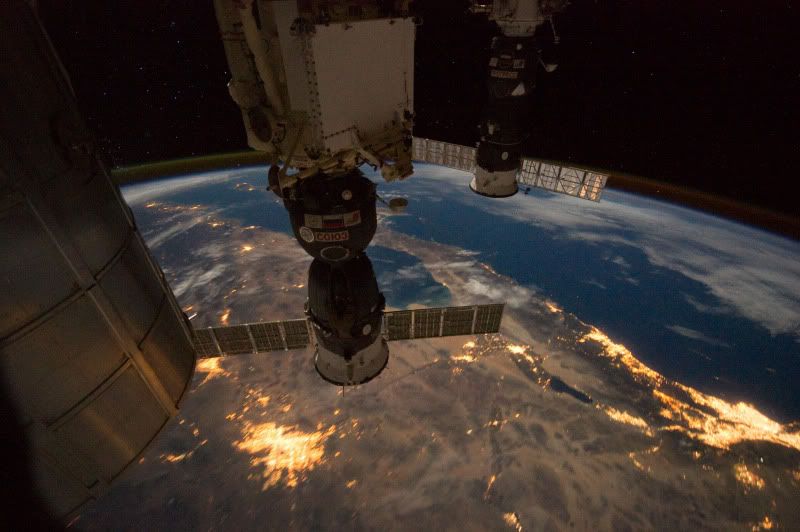
I guess it made at least somewhat of a splash because it ended up today in the San Diego Union Tribune newspaper. My point was to show the city lights as a discussion point for light pollution, energy waste, etc. No mention of that made it into the paper, although the reporter did point out that I work for the International Dark-Sky Association.
For those who do not recognize the scene below the International Space Station, the coastlines of southwest California and Baja Mexico are visible as well as (from left to right along the coast) the city lights of Tijuana, San Diego and Orange County. The big city well inland is Phoenix, AZ (South is left of up in this view).
Here is another view that covers some of the same geography, but looking almost 180 degrees in a different direction and without the ISS taking up so much of the frame:

This time the Sea of Cortez is in the lower center, with Baja and the lights of the California cities on the left (North is left of up). Also visible inland (from left to right) are Las Vegas, Phoenix and Tucson. Here's an annotated version to help you find them:

You probably already know the answer to this, but which of these cities have lighting controls? Notice that the lights of Las Vegas look white - they have saturated that portion of the camera's electronic detector. Like everything in Las Vegas, its lights are also famous for being over the top. The light polluting sky glow produced there is visible from hundreds of miles away and proves that what is illuminated in Vegas does not stay there.
The brightest city in Arizona, Phoenix, is bigger than Las Vegas. While it is a very large source of light pollution, notice that its core is not a intensely illuminated as that of Vegas. Tucson is certainly bigger than Vegas, but it is much dimmer. That's the result light pollution controls put in place there. The latest revision of Tucson/Pima County Outdoor Lighting Code was put in place just last week and should help to keep Southern Arizona friendly for astronomy for some time to come.
Can you spot Flagstaff? It became the world's first International Dark-Sky City in 2001. It is smaller than Tucson and has even tighter lighting controls. I believe that you'll find it just to the left of the "P" in Phoenix.
Coming back to California, can you tell which cities have lighting controls? Look at the LA & San Diego areas. There is a difference.
I guess it made at least somewhat of a splash because it ended up today in the San Diego Union Tribune newspaper. My point was to show the city lights as a discussion point for light pollution, energy waste, etc. No mention of that made it into the paper, although the reporter did point out that I work for the International Dark-Sky Association.
For those who do not recognize the scene below the International Space Station, the coastlines of southwest California and Baja Mexico are visible as well as (from left to right along the coast) the city lights of Tijuana, San Diego and Orange County. The big city well inland is Phoenix, AZ (South is left of up in this view).
Here is another view that covers some of the same geography, but looking almost 180 degrees in a different direction and without the ISS taking up so much of the frame:
This time the Sea of Cortez is in the lower center, with Baja and the lights of the California cities on the left (North is left of up). Also visible inland (from left to right) are Las Vegas, Phoenix and Tucson. Here's an annotated version to help you find them:
You probably already know the answer to this, but which of these cities have lighting controls? Notice that the lights of Las Vegas look white - they have saturated that portion of the camera's electronic detector. Like everything in Las Vegas, its lights are also famous for being over the top. The light polluting sky glow produced there is visible from hundreds of miles away and proves that what is illuminated in Vegas does not stay there.
The brightest city in Arizona, Phoenix, is bigger than Las Vegas. While it is a very large source of light pollution, notice that its core is not a intensely illuminated as that of Vegas. Tucson is certainly bigger than Vegas, but it is much dimmer. That's the result light pollution controls put in place there. The latest revision of Tucson/Pima County Outdoor Lighting Code was put in place just last week and should help to keep Southern Arizona friendly for astronomy for some time to come.
Can you spot Flagstaff? It became the world's first International Dark-Sky City in 2001. It is smaller than Tucson and has even tighter lighting controls. I believe that you'll find it just to the left of the "P" in Phoenix.
Coming back to California, can you tell which cities have lighting controls? Look at the LA & San Diego areas. There is a difference.
Saturday, March 17, 2012
Help End the Waste of Light Pollution
The standard technique in the digital age to take star trail photos is to take a series of still photos and then combine them into one single image like this one:
 The resulting image is a dramatic view that shows stars trailing across the image as a result of Earth's rotation. Polaris (aka "the North Star") is the nearly stationary star near the upper left. In this shot the telescope dome also moved several times giving it an odd look.
I used StarStaX to combine the images. It is a free program for the Mac that is very easy to use and gives great results.
If you have been reading this blog you know I have been spending a fair amount of time looking at the remarkable photography coming from the International Space Station (ISS) - the astronauts have been taking images of Earth and its cities from their vantage point in space.
The resulting movies, like the one linked in my last post, vividly show off their view from on high and that the glow of city lights can easily be seen from space. Since the individual frames for the movies are available, I decided to try some "star trail photography" using the images from the ISS. The result was this jaw-dropping image:

The shot was produced by adding some 900 frames taken as the astronauts passed from SW Texas to New Brunswick, Canada. It vividly shows that, even from space, the lights of our cities are dramatically brighter than the stars. The city lights form bright streaks across the view. They are the result of poorly directed light, a waste of energy almost too large to comprehend.
Next, I created a time-lapse movie from the images, stuck on the original movie and gave it a bit of narration. Here's the result:
The problem of light pollution is not unique to North America. This view of the European Union shows that continental Europe also has a lot of work to do in switching to more environmentally-friendly lighting.

It doesn't have to be this way. The International Dark-Sky Association is working to end light pollution, but your help is needed. By joining the IDA you can contribute to the cause and help the environment by cutting energy waste, greenhouse gas emissions and sky glow. This can all be done by using responsible lighting that still provides for safety and security while limiting light pollution.
I used StarStaX to combine the images. It is a free program for the Mac that is very easy to use and gives great results.
If you have been reading this blog you know I have been spending a fair amount of time looking at the remarkable photography coming from the International Space Station (ISS) - the astronauts have been taking images of Earth and its cities from their vantage point in space.
The resulting movies, like the one linked in my last post, vividly show off their view from on high and that the glow of city lights can easily be seen from space. Since the individual frames for the movies are available, I decided to try some "star trail photography" using the images from the ISS. The result was this jaw-dropping image:
The shot was produced by adding some 900 frames taken as the astronauts passed from SW Texas to New Brunswick, Canada. It vividly shows that, even from space, the lights of our cities are dramatically brighter than the stars. The city lights form bright streaks across the view. They are the result of poorly directed light, a waste of energy almost too large to comprehend.
Next, I created a time-lapse movie from the images, stuck on the original movie and gave it a bit of narration. Here's the result:
The problem of light pollution is not unique to North America. This view of the European Union shows that continental Europe also has a lot of work to do in switching to more environmentally-friendly lighting.
It doesn't have to be this way. The International Dark-Sky Association is working to end light pollution, but your help is needed. By joining the IDA you can contribute to the cause and help the environment by cutting energy waste, greenhouse gas emissions and sky glow. This can all be done by using responsible lighting that still provides for safety and security while limiting light pollution.
Saturday, February 11, 2012
A Pass Over North America at Night with Annotated Stills
The videos from the International Space Station keep on coming. The astronauts are now shooting them at the rate of one frame per second, which gives a much closer resemblance to the true speed of the International Space Station than was shown in their previous videos. This sequence was captured January 30, 2012.
I grabbed some of the individual images from the sequence and annotated them to give you some reference points.
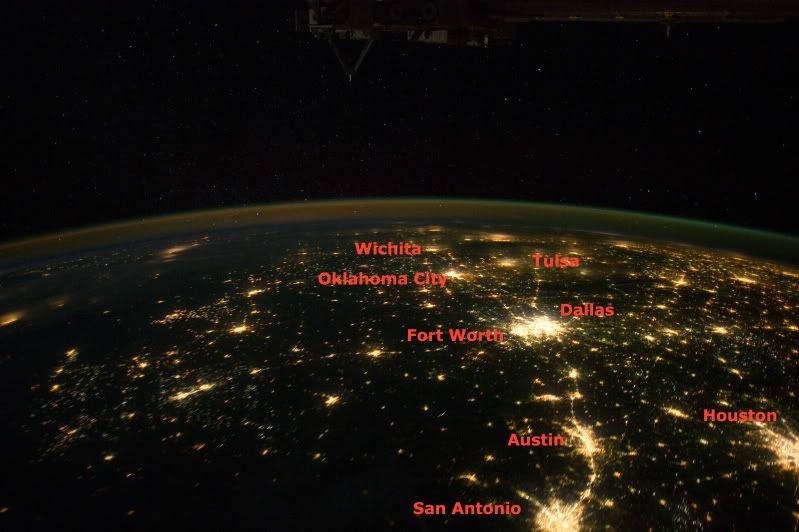
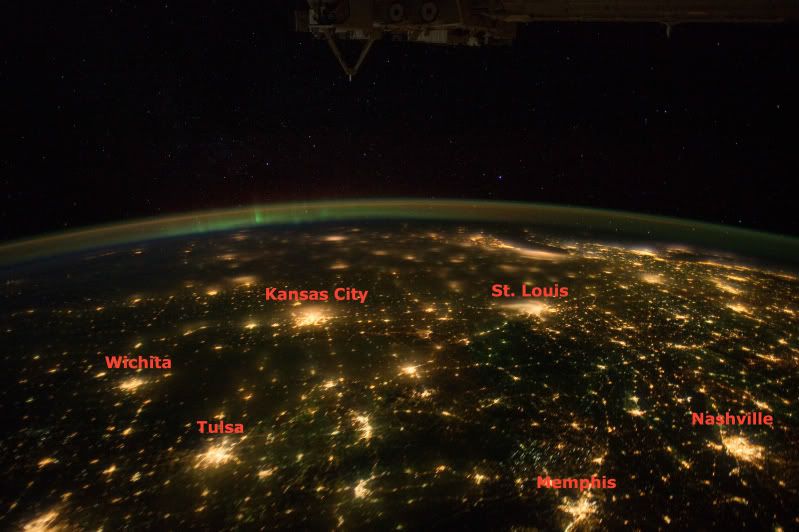
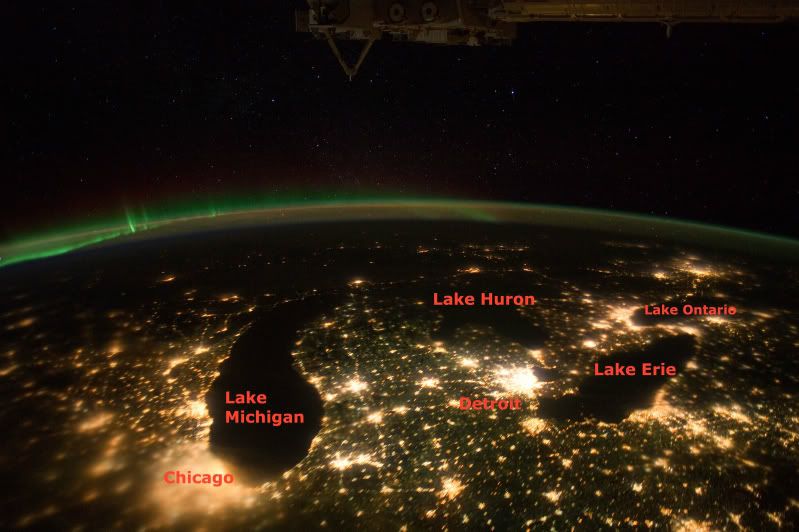
The ISS photographed three International Dark Sky Parks in this passage. Can you name them? I will point them out in a follow up post.
I grabbed some of the individual images from the sequence and annotated them to give you some reference points.
The ISS photographed three International Dark Sky Parks in this passage. Can you name them? I will point them out in a follow up post.
Monday, February 6, 2012
Red Aurora Australis
Here's a beautiful time-lapse video of the southern Milky Way (including the Magellanic Clouds) and the Aurora Australis. Enjoy!
Red Aurora Australis from Alex Cherney on Vimeo.
Subscribe to:
Posts (Atom)