Last night I gave a talk at Wavelength Brewing Company in Vista, California. They live-streamed the event through their Facebook page and you can watch it here:
Showing posts with label light pollution. Show all posts
Showing posts with label light pollution. Show all posts
Saturday, June 25, 2016

Monday, September 28, 2015
Lunar Eclipse 2.0
We had a wonderful sky show last night. Was it a Super Moon? A Blood Moon? Nah, it was just your basic (but quite beautiful) total lunar eclipse. Our second of 2015. I enjoyed the event with a bunch of college astronomy students and members of the general public at an observing session last night.
 Way out west here in California (where I now reside) the eclipse had already begun at moonrise. It was a nice sight seeing the Moon rise in the east already partially eclipsed, but the real show began as darkness fell and the Moon advanced further into Earth's shadow.
 Here it is, nearly total, through a thin layer of cirrus clouds.
 Ah, totality.

 Here are some people in silhouette seen against the city lights of San Marcos and Vista. Their glow illuminates the cirrus clouds. The Big Dipper can be seen through the clouds. With all this this light pollution it is hard to imagine that the Milky Way was visible from our observing site, but it was.
Saturday, June 6, 2015
Telescope Tourist: Kitt Peak & Mont-Mégantic Observatories
Recently I had the chance to visit two observatories in the same week, the first was Kitt Peak National Observatory. As a native and current resident of Tucson, Arizona it's not unusual for me to have the opportunity to visit Kitt Peak. This time was a bit unusual though, as I was there to make an evening presentation on light pollution.
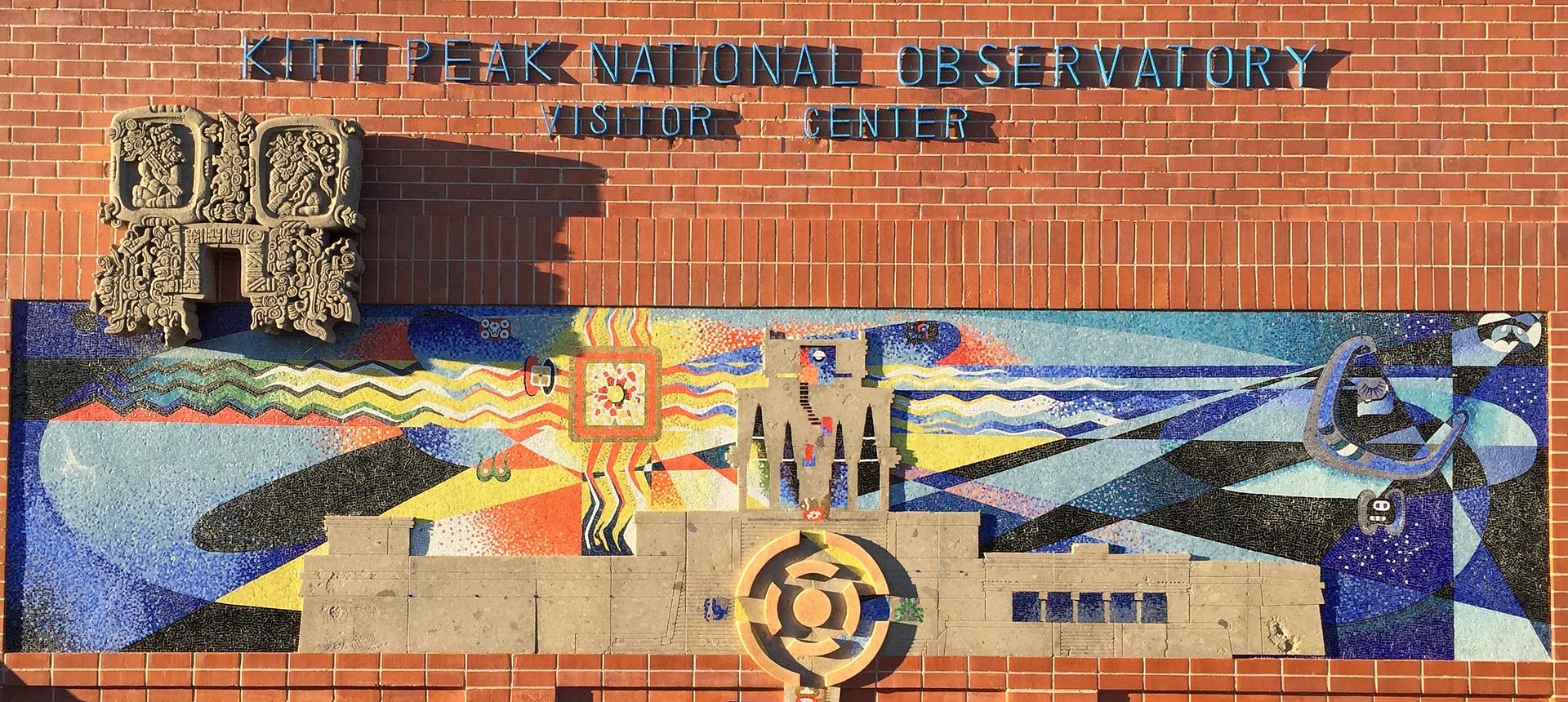 I really love the mosaic at the observatory's visitor center (For some detailed shots of it, have a look here). Nearby there's a second, much smaller mosaic on the building that's also pretty cool. It's located around the corner to the left and it looks like this:
 This one depicts the dome of the 4-meter Mayall Telescope sitting on the mountain with a comet above. Speaking of the Mayall, it was a sunset visit to this telescope that made this trip so special.
 Here's the view from out in front of the Mayall, looking back at the rest of the mountain. Kitt Peak has one of the largest telescope concentrations on Earth. That's the McMath-Pierce Solar Telescope at left and the Steward Observatory 90" (2.3 meter) Bok Telescope in the foreground at right.
 Heading inside the dome, we arrived just in time to see the last orange rays of sunlight kissing the Mayall.
 Soon it was dark enough for its astronomical research mission to begin. We snapped a few photos and were soon ushered out. Seeing big scopes (well these days, with BIG super telescopes just around the corner, 4 and 5 meter telescopes are called small) is always a treat and this was no exception.
The next morning I was off to Sherbrooke in Québec, Canada to attend the Third International Conference on Artificial Light at Night. The conference included a field trip to Observatoire Astronomique du Mont-Mégantic.
 In 2008 the International Dark-Sky Association designated Mont-Mégantic as the world's first International Dark Sky Reserve. At the heart of the reserve is a research observatory and their visitor center, the ASTROLab.
 The ASTROLab has a wonderful array of astronomical exhibits, a gift shop, a theater and more.
 Uphill, and behind a gate from there is their is their 1.6 meter telescope, the largest research telescope in eastern North America. That's its dome above, illuminated by moonlight.
 For the telescope geeks, here's the telescope's aluminizing chamber located on the ground floor. Periodically telescope's primary mirror needs a new reflective coating of aluminum, which means the mirror needs to be pulled from the telescope, washed and stripped of its old coating. Then the mirror is carefully lowered through a trap door and placed inside this chamber, where a new coating of aluminum is vacuum-deposited on the mirror.
 Located in another dome nearby is their so called "Popular Observatory" (I suppose that means the 1.6 meter is unpopular). I didn't photograph it, but inside the dome of the Popular Observatory is a 0.61 meter (24-inch) telescope and nice theater-style seating, making this telescope perfect for public outreach programs. I guess that's what makes it so popular!
In spite of the total mechanical breakdown of the bus on our field trip (don't ask), it was a wonderful trip and I'm glad to have made the visit to Mont-Mégantic. I very much recommend the trip.
The next morning I was off to Sherbrooke in Québec, Canada to attend the Third International Conference on Artificial Light at Night. The conference included a field trip to Observatoire Astronomique du Mont-Mégantic.
In spite of the total mechanical breakdown of the bus on our field trip (don't ask), it was a wonderful trip and I'm glad to have made the visit to Mont-Mégantic. I very much recommend the trip.
Sunday, May 3, 2015
Night Flights - Spring, 2015
In April, I flew to Newark, New Jersey to attend the Northeast Astronomy Expo (NEAF) and the annual board meeting of the Astronomy Foundation. As I got closer to my destination, darkness was falling and I took advantage of my window seat to take iPhone pics of the city lights below.
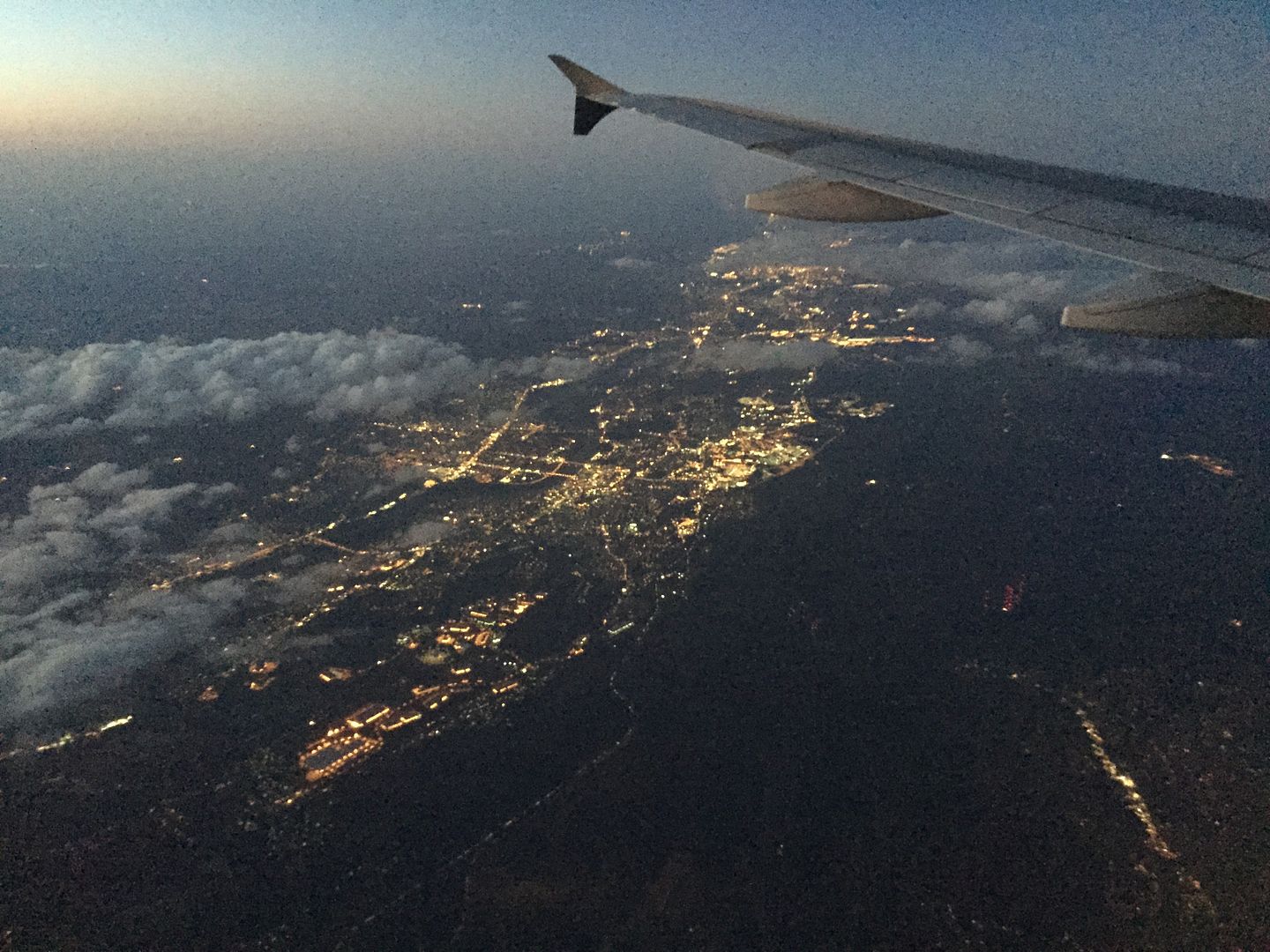 According to the location info that came with the pic, the shot above shows Solcum, Pennsylvania. It was taken in twilight, while it was still light enough to see the wing of the plane, the sky and the clouds illuminated naturally.
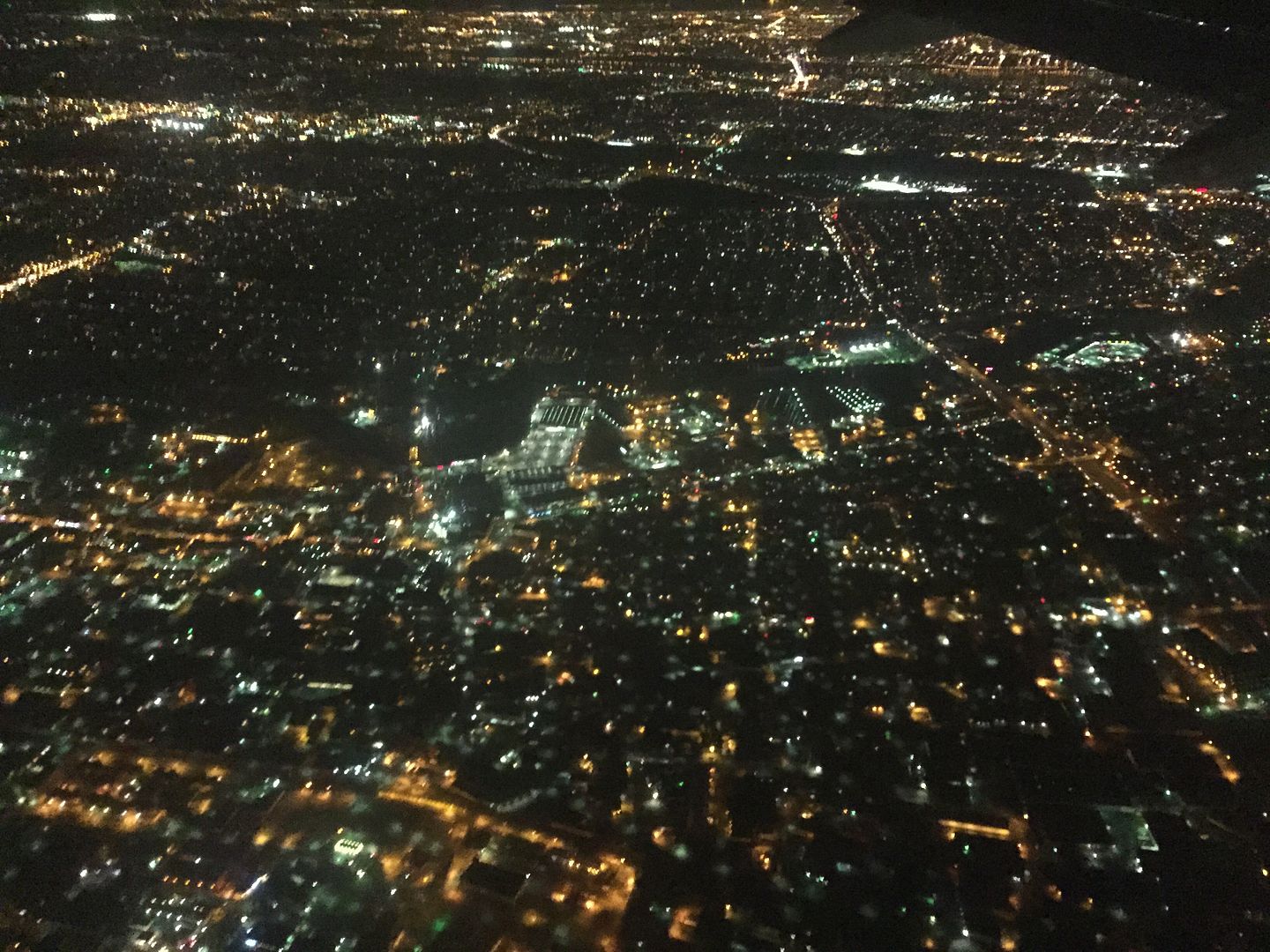 Above, the many lights of Hackensack, New Jersey.
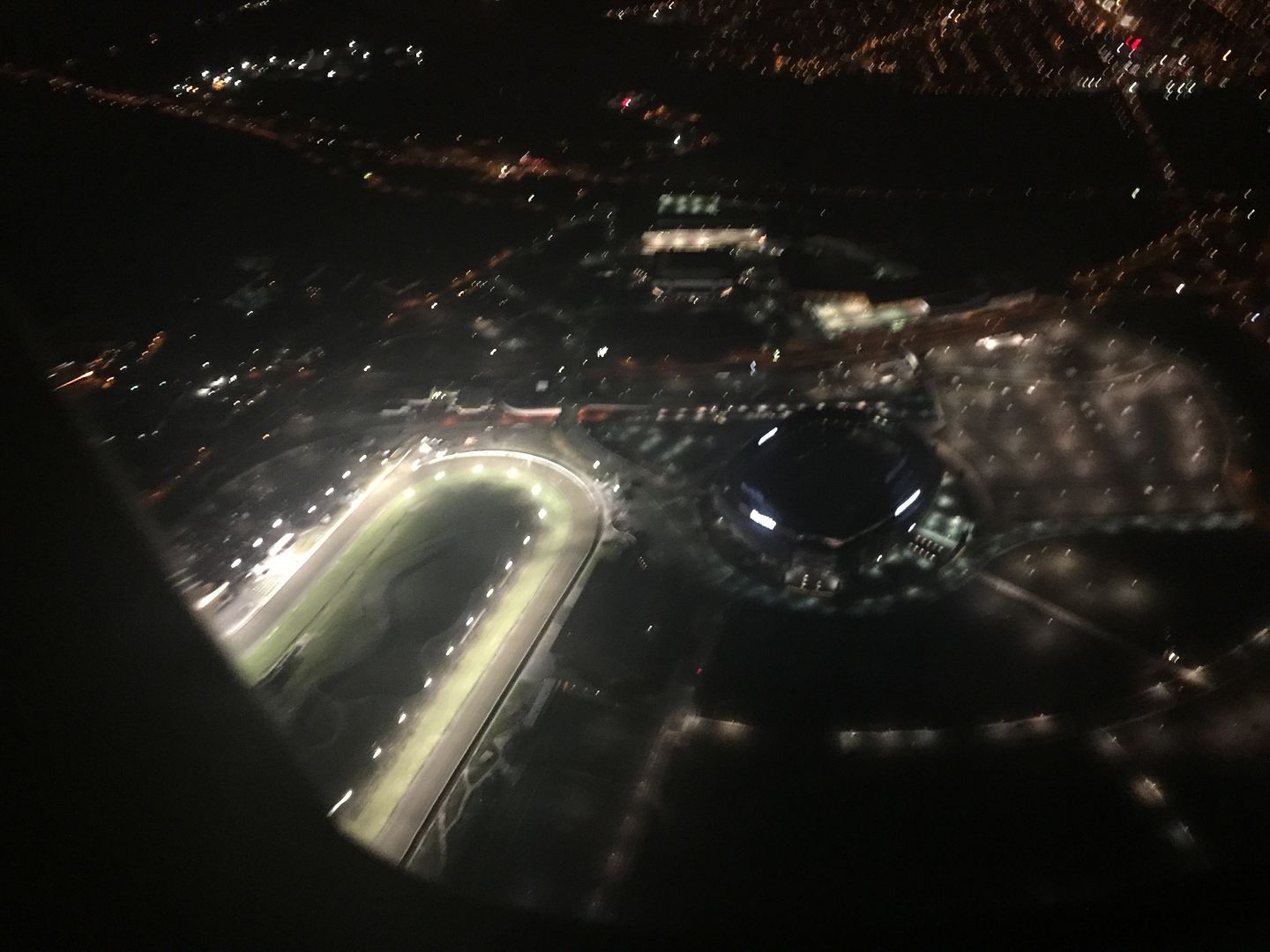 On our approach to Newark, we passed almost directly above the Meadowlands Racetrack. As you can see, it is crazy bright. Which makes sense if, you know, you are racing at night. I didn't see any signs of activity though, which made me wonder why all the lights were turned on. The track is bright enough at night to be seen from space - more on that in a moment.
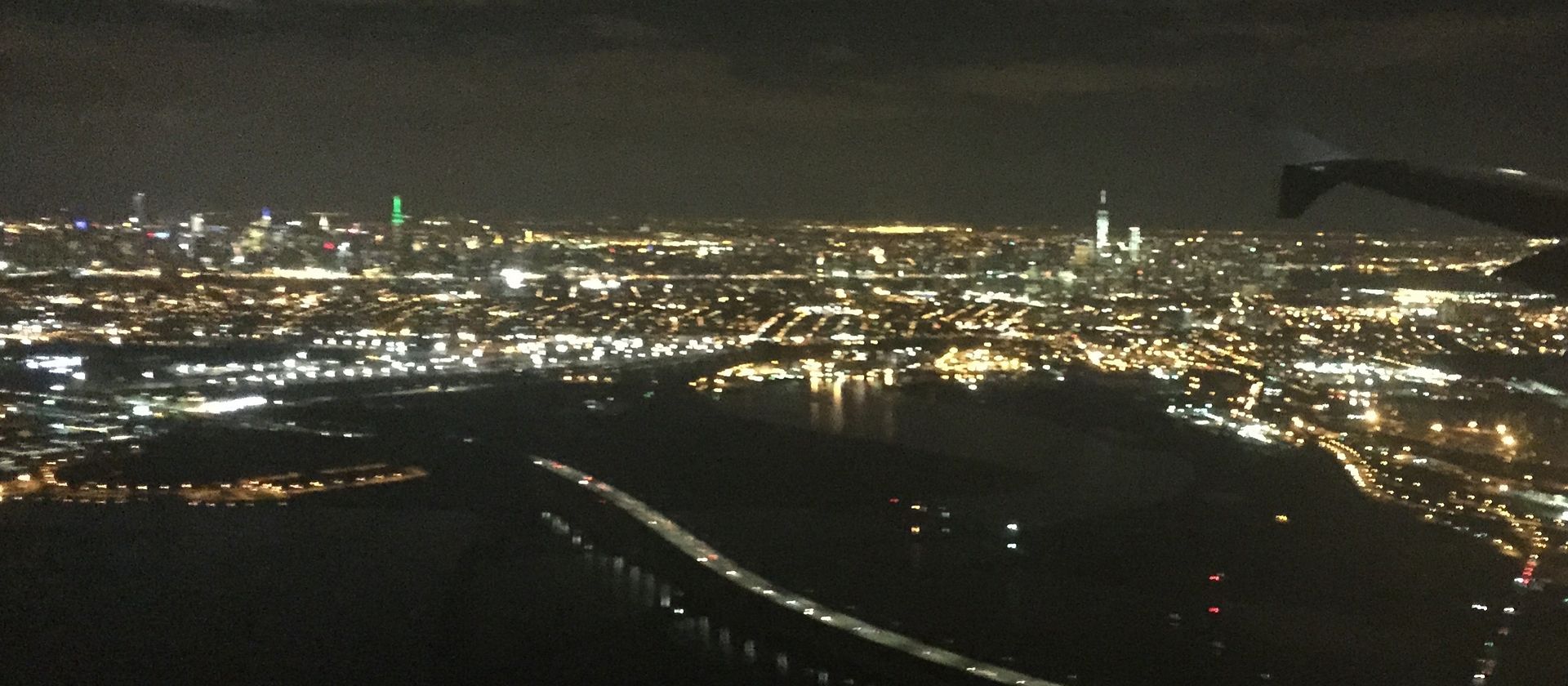 I also had a this great, but not especially close, view of the New York City skyline. That's the Empire State Building near the left lit up in green. My geography of Manhattan is a bit weak, so I leave the identification of the other tall buildings as an exercise to the reader.
While we're here, let's check out the last two scenes from space.
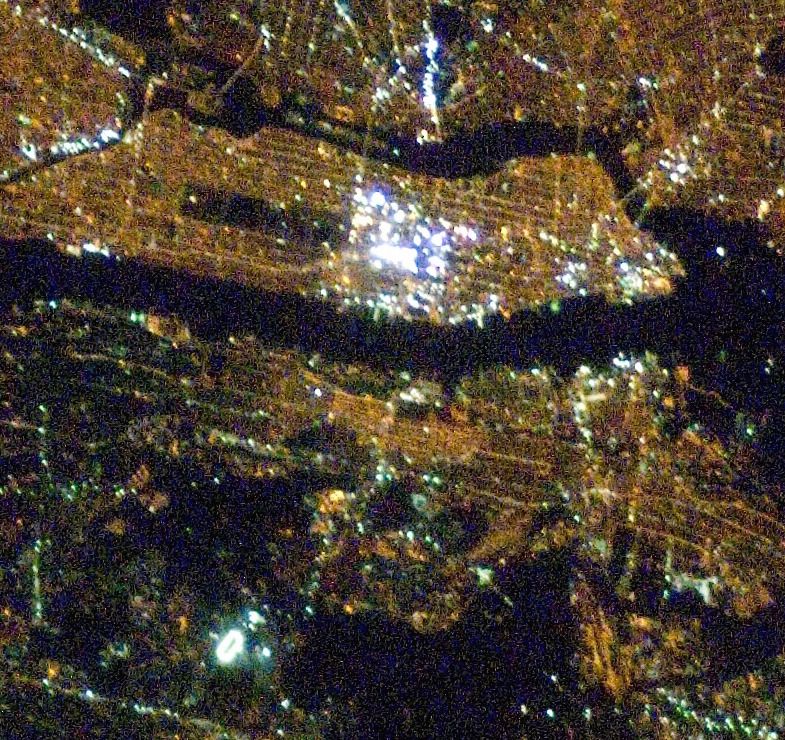
I used this pic in my Times Square from Space post from a few years ago, but it's worth seeing again. The photo was taken from the International Space Station & I've cropped it from the full frame and North is to the left (sorry). The Meadowlands Racetrack is easily visible as a bright oval in the lower left. Across the dark Hudson River lies the very brightest section of NYC and just to the left of that is the relatively dark rectangle of Central Park. The orange color that is virtually everywhere comes from high-pressure sodium streetlights. NYC is in the process of converting their lights from their existing orange lights to white LED. For good reasons not everybody is happy about it, and it will be interesting to see how the view from space changes as the conversion happens.
Earlier this week I had a window seat on a night flight from Phoenix Sky Harbor Airport to San Diego's Lindbergh Field. Naturally, I grabbed my iPhone and took pics of the city lights on this flight too.
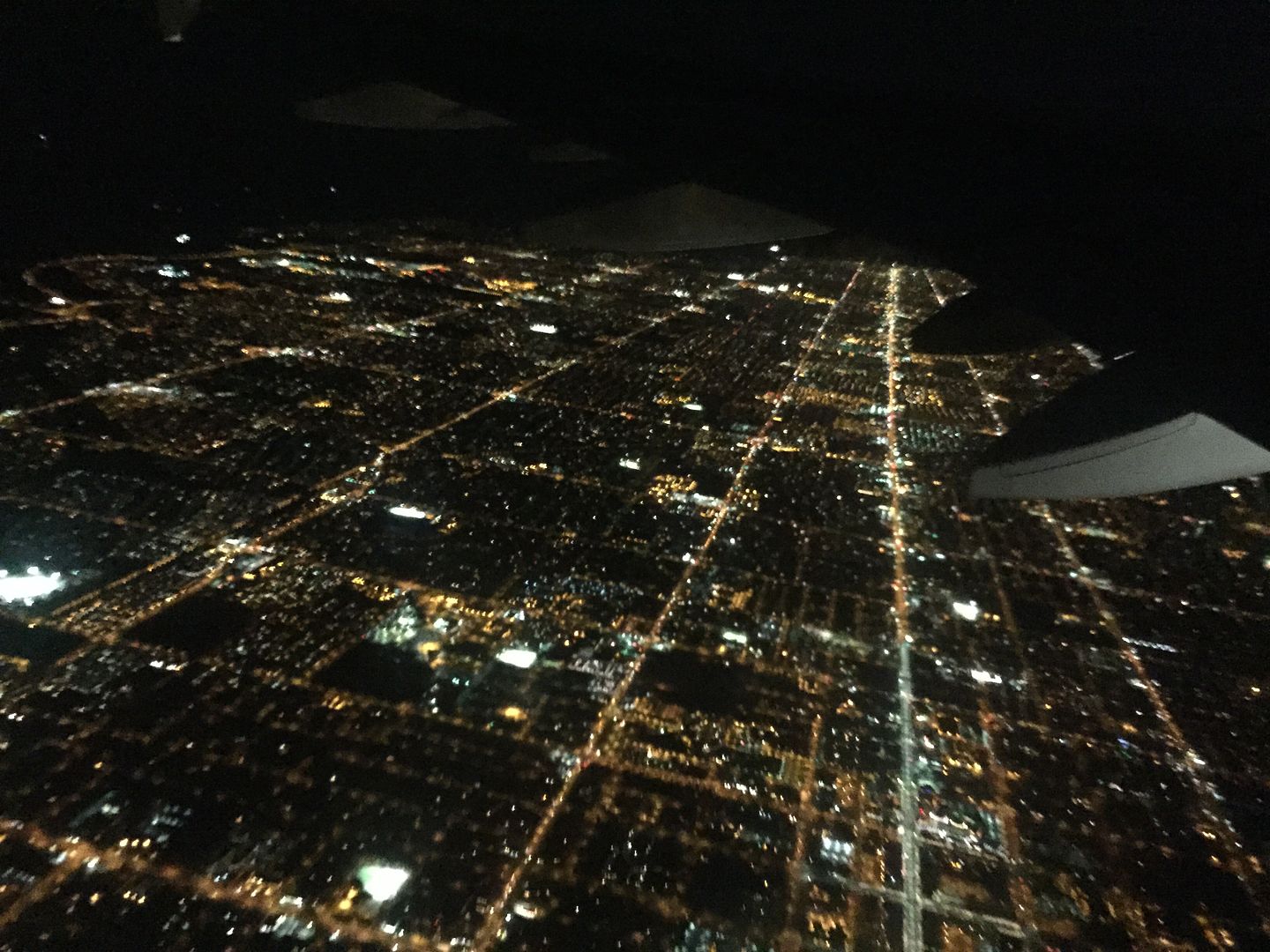 That's the Phoenix area above. Unlike many cities that grow around many geographic features, the "Valley of the Sun" is laid out in a vast, regular grid pattern that's easily seen here. The occasional bright, white splotches of light are sports fields which are illuminated at much higher levels than other parts of the community. Such sports fields often contain unshielded light and shine light directly upwards creating glare that can be seen from inside aircraft flying at night. Such upward shining light is wasteful and a source of light pollution.
Like NYC, Phoenix is about to undergo a conversion to LED streetlights. In a couple of years the city should look completely different at night. In spite of the claims that are made, LED streetlights are likely to create more light pollution than what is already in place.
While I enjoyed seeing Phoenix at night, I was more interested in seeing the U.S. - Mexico border.
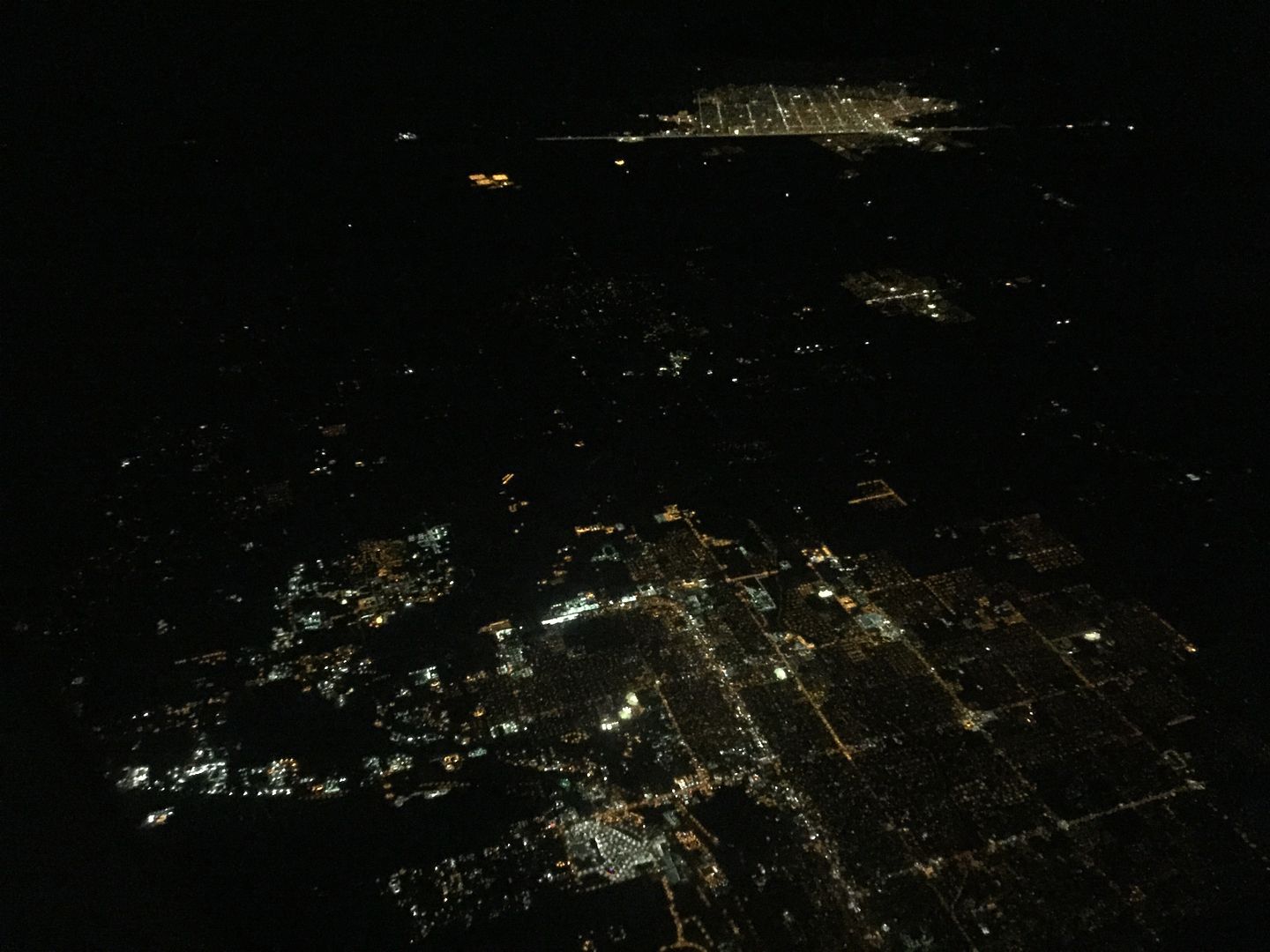 I believe that the bottom of the photo shows Winterhaven, California - located just west of Yuma, Arizona. Notice that at the top of the pic there's a community that has a straight light of light that forms an unusual looking boundary. That's likely Los Algodones, Mexico lying just south of the illuminated international border. It is unusual to see a city just stop like that in a straight line.
Here's another example:
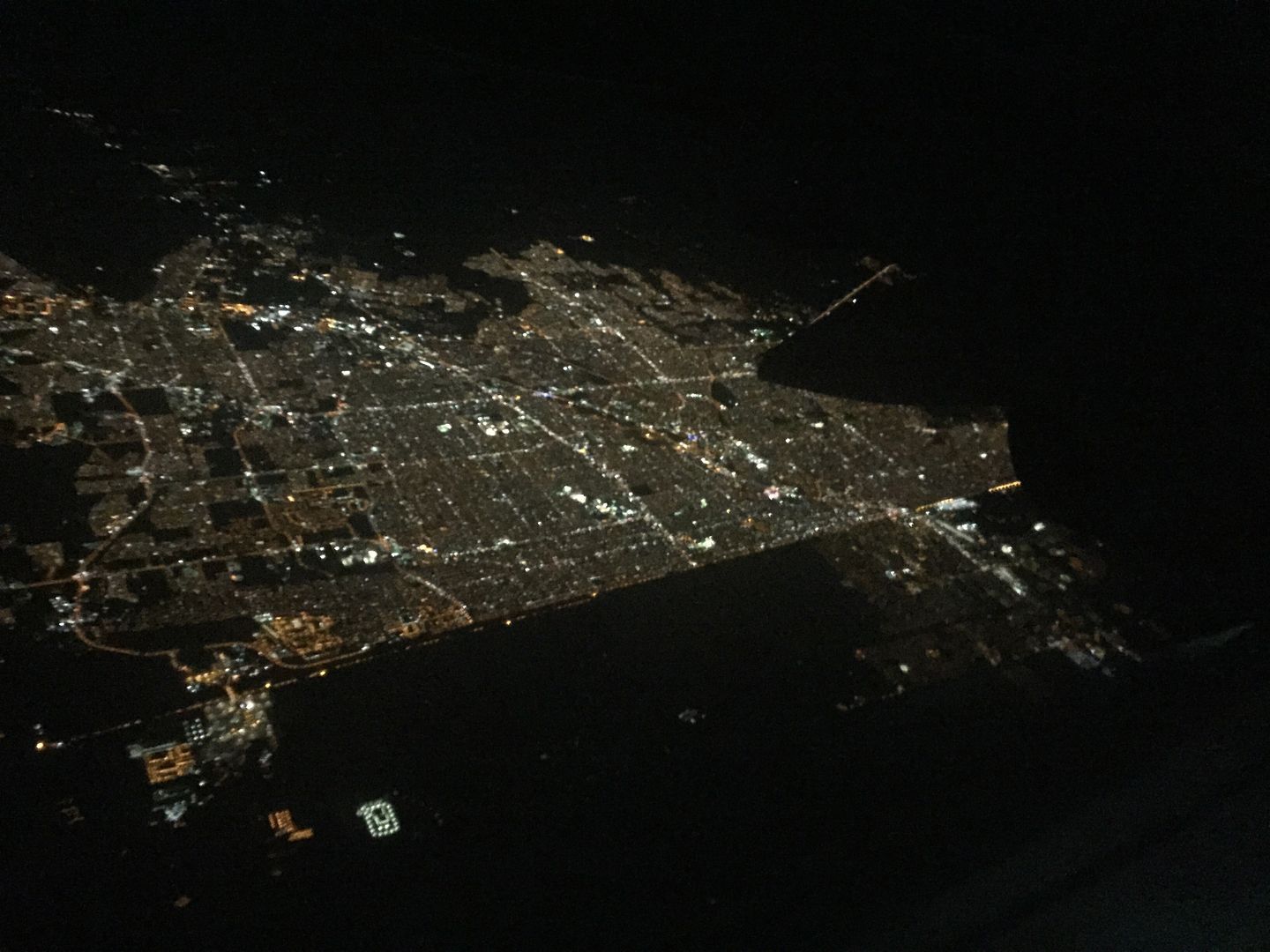 A short while later we flew even closer to the border and had this view of Mexicali, Mexico (top) and Caliexico, California (lower right). Again, here's a city that stops long the political line and physical fence that separates two countries.
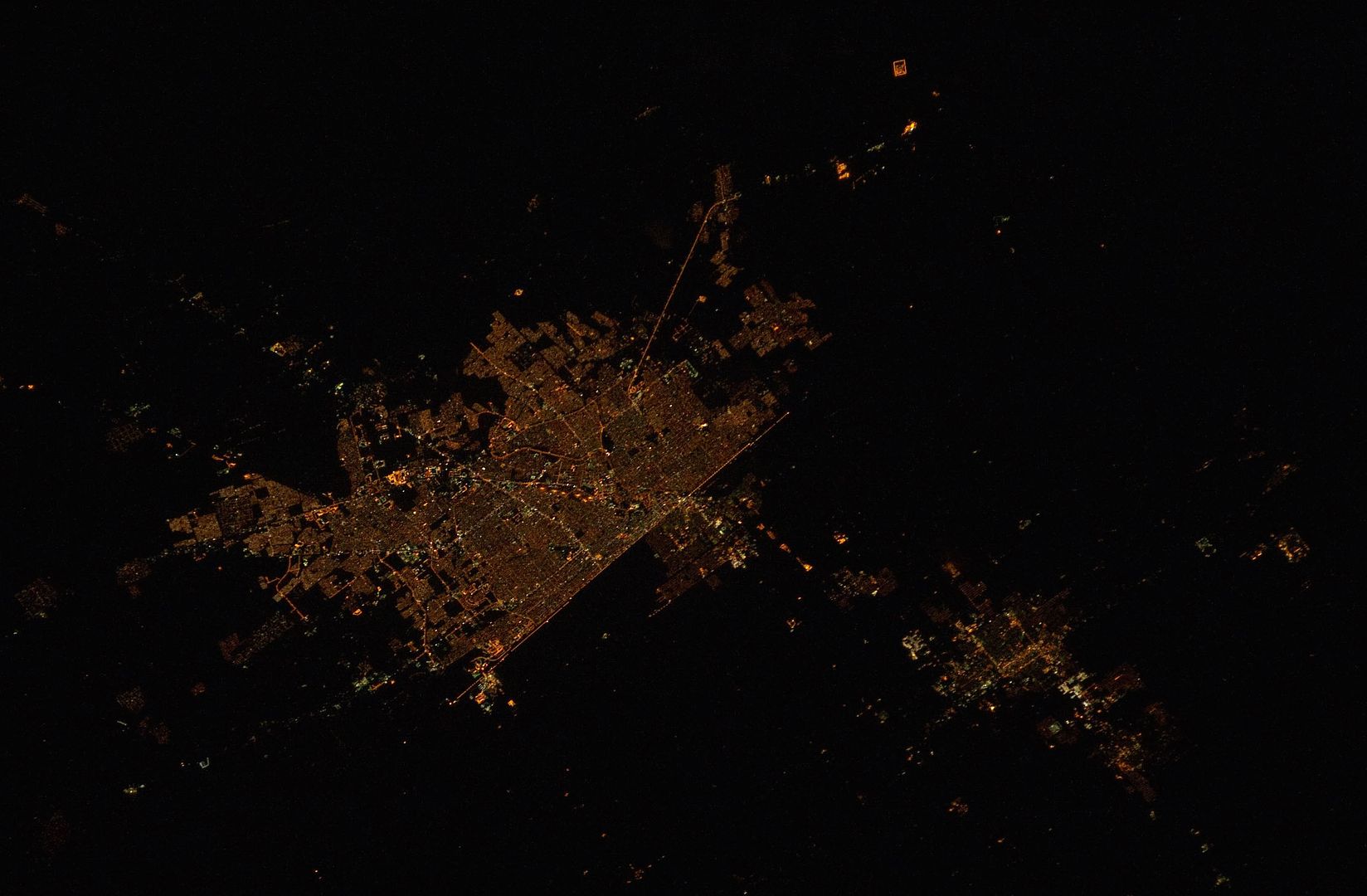
Here's how it looks from the International Space Station:
When I was a kid, I imagined that the lines of geography that we find on maps and globes were real and that you could actually see them. It turns out that my imagination wasn't too far off. The line between Mexicali and Calexico is pretty obvious at night from above.
While we're here, let's check out the last two scenes from space.
 |
| Credit: The Gateway to Astronaut Photography of Earth |
Earlier this week I had a window seat on a night flight from Phoenix Sky Harbor Airport to San Diego's Lindbergh Field. Naturally, I grabbed my iPhone and took pics of the city lights on this flight too.
Like NYC, Phoenix is about to undergo a conversion to LED streetlights. In a couple of years the city should look completely different at night. In spite of the claims that are made, LED streetlights are likely to create more light pollution than what is already in place.
While I enjoyed seeing Phoenix at night, I was more interested in seeing the U.S. - Mexico border.
Here's another example:
Here's how it looks from the International Space Station:
 |
| Credit: The Gateway to Astronaut Photography of Earth |
Wednesday, December 31, 2014
My Top Books of 2014
I made a list of my top books of the year on New Year's Eve 2013 so I figured I should do the same this year too. So here it is.
I keep track of my books over on Goodreads and according to what's there I read just 18 books this year, which I suppose isn't too bad, but it really doesn't feel like nearly enough to me.
This year I read science fiction and what I might categorize as technological non-fiction. The latter includes one astronaut biography (Falling to Earth by Apollo astronaut Al Worden), two space histories (In the Shadow of The Moon and Into That Silent Sea) and a history of electric lighting in the U.S. (The Age of Edison: Electric Light and the Invention of Modern America). None of these were published in 2014, but all were good reads.
 The space books are great, but I especially recommend The Age of Edison for anyone interested in light pollution and the history (good, bad & ugly) of artificial lighting here in the U.S.
 These Are the Voyages TOS Season One made my list of top books last year and I also recommend Season Two for anyone interested in the creation of the original Star Trek series. Yeah, I realize that this is non-fiction, but I didn't think it belonged with the other non-fiction titles.
Season Three has already been published and will be one of my reads for 2015. Also recently arrived to my doorstep is Return to Tomorrow, a book about the creation of Star Trek: The Motion Picture. It looks to be a great book.
Highlights from my science fiction reads include three volumes of Kevin J. Anderson's Saga of The Seven Suns series. They are pure space opera and I'm looking forward to reading the final two books in the series.
For science fiction actually published in 2014 I enjoyed Cibola Burn, the fourth novel in the Expanse series by James S.A. Corey and Coming Home by Jack McDevitt but there were two books that stood out above them.
 John Scalzi made my list last year with The Human Division, but this year's book Lock In is even better. It's a unique and important work in science fiction. I wont spoil the book here, but it is a mystery that takes place in a not too distant future after a disease has left large large segments of the population literally locked into their minds (hence the title) with no ability to move or otherwise communicate. An Apollo-style project has provided a technological way for those locked in to communicate and live their lives. The book looks at how this has changed society and follows its central character who has just become an FBI agent. I can't think of any book even remotely like it.
By the way, Lock In has been optioned for a TV series, so if you are too lazy to read it . . . . nah, you should read it.
 My other pick for top science fiction novel of 2014 is The Martian by Andy Weir. Imagine being accidentally marooned on Mars, that's the story behind The Martian and it works wonderfully well. There's a lot of science that went in to this tale as it takes a realistic, but very exciting, look at what it would take to survive on and get rescued from the Red Planet. Mars is cold, nearly airless and wants to kill you. All this makes for a very good read.
Plans are underway to make The Martian into a movie, but you should really read the novel.
I was about 2/3 of the way through The Martian when I accidentally left it in the middle of nowhere South Korea. I wasn't going to let that stop me from finishing it. I certainly can't say that for everything else that I read.
As we head into 2015 I am feeling rich. Why? Have a look at my To Read pile:
 Yeah, it looks like it will be a good year.
I keep track of my books over on Goodreads and according to what's there I read just 18 books this year, which I suppose isn't too bad, but it really doesn't feel like nearly enough to me.
This year I read science fiction and what I might categorize as technological non-fiction. The latter includes one astronaut biography (Falling to Earth by Apollo astronaut Al Worden), two space histories (In the Shadow of The Moon and Into That Silent Sea) and a history of electric lighting in the U.S. (The Age of Edison: Electric Light and the Invention of Modern America). None of these were published in 2014, but all were good reads.
Season Three has already been published and will be one of my reads for 2015. Also recently arrived to my doorstep is Return to Tomorrow, a book about the creation of Star Trek: The Motion Picture. It looks to be a great book.
Highlights from my science fiction reads include three volumes of Kevin J. Anderson's Saga of The Seven Suns series. They are pure space opera and I'm looking forward to reading the final two books in the series.
For science fiction actually published in 2014 I enjoyed Cibola Burn, the fourth novel in the Expanse series by James S.A. Corey and Coming Home by Jack McDevitt but there were two books that stood out above them.
By the way, Lock In has been optioned for a TV series, so if you are too lazy to read it . . . . nah, you should read it.
Plans are underway to make The Martian into a movie, but you should really read the novel.
I was about 2/3 of the way through The Martian when I accidentally left it in the middle of nowhere South Korea. I wasn't going to let that stop me from finishing it. I certainly can't say that for everything else that I read.
As we head into 2015 I am feeling rich. Why? Have a look at my To Read pile:
Saturday, November 15, 2014
Korea's Bright Lights, Big Cities
I recently spent two weeks in South Korea. Much of my time was in Daegu, Korea's third largest metropolitan area which has a population of 2.5 million people.
Korea is a very interesting place, with many differences from what I am used to. Their cities are very bright with unshielded streetlights and numerous bright LED billboards. There's an explosion of light a color that's pretty much everywhere.
 Here's part of the Daegu skyline. There are numerous giant LED billboards (all over exposed in this shot) visible on the tops of buildings. Most of these are not easily seen from street level, but rather seem to be targeted toward the huge blocks of high-rise apartment buildings -- the most common form of housing in Korea.
 These photos were taken on a rainy evening, so the weather conditions exaggerate the brightness of the night sky. Still, while I was in Daegu and Seoul there were essentially no stars visible.
These photos were taken from the vantage point of the 16th floor of the hotel I was staying in. While I was there I decided to shoot some time-lapse video with my iPhone looking down on the traffic below. Here's how it looked:
There's a constant flicker of light visible in the lower left portion of the video, that's from a giant LED billboard that was facing the oncoming traffic.
I used my DSLR too. Here's a short exposure of the view below:
 and a couple of longer ones to capture the motion of the cars:

 It isn't too surprising that a main corridor of a big city would look like this. What was more surprising to me was that the back streets, frequented by pedestrians, are so brightly lit.
 There is light and color everywhere. Much of the brightness here is due not just to unshielded lighting but from advertising and high levels of light spilling out from the interiors of shops.
 The view above is pretty typical of many of these streets. It didn't seem to matter what city or town it was, the back streets were all very colorful and very bright.
 Here's a view looking down on a portion of Seoul, Korea.
There's an increasing awareness of light pollution in Korea, which recently convened an international conference on the topic. They've got a long way to go, but there's plenty of room for improvement.
Yet there are still regions of darkness in South Korea. There's a move underway to create an International Dark Sky Park in southeast Korea, in Yeongyang County, the country's least populated area. I visited the area and, with some work, it could certainly happen. Stay tuned.
Korea is a very interesting place, with many differences from what I am used to. Their cities are very bright with unshielded streetlights and numerous bright LED billboards. There's an explosion of light a color that's pretty much everywhere.
These photos were taken from the vantage point of the 16th floor of the hotel I was staying in. While I was there I decided to shoot some time-lapse video with my iPhone looking down on the traffic below. Here's how it looked:
I used my DSLR too. Here's a short exposure of the view below:
There's an increasing awareness of light pollution in Korea, which recently convened an international conference on the topic. They've got a long way to go, but there's plenty of room for improvement.
Yet there are still regions of darkness in South Korea. There's a move underway to create an International Dark Sky Park in southeast Korea, in Yeongyang County, the country's least populated area. I visited the area and, with some work, it could certainly happen. Stay tuned.
Sunday, September 14, 2014
Recent Sky Shots
I took some fun shots of lightning Friday night, but that's not been the only thing in the sky to catch my attention lately. I've been photographing the cloud shadows, the Milky Way and for the last several mornings the waning gibbous moon.
Saturday's sunset was remarkable not for its vivid colors. Instead there was a big thunderstorm near the western horizon. The resulting cloud shadows were cast clear across the sky. Check it out:
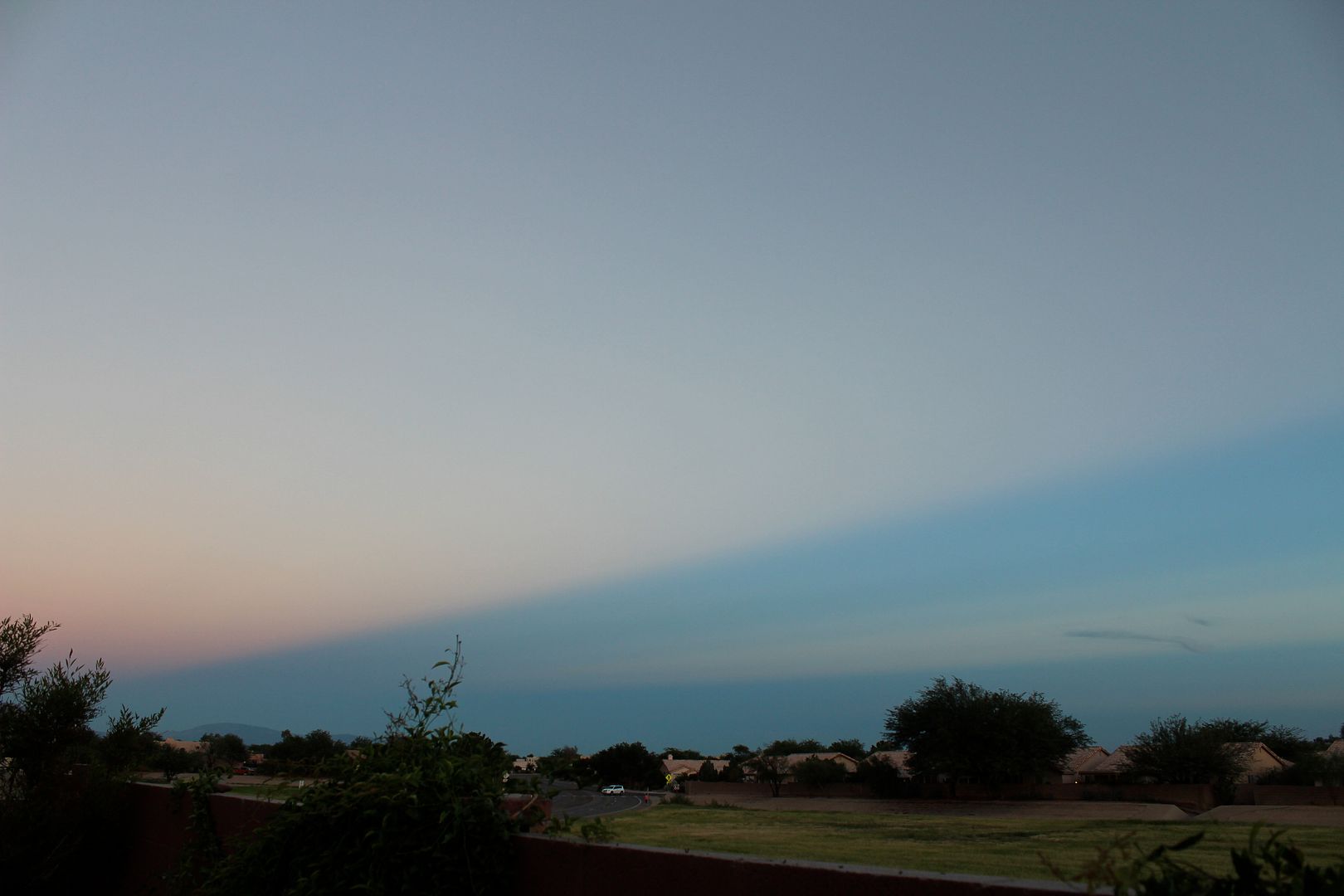 That's the view looking east with the darker cloud shadows in the twilight sky.
There's an increasing chance of stormy weather for the next few days, but now that the moon is out of the evening sky, and with the skies clear the Milky Way shines nicely. Not as nice as it was in Hawai'i though. From my vantage point NW of Tucson it is nicely placed in the early evening with the constellation of Sagittarius well away from the light pollution of the city.
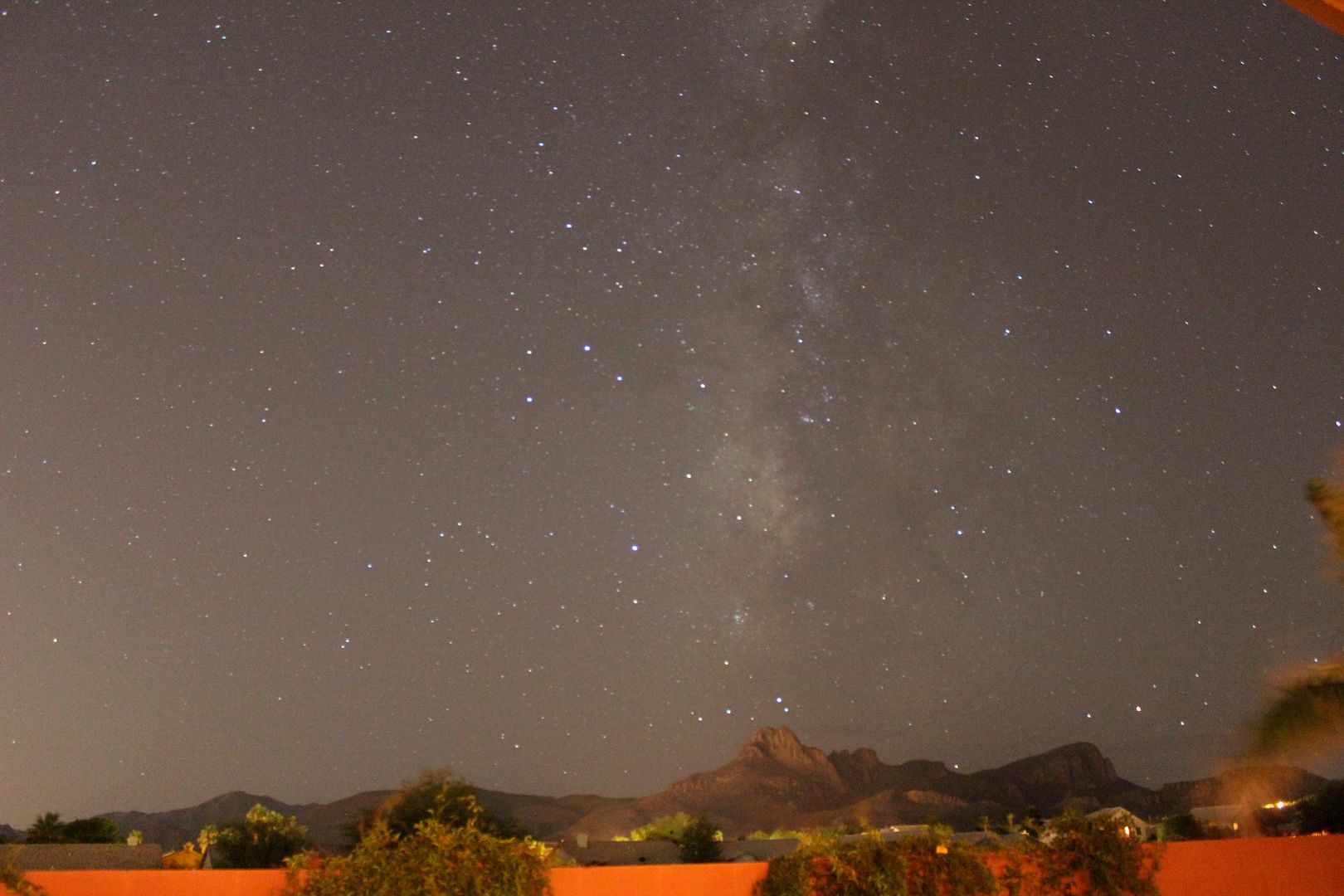 The focus is a bit soft on this one, but here's the view I have from my back yard and the Milky Way extending up over Sombrero Peak. Not too bad.
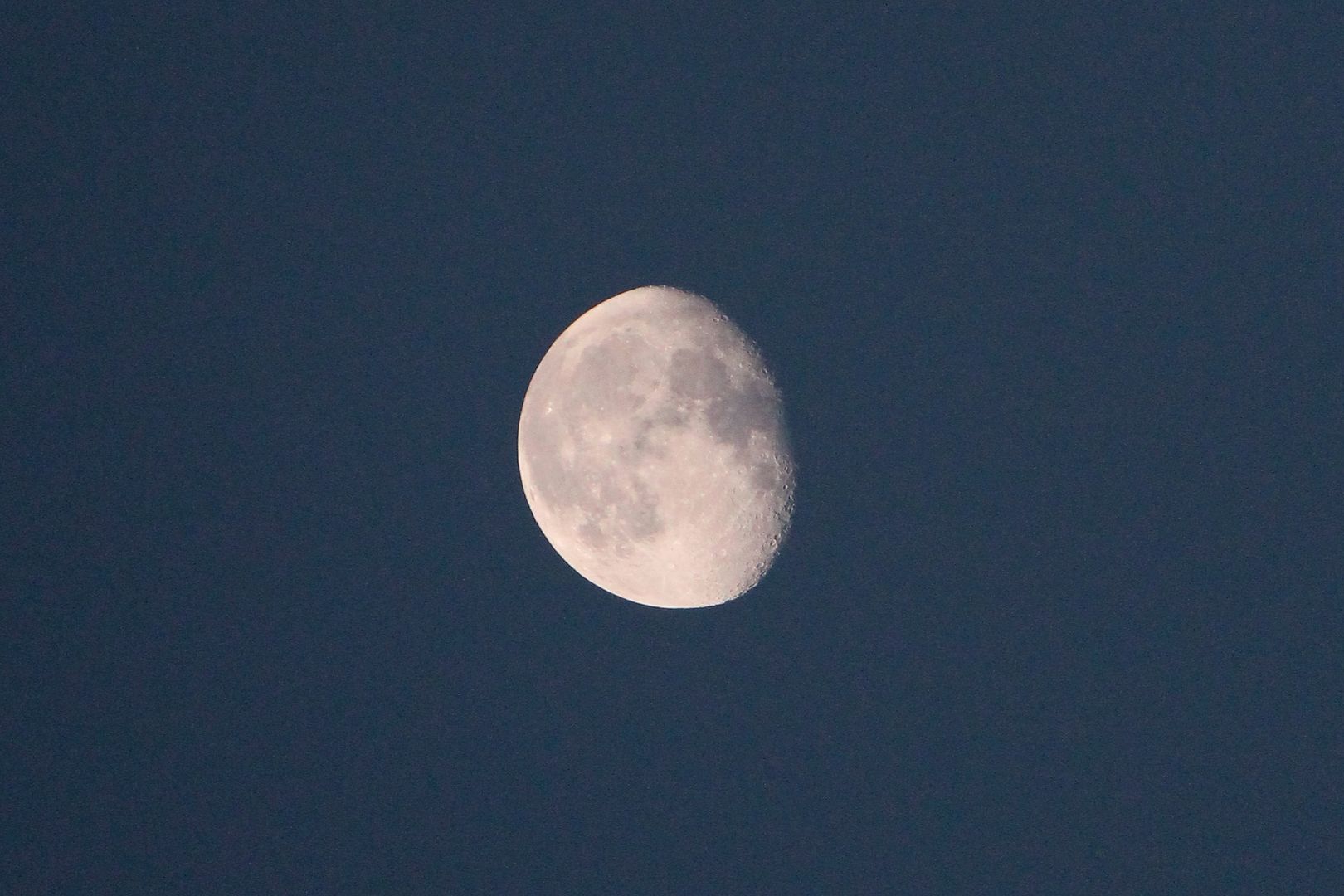 |
| Friday September 12 |
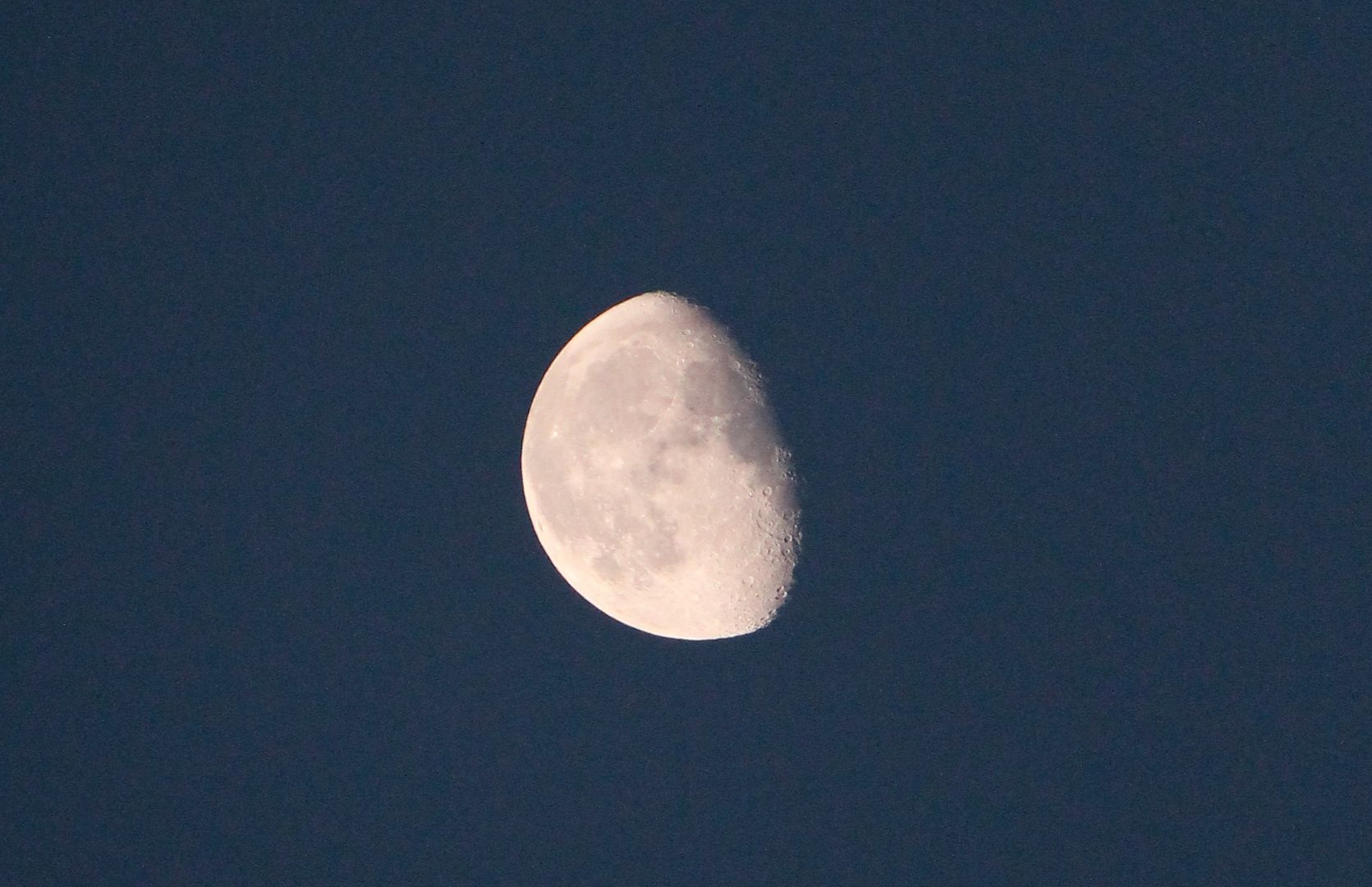 |
| Saturday September 13 |
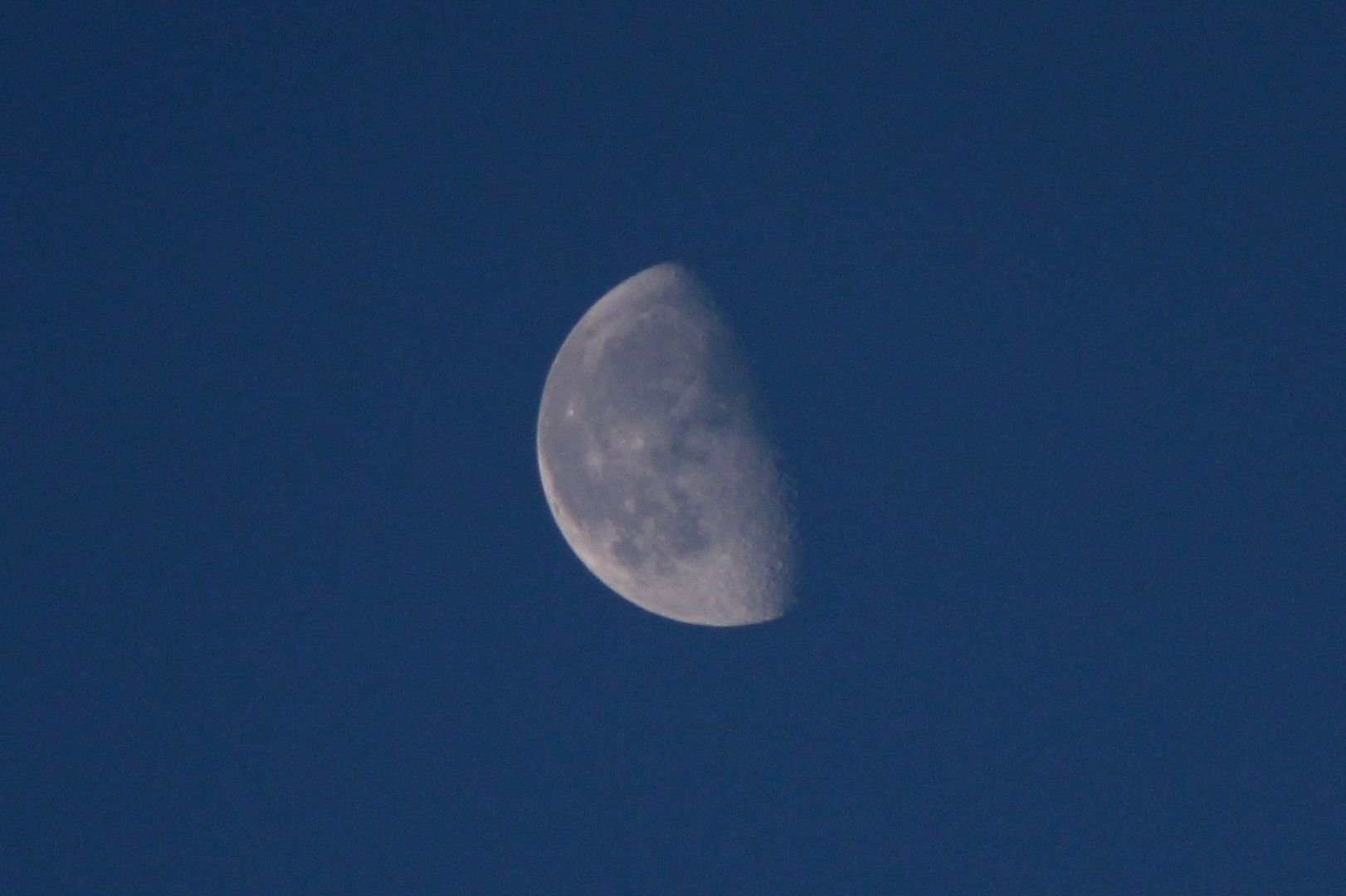 |
| Sunday September 14 |
There's an increasing chance of stormy weather for the next few days, but now that the moon is out of the evening sky, and with the skies clear the Milky Way shines nicely. Not as nice as it was in Hawai'i though. From my vantage point NW of Tucson it is nicely placed in the early evening with the constellation of Sagittarius well away from the light pollution of the city.
Saturday, August 23, 2014
Are Your Clouds at Night Bright or Dark?
My day job is working for the International Dark-Sky Association, where it is our mission to fight light pollution. I didn't need it, but I had a pretty vivid reminder of what we are fighting for on my recent vacation in Hawai'i.
My wife and I rented a place in the Puna District of the Big Island, right on the ocean, where there is very little artificial light. The first night there I hadn't yet adjusted to the time change and woke up hours before sunrise. When I realized that I wasn't going to be able to get back to sleep, I grabbed my binoculars and stepped in the dark to the beach-facing balcony. There the glittering majesty of the night sky was an awesome thing to behold. Ocean waves crashed below but my attention was on the sky. The stars of late fall and early winter filled the sky, all the way down to the horizon.
It has been quite some time since I experienced skies so
dark. When Venus finally poked up above the distant clouds its light
quite noticeably brightened the deck.
 In the evening skies the summer Milky Way (above) was brilliant with its bright 'clouds' of stars and dark lanes of dust instantly visible - no dark adaptation was needed.
Occasionally clouds drifted past and I was reminded of a paper published two years ago, Red is the new black, how the color of urban sky glow varies with cloud cover (pdf). The paper points how how in cities with sky glow clouds actually magnify the problem, but in times before the advent of artificial light skies actually got darker when it was cloudy. There are a lot of implications from this (read the paper), but let me illustrate the phenomenon.
Compare the view (above) that I took last month in Hawai'i with dark clouds silhouetted against the star-filled sky, with this shot (below) that I took last night from my home near Tucson, Arizona.
The difference is shocking. The two photos were taken on moonless nights, just about 1 month apart with the same camera and settings looking at the same part of the sky.
Even though there are relatively strict outdoor lighting ordinances in Tucson/Pima County, the skies here are awash with light pollution and sky glow. Sadly, many communities have little or no controls of outdoor lighting and there skies there are even worse. The clouds in the photo above are white, almost as if illuminated by moonlight. The likely culprit illuminating the clouds with white light is a sports complex to my south. Clouds in other directions had a more orange hue, as in the photo below:
The photos show that there is much work to be done in controlling light pollution, even in communities where the effort is underway. Learn more about the problem and what you can do about it at darksky.org.
My wife and I rented a place in the Puna District of the Big Island, right on the ocean, where there is very little artificial light. The first night there I hadn't yet adjusted to the time change and woke up hours before sunrise. When I realized that I wasn't going to be able to get back to sleep, I grabbed my binoculars and stepped in the dark to the beach-facing balcony. There the glittering majesty of the night sky was an awesome thing to behold. Ocean waves crashed below but my attention was on the sky. The stars of late fall and early winter filled the sky, all the way down to the horizon.
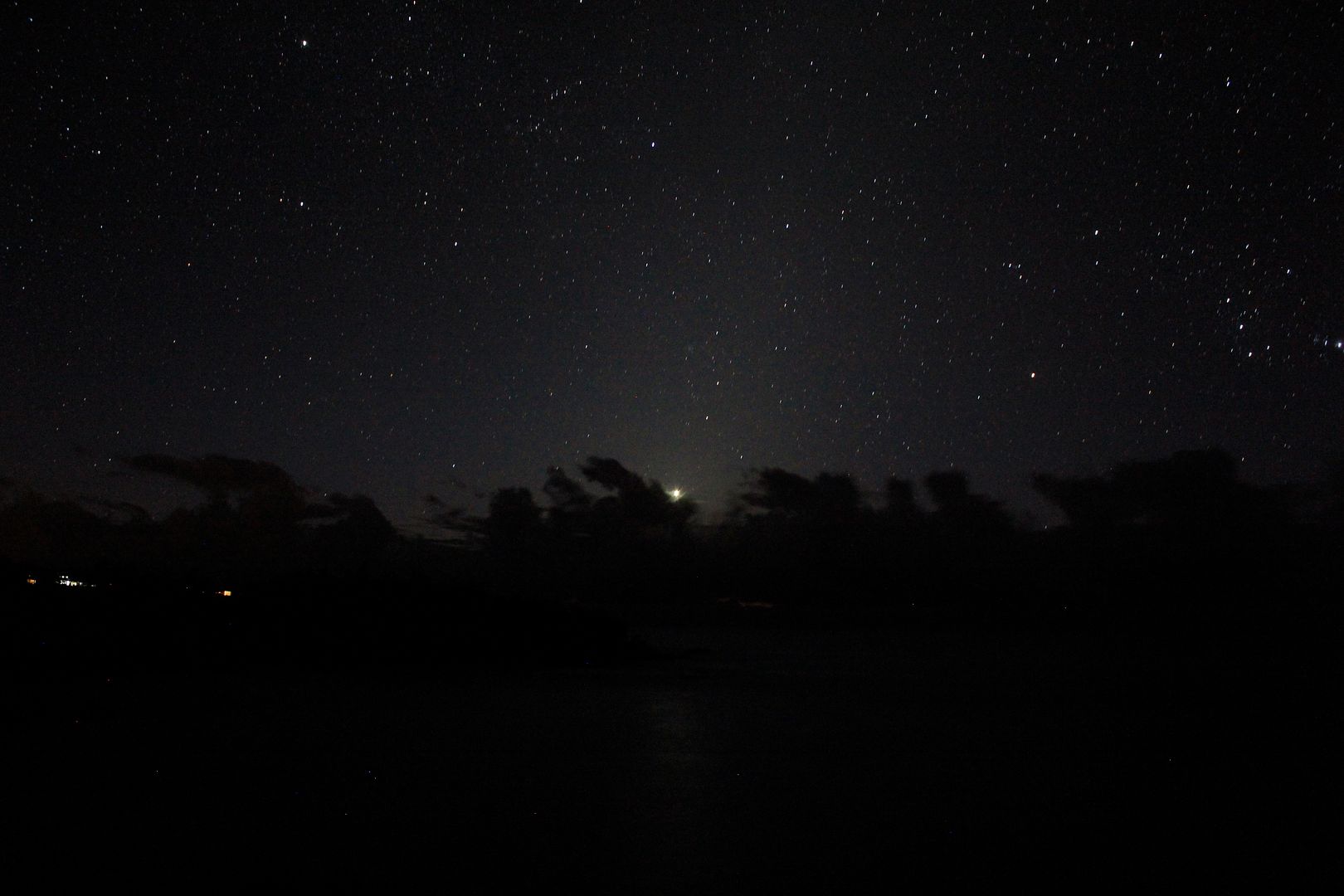 |
| Venus rises, with Orion at right |
Occasionally clouds drifted past and I was reminded of a paper published two years ago, Red is the new black, how the color of urban sky glow varies with cloud cover (pdf). The paper points how how in cities with sky glow clouds actually magnify the problem, but in times before the advent of artificial light skies actually got darker when it was cloudy. There are a lot of implications from this (read the paper), but let me illustrate the phenomenon.
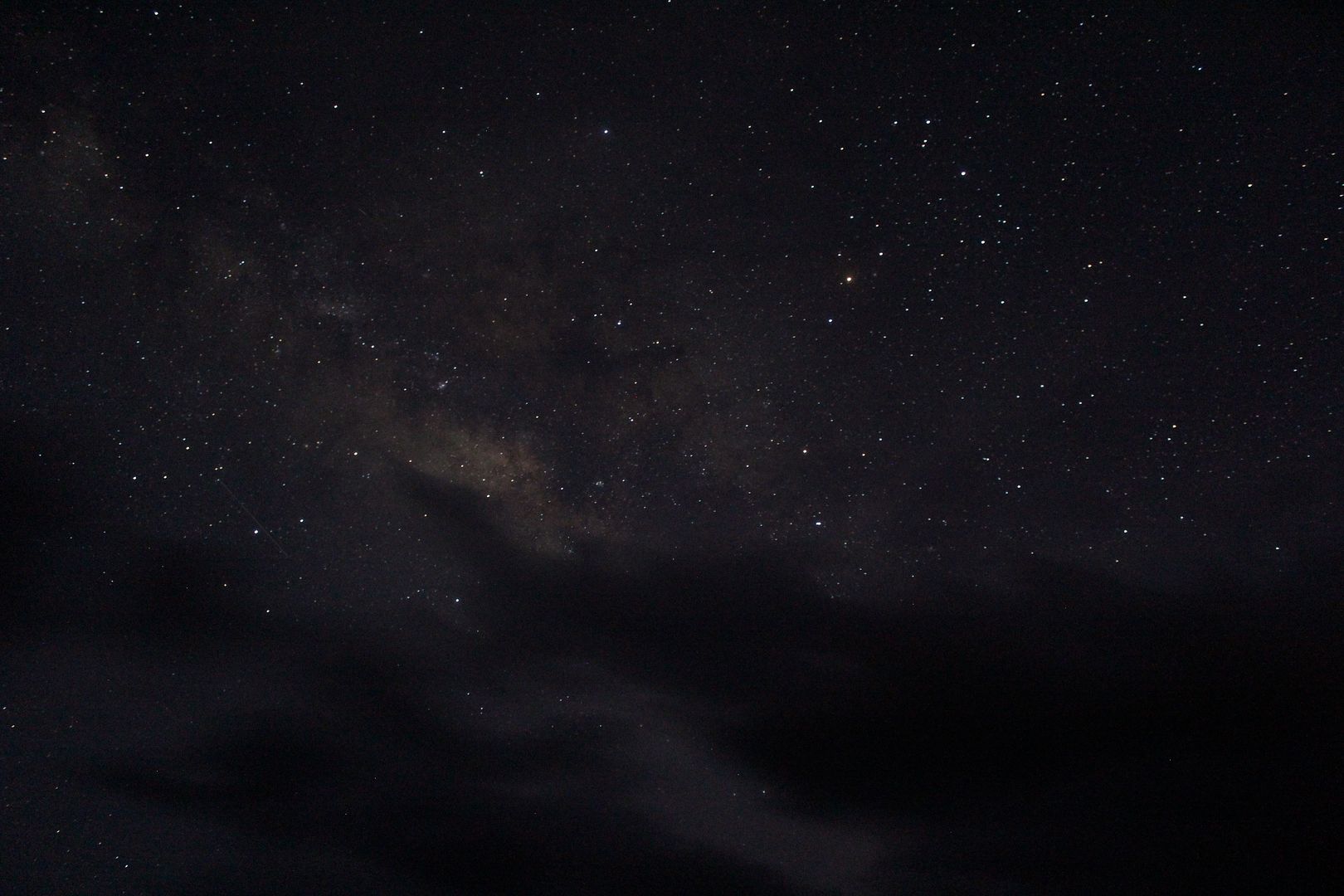 |
| Sagittarius and Scorpius with dark clouds in silhouette |
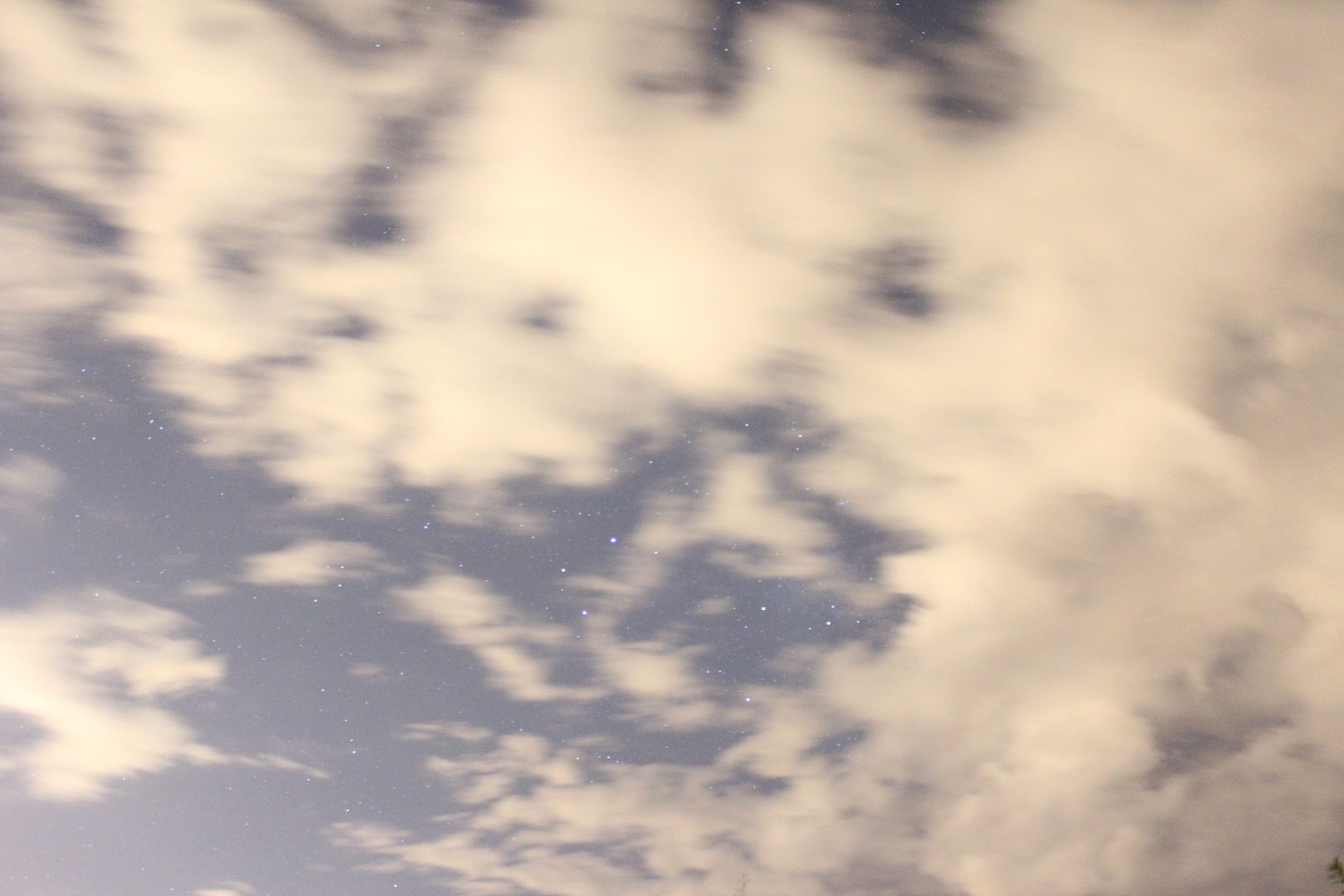 |
| Sagittarius in cloudy, light polluted skies |
Even though there are relatively strict outdoor lighting ordinances in Tucson/Pima County, the skies here are awash with light pollution and sky glow. Sadly, many communities have little or no controls of outdoor lighting and there skies there are even worse. The clouds in the photo above are white, almost as if illuminated by moonlight. The likely culprit illuminating the clouds with white light is a sports complex to my south. Clouds in other directions had a more orange hue, as in the photo below:
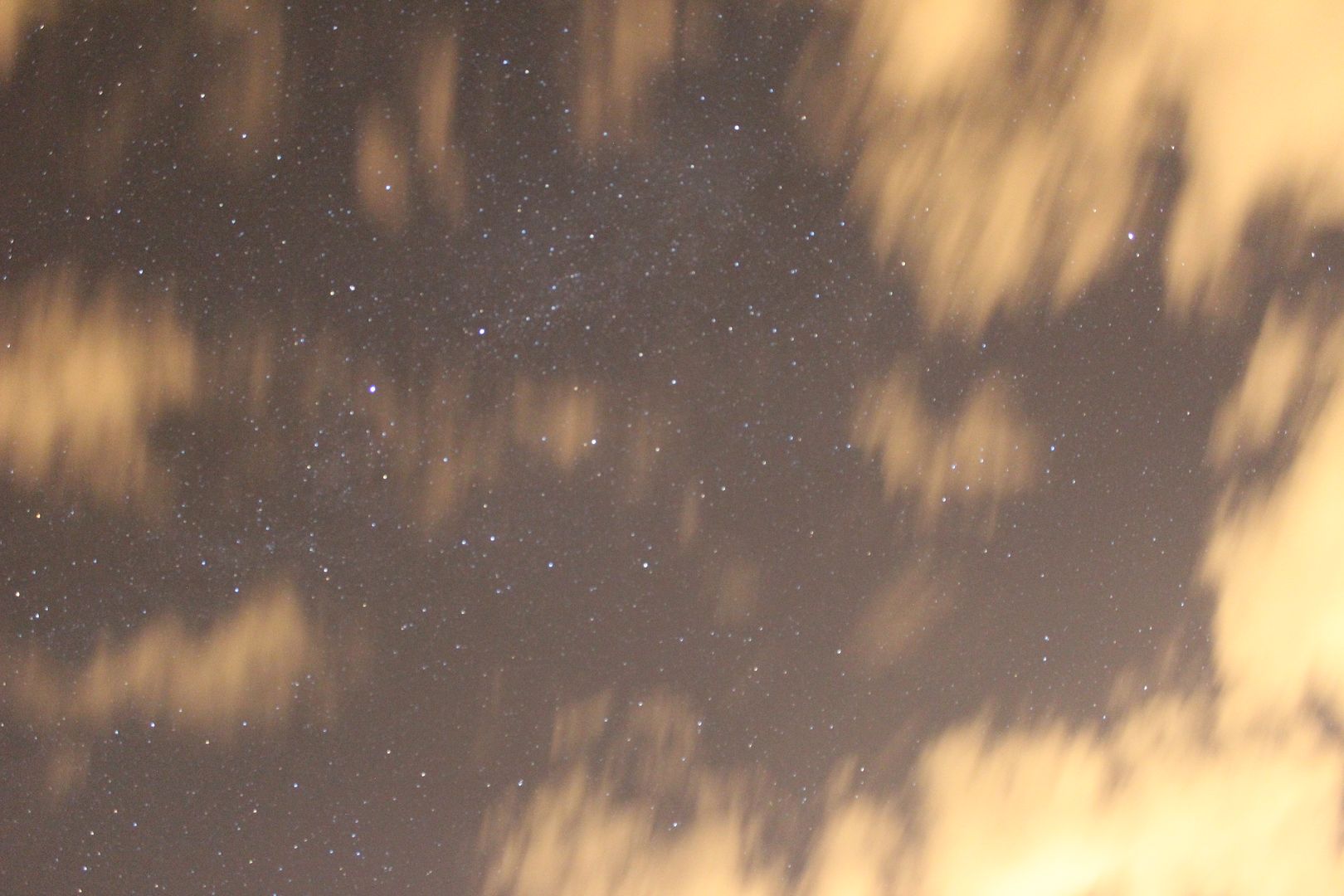 |
| Cygnus in light polluted, party cloudy skies |
Saturday, August 9, 2014
Volcano! (Part 1)
My wife and I visited Hawai'i in 2004 and were fortunate enough that we were able to view lava from Puʻu ʻŌʻō, erupting on Kīlauea's East Rift, flowing into the ocean at night. The experience was one of the most amazing sights in Nature that we'd ever seen.
I didn't have much of a camera then or even a tripod with me, but I did manage to record a few decent photos of the site. Here's one of them:
 As we were planning our 2014 trip I knew that I needed to bring my DSLR and a decent tripod to be able to record any nighttime lava action.
Of course Pele does what she wants and there was no lava flowing into the ocean during our recent visit. Lava is still erupting from Puʻu ʻŌʻō, but was not easily accessible during our visit. We later paid a visit to Puʻu ʻŌʻō but that will be in Volcano! Part 2.
Fortunately, there is Hawai'i Volcanoes National Park. Within the park is the Kīlauea caldera and within that is Halemaʻumaʻu crater. There's a lava lake in Halemaʻumaʻu and, while the lava isn't directly visible, after dark the glow of the lava illuminates the volcanic gasses. It makes for a wonderful show.
Even in the daytime the crater is an impressive sight.
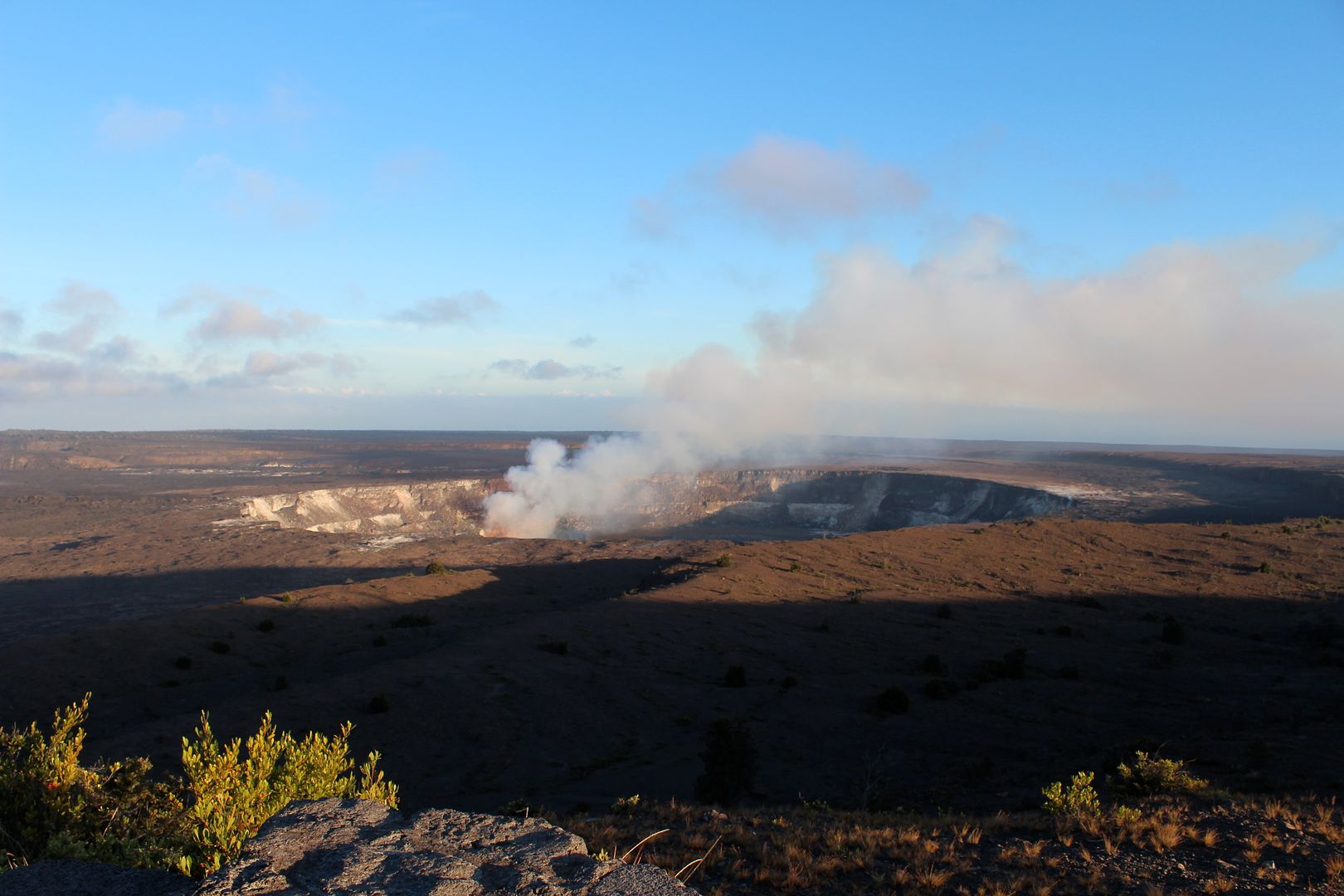
We headed up twice (July 26 & 28) to see Halemaʻumaʻu--both times just before sunset. I did some time-lapse photography. I adjusted the position of the camera a bit now and then, but the results aren't too bad.
Here are some stills that I shot from the second evening.
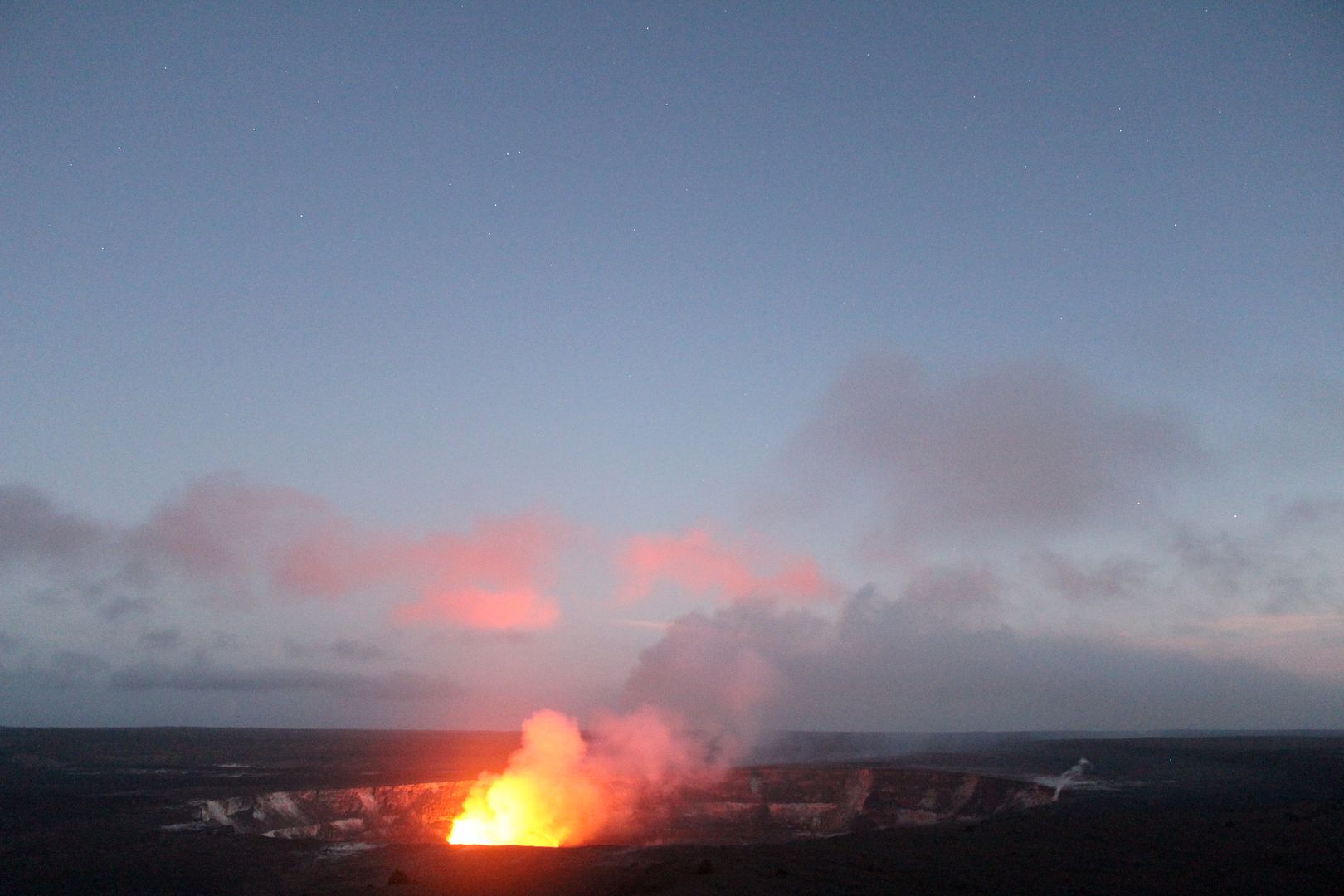 There were low clouds streaming just over the crater, adding to the effect of the volcanic glow.
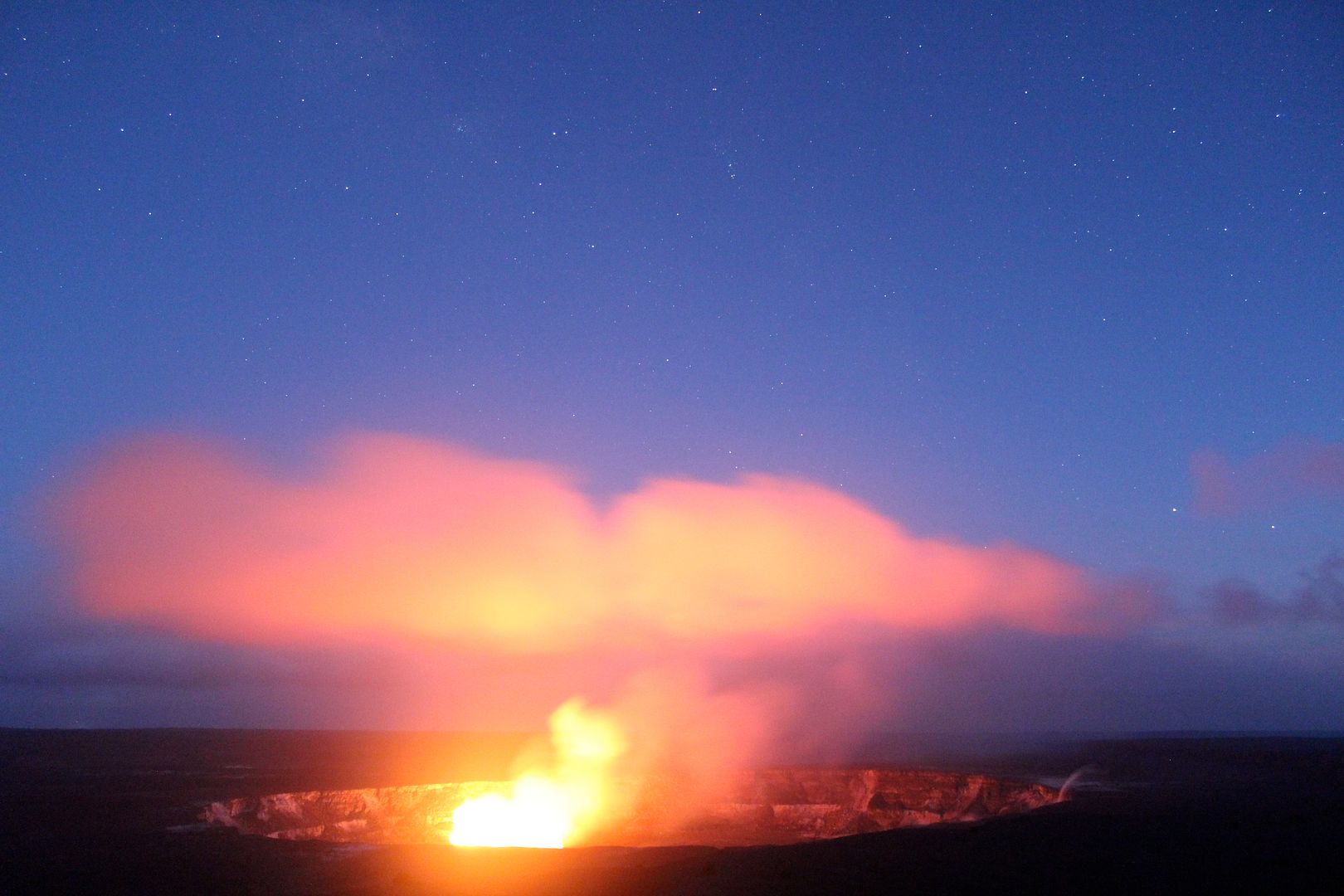
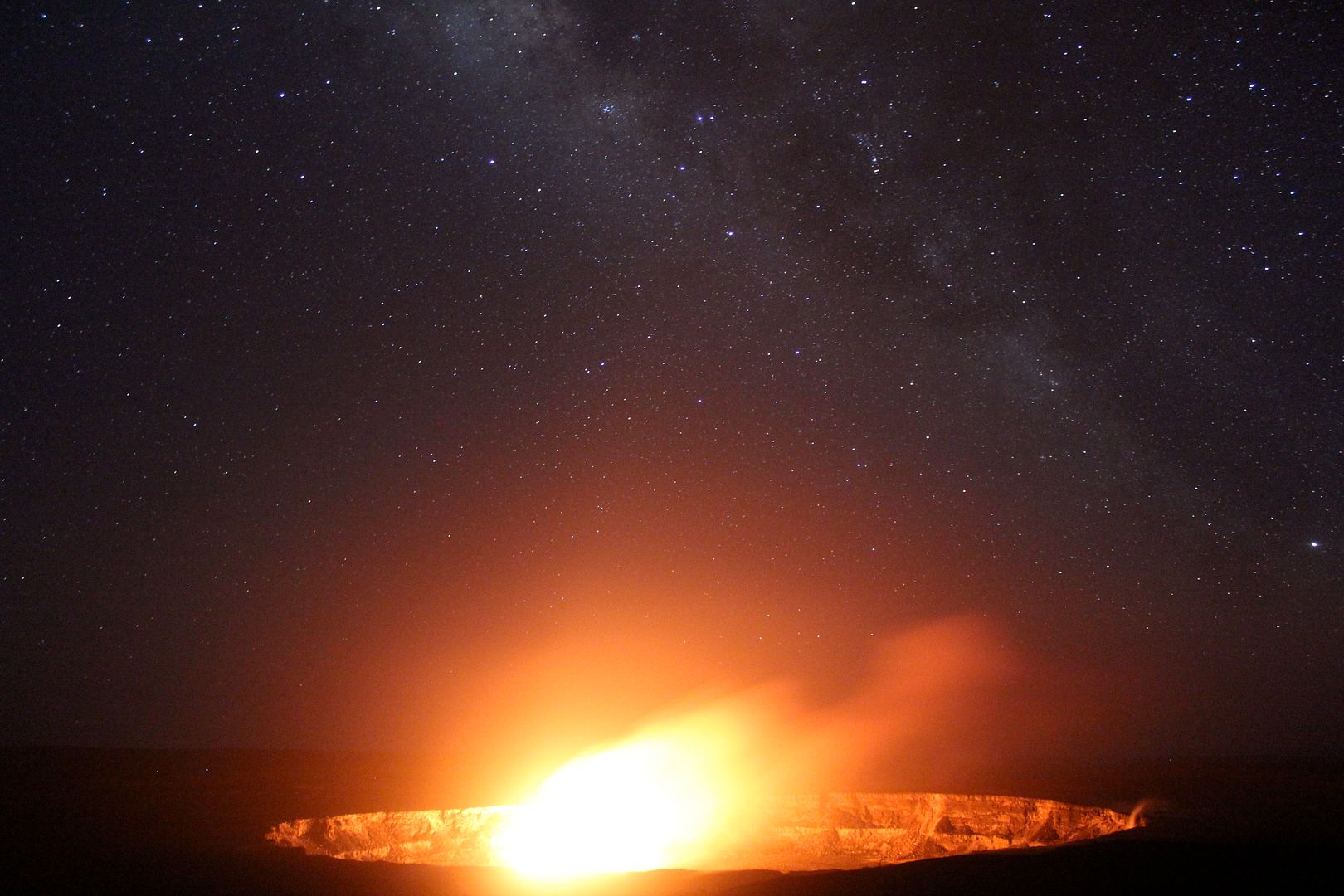 Only the glow of Halema'uma'u itself competed with the stars. Well....the annoying people trying flash photography of the crater were causing their own periodic light pollution too but I digress.
One way to catch the volcanic action without making the trip to Hawai'i is to look at the USGS Hawaiian Volcano Observatory's website. They have a live webcam pointed looking down at the lava lake. Here's a shot I grabbed from last Saturday:
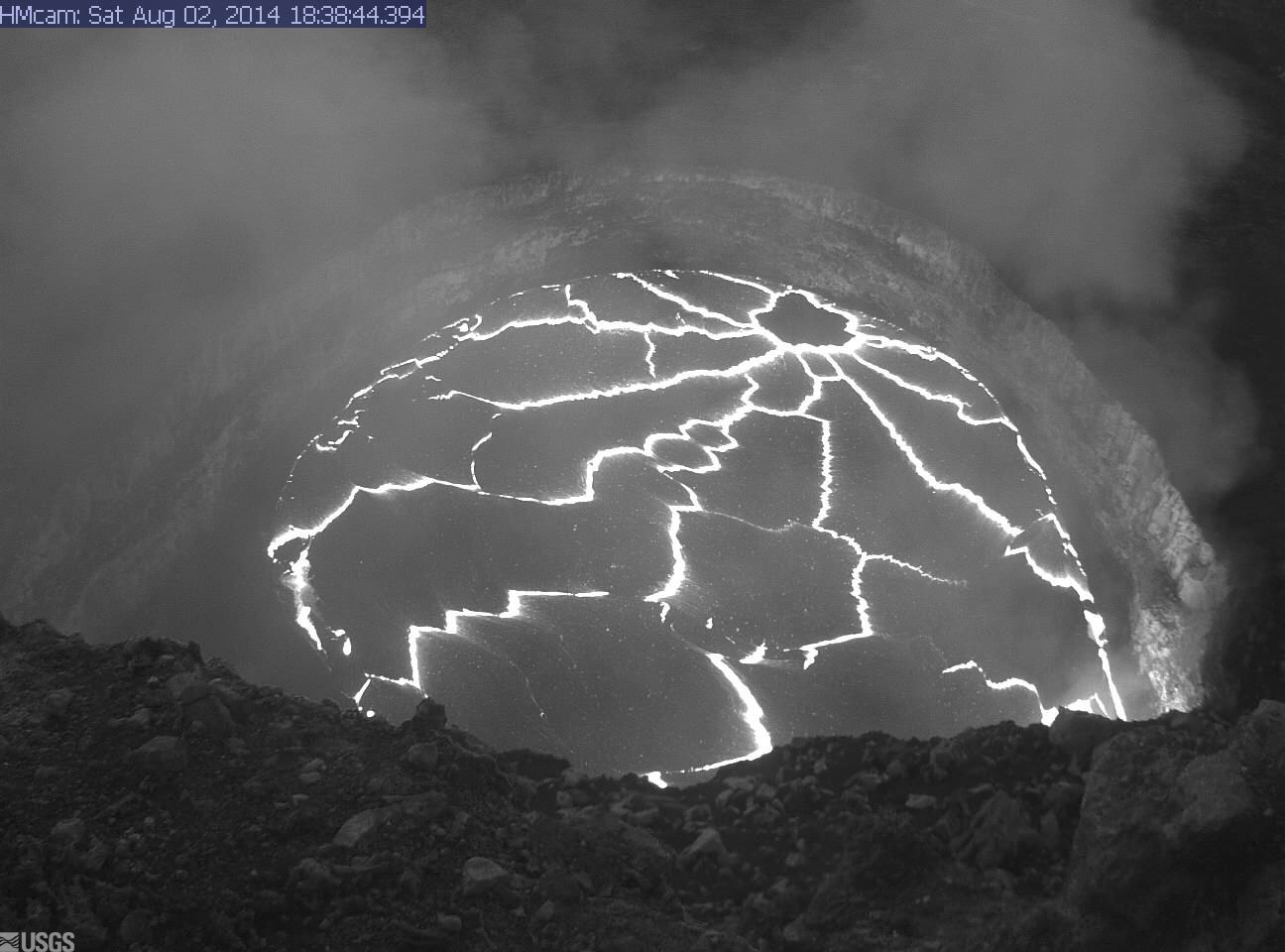 It looks like the recent hurricane has kept the webcam from updating right now but it provides dramatic look into the crater showing the darker crusted over lava sheets floating on the bright molten lava lake.
While we were in Hawai'i we had another volcano adventure which will be the subject of my next blog post.
I didn't have much of a camera then or even a tripod with me, but I did manage to record a few decent photos of the site. Here's one of them:

Of course Pele does what she wants and there was no lava flowing into the ocean during our recent visit. Lava is still erupting from Puʻu ʻŌʻō, but was not easily accessible during our visit. We later paid a visit to Puʻu ʻŌʻō but that will be in Volcano! Part 2.
Fortunately, there is Hawai'i Volcanoes National Park. Within the park is the Kīlauea caldera and within that is Halemaʻumaʻu crater. There's a lava lake in Halemaʻumaʻu and, while the lava isn't directly visible, after dark the glow of the lava illuminates the volcanic gasses. It makes for a wonderful show.
Even in the daytime the crater is an impressive sight.
We headed up twice (July 26 & 28) to see Halemaʻumaʻu--both times just before sunset. I did some time-lapse photography. I adjusted the position of the camera a bit now and then, but the results aren't too bad.
 There were low clouds streaming just over the crater, adding to the effect of the volcanic glow.
As darkness fell, I was starting to get pretty worried that we wouldn't end up with clear skies at all.
Look closely and you'll see that there are stars in the photo above. Two in particular were of special interest to me. Look on the right just above the darker clouds. That's Alpha Centauri (the leftmost of the two) and Beta Centauri (to the right). Alpha Centauri is, of course, famous for being the brightest member of the system of stars that is closest to our own solar system. It is too far south to be seen from Arizona, so catching it was a thrill.
As the sky grew darker the low clouds cleared away leaving a magnificent star-filled dark sky, free of all artificial light.
One way to catch the volcanic action without making the trip to Hawai'i is to look at the USGS Hawaiian Volcano Observatory's website. They have a live webcam pointed looking down at the lava lake. Here's a shot I grabbed from last Saturday:
While we were in Hawai'i we had another volcano adventure which will be the subject of my next blog post.
Subscribe to:
Posts (Atom)