Showing posts with label astronomy. Show all posts

Saturday, September 23, 2023

Here Comes the Sun

The most viewed post on my blog from last year was Observing the Sun with an eVscope. Everything about that post is now completely out of date thanks to some recent and exciting updates from Unistellar with the new release of version 2.5 of their app.

What's in version 2.5? The ability to have one of their telescopes to automatically find and guide on the Sun. Of course, to observe the Sun you need a safe solar filter that goes on the front end the telescope. 

a telescope with a solar filter on it

Above is my eVscope 2 outfitted with the new solar filter available from Unistellar. 

The new version of the app includes the Sun in the catalog (see below), though it strangely describes it as a planet. When you choose the Sun it will remind you that you need to have a solar filter in place before pointing the telescope at the Sun. Pointing at the Sun without having a filter on it will ruin your telescope.

a screen grab from the Unistellar app

Pointing at the Sun is automatic, unlike previously where the telescope had to be manually pointed by looking at the shadow of the telescope. Once the telescope is pointed at the Sun it now automatically tracks on the Sun, which is also a major improvement, as the old version had no tracking. That made focusing very difficult as the Sun was always drifting across the field of view. Now, focusing is much easier, especially with the Sun having so many sunspots.

So how does it look?

image of the Sun showing sunspots
Image of the Sun taken September 23, 2023

Great! Unistellar seems to be applying a color shift to the image to give it a pleasing look. Images taken prior to the app update made the Sun look very un-Sun like (see image below taken last year). I used to always convert them to grayscale because I couldn't stand the color. 

image of the Sun


Also, I suspect that the Unistellar app is now applying a sharpening routine to the images of the Sun when you save them, but that's okay, as they look great. 

All of this is perfect timing as there is a solar eclipse happening in 3 weeks, another one in April and solar maximum is just around the corner! Expect to see more solar image posted here soon.

Saturday, July 29, 2023

On Top of the World - A Visit to Mauna Kea

Earlier this year I was one of 18 educators selected for 2023 to be in the NASA/SETI Institute Astronomy Activation Ambassadors program. It focuses on teaching hands-on methods for teaching about multi-wavelength and especially infrared astronomy. Along the way we've had lots of training which included an online course to complete, a bunch of Zoom meetings and lots of emails. All of this culminated in an intense week of curriculum training and a visit to the Mauna Kea Observatories, specifically to get a first-hand look at NASA's Infrared Telescope Facility (IRTF). 

I'm not going to focus on the curriculum training here (that's for my students to experience), but instead on the visit to Mauna Kea Observatory. I've been to Mauna Kea before (and blogged about it here!), but it was many years ago and this visit offered so much more. I made this return trip with great reverence and a profound appreciation for what this special place means both to the Hawaiian people and the world of astronomy.  

That's me on Mauna Kea with the domes for the Subaru (left) and Keck Telescopes in the background.

After first spending time at the headquarters for the Gemini Observatory and the Institute for Astronomy in Hilo we prepared for our visits to the observatories by spending time at Hale Pohaku, the astronomers quarters, at the 9,300 foot level of Mauna Kea. This allowed us not only to acclimate to the elevation, but to take in its breathtaking night sky. 

The Milky Was so brilliant that you didn't need to be dark adapted at all to see it. Here's a photo of it that I captured with my iPhone:

The summer Milky Way as seen from Hale Pohaku, Mauna Kea

The Milky Way and its spectacular dust clouds were beautiful. It is a shame that because of light pollution most people in the world never get to see it (even fewer see it from such an amazing site as this one!). Of special interest to me are the two stars near the bottom of the image.  The one on the left is Alpha Centauri, the famous Sun-like star that's just 4.3 light years from Earth. To its lower right is Beta Centauri, also known as Hadar, a blue giant star located 90 times further away. Both of these bright stars are too far south to see from my home in Southern California, so catching them was a special treat.

The next day we made a daytime visit to the summit and got our first close look at NASA's IRTF. Fun Fact: the IRTF was built to help support NASA's Voyager missions and made its first infrared observations of Jupiter just before Voyager's first flyby.

Here's the dome of the IRTF:

Behind the IRTF is the Pacific Ocean and the island of Maui. Inside is a 3.0-meter reflecting telescope:

The view above looks up to the telescope's secondary mirror. Most infrared telescopes have an undersized secondary mirror to avoid reflecting any of the heat of the telescope itself to the science instruments. 

When the telescope points at the astronomical object being studied infrared light reflects off of its primary mirror, to the secondary mirror and then down to the Cassegrain focus underneath the main mirror where one of the science instruments collects the light.

Science instruments in the IRTF's Cassegrain focus.
After our daytime visit we returned to the IRTF that night to sit in on some observing. The targets: debris disks around young stars where planetary systems are forming, then studies of the atmospheres of Saturn's moon Titan and Jupiter's volcanic moon Io. These were all studied using spectroscopy, which provides astronomers with a detailed look at the composition of objects.

We got to the telescope before sunset and what a sunset it was.

Mauna Kea sunset with the Keck telescopes.

Here's the open dome of the IRTF during the 'golden hour':

The view was spectacular looking across the mountain, away from the sunset:

From left to right that's the shadows of the IRTF, Keck I & II and the Subaru Telescope domes. Behind the shadows are the domes of the Canada France Hawai'i Telescope, Gemini North, the 2.2-meter University of Hawai'i telescope and the 3.8-meter United Kingdom Infrared Telescope (UKIRT). Note: the UK no longer operates UKIRT. 

Nature put on its own show after sunset as the Moon, Mars (left of the Moon) and Venus (just above the dome) were out in the western sky:

After it got dark and the scientific observations were underway at the IRTF I captured its dome against the starry backdrop of the summer Milky Way:

Looking the other way, the Keck Observatory was making use of its adaptive optics laser guide star:

While we were there the observing program using the laser guide star at Keck was headed up by Andrea Ghez, who won the 2020 Nobel Prize in Physics for her studies of the stars orbiting the supermassive black hole at the center of the Milky Way Galaxy. The observing here was a continuation of that research and we could see that the laser was indeed pointed toward the center of the Milky Way:

All-in-all it was an amazing night that culminated in our having some conversations with the astronomers who used IRTF. They needed to be focused on the work at hand while they were observing, so speaking with them afterwards was the way to go so as to not get in the way of their limited telescope time.

The next day we were given a daytime tour of the James Clerk Maxwell Telescope (JCMT). The Observatory is also on Facebook. Find it here.

The JCMT observes at wavelengths that are longer than infrared, but shorter than radio waves in the submillimeter part of the electromagnetic spectrum. As such, it looks a lot like a big radio dish antenna:

The JCMT is one of the telescopes that make up the Event Horizon Telescope that was used to produce the first image of a supermassive black hole (in the galaxy known as M87). It has also been used to detect phosphine in the atmosphere of Venus, which *may* suggest the possibility of bacterial life in its atmosphere (at very best its presence is unexplained).

Daniel Chase, me, project P.I. Dana Backman, Mark Lenfestey, and Vikini Santhanakrishnan underneath the JCMT. Photo by Callie Matulonis.
A big thank you to Callie Matulonis for giving us such a great tour that served as a wonderful capstone to an amazing week of astronomy that has had a huge impact on me personally and will carry over into my teaching in many ways.


Saturday, June 24, 2023

Observing High Proper Motion Stars

Everything in the universe is in constant motion, even the stars themselves. Yet the stars are so far away that the constellations of the night sky seem to be essentially unchanging. But, everything is moving. 

The various motions of the stars and our own Sun through space can make the nearby stars appear to change their positions relative to more distant background stars. Alas, none of these are the stars that shine brightly in our sky. 

61 Cygni is a binary star that is 11.4 light years distant and can faintly be seen under dark skies. The two stars of the 61 Cygni system are a little smaller and cooler than the Sun. They take over 600 years to orbit about each other. 

I used my Unistellar eVscope to take an image of this system in September 2021 and again earlier this week. As you can see in the image below, this system of two stars is indeed moving relative to the more distant background stars:

This is motion known as 'proper motion' and, I confess, wasn't something that I thought I would be able to see, because I hadn't actually given it much thought and I am happy to know that for the right stars this is pretty easy to observe. The main thing needed (other than the telescope & camera) is time.

61 Cygni isn't alone in having a high proper motion. Other stars have it too. One of them is known as Lalande 21185. It is a red dwarf star located just 8.3 light years from Earth, but it is too faint to be seen without a telescope. Here's an image from June 2021 blinked with one from earlier this week:

Finally, here's the star with the highest proper motion: Barnard's Star:

Like Lalande 21185, Barnard's Star is a cool red dwarf star that is too faint to be see without a telescope. It is located just six light years from Earth.

There are other stars that are near to us that have high proper motions and I'll be spending some of my evenings looking to see if I can catch them as they move through the skies.


Thursday, August 5, 2021

Going Dark

It all began back in early June when I took a look at the globular star cluster known as Messier 9 in Ophiuchus. I didn’t realize it until I pointed my Unistellar eVscope there, but in the sky very near to M9 is a dark nebula, specifically the dark nebula known as Barnard 64 (The name comes from its entry into a catalog of dark nebulae compiled by Yerkes Observatory astronomer E.E. Barnard in 1919.).

Messier 9 (left) and Barnard 64 (upper right)
Sure, I realized that dark nebulae where out there. You can see them when you look at photos of the Triffid Nebula or the Lagoon Nebula (see my post on Messier Nebulae). The most famous dark nebula of them all is the Horsehead Nebula (Barnard 33)—a dark cloud that is silhouetted against a faintly glowing red emission nebula near the Belt of Orion.

B33, the Horsehead Nebula in Orion

 But to me Barnard 64 is something different than those examples. It’s a dark cloud that is blotting out the light of stars behind it and not a dark cloud seen in front of a bright one. Seeing Barnard 64 started me on a journey to look for more dark nebulae, so I thought I would share a few of the dark things that I’ve recently been looking at.

Also in the constellation of Ophiuchus is Barnard 72, commonly known as The Snake.

The photo above is a mosaic of images that I made with my Unistellar eVscope of The Snake (the big "S"), but also visible in the image are other dark nebulae. To the right of The Snake is Barnard 68 and below that is Barnard 69.

There are plenty of dark nebulae in other constellations too. The center of our Milky Way Galaxy lies in the direction of the constellation of Sagittarius where more members of Barnard's catalog can be found. 

The image above shows dark nebula Barnard 86 next to a small, brilliant open star cluster (NGC 6520). They make a striking contrast. That's a red giant star visible on the upper edge of the nebula. 

Finally, (for now) let me show you three more dark nebulae in Sagittarius.

There's a lot in this image. I made it by taking 11 different exposures to produce this mosaic that covers about 1.3 degrees x 0.9 degrees. 

The amazingly dense field of stars seen here on the left half of the image forms Messier 24, the Sagittarius "Star Cloud."  

In the lower left you'll notice a trio of bright stars. The topmost of those is a red giant star. To the right of the red giant is a hot blue star that is vastly more luminous than our Sun. Above the red giant is the open star cluster known as NGC 6603. Near the center there's another little cluster of stars known as Collinder 469. To the right of Collinder 469 is the dark nebula known as Barnard 92. Up and left from Barnard 92 is the somewhat squid-shaped Barnard 93. In the upper left of the image is the smaller Barnard 307. Barnard 307 is one of the many dark nebulae in Barnard's catalog that were added to an expanded version to the catalog that was published in 1927, several years after his death. 

I've got more dark nebulae on my list. Hopefully in the not too distant future I'll post images of some of them here.


Tuesday, July 13, 2021

The Nebulae of the Messier Catalog: Ranked

Note: All of the images in this post, with the exception of the two star maps and the one image from the Hubble Space Telescope, were taken by me with my 4.5" Unistellar eVscope.

In the 1700s a French comet hunter named Charles Messier compiled a list of things in the night sky that aren’t comets. As someone who was actively looking for comets, this represented his list of things that could be ignored because they aren’t what comet hunters want to find. His list of not-comets is a catalog of more than 100 objects that represent some of the finest objects in the night sky. The list is mostly made up of star clusters and galaxies, but there are 12 nebulae. 

Nebulae (that’s the plural for nebula) are clouds of gas. They come in different types and the 12 that are found on in the Messier nicely represent them. Here are images of the 12 Messier nebulae and I decided to rank them, because, why not?  (Note: there are some other nebulae that are sort of in the catalog. For instance there's a little nebula that can be seen when looking at open star cluster M46, but I decided not to include those here.)

Nebulae of the Messier Catalog
The 12 Nebulae of the Messier Catalog in numerical order.
 

M78
 

Number 12: M78. M78 is dark and moody. It’s the kind of nebula that is okay with the fact that it doesn’t have a widely used proper name. It’s nothing more than a reflection nebula, something that is produced as light from its two central stars passes through the dust. Darker clouds of dust surround the brighter region cloaking M78 in mystery (except when viewed in the infrared. There's an entire cluster of stars there).


M43 is the little luminous blob in the middle.


Number 11: M43, De Mairan’s Nebula. Who was De Mairan? I confess that I had to look him up. Jean-Jacques Dortous de Mairan discovered this nebula (according to Wikipedia “some time before 1731"), but frankly this nebula really shouldn’t be classified as its own thing. I mean it’s right there with the fabulous M42. There’s some dark interstellar dust that makes M43 seem like a separate thing, but they really are connected making M43 somewhat of a poser on the edge of greatness.


Number 10: M76, the Little Dumbbell Nebula. That's "dumbbell", as in barbell and as in M27, the actual (not little) Dumbbell Nebula, which we’ll get to later. M76 is a planetary nebula which, as I tell my students, has nothing to do with planets at all. Many of these nebulae are small and round and blueish green in color, much like the planet Uranus. Sir William Herschel, who discovered Uranus, thought that these looked a bit like his planet, so he gave them the name planetary nebulae. Because of this astronomy students have hated him for years. 

In a planetary nebula gas is being ejected out from a dying star. The hot core of the dying star heats the surrounding gas and makes it glow like the gas of a neon sign. M76 is small, but it has distinct colors that are easily revealed with the eVscope making it a nice target. 


Owl Nebula with a satellite photobombing the image.


 Number 9: M97, the Owl Nebula. The Owl is another planetary nebula and gets its distinctive name from two large dark areas like “eyes” that make it somewhat reminiscent of an owl’s face. It is faint and takes some time to really see it well, but it is a cool thing nonetheless.


M1, the Crab Nebula


Number 8: M1, the Crab Nebula. The Crab gets extra points for being the only supernova remnant in the bunch, but let’s be honest, it looks nothing like a crab. It was produced when a star exploded as seen from Earth on July 4, 1054 A.D. The eVscope reveals it easily, though it takes some time to see much color here. No matter how you slice it, it is cool to observe a hot cloud of expanding star guts.


M20, the Trifid Nebula


Number 7: M20, the Trifid Nebula. Stars. Gas. Dust. The Trifid has it all. The red comes from a glowing cloud of hydrogen gas which is cut across by dark dust lanes, that help to give it its distinctive name (Trifid means tri-lobed). The faint blue color comes from starlight shining through dust (like sunlight shining through a dirty car windshield), similar to what we saw in M78. It’s an all-round good nebula.


 Number 6: M27, the Dumbbell Nebula. Like M76, the name means barbell, though according to Wikipedia it is sometimes known as the Apple Core Nebula, which is a name I like much better than Dumbbell. Alas, I’ve never actually heard anyone use that name and I fear that if I start calling it the Apple Core Nebula no one will know what I am talking about. It’s another planetary nebula. As you can see it is a big (about 1 light year across) bubble of gas seen against a dense field of stars.


Let’s face it, bubbles are cool and this is likely one of the biggest you’ll ever see. Of the planetary nebulae in the Messier catalog, this one is the closest which also makes it the one that has the largest apparent size. 

Number 5: M17, the Omega Nebula (also called the Swan and other names too). This giant cloud of hydrogen gas is a site of active star formation which means that the nebula is converting itself into a cluster of stars. It has already formed many stars, but they are largely hidden by the nebula itself. Some of the younger, hotter stars that have formed shine on the gas cloud and make it glow.
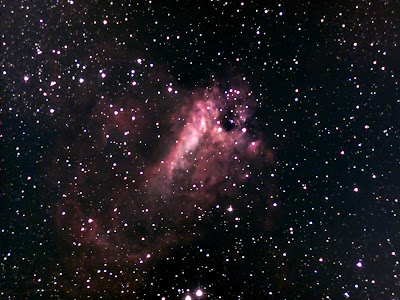
Messier 17
M17, the Omega Nebula

Location of the Ring Nebula. Image from SkySafari Pro.

Number 4: M57, the Ring Nebula. The Ring is awesome. It is another planetary nebula, so we are seeing gas that has been ejected by a dying star. The Ring always impresses people when they see it through a telescope. I remember once years ago (when I was working at Lake Afton Public Observatory in Wichita, Kansas) I was using a 16-inch telescope to show the Ring Nebula to a young lad who then described it as looking like a “dimly-lit Cheerio.” His description was perfect and much better than the “smoke ring” description that most people use. Of course, the eVscope quickly reveals its colors (something you won’t see at the eyepiece of traditional telescopes). This color perhaps makes M57 more like a Froot Loop than a Cheerio. 

Bonus points are given to the ring for being so easy to find in the sky, it is easily found even without using a go-to telescope. It is nestled between two stars in the parallelogram of Lyra, the Harp.

M57, the Ring Nebula

Number 3: M16, the Eagle Nebula. No star death here. Like M17, the Eagle Nebula is a glowing cloud of gas that is actively giving birth to stars. In fact there’s a cluster of baby stars (NGC 6611) that have already emerged from the nebula. This nebula was made famous by the “Pillars of Creation” image from the Hubble Space Telescope. The pillars are easily visible in my image. Here’s a comparison of my image next to the one from Hubble. The Hubble image is presented in a different and not very realistic color palette, but it beats my image in every possible way (as it should). Still it is nice to capture something that famous with my little telescope. The Pillars themselves are 4-5 light years long and are sites of active star formation in the nebula. 

M16, the Eagle Nebula

Number 2: M8, the Lagoon Nebula. While I didn't rank this as number 1, I confess that the Lagoon is perhaps my favorite. It is another star-forming nebula like we saw in M16 & M17, but it has so much more. There's good color, a prominent dark dust lane that cuts across it, a great star cluster (NGC 6530), dark clouds of dust that lurk at the edges of the main nebula, but also dark blobs of dust (called Bok Globules) that are revealed in silhouette. I like everything about this nebula. The region is too big to completely fit into the field of view of the eVscope. Below is a mosaic that I took of the area:

Messier 8, the Lagoon Nebula

And the best Messier nebula is....

Location of Orion Nebula (image from SkySafari Pro)
 

Number 1: M42, the Great Orion Nebula. When you have the word "great" in your name there shouldn't be any doubt as to your status. The Orion Nebula is bright and super easy to find. It sits in a prominent spot in Orion, which is arguably the brightest and most famous constellation of them all. Pretty much everyone can find the three stars that make up the Belt of Orion. The Orion Nebula is the middle "star" of the Sword which hangs down from the Belt. It is easily seen without any optical aid if you are away from light polluted skies. It looks fine in binoculars and good in every telescope. 


Like the Lagoon, this nebula is too big to see all at once, so I took a mosaic of the region:

M42, the Great Orion Nebula


Yes, M43 is hanging on there on the left, but it's really part of M42. The Great Orion Nebula, which like the Lagoon and the others we've seen, is a vast cloud of mostly hydrogen gas that is actively forming stars. The central white area is overexposed here, but it is home to a group of young stars called the Trapezium which are making the gas fluoresce. There's dark dust, blue reflected starlight and red glowing hydrogen. 

It really is a stunning sight to see.

I am working my way through photographing the entire Messier Catalog, with only a few objects left to get. If I feel super energetic about it I might just rank all 110 of them.  

Thursday, July 8, 2021

And We're Back...

After a break of just over a year and a half it is time for me to start blogging again.

Since mid November of 2020 I have been spending a lot more time under the night sky imaging astronomical objects from my backyard (also while I sit comfortably inside too).  The main reason for my change in behavior has been because I decided to purchase an eVscope from Unistellar Optics.

The telescope, pictured at left with the constellation Orion in the background, is a 4.5" telescope with an imaging system fully integrated into it. It is controlled by an app from a smartphone or tablet and it is amazingly easy to use. It is every easy to set up and its low weight makes it extremely portable (though I pretty much never go anywhere except my backyard). 

My yard is small and there are many tall trees nearby which can block large portions of the sky. This means that some parts of my yard have a good view of the east, others the south and there's one particular spot that has a limited view of the west. For any traditional backyard observing this would be a huge challenge, but not for the eVscope. It is not uncommon for me to finish looking/imaging at one part of the sky and then pick up my telescope to move it to another part of the yard. It is then a simple matter for the telescope to figure out where I've moved it to (an operation that takes less than a minute) and then we're off to the next target. 

With this telescope I have been able to successfully image the Moon, stars, galaxies, asteroids (including making citizen science observations of an asteroid occultation), comets, Kuiper Belt Objects, supernovae and more. 

I post a lot of my pics on social media, but I'll be using this space to put some of them here where I've got the room to talk about whatever moves me. 

So I figure I can't get away from this post without leaving at least one astrophoto here, so have a look at the galaxy known as Centaurus A:

Centaurus A is a peculiar galaxy which lies over 10 million light years away. It is possibly a giant elliptical galaxy, but it has a major dust lane cutting across it, which is not a thing that giant elliptical galaxies usually have. Like most big galaxies Centaurus A has a supermassive black hole at its center (this one has a mass 55 million times greater than our Sun!), but this one is quite active emitting radio waves, X-rays and jets of gas moving at relativistic speeds (none of which are visible here).

I had only seen this galaxy though a telescope just once before and I was a little worried that I might not be able to pick this up with my new telescope as it is a southern object that never gets very high in the sky for northern observers. I looked the best possible time, but even so it less than 15 degrees above the horizon and just over a big hill (some might call it a small mountain) that almost blocked my view. I am happy that my eVscope delivered a nice view of this mysterious galaxy though its electronic eyepiece and I was able to capture the image above. 

I've taken a great many images of astronomical objects in the eight months that I've owned this telescope, so expect to see more of them here soon.

Tuesday, January 1, 2019

My Top Books of 2018

2018 was a bad year for blogging, but another good year for reading. Like last year I managed to read 60 books, though not quite as many pages as I hit in 2017.

I use Goodreads to keep track of what I've read, so if you are interested here's the full list of what I read in 2018. My "best books of the year" are drawn from titles that I read that also came out this year. I read a lot of science fiction and science books, so my list comes from a pretty narrow spectrum of books.

In the realm of science books my top two were We Have No Idea: A Guide to the Unknown Universe by cartoonist Jorge Cham and physicist Daniel Whiteson. It's a very friendly look at the big mysteries of modern science and I enjoyed the heck out of it.  Even better though is Alan Stern and David Grinspoon's Chasing New Horizons: Inside the Epic First Mission to Pluto. It is the inspiring story of how the New Horizons mission was created, funded, cancelled, re-born and eventually sent for its 2015 flyby of Pluto, giving us our only look at the most famous of dwarf planets.

By the way, New Horizons just completed a successful flyby of another and more distant object, but as of this writing the data is only now being returned to Earth.

I also very much enjoyed Adam Frank's Light of the Stars: Alien Worlds and the Fate of the Earth.

Another non-fiction book that I very much enjoyed was Michael Benson's Space Odyssey, which looks at the making of the classic film 2001: A Space Odyssey. 

There were so many good science fiction books out in 2018. John Scalzi gave us two (Head On and The Consuming Fire). Becky Chambers Record of a Spaceborn Few was very enjoyable, but my favorites were How to Stop Time by Matt Haig and Mary Robinette Kowal's two Lady Astronaut books: The Calculating Stars and The Fated Sky.

How to Stop Time is wonderful, quotable and profound, while MRK's two Lady Astronaut books are adventurous, tragic, inspiring and important. They tackle head on issues of inclusion, race and discrimination. I highly recommend them.

2019 should be another good year for reading. I got a nice pile of books for Christmas that is getting me off to a good start.