Showing posts with label messier. Show all posts

Monday, September 1, 2025

Summer's Greatest Hits

Well, it's Labor Day. Summer is officially over and the fall semester has begun. I got in a lot of telescope time over the summer, so I thought I would post a few of my favorite images taken during my break.

Comet 3I/ATLAS, the third ever interstellar object known to pass through our Solar System was discovered in early July. It is faint, but the Unistellar / SETI Institute citizen science program was interested in seeing if people could detect it with their telescopes. 

Stars appear as streake in this image of Comet 3I/ATLAS which looks like a circled dot.
 

The image above shows 3I/ATLAS (circled). The individual frames were aligned on the comet, which means that the stars in the image appear as streaks. At that time the comet was about 17th magnitude, (translation: very faint!) but detectable. I am happy to be contributing to the science being collected on this mysterious visitor which, despite some claims, is indeed just a comet.

Of course, I continue to image some celestial objects just because they look pretty. Probably my favorite of the summer was this beautiful mix of stars, gas and dust known as the Elephant Trunk Nebula. 

An image of the Elephant Trunk Nebula, an elongated dark cloud of gas.
It is located some 2,400 light years away in the direction of the constellation of Cepheus, the King. Like many nebulae, it is a region of space where new stars are forming. This was a 2-hour exposure taken with my Celestron Origin telescope. I honestly never imagined that I would someday be able to take images like this one and the others below, but I am happy to be living in the age of the smart telescope.

Much farther afield is the spiral galaxy known as Messier 33.

An image of a spiral galaxy.
This is a 2-hour exposure of M33 which, at a distance of 2.7 million light years, is the second closest spiral galaxy to our Milky Way Galaxy. It is a galaxy that always challenged me when I tried to see it visually with a traditional telescope, so being able to capture it this way is wonderful.

Earlier in the summer I posted images of other nebulae, one of which was the fabulous Lagoon Nebula in Sagittarius. After further review, I thought that maybe the image I posted there, which was a 1-hour exposure, was perhaps overexposed. So, I decided to try something much shorter and I am even happier with the result. 

This image was just a 2-minute exposure! Even with this short exposure the nebula still reveals brilliant color, dark globules of dust and the young star cluster that has formed from the nebula.  

Just last night I pointed my Origin telescope at NGC 6729, a target that was new to me. It is located so far south that it never gets even 20-degrees above my horizon. Still, I managed to get a 70-minute exposure and am happy with how it came out. 

Dark clouds of dust surround embedded stars.

What you are seeing here are some stars that are embedded within opaque clouds of gas and just. A pair of bright, young stars are shining forth just above center while other fainter ones struggle to be seen at all. The nebula very much reminds me of the much more famous Messier 78.

At practically the other end of the sky is the more famous Bubble Nebula (NGC 7635):

A glowing cloud of red gas with a bubble at the center.
The bubble at the center of the image is not a thin film of soapy water but rather of gas that has been blown off a massive supergiant star located thousands of light years away in the direction of the constellation of Cassiopeia, the Queen. Some day this star will explode forming a supernova.

Ten to twenty thousand of years ago there was a supernova explosion in the constellation of Cygnus, the Swan. It produced the Veil Nebula (a part of which is in my nebula post linked above), which is just a piece of the much larger supernova remnant known as the Cygnus Loop. 

The Cygnus Loop is about five full moons across, which means it is much, much larger than the field of view in my Origin telescope. Yet, I decided I wanted to capture it all. To do so I had to make a mosaic of 15 images. Here it is:

Wispy clouds of red and blue gas in a roughly circular shape, like a burst bubble, against a background of stars.

To me, it resembles a bubble that has just burst, but it is an expanding cloud of 'star guts' from the supernova explosion. 

I mentioned the size of the nebula above, but wanted to illustrate that with a correctly scaled image of the full Moon, so here it is: 

The Cygnus Loop supernova remnant with a full moon to show its size.
These were just a few of the many objects observed this summer. There's a whole lot of sky still to observe and I'll be back later with more.

Saturday, July 16, 2022

The Cluster and the Comet

Back in June I posted about observing comets (see it here) and even mentioned the one that is currently closest to Earth which has this beautiful name: C/2017 K2 PanSTARRS. 

Comets have different parts to their names. The C means that is is a non-periodic comet. Once it makes this pass through the inner Solar System it is never coming back. 2017 was the year of its discovery and the K2 means that it was the 2nd comet discovered in the 2nd half of May. Comets also get the name of their discoverer. In this case that wasn't a person, but rather the Panoramic Survey Telescope & Rapid Response System, aka PanSTARRS. 

The image below shows the comet's orbit through the inner Solar System. 

orbit of comet 2017 K2 PanSTARRS

It doesn't get especially close to Earth. It was at its closest a few days ago when it was 1.8 astronomical units (166 million miles) from Earth. Interestingly enough when the comet was closest to Earth it was also  nearly in the same direction in the sky as the globular star cluster Messier 10. I managed to catch them with my Unistellar eVscope 2 on July 15th.

While the cluster and the comet appear to be next to each other, they are merely in the same direction. M10 is more than 14,000 light years from Earth, but when I took this image the comet was just 15 light minutes away. That's not close at all.


Friday, October 15, 2021

The Messier Catalog

I don't know about you, but I finally kept a New Year's resolution. What was it? To use my Unistellar eVscope to observe and photograph all 110 objects of the Messier Catalog. Yes, I know some people do Messier marathons and catch them all in just one evening, but it takes time if you want to take a photograph each and every one of them. Besides, I do like to sleep. 

I caught my first Messier object this year, the famous Orion Nebula (M42), on January 3rd. The last one that I observed was on October 9th: the galaxy known as M77.

I will certainly be revisiting each and everyone of these objects in the future (especially since I'll will soon have the eVscope2), but for your visual enjoyment here are a few mosaics of the objects of the Messier Catalog.

Messier 1 through 20: 

Messier 21 - 40:

Messier 41 - 60:

Messier 61- 80:

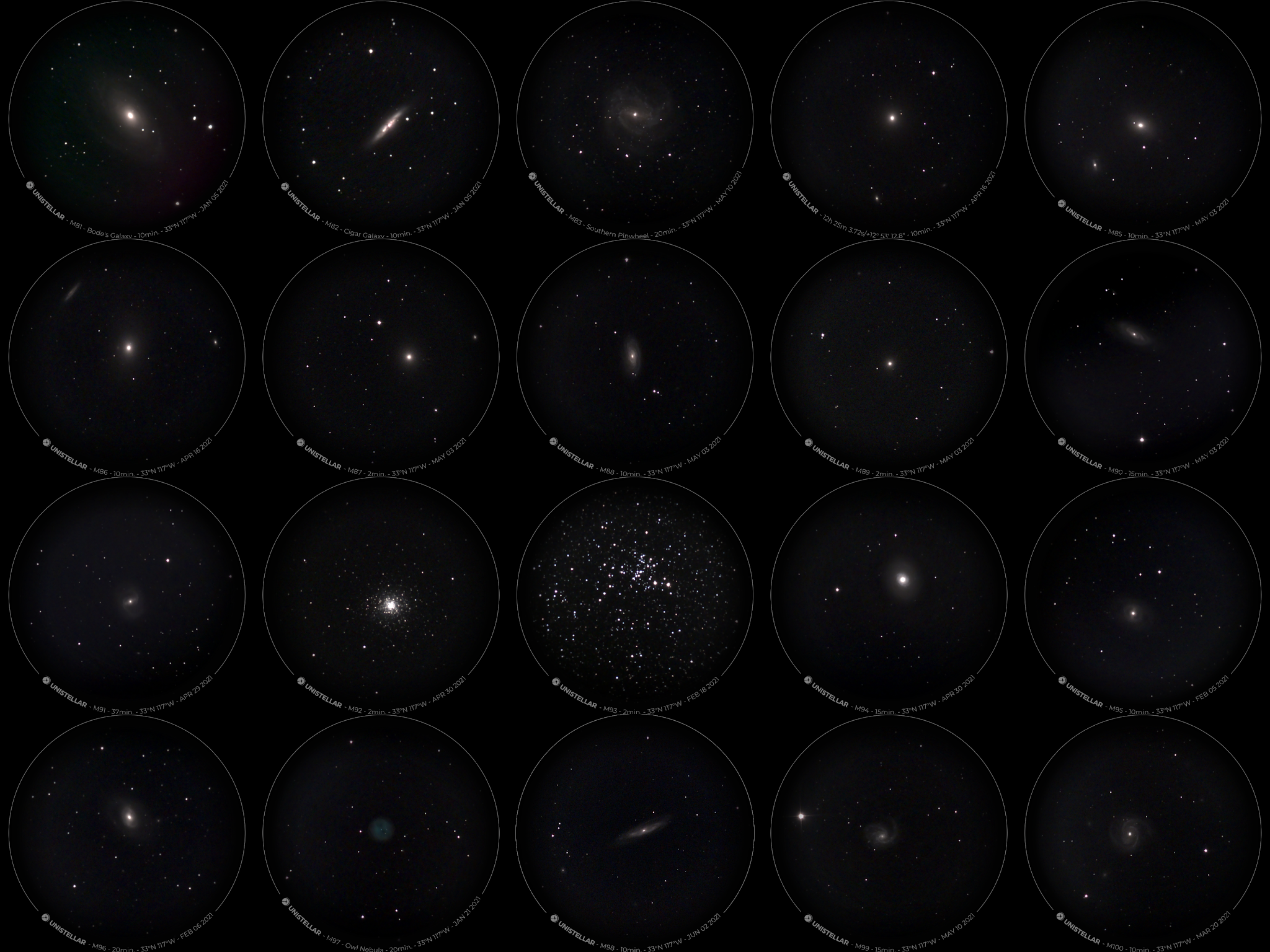
Messier 81 - 100:

 and finally Messier 101 - 110:

I've previously blogged about the globular star clusters and the nebulae of the Messier Catalog and I've still got a few things left to say about the whole thing, but I'll save those thoughts for another time.


Thursday, August 12, 2021

Globular Star Clusters of the Messier Catalog

Globular star clusters are collections a few hundred thousand old stars that are gravitationally bound together. There are 29 globular star clusters in the catalog of objects that might be mistaken for comets made by French comet hunter Charles Messier in the 1700s. Globular star clusters make up just over 26% of the the 110 on the list. Other objects in the Messier Catalog include open star clusters, nebulae, galaxies and a few odds and ends. It makes sense that globulars would be well represented as a globular star cluster can very much resemble a comet that does not have a tail.

Summer evenings in the Northern Hemisphere are the best time to see globular star clusters as so many of them are in the sky at once. Have a look at this image from the SkySafari app:

The graphic is just over 50 degrees wide and mainly shows the constellations of Sagittarius, Scorpius and Ophiuchus (alas, headless here). Marked on the image are the locations of 16 of the 29 (55%) globular star clusters on Messier’s list. Also marked on the image (up and right from the tip of the arrow of Sagittarius) is the location of Sagittarius A*, the black hole at the center of the Milky Way Galaxy. Sagittarius A* is invisible to our eyes and in optical telescopes, but it is no coincidence that so many globular star clusters are in the area surrounding the center of our galaxy. They are there because they are in orbit around the center of our galaxy. 

Over the last several months I have used my Unistellar eVscope to photograph the Messier globulars. Here is a mosaic I made that shows the first 15 globulars in the catalog:

Row 1: Messier 2, 3, 4, 5, 9. Row 2: Messier 10, 12, 13, 14, 15. Row 3: Messier 19, 22, 28, 30, 53.
 
Here are the rest:
Row 1: M54, 55, 56, 62, 68. Row 2: M69, 70, 71, 72, 75. Row 3: M79, 80, 92, 107.

For some reason I initially felt it was necessary for me to rank the clusters, but as I got started it began to seem like writing about each and every one of them was a far more daunting task than observing them was. So instead, here are a few things that I think are interesting about some of them. 

M107

M107 is the eighth closest globular star cluster in the Messier Catalog, yet it is the faintest of all 29. This cluster wasn’t officially added to the Messier list until 1947, some 130 years after Messier’s death. M107 was discovered by Pierre Méchain in 1782 a year after Messier compiled his “final” list. Méchain, who collaborated with Messier, often shared his discoveries with Messier who then confirmed them and then added them to his list. So why is M107 on the official list? Because it is, though if you ask me these late addition objects (M104 - 110) are on shaky ground. The cluster is not amazing and when combined with the dubious nature of it being on the list it ranks as my least favorite.

M3
M3 is 33,900 light years away in the direction of the constellation of Canes Venatici. It has half a million stars and is 90 light years across. M3 is one of the first globular star clusters to appear in the evening as summer season of globular star cluster observing begins.

M4

Located just over a degree west of the bright star Antares in Scorpius makes M4 an easy target to find in the sky. The cluster is relatively close to us with a distance of just 7,200 light years. It is 75 light years across and has just 44,000 stars, which is kind of low for a globular star cluster. Clouds of interstellar dust lie between us and M4. The dust gives it a distinct orange color and if the dust weren’t there M4 would be much brighter in our skies, as it is it is it is the third brightest on the list.

M13

M13 is widely considered the best globular star cluster of the bunch. It is often referred to as the “Great Hercules Cluster.” What makes it so great? It is the 2nd brightest of the globular star clusters in the Messier catalog. It is also the 2nd most northern of the globulars, putting it much higher in the sky for observers in the Northern Hemisphere. It’s not amazingly close, in fact it is some 22,000 light years away from us. Unrelated, but back in 1974 the now defunct Arecibo radio telescope was used to beam a brief message (the most powerful signal ever sent from Earth) to this cluster. Finally, M13 is an easy target to find because of its location in the “Keystone” asterism within the constellation of Hercules. Is it the best globular on the list? Almost.

M15

M15 is 33,600 light years away from our Solar System. It is seen in the direction of the constellation of Pegasus, which makes it one of the few globular clusters to see in fall evenings (for observers in the Northern Hemisphere). It sports an intermediate mass black hole at its core which weighs in at 4,000 times the mass of our Sun.

M22

At a distance of around 10,000 light years M22 is the 2nd closest of the globular star clusters. It is 97 light years across and shines with a brightness of over 200,000 Suns. It’s visual magnitude is 5.1, making it the brightest of the Messier globular star clusters (Two other globular star clusters are brighter, but they are located too far south for Messier to have observed them). Like M4, there’s dust between us and the cluster, so it would be even brighter if the dust were not obscuring some of its light. Still, it is a beautiful looking star cluster. For most people it loses points for being so far south in the sky, but M22 more than makes up for it by looking so great and giving us stars all the way down to its center. 

Above is a screen grab from SkySafari showing the location of M54 and at right is an image of it. It isn't an impressive globular star cluster, unless you know its story. M54 lies some 87,000 light years from our Solar System, making it the most distant globular on the list by a whopping 20,000 light years! In fact you could even say that M54 is extra galactic, as in it doesn’t even belong to our galaxy, the Milky Way, making it the only globular in the Messier Catalog that lies outside of our galaxy. It belongs to the faint Sagittarius Dwarf Elliptical Galaxy (SDEG). The SDEG is the big (7.5 degrees in length) oval in the image above left. It is possible that M54 might be the core of the SDEG instead of a true globular star cluster. There’s evidence that there’s a black hole at its core. It is one of the most luminous globular star clusters known, shining with a brilliance 850,000x times that of the Sun. There’s just one globular star cluster that exceeds that, Omega Centauri, a cluster too far south for Messier to have seen.

M55
Finally, here's M55. For some reason M55 is one of those star clusters that I tend to forget about, but it is a really nice one. It is one of the seven Messier globulars in Sagittarius. It lies 17,600 light years away and it a beautiful sight to see.

I could go on, but I think that perhaps instead I'll start planning my next observing session.

Tuesday, July 13, 2021

The Nebulae of the Messier Catalog: Ranked

Note: All of the images in this post, with the exception of the two star maps and the one image from the Hubble Space Telescope, were taken by me with my 4.5" Unistellar eVscope.

In the 1700s a French comet hunter named Charles Messier compiled a list of things in the night sky that aren’t comets. As someone who was actively looking for comets, this represented his list of things that could be ignored because they aren’t what comet hunters want to find. His list of not-comets is a catalog of more than 100 objects that represent some of the finest objects in the night sky. The list is mostly made up of star clusters and galaxies, but there are 12 nebulae. 

Nebulae (that’s the plural for nebula) are clouds of gas. They come in different types and the 12 that are found on in the Messier nicely represent them. Here are images of the 12 Messier nebulae and I decided to rank them, because, why not?  (Note: there are some other nebulae that are sort of in the catalog. For instance there's a little nebula that can be seen when looking at open star cluster M46, but I decided not to include those here.)

Nebulae of the Messier Catalog
The 12 Nebulae of the Messier Catalog in numerical order.
 

M78
 

Number 12: M78. M78 is dark and moody. It’s the kind of nebula that is okay with the fact that it doesn’t have a widely used proper name. It’s nothing more than a reflection nebula, something that is produced as light from its two central stars passes through the dust. Darker clouds of dust surround the brighter region cloaking M78 in mystery (except when viewed in the infrared. There's an entire cluster of stars there).


M43 is the little luminous blob in the middle.


Number 11: M43, De Mairan’s Nebula. Who was De Mairan? I confess that I had to look him up. Jean-Jacques Dortous de Mairan discovered this nebula (according to Wikipedia “some time before 1731"), but frankly this nebula really shouldn’t be classified as its own thing. I mean it’s right there with the fabulous M42. There’s some dark interstellar dust that makes M43 seem like a separate thing, but they really are connected making M43 somewhat of a poser on the edge of greatness.


Number 10: M76, the Little Dumbbell Nebula. That's "dumbbell", as in barbell and as in M27, the actual (not little) Dumbbell Nebula, which we’ll get to later. M76 is a planetary nebula which, as I tell my students, has nothing to do with planets at all. Many of these nebulae are small and round and blueish green in color, much like the planet Uranus. Sir William Herschel, who discovered Uranus, thought that these looked a bit like his planet, so he gave them the name planetary nebulae. Because of this astronomy students have hated him for years. 

In a planetary nebula gas is being ejected out from a dying star. The hot core of the dying star heats the surrounding gas and makes it glow like the gas of a neon sign. M76 is small, but it has distinct colors that are easily revealed with the eVscope making it a nice target. 


Owl Nebula with a satellite photobombing the image.


 Number 9: M97, the Owl Nebula. The Owl is another planetary nebula and gets its distinctive name from two large dark areas like “eyes” that make it somewhat reminiscent of an owl’s face. It is faint and takes some time to really see it well, but it is a cool thing nonetheless.


M1, the Crab Nebula


Number 8: M1, the Crab Nebula. The Crab gets extra points for being the only supernova remnant in the bunch, but let’s be honest, it looks nothing like a crab. It was produced when a star exploded as seen from Earth on July 4, 1054 A.D. The eVscope reveals it easily, though it takes some time to see much color here. No matter how you slice it, it is cool to observe a hot cloud of expanding star guts.


M20, the Trifid Nebula


Number 7: M20, the Trifid Nebula. Stars. Gas. Dust. The Trifid has it all. The red comes from a glowing cloud of hydrogen gas which is cut across by dark dust lanes, that help to give it its distinctive name (Trifid means tri-lobed). The faint blue color comes from starlight shining through dust (like sunlight shining through a dirty car windshield), similar to what we saw in M78. It’s an all-round good nebula.


 Number 6: M27, the Dumbbell Nebula. Like M76, the name means barbell, though according to Wikipedia it is sometimes known as the Apple Core Nebula, which is a name I like much better than Dumbbell. Alas, I’ve never actually heard anyone use that name and I fear that if I start calling it the Apple Core Nebula no one will know what I am talking about. It’s another planetary nebula. As you can see it is a big (about 1 light year across) bubble of gas seen against a dense field of stars.


Let’s face it, bubbles are cool and this is likely one of the biggest you’ll ever see. Of the planetary nebulae in the Messier catalog, this one is the closest which also makes it the one that has the largest apparent size. 

Number 5: M17, the Omega Nebula (also called the Swan and other names too). This giant cloud of hydrogen gas is a site of active star formation which means that the nebula is converting itself into a cluster of stars. It has already formed many stars, but they are largely hidden by the nebula itself. Some of the younger, hotter stars that have formed shine on the gas cloud and make it glow.
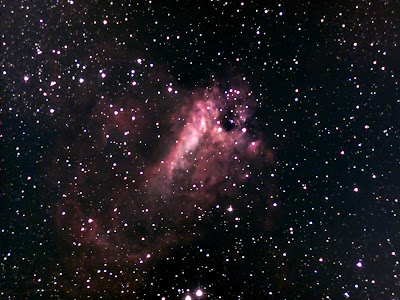
Messier 17
M17, the Omega Nebula

Location of the Ring Nebula. Image from SkySafari Pro.

Number 4: M57, the Ring Nebula. The Ring is awesome. It is another planetary nebula, so we are seeing gas that has been ejected by a dying star. The Ring always impresses people when they see it through a telescope. I remember once years ago (when I was working at Lake Afton Public Observatory in Wichita, Kansas) I was using a 16-inch telescope to show the Ring Nebula to a young lad who then described it as looking like a “dimly-lit Cheerio.” His description was perfect and much better than the “smoke ring” description that most people use. Of course, the eVscope quickly reveals its colors (something you won’t see at the eyepiece of traditional telescopes). This color perhaps makes M57 more like a Froot Loop than a Cheerio. 

Bonus points are given to the ring for being so easy to find in the sky, it is easily found even without using a go-to telescope. It is nestled between two stars in the parallelogram of Lyra, the Harp.

M57, the Ring Nebula

Number 3: M16, the Eagle Nebula. No star death here. Like M17, the Eagle Nebula is a glowing cloud of gas that is actively giving birth to stars. In fact there’s a cluster of baby stars (NGC 6611) that have already emerged from the nebula. This nebula was made famous by the “Pillars of Creation” image from the Hubble Space Telescope. The pillars are easily visible in my image. Here’s a comparison of my image next to the one from Hubble. The Hubble image is presented in a different and not very realistic color palette, but it beats my image in every possible way (as it should). Still it is nice to capture something that famous with my little telescope. The Pillars themselves are 4-5 light years long and are sites of active star formation in the nebula. 

M16, the Eagle Nebula

Number 2: M8, the Lagoon Nebula. While I didn't rank this as number 1, I confess that the Lagoon is perhaps my favorite. It is another star-forming nebula like we saw in M16 & M17, but it has so much more. There's good color, a prominent dark dust lane that cuts across it, a great star cluster (NGC 6530), dark clouds of dust that lurk at the edges of the main nebula, but also dark blobs of dust (called Bok Globules) that are revealed in silhouette. I like everything about this nebula. The region is too big to completely fit into the field of view of the eVscope. Below is a mosaic that I took of the area:

Messier 8, the Lagoon Nebula

And the best Messier nebula is....

Location of Orion Nebula (image from SkySafari Pro)
 

Number 1: M42, the Great Orion Nebula. When you have the word "great" in your name there shouldn't be any doubt as to your status. The Orion Nebula is bright and super easy to find. It sits in a prominent spot in Orion, which is arguably the brightest and most famous constellation of them all. Pretty much everyone can find the three stars that make up the Belt of Orion. The Orion Nebula is the middle "star" of the Sword which hangs down from the Belt. It is easily seen without any optical aid if you are away from light polluted skies. It looks fine in binoculars and good in every telescope. 


Like the Lagoon, this nebula is too big to see all at once, so I took a mosaic of the region:

M42, the Great Orion Nebula


Yes, M43 is hanging on there on the left, but it's really part of M42. The Great Orion Nebula, which like the Lagoon and the others we've seen, is a vast cloud of mostly hydrogen gas that is actively forming stars. The central white area is overexposed here, but it is home to a group of young stars called the Trapezium which are making the gas fluoresce. There's dark dust, blue reflected starlight and red glowing hydrogen. 

It really is a stunning sight to see.

I am working my way through photographing the entire Messier Catalog, with only a few objects left to get. If I feel super energetic about it I might just rank all 110 of them.