Showing posts with label New Horizons. Show all posts

Friday, May 27, 2016

Pluto At Its Best

Last summer the New Horizons mission made its historic flyby of Pluto. Data from the spacecraft have been slowly beamed back to Earth and its still not all here yet. But what is here is an amazing array of images and other information that have revealed this world to be nothing short of spectacular.

Today NASA unveiled their highest resolution imagery of Pluto showing an amazing and diverse range of landscapes.

Have a look at their video which cuts across our solar system's most famous dwarf planet:

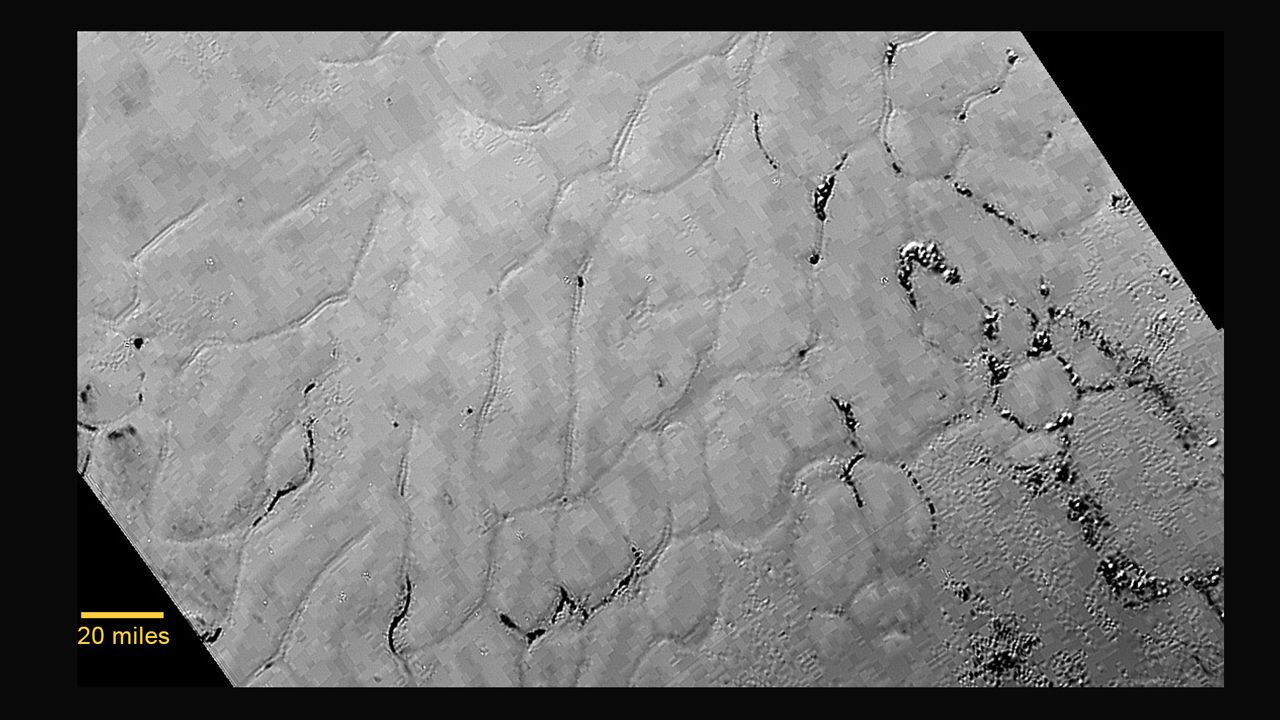
Here's a just a piece of the cut across Pluto, its what they labeled at the Pitted, hummocky Nitrogen ice plains:
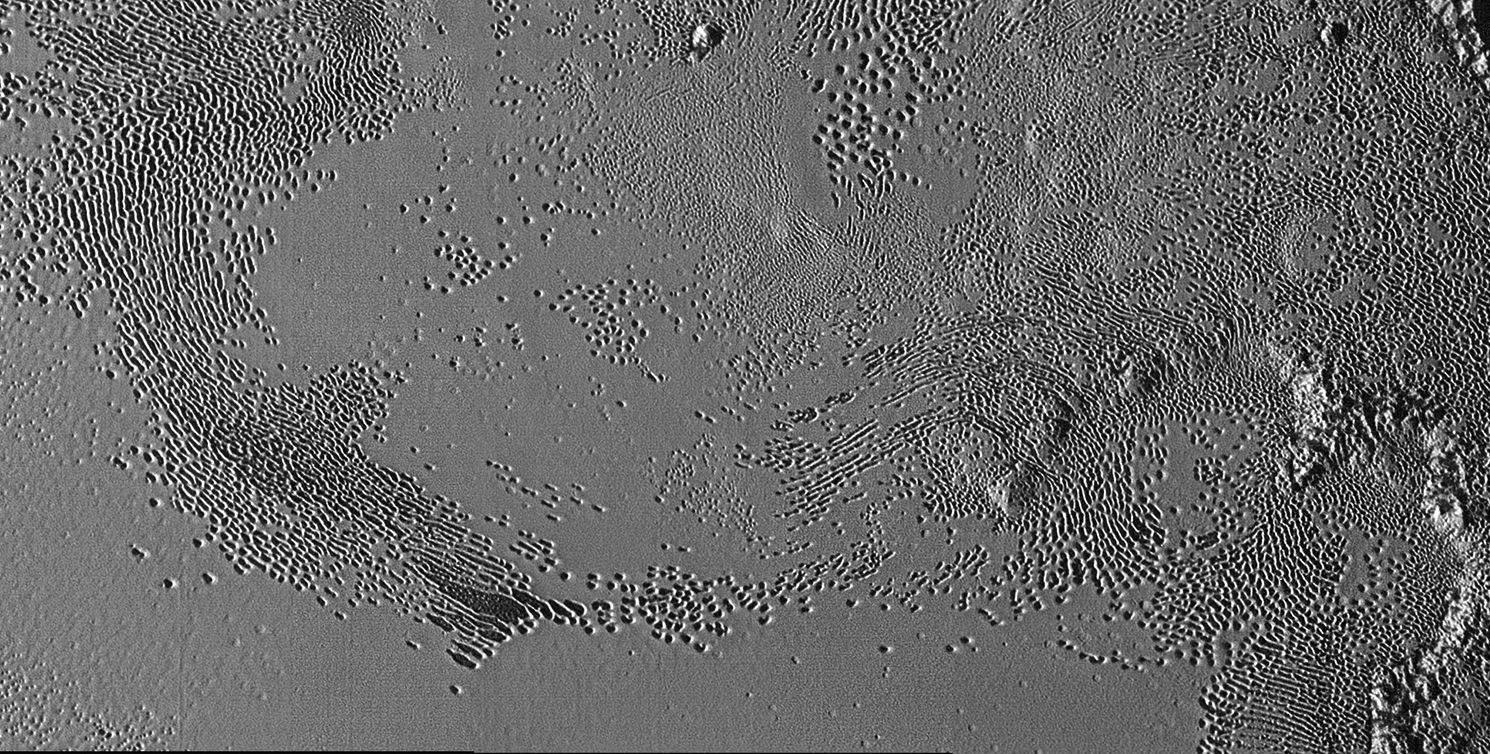
It's like nothing seen on any other surface in the solar system. (Note: I rotated the image.) The video goes too fast for my tastes, so it is worth the time to look at the full cut across Pluto. You can see the full image here. It's amazing.

Saturday, July 18, 2015

More from Pluto & Last Night's Moon and Planets

The early returns from the New Horizons flyby of Pluto have been amazing.
Only a tiny percentage of the data has been returned so far (it will be many months before it's all in), but Pluto is being revealed to be a remarkable world. The images so far indicate a nearly total lack of impact craters, suggesting that Pluto is an active world. There currently is much speculation as to what forms that activity takes (geysers, ice volcanoes, other things), but there's no consensus of any kind yet.

More images are expected to be released on July 24th, so stay tuned for them.

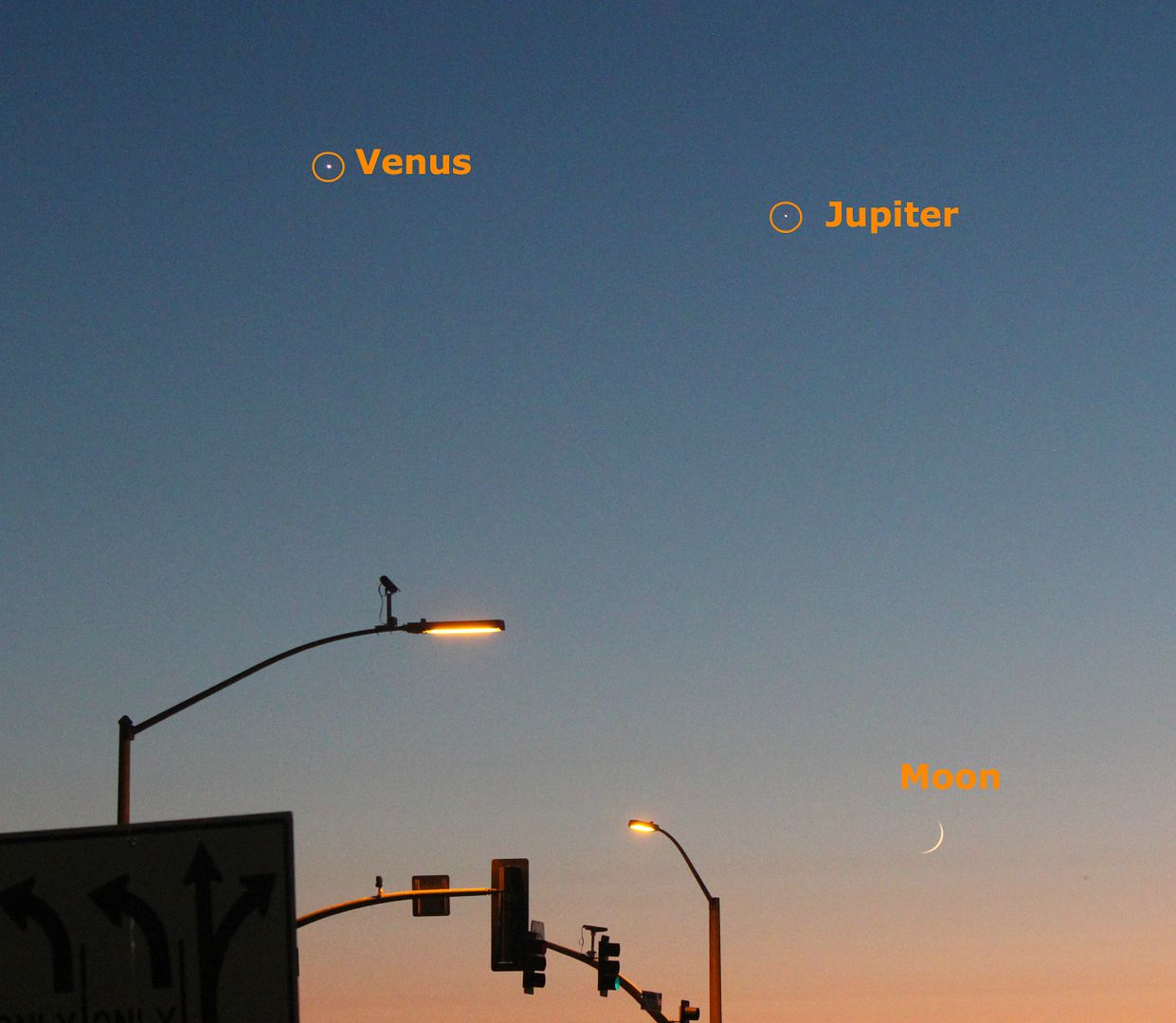
There's a planetary show of another kind still going on out west in the evening skies. Venus and Jupiter are still relatively close together and tonight (Saturday, July 18th) the moon will be especially close to Venus.
Here's how the scene looked last night, with the thin crescent moon well below Venus and Jupiter. By tonight the moon will have moved close to Venus and should look very nice. If you've got clear skies be sure to go out and look for them tonight as it gets dark.
A closer look at last night's moon.

Tuesday, July 14, 2015

The Snows of Pluto?


Pluto nearly fills the frame in this image from the Long Range Reconnaissance Imager (LORRI) aboard NASA’s New Horizons spacecraft, taken on July 13, 2015, when the spacecraft was 476,000 miles (768,000 kilometers) from the surface. This is the last and most detailed image sent to Earth before the spacecraft’s closest approach to Pluto on July 14. The color image has been combined with lower-resolution color information from the Ralph instrument that was acquired earlier on July 13.

This view is dominated by the large, bright feature informally named the “heart,” which measures approximately 1,000 miles (1,600 kilometers) across. The heart borders darker equatorial terrains, and the mottled terrain to its east (right) is complex. However, even at this resolution, much of the heart’s interior appears remarkably featureless—possibly a sign of ongoing geologic processes.
Alan Stern, the P.I. of the New Horizons mission suggested that the smooth nearly featureless area is due to snow on the surface of Pluto. We'll now more after the closest images are returned. Stay tuned.

Monday, July 13, 2015

Strange New Worlds

The latest pics of Pluto and Charon from New Horizons have just been released and, while the best is still yet to come, they show these worlds as never seen before.

Here's the official description given to the image of Pluto above:
Pluto’s bright, mysterious “heart” is rotating into view, ready for its close-up on close approach, in this image taken by New Horizons on July 12 from a distance of 1.6 million miles (2.5 million kilometers). It is the target of the highest-resolution images that will be taken during the spacecraft’s closest approach to Pluto on July 14. The intriguing “bulls- eye” feature at right is rotating out of view, and will not be seen in greater detail. 
And Charon:
Charon’s newly-discovered system of chasms, larger than the Grand Canyon on Earth, rotates out of view in New Horizons’ sharpest image yet of the Texas-sized moon. It’s trailed by a large equatorial impact crater that is ringed by bright rays of ejected material. In this latest image, the dark north polar region is displaying new and intriguing patterns. This image was taken on July 12 from a distance of 1.6 million miles (2.5 million kilometers).
The best is yet to come with data collected during tomorrow's flyby. As I write this closest approach is in just 8 hours 45 minutes. The New Horizons spacecraft will spend the encounter performing science observations to the exclusion of all else. This means that there will be no science data or communications of any kind coming from the spacecraft until well after the encounter has ended.

This means that all the cool pics will not come until later. Because of the slow download times much of the data will be very slow in coming back, taking many months. Still, if all goes well there will be some wonderful imagery soon enough.

Sunday, July 12, 2015

Closing in on Pluto and Charon

The New Horizons space probe is starting to reveal wonderful details on Pluto. Here's a shot taken on July 11th (yesterday):
There's some interesting terrain and brightness variations. Because of Pluto's rotation and the path that the spacecraft is flying, this is the last and best look that we'll get of this side of Pluto - the one that permanently faces its large moon Charon. This photo was taken from a distance of 2.4 million miles and it may be some decades before we get a closer look that these large dark areas.
Charon is also starting to come into focus. The image above (also taken yesterday) hints at features similar to what is seen on Pluto, but what they are remains to be seen.

The view of both worlds will continue to improve as the probe closes in.
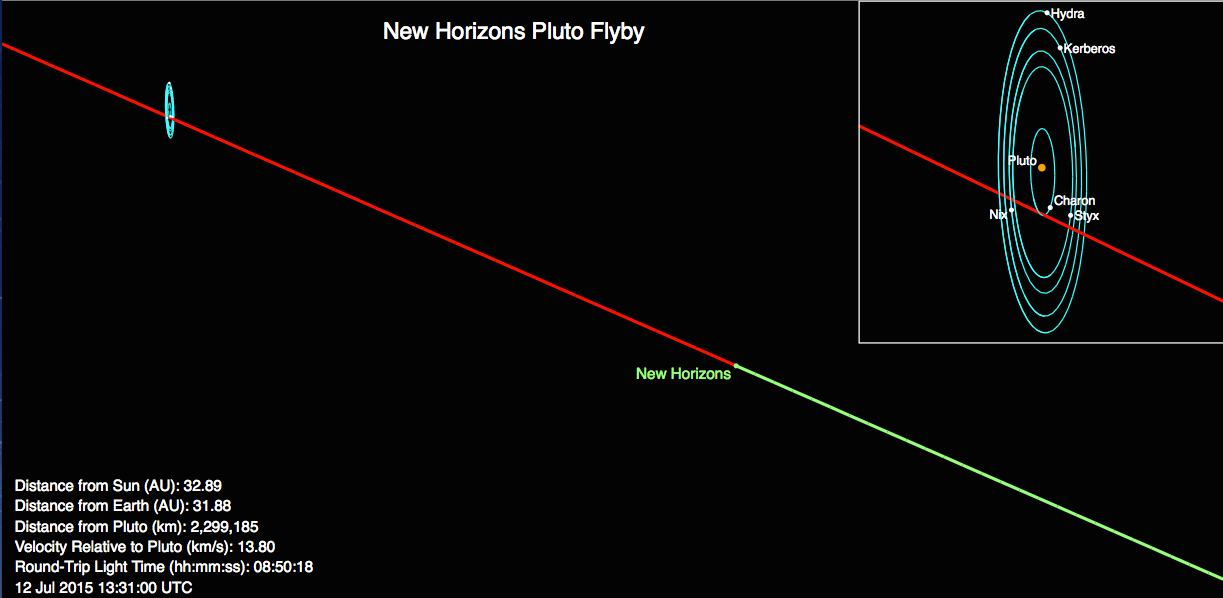
For the latest on where New Horizons is in its flight path be sure to visit their Current Position page. When I grabbed this image New Horizons was just 2,299,185 km (1.4 million miles) from Pluto and closing in on the dwarf planet at 13.8 km/sec (8.6 miles/second).

Thursday, July 9, 2015

Encounters with Pluto

The New Horizons space probe is zooming along headed toward its July 14th flyby of Pluto.
Even though it still has just under five days until its closest approach, it is already returning amazing images like the one above that show Pluto (right) and its largest moon Charon (left) in wonderful detail. The image above was taken July 7th from a distance of 7.8 million kilometers (4.8 million miles).

Living in the future as we are, we all have a front row seat to the encounter. Raw images like the one above are posted online almost as they are received. (Of course, that's done for other missions too - check out the raw images for Cassini at Saturn.) Don't expect to see the best images right away though. New Horizons will not be returning any data during the actual flyby of the Pluto system. At that time all its efforts will be focused on collecting data. The data will come back afterwards, when every moment is a little less precious. Here's a complete rundown on everything that is expected and when the data will return to Earth.

Even though we will not be getting immediate results from the encounter, lots of observatories, science centers and planetaria will be hosting Pluto Palooza events for the flyby.
The dome where Pluto was discovered in 1930.
Certainly one of the best places to have a Pluto Palooza is Lowell Observatory, where Pluto was discovered. Their celebration runs an entire week! And why not. There's a very special Pluto connection and history there.
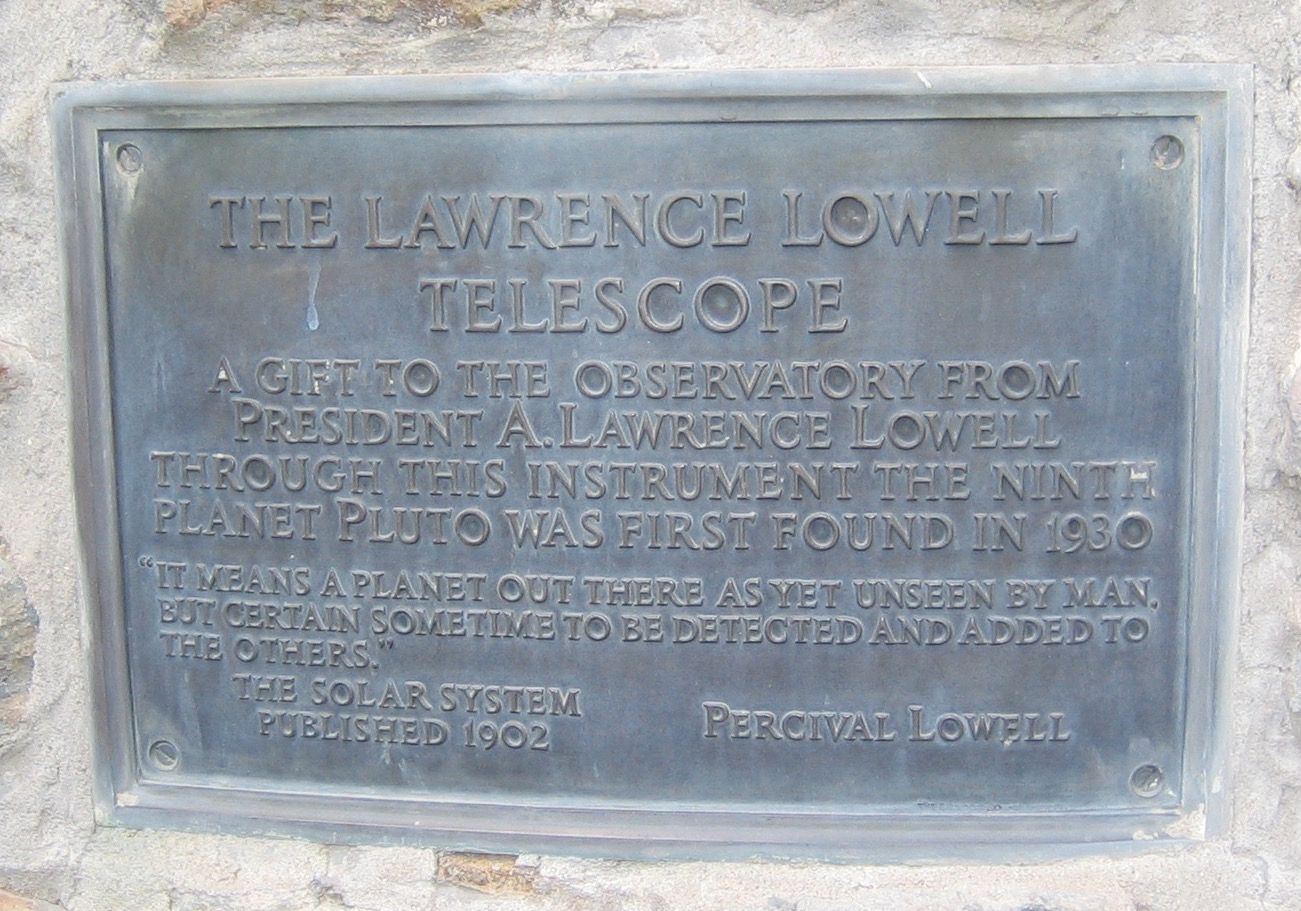
Known as the Lawrence Lowell Telescope, this 13-inch astrograph was used by Clyde Tombaugh to conduct the photographic survey that discovered Pluto.
The 13-inch "Pluto scope" is a photographic instrument. There's no way to look through it. It was designed to have light collected and focused onto a glass photographic plate. The square area at the bottom of the telescope is where the plate goes. The telescope at Lowell Observatory is shown daily on guided tours. It is well worth visiting, even without a Pluto Palooza in progress.

Pluto was the first member of the Kuiper Belt to be discovered. While classified as a planet for 76 years, Pluto is now officially known as a "dwarf planet." I'm not getting into the planet debate here, but what we already know for certain is that Pluto and its system of moons are interesting and temporarily unknown. This will be our first look at these strange new worlds. I can't wait to see what's found.