Showing posts with label asteroids. Show all posts

Sunday, November 7, 2021

Asteroid Encounters

This year I have observed more asteroids than ever before with 29 detected so far. Some them have been as a part of the Unistellar Citizen Science campaigns, but most of them have just been for fun. For instance, earlier this week I looked at the asteroid 626 Notburga which was in the constellation of Cassiopeia.

The image above is an animated gif of two images taken 75 minutes apart showing Notburga's motion though the sky. The individual exposures were short so it wasn't easy spot the nebula that was nearby it in the sky. So in between these two images I took a longer one to try to bring out a part of the Heart Nebula.
 
Here the asteroid appears as a line and there's some hint of the red hydrogen gas of the Heart Nebula across much of the upper right portion of the image. 

Since asteroids look like moving dots or streaks it is sometimes more interesting to catch them when they are near some other astronomical object in the sky. A great resource to find out when as asteroid will be near a bright star, a deep sky object or even another asteroid are the observing guides at MinorPlanet.info. I've used that to find all of the close encounters on this page.

Here are asteroids 712 Boliviana (top right) and 89 Julia (below center) from back in October:

Just this week asteroids 1 Ceres and 1140 Crimea have been passing the bright star Aldebaran.

Aldebaran is the bright star at center. Asteroid (and dwarf planet) 1 Ceres is the bright moving object to its lower right. Much fainter is 1140 Crimea. It is the faint moving dot in the upper left. At the time of the images Crimea was actually 25 million miles closer to Earth than Ceres. That doesn't help it much in brightness though because it is much smaller. 1146 Crimea is just 17 miles across while Ceres is 587 miles across!

In early October asteroid 27 Euterpe passed directly in front of one of my favorite globular star clusters: Messier 22. I caught the event on two nights as the asteroid was near the cluster, but it was cloudy the night it passed in front of it.

Euterpe is to the right of the cluster. At the time it was 21 light minutes from Earth, while the star cluster is some 10.600 light years away.

An even bigger disparity in distance was back in March when asteroid 70 Panopaea passed directly in front of spiral galaxy NGC 3344. 

That night asteroid 70 Panopaea was 17 light minutes from Earth while the spiral galaxy is more than 22 million light years from our Milky Way Galaxy.

In the coming weeks and month I will be looking for more interesting asteroid encounters and posting some of them here.


Sunday, September 11, 2016

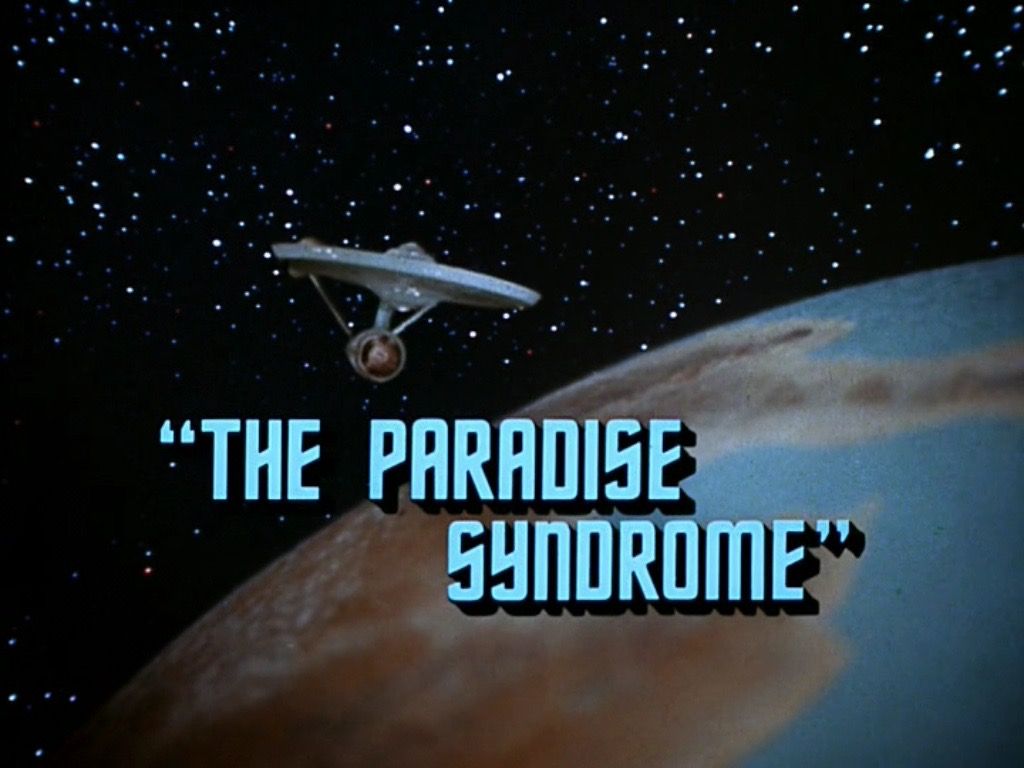
Star Trek: The Paradise Syndrome

Star Trek turned 50 years old just a few days ago, so (only a few days late) here's another look at an episode from the original series.
The Paradise Syndrome is a pretty decent episode, especially for season 3.

It begins with Kirk, Spock and McCoy on a very Earth-like planet. Kirk is surprised at the plant life, saying "It's unbelievable. Growth exactly like that of Earth on a planet half a galaxy away." He asks Spock about the odds of this and Spock replies that they are "Astronomical." Was that a pun? Probably not.  Spock continues, "The relative size, age and composition of this planet makes it highly improbable that it would evolve similarly to Earth in any way."
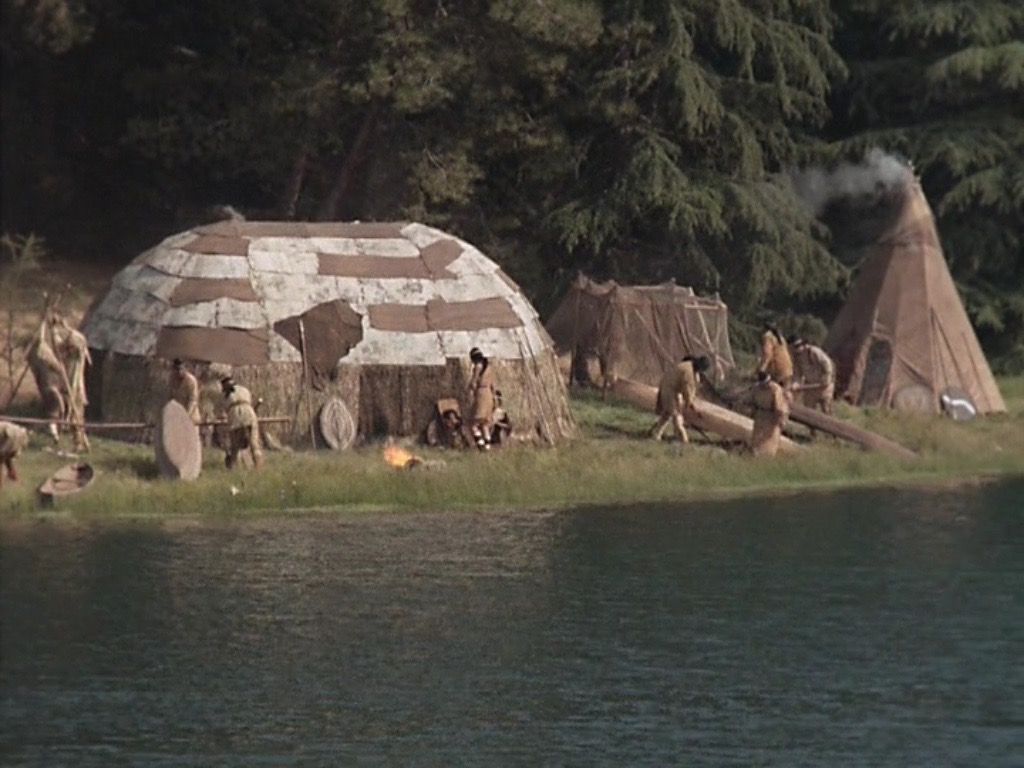
Okay, that is surprising, but even more surprising is that the planet is populated by Native Americans (though they called them American Indians, as it was the 60s you know). Spock impressively can even tell that they are a mix of the Navajo, Mohican, and Delaware Tribes. Strangely, the landing party seems to have been more surprised by the Earth-like plants than seeing the Native Americans.

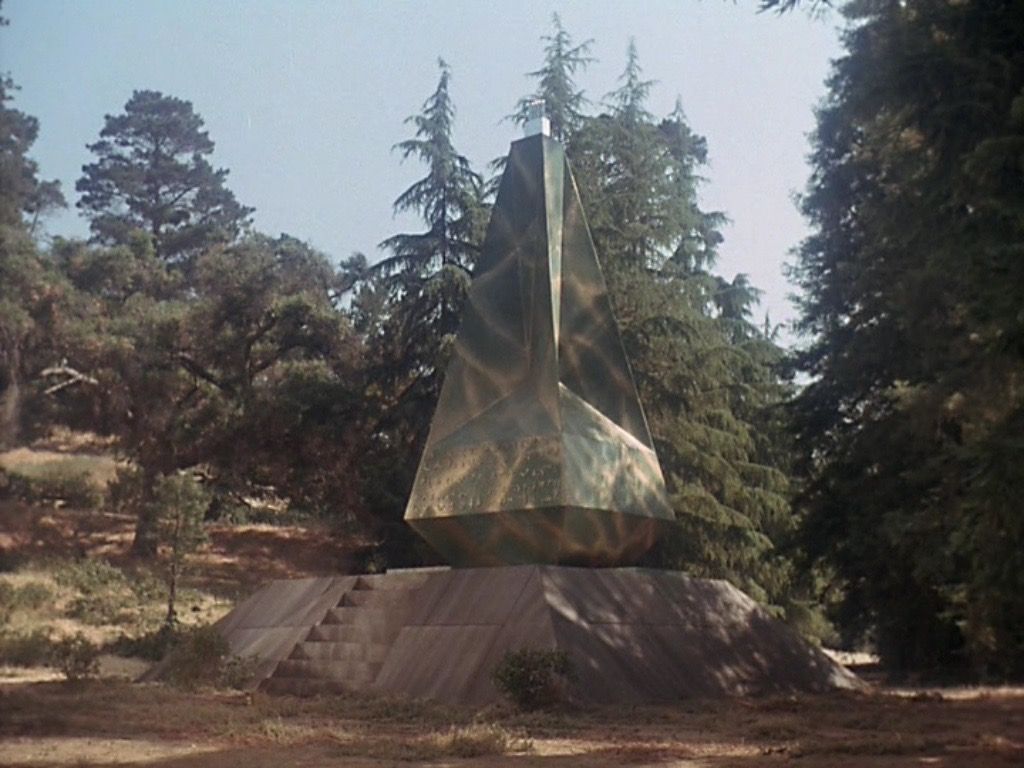
There's also a curious obelisk that doesn't fit with the native's level of technology, but they'll have to check it out later as the Enterprise needs to go and stop an asteroid from crashing into this planet and causing an extinction-level event. It's a big one too--almost as large as Earth's moon.
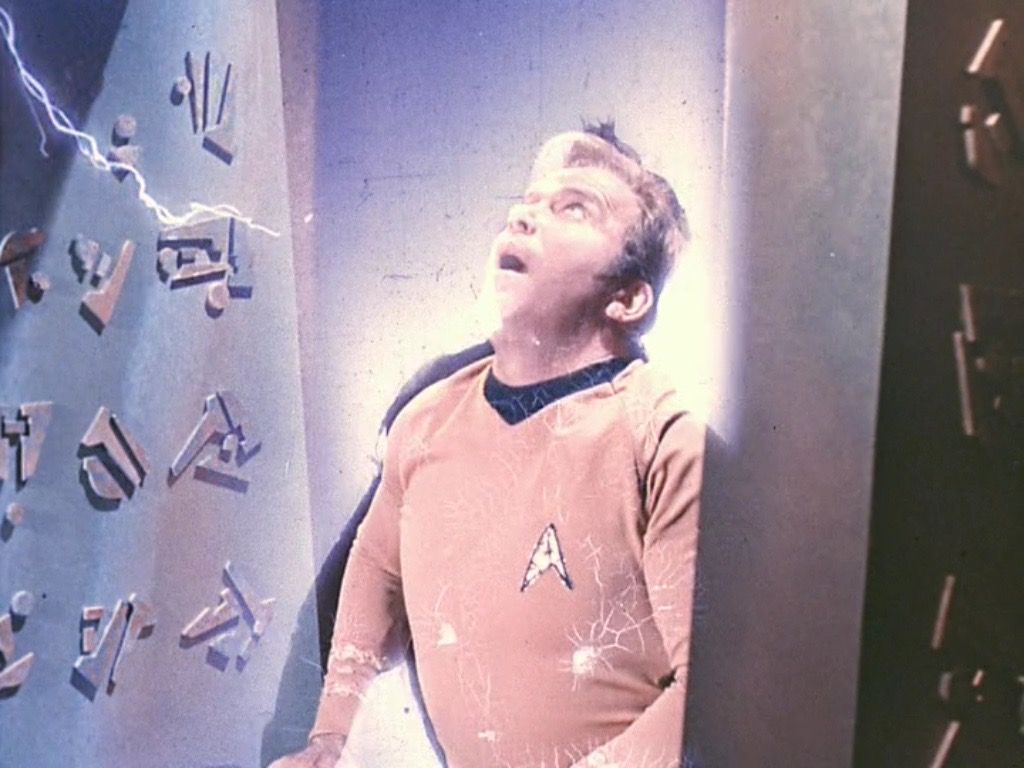
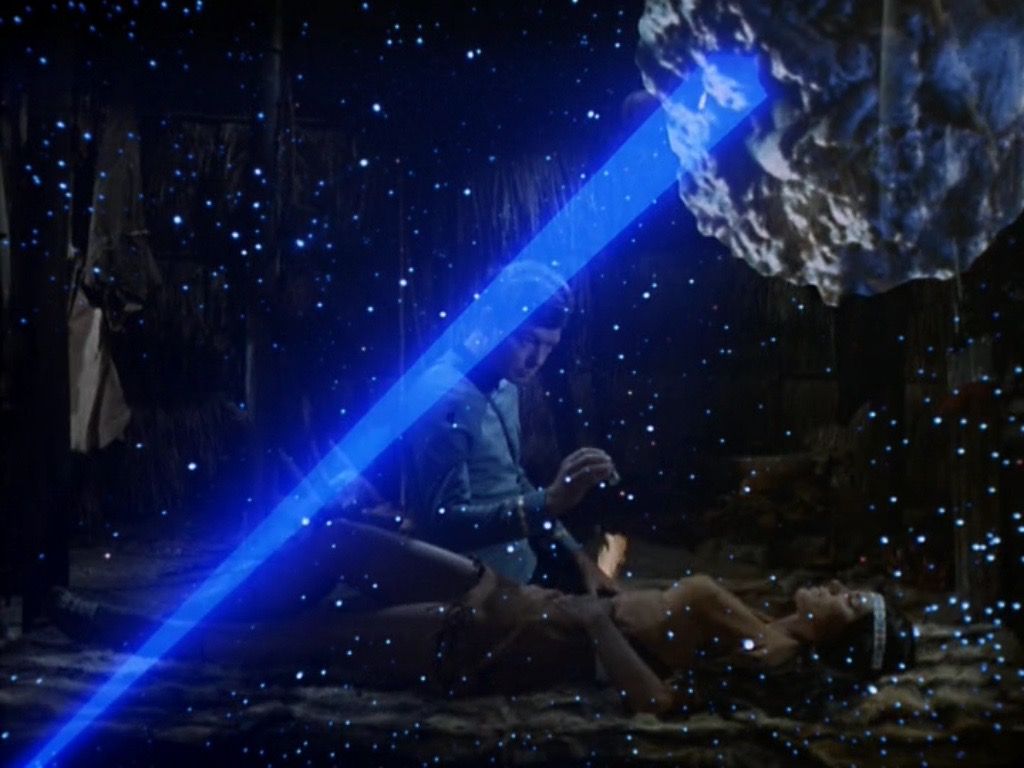
Just before they beam up, Kirk falls into the obelisk and gets zapped into unconsciousness. Spock and McCoy didn't see what happened to him. McCoy wants to stay behind to hunt for Kirk, but Spock reminds them that they need to get moving if they are going to stop that asteroid.
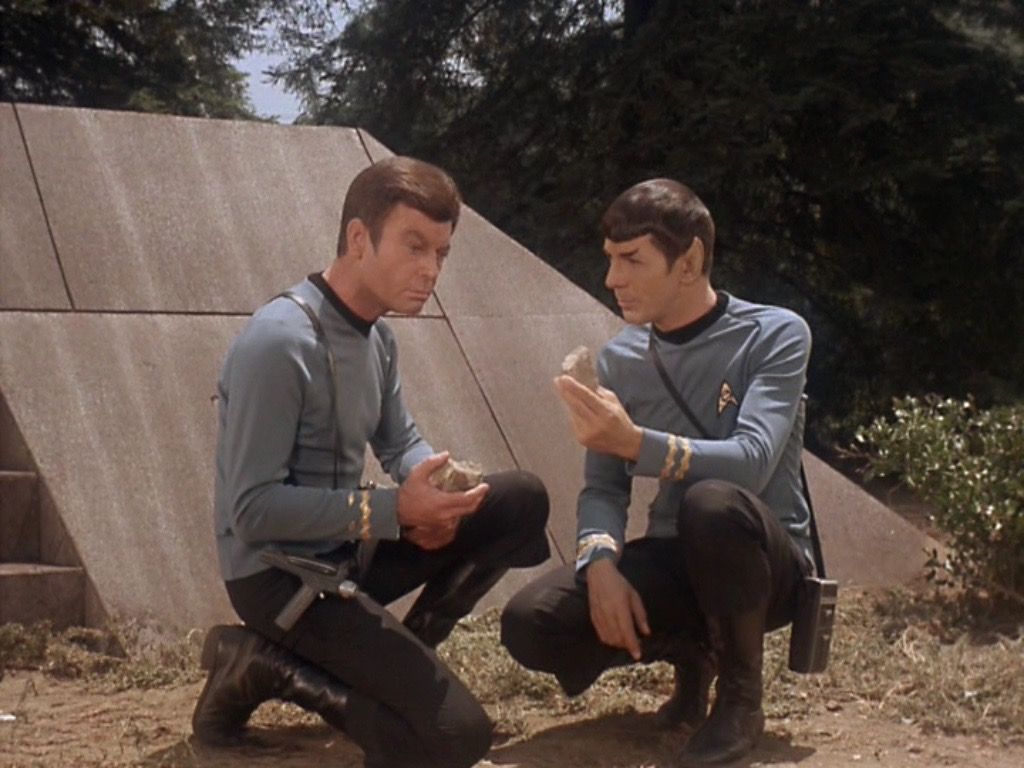
Spock uses rocks to explain to McCoy how asteroids move in space. McCoy looks confused.

For some reason no one suggests leaving a landing party behind to hunt for Kirk while the rest take care of business. Instead, they beam up and head off to divert the big rock that is headed this way.
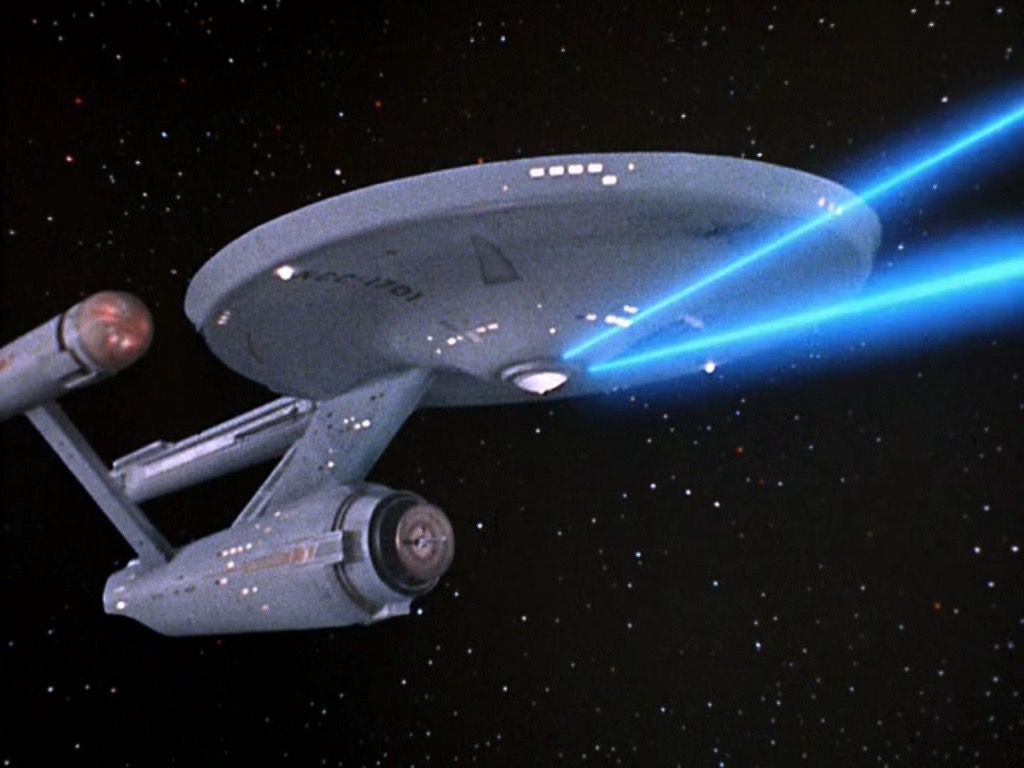
Spock really pushes the Enterprise to the limit, but the deflector beam doesn't move the asteroid enough. The result is that they limp ahead of the asteroid until they can muster another attempt with their phasers.
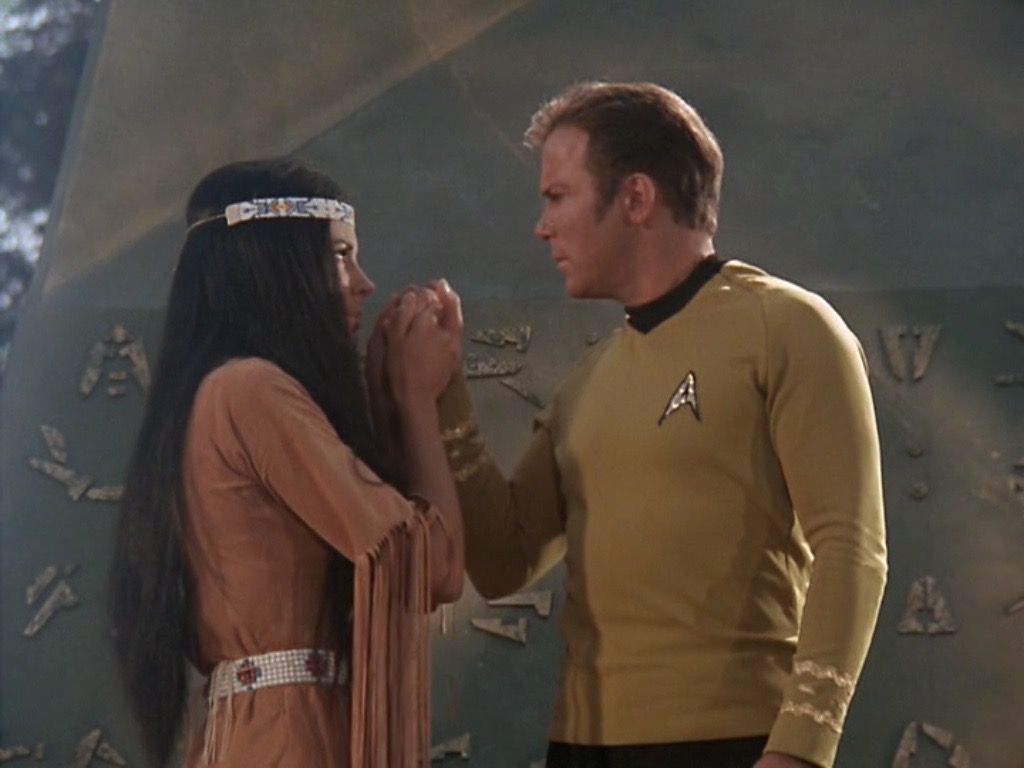
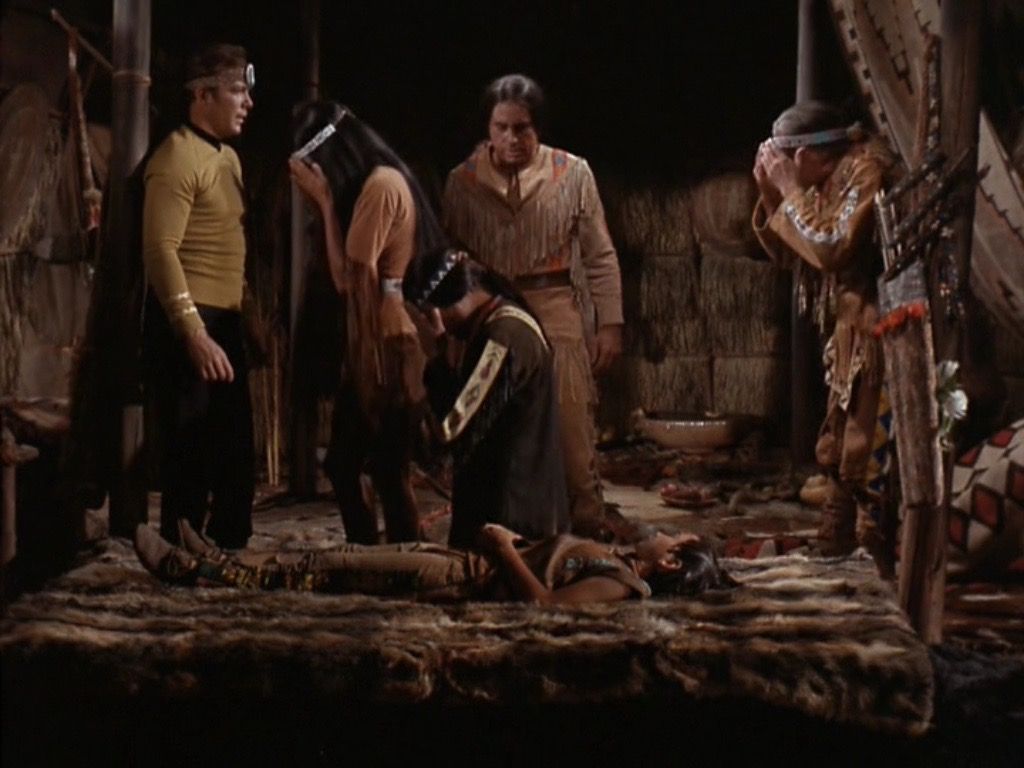
Meanwhile, Kirk awakens and emerges from the obelisk. He's lost all his memories but, because he was seen coming from the obelisk, is assumed to be a god. Kirk's godhood seems legit when successfully brings back a boy to life with something like CPR. They make him medicine man and, by tribal tradition, he gets to marry Miramanee, the hottie who first found him. This sits well with everyone, except Salish, who is the now former tribal medicine man.
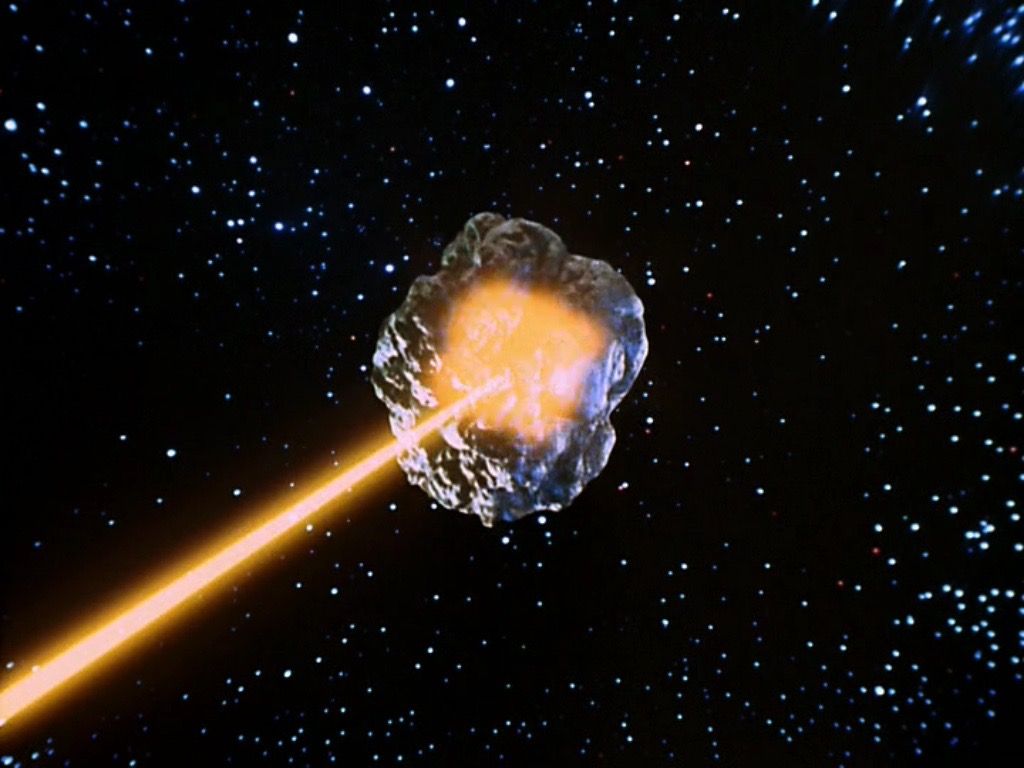
The Enterprise fires phasers as the asteroid, as Spock wants to split it in half. Would that really help? Probably not. I'm guessing there's a big convex lens somewhere between the starship and the rock. Otherwise, how can those converging beams come together? Anyway, it doesn't work and the Enterprise ends up in even worse shape. As Scotty says, "That Vulcan won't be satisfied till these panels are a puddle of lead!"

Soon Salish's stunt double (left) challenges Kirk's stunt double (who looks nothing like Kirk) in a knife fight. The best line here comes from Salish: "Behold a god who bleeds."

In spite of this, Kirk, or should I say Kirok as he was known, is happy. He and Miramanee marry and she becomes pregnant. Yet everyone expects him to fulfill his destiny of saving them all. As the tribal elder asks, "Wise Ones who planted us here will send a god to save us, one who can rouse the temple spirit and make the sky grow quiet. Can you do this?" Um. Kirok really has no idea about this at all. At least we know now why there are Native Americans on this planet. The Wise Ones apparently lifted them from Earth some time ago.

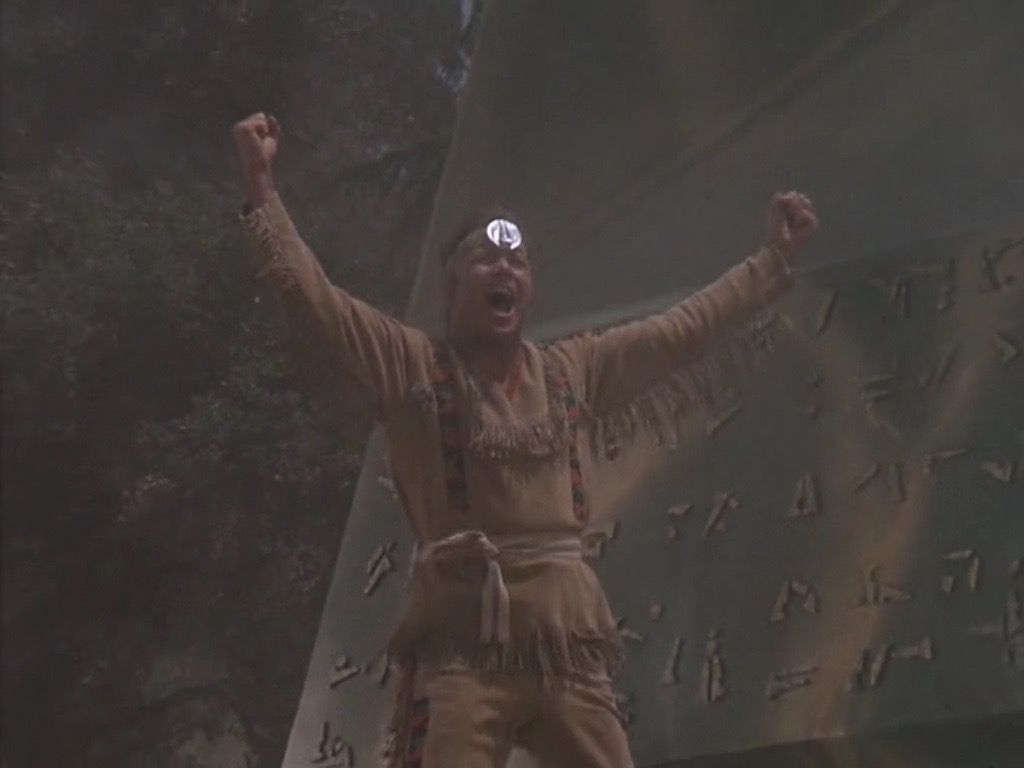
When push comes to shove and it is clear that now is the time for action, Kirk can't do anything more than run to the temple/obelisk and shout "I am Kirok!" The people are unimpressed and immediately begin throwing rocks at him. Miramanee rushes to him and is pelted as well.

Thankfully, the Enterprise arrives just in time and Spock has figured out what the writing on the obelisk means.
Kirk gets his memories back, thanks to a timely mind meld. They rigger the asteroid deflection mechanism in the temple, but they are too late to save Miramanee and her unborn child.

All-in-all it is a fine episode. In spite of it being a Kirk-centered episode, there's good tension between Spock & McCoy and Scotty gets to rant from the engine room. Its all good.

It was an early episode in season 3, so it got its own musical score by Gerald Fried, which is very nice.

By the way, The Paradise Syndrome has a very good followup by Star Trek Continues. Their episode The White Iris is a very moving story that is worthy of your time.

Next up for me is an episode that many consider to be one of the finest in season three--The Enterprise Incident.

Sunday, June 12, 2016

The Asteroids of Star Trek

I was recently re-watching Star Trek: The Motion Picture. There's a scene in the first half of the movie where the newly re-fitted Enterprise is having problems with its warp engines.
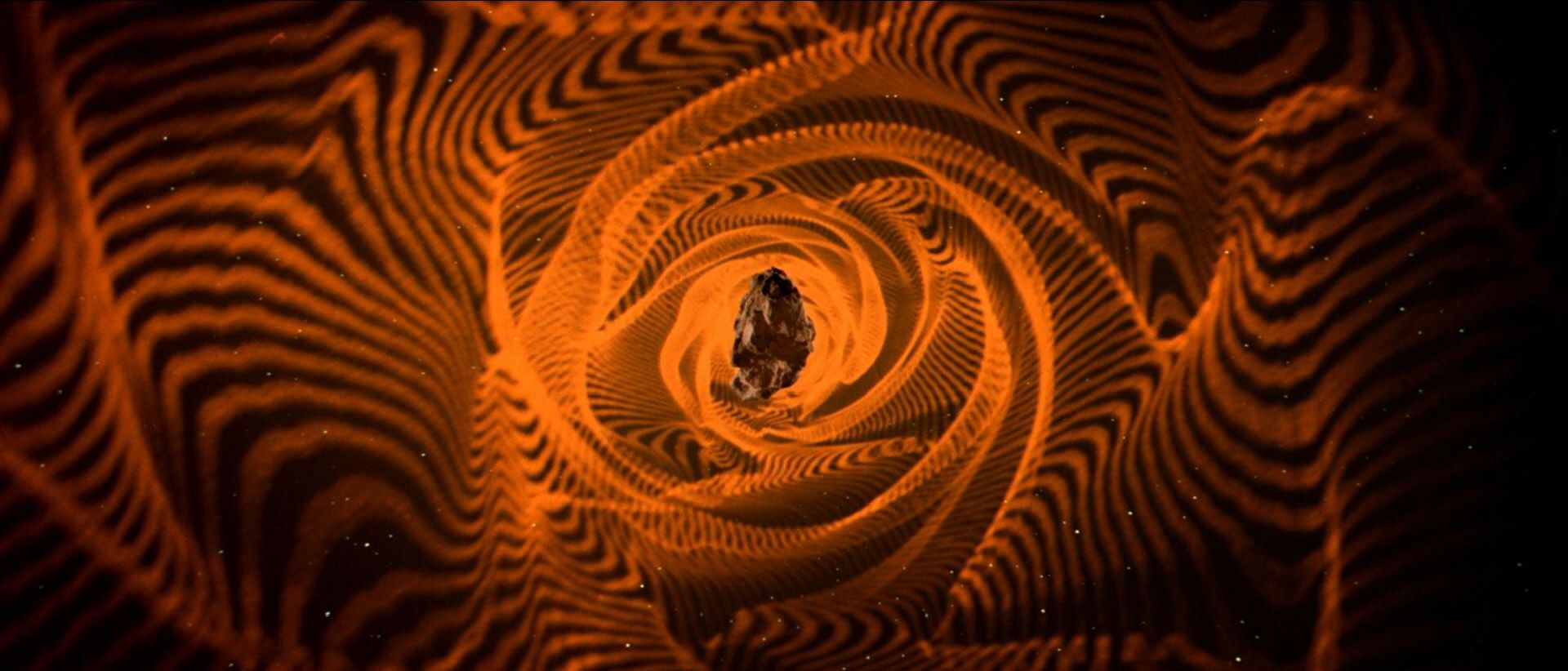
When the crew tries to bring the ship to warp speed an instability in the warp engines instead creates a wormhole (and not the good kind like they had on DS9). While the ship is caught in the wormhole, they encounter and nearly collide with an asteroid.

This got me to thinking about:
a) how asteroids are portrayed in the Star Trek universe and
b) what asteroids are named for either Star Trek characters or those people who helped to create the series. It turns out that there are several of them.

The writers of Star Trek didn't always get their astronomy right. In classic Trek (which is mostly what I'll be talking about here) they encountered a few 'planetoids' (like the one in Metamorphosis and later Regula seen in Star Trek II: The Wrath of Khan). As near as I can figure, in Star Trek a 'planetoid' is something that astronomers today would call dwarf planet. It wasn't until the 3rd season's Paradise Syndrome (which I have yet to cover in my blog) that Star Trek gets good and close to an actual asteroid.

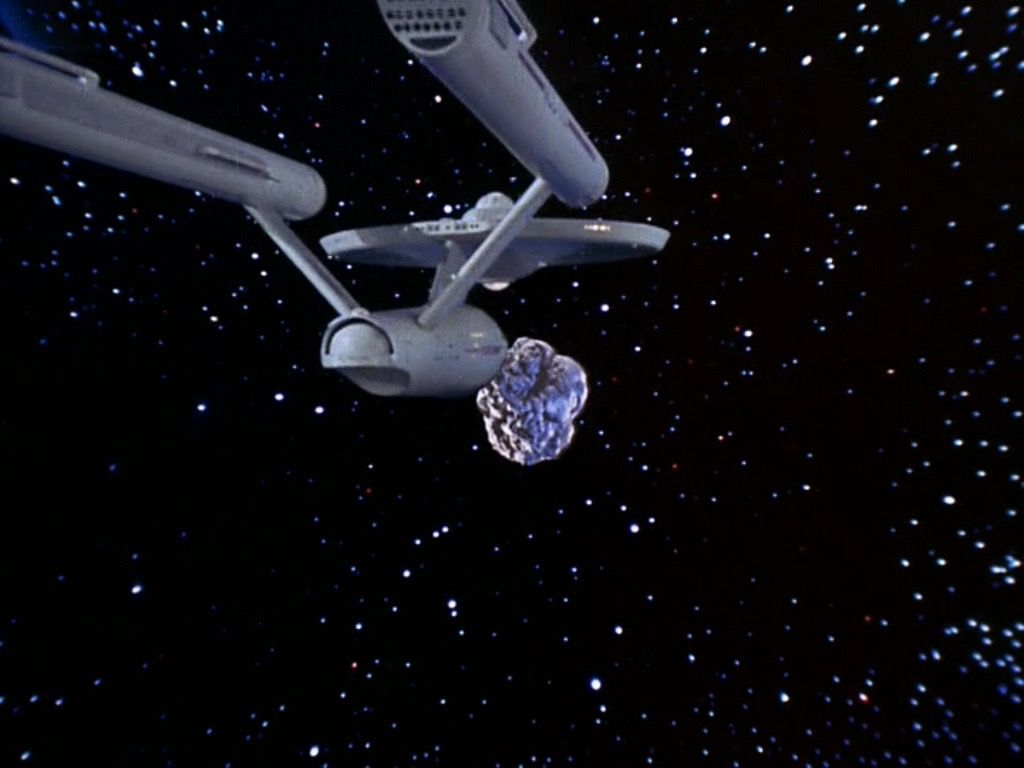
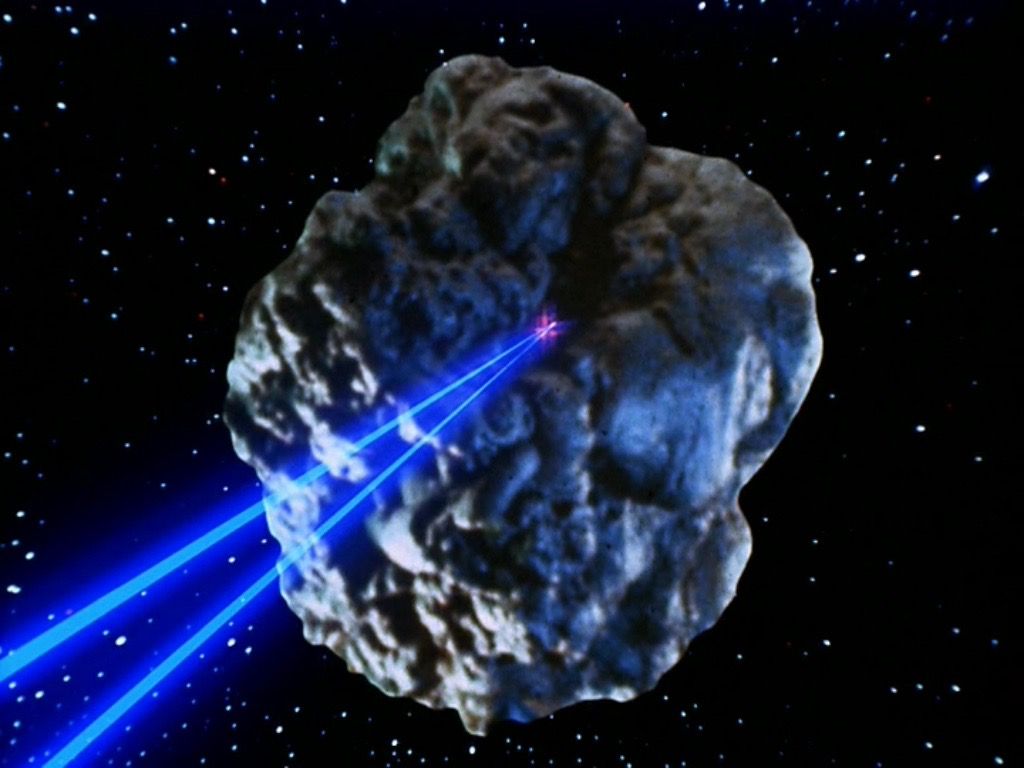
In the episode an asteroid (shown above) is on a collision course with a planet populated by Native Americans (!). The Enterprise is to deflect the asteroid before causes mayhem on the planet. Naturally, there are complications, but today I'm talking about asteroids.

The asteroid shown in the episode doesn't look anything like any real asteroid that has yet been seen up close with a spacecraft.

Of course the episode was produced in 1968 and the first spacecraft encounter with an asteroid wasn't until 1991, when the Galileo probe flew past asteroid 951 Gaspra (shown above). Asteroids come in several different types. Gaspra is a S-type asteroid (the most common), meaning that it is basically a big rock.

It is possible that the black, shiny asteroid shown in Paradise Syndrome represents a different type of asteroid though. At least some of the M-type asteroids are thought to be largely made of metals such as nickel and iron. What was shown in the episode could certainly have been one of these asteroids. No M-type asteroids have been visited by a spacecraft yet, so we don't have a close look at one. There are forward-looking groups who are considering how we might eventually mine M-type asteroids, but it will be a few years before we see one up close. When we finally do we'll know how well the 1960s effects team did.

As I mentioned earlier, there is an asteroid portrayed in the 1979 movie Star Trek: The Motion Picture. This of course was made more than a decade before the first spacecraft had an encounter with an asteroid. So how did they do?
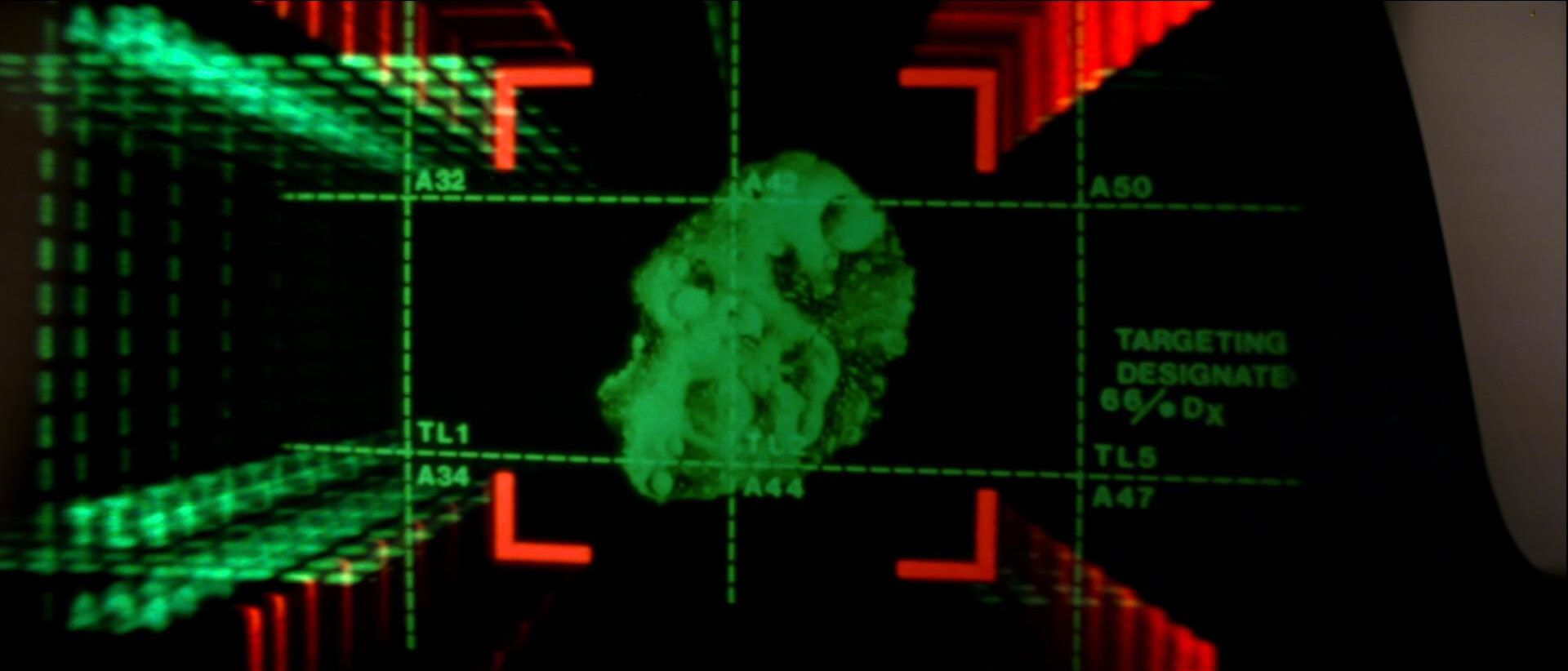
The movie gives two visualizations of the asteroid. In the view above, we see how it looked in the wormhole. There's more wormhole than asteroid here, so there isn't much detail that can be discerned. But the view shown on Chekov's targeting computer (below) gives a much better look.
The effects team rendered a key feature that was later found on all the asteroids that have been seen by spacecraft - impact craters. These craters, like the ones on the Moon, form when smaller objects crash into larger ones. This collision process was very important in the early solar system, but I digress.

Compare the asteroid as shown in the movie (above) with this real-life asteroid (at right). That's the asteroid known as 243 Ida. Ida was photographed by the Galileo spacecraft in 1993. It too is an S-type asteroid.

If I stripped away the green and the targeting graphics from the movie asteroid, you'd see that two are very similar and that the Star Trek: TMP effects did a fine job of nailing down that small asteroids are both irregular in shape and are largely covered by impact craters of various sizes.

Don't think that the effects team was being especially prophetic though. The fact that small asteroids have an irregular shape and that they should be covered with craters was expected by astonomers. Still, they did a good job.

I don't recall any asteroid belts that were shown in the original series, but they certainly were in Star Trek: The Next Generation and in the other series that have followed (probably because everyone was better at special effects).
Here's a shot from an episode of Star Trek: The Next Generation's season four episode Final Mission. Asteroids are everywhere. Effects teams know that audiences need something exciting to see, which is why asteroid belts look so crazy dangerous on TV and in the movies. Naturally, we've not yet explored asteroid belts in other solar systems, but in our own, the asteroids are very, very small compared to the vast regions of space that separate them. So basically asteroid belts are nothing like what you see.

Which brings me to our real asteroid belt and the worlds in it that have names associated with Star Trek.
Both Leonard Nimoy and Mr. Spock have asteroids named for them. Well, sort of. It turns out that asteroid 2309 Mr. Spock was technically named for the cat of the astronomer who discovered the asteroid. And of course, the cat as named for Star Trek's Mr. Spock. 4864 Nimoy was named for the real Leonard Nimoy. The orbits of those two are shown above, looking down on the solar system, and below in a view from the side.
As you can see 4864 Nimoy is only slightly tipped relative to the orbital planes of the major planets, but 2309 Mr. Spock is tipped nearly 11 degrees to their orbital plane.

Other Trek actors have been honored with asteroid names. They are:

7307 Takei was named for George Takei, who played Lt. Sulu.
68410 Nichols was named for Nichelle Nichols, who played Lt. Uhura.

So far, it looks like there is no asteroid named for William Shatner.

There is an asteroid named for Gene Roddenberry (4659 Roddenberry). 9777 Enterprise is named for my favorite starship.
All of these are main belt asteroids, meaning that they orbit between the orbits of Mars and Jupiter.

Several writers from the original series also have asteroids named for them. They include:

10177 Ellison was named for Harlan Ellison (The City On The Edge Of Forever).
143622 RobertBloch was named for Robert Bloch (What Are Little Girls Made Of?, Catspaw, Wolf in the Fold).
186835 NormanSpinrad was named for Norman Spinrad (The Doomsday Machine).

In all cases these authors had the asteroids named for them because of their larger body of work and not because of their association with Star Trek, but because they were contributors to the show, I included them here. (For other science fiction authors that have had asteroids named for them see my post The Asteroids of Science Fiction from earlier this year.)
Putting it all together, we have the plot above, but what about later incarnations of Star Trek? I've searched on the more famous actors and writers from the movies and TV shows and haven't turned up anyone else. I'm not saying that my list necessarily captures all of the people and characters from Star Trek that have asteroids named for them, but these are all the ones that I know about. There are some red herrings out there too. For instance, 178008 Picard was named for a French Engineer, not the fictional captain of the Enterprise.

If anyone knows of some that I've missed, I would love to hear about them in the comments.

I assembled the orbit diagram images from the plots available at the JPL Small-Body Database Browser and I used various sources (including the Minor Planet Center's Minor Planet Names: Alphabetical List) to compile this list.

Sunday, March 13, 2016

The Asteroids of Science Fiction

Jack McDevitt, one of my favorite science fiction writers, was recently honored by having an asteroid named for him.
328305 JackMcDevitt is a main-belt asteroid (located between Mars and Jupiter) that on average lies 2.55 astronomical units (237 million miles) from the Sun and has an orbital period of 4.08 years.

Note the number 328305. Asteroids are named by their order of discovery. The first one found was 1 Ceres (back in 1801) and now we are up to more than 328,305 of them that have been discovered. That's a lot of asteroids!

The naming of this asteroid for Jack McDevitt got me to wondering what other science fiction authors have asteroids named for them. I decided to find out which authors from my science collection have asteroids. So this isn't a comprehensive list, but rather one that reflects my reading preferences:

230765 Alfbester
5020 Asimov
9766 Bradbury
4923 Clarke
5748 DaveBrin
25924 DouglasAdams
10177 Ellison
115561 FrankHerbert
196772 FritzLeiber
6371 Heinlein
328305 JackMcDevitt
12284 Pohl
127005 Pratchett
2675 Tolkien
5231 Verne

Yes, I included a few fantasy writers (Terry Pratchett and J.R.R. Tolkien) too. The list is much smaller than I thought it would be and I was surprised to find that other giants of the field, such as Gregory Benford, Philip K. Dick, Larry Niven or H.G. Wells*, do not have asteroids named for them. I left 21811 Burroughs off of the list because I don't think that I've ever actually read anything by Edgar Rice Burroughs.

There are of course other names from science fiction that could have been added such as 4659 Roddenberry and 9777 Enterprise, but I decided for now to focus on science fiction writers (Maybe asteroids of Star Trek will be a future post here).
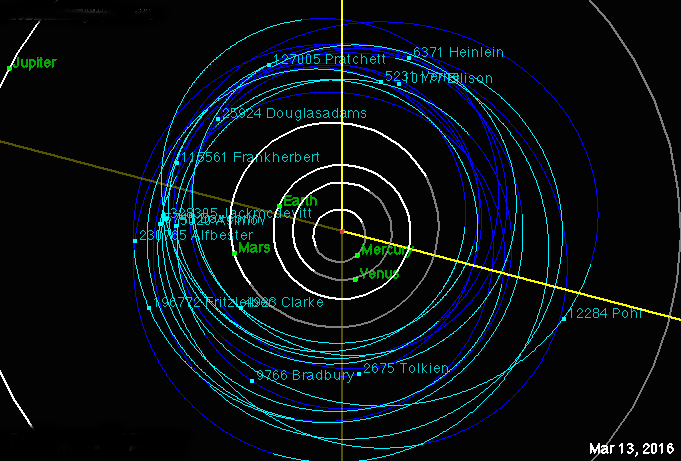
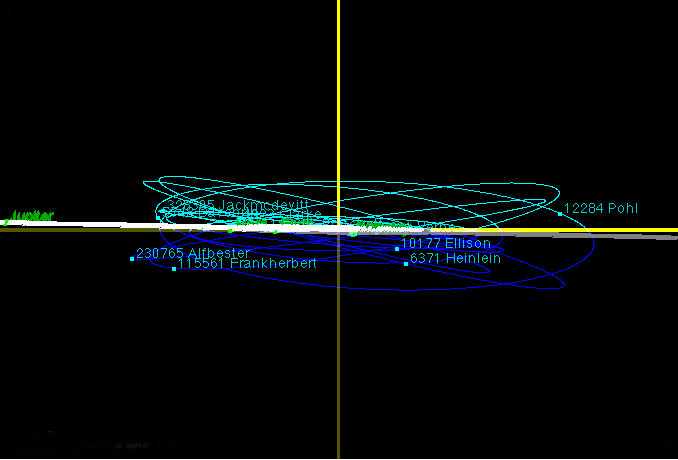
Here are the orbits of the asteroids that are on my list as seen from directly above the solar system. The orbital planes of the major planets are all very nearly aligned, but that's not true for the asteroids. The parts of their orbits that lie below the plane of Earth's orbit (known the ecliptic) are shown in dark blue while the lighter color shows where in their orbits they are above this plane.

A view from the side shows this more clearly:
In this case I didn't include all the asteroids on the list. Instead, it only shows the ones with orbits that have a significant tilt with respect to Earth's orbit.
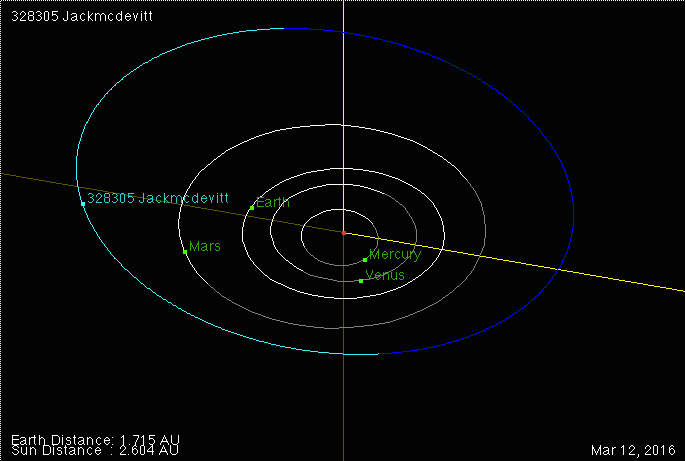
There are a few astronomers who have written science fiction that have asteroids named for them, but the main reason for their having been honored with an asteroid was due to their work in astronomy rather than for their work in literature. Those include:

2709 Sagan which was named for the late, great astronomer Carl Sagan author of the wonderful science fiction novel Contact; 3341 Hartmann for planetary scientist and artist William K. Hartmann who wrote the under appreciated Mars Underground; and 8077 Hoyle for astronomer Fred Hoyle who wrote or co-wrote more than a dozen (mostly not-so-great) science fiction novels.

I assembled these images from the plots available at the JPL Small-Body Database Browser and I used various sources (including the books on my bookshelves and the Minor Planet Center's Minor Planet Names: Alphabetical List ) to compile the list of science fiction authors who have had asteroids named for them.

*Note: 17458 Dick is named for an astronomer, 12513 Niven was named for a mathematician and 1721 Wells was named for a university administrator.