People with an interest in light pollution can now use their smartphones to measure the brightness of the night sky. There are new apps out for both iPhone and Androids that are easy, accurate and inexpensive.
The iPhone app is called Dark Sky Meter. It works very much like the much more expensive Sky Quality Meter and its results compare very favorably to it. It is available in both free (also called Lite) and Pro versions. The Pro version currently costs just $3.99.
It uses the iPhone's camera to first take a dark frame (done by placing your finger over it) and then measures the night sky. The app knows date, time, location, moon phase, weather and the phone's tilt so it can generally tell what data is good or not.
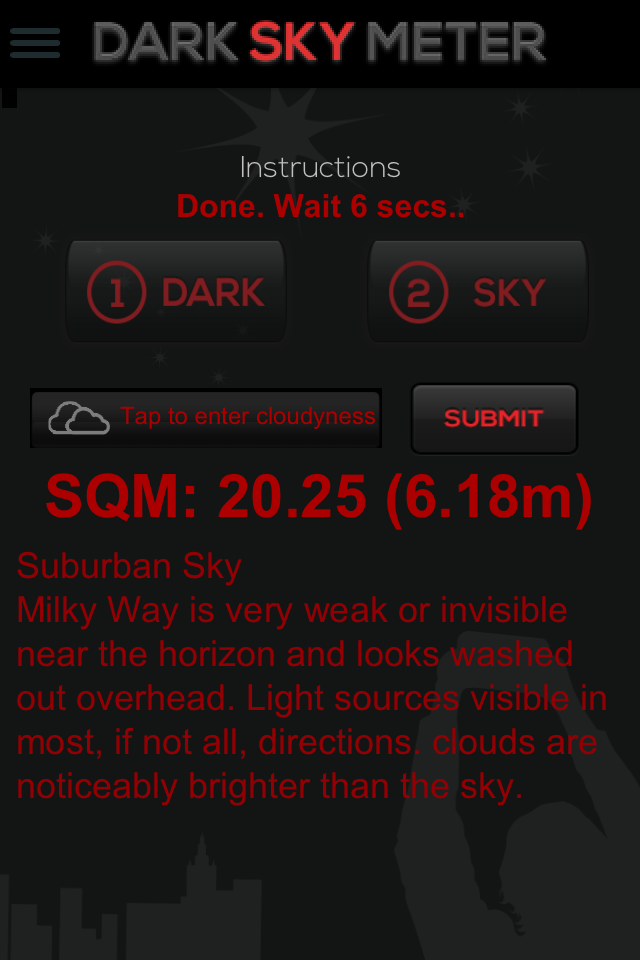
Here's a sample of what the readout looks like with the Pro version.
That's a measurement made from my yard. 20.25 is the night sky brightness as measured in magnitudes per square arc second. While that may be arcane to some, it is a useful number to know. I wont go into the details here, but higher numbers are darker. There's also a description to go with it. Also reported is the naked eye limiting magnitude, which happened to 6.18 at the zenith for me.
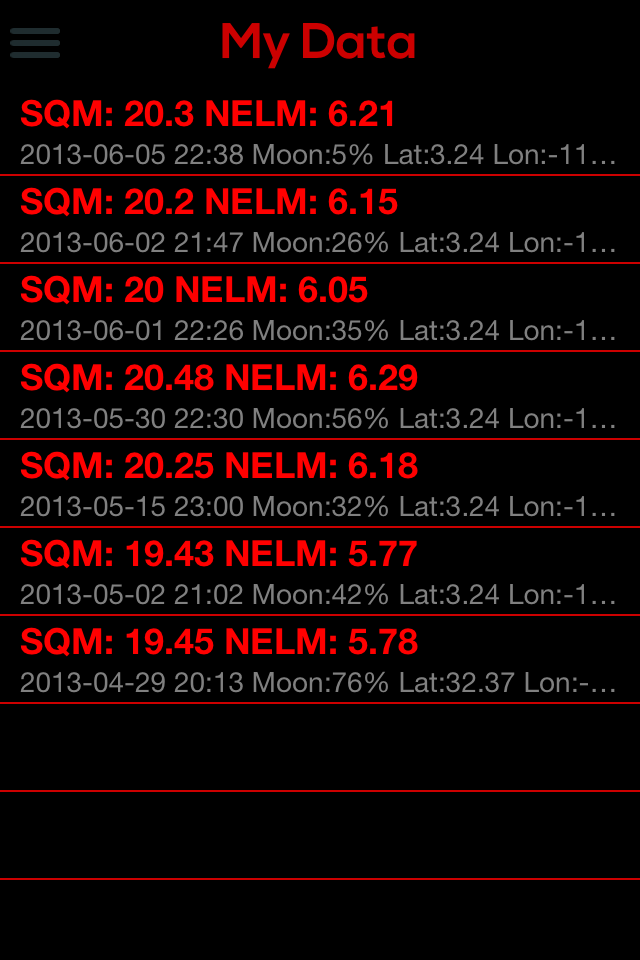
The Pro version also lets you see your own data:
That's a nice feature as it lets you track what is going on from your observing site and, if you want, to send your numbers off to programs like GLOBE at Night. Yes, I need to make more measurements. The user also has the option of uploading the data to the app's database. You can view all the data on their interactive map, here. It is good stuff, but more people need to be contributing. The International Dark-Sky Association has worked directly with the app developers and is hoping that crowdsourcing will lead to many useful measurements.
The app is currently most accurate using the iPhone 4S or 5. It works for the 4, but the camera is not as good, so the quality of the data suffers.
Android users should not feel left out as there is an app for them too. The free app Loss of the Night allows Android users to measure night sky brightness by observing stars. The data from that program is also used to help track and study light pollution. As you may have guessed, I do not have an Android phone. So, while I have not personally tried it out I hear very good things about the app and how it works.
It has never been easier to measure the impact of light pollution on the night sky. So why not download one of the apps and help contribute to science?
Showing posts with label GLOBE at Night. Show all posts
Sunday, June 9, 2013
Monday, April 29, 2013
GLOBE at Night - Now Through May 8
The GLOBE at Night citizen science program is underway again. This is an easy way for people to go out and measure the brightness of the night sky. I did so myself earlier this evening:
This is their last campaign for the year, so if you are thinking of trying it out, don't wait to participate. It is really quite easy and the results are helpful. Go on over to their website http://www.globeatnight.org/ to see how to join in.
Soon I'll be blogging about how you can use your cell phone to make night sky brightness measurements. Look again later this week.
Friday, February 1, 2013
Orion in the Evening, GLOBE at Night
If it isn't too cold where you are these evenings you might want to head out and have a look at Orion. It looks pretty good. Jupiter hanging nearby in the constellation of Taurus the Bull adds to the show.
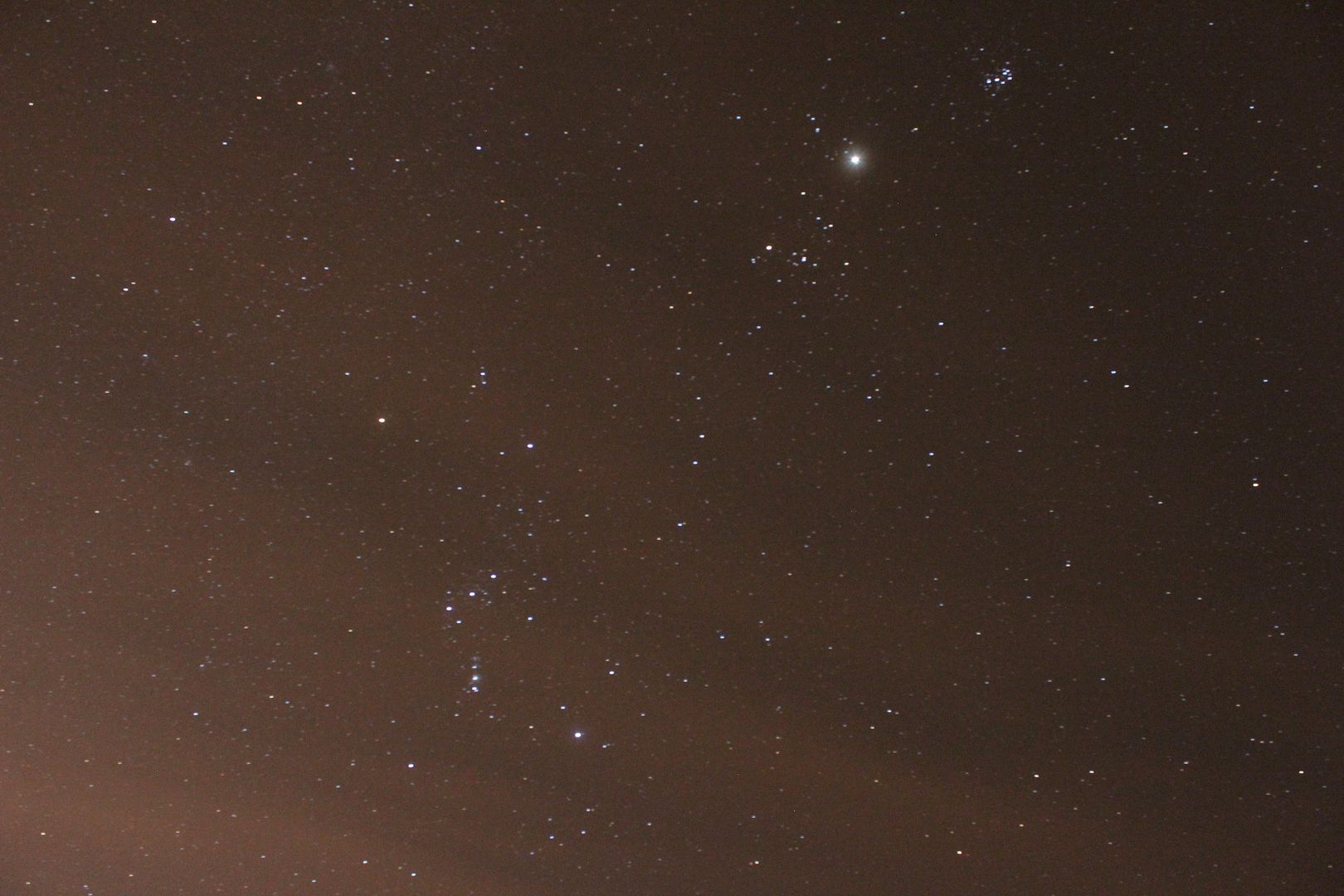
Here is a picture that I snapped earlier this evening.
The grouping of stars left of center is Orion. The bright "star" in the image is Jupiter. The V shaped group of stars to the lower of Jupiter is the head of Taurus the Bull. To the right of Jupiter is the Pleiades, a cluster of stars that is also called the Seven Sisters.
There is a bit of cirrus cloud in the image, so I'll have to shoot again when it is really clear.
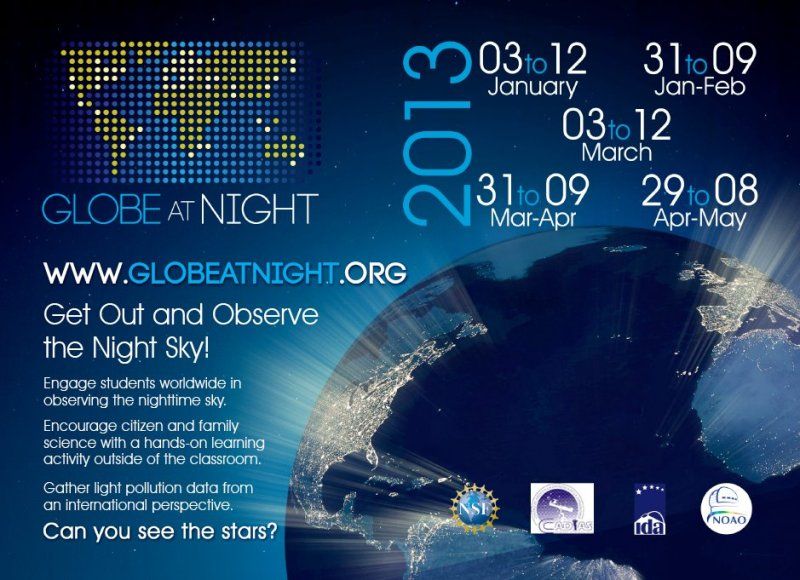
If you are out in the evening enjoying the sky, you might as well also participate in the GLOBE at Night program. The program runs now through February 9th and again during the next two months when there is no Moon in the evening sky. To participate one needs to only look at Orion and compare it to their charts. By doing so you can help measure light pollution in your area and join thousands of people from around the world in an important citizen science program. It is easy and worth while. Why not give it a shot.
Here is a picture that I snapped earlier this evening.
The grouping of stars left of center is Orion. The bright "star" in the image is Jupiter. The V shaped group of stars to the lower of Jupiter is the head of Taurus the Bull. To the right of Jupiter is the Pleiades, a cluster of stars that is also called the Seven Sisters.
There is a bit of cirrus cloud in the image, so I'll have to shoot again when it is really clear.
If you are out in the evening enjoying the sky, you might as well also participate in the GLOBE at Night program. The program runs now through February 9th and again during the next two months when there is no Moon in the evening sky. To participate one needs to only look at Orion and compare it to their charts. By doing so you can help measure light pollution in your area and join thousands of people from around the world in an important citizen science program. It is easy and worth while. Why not give it a shot.
Wednesday, January 2, 2013
The Persian Gulf. At Night. From Space.
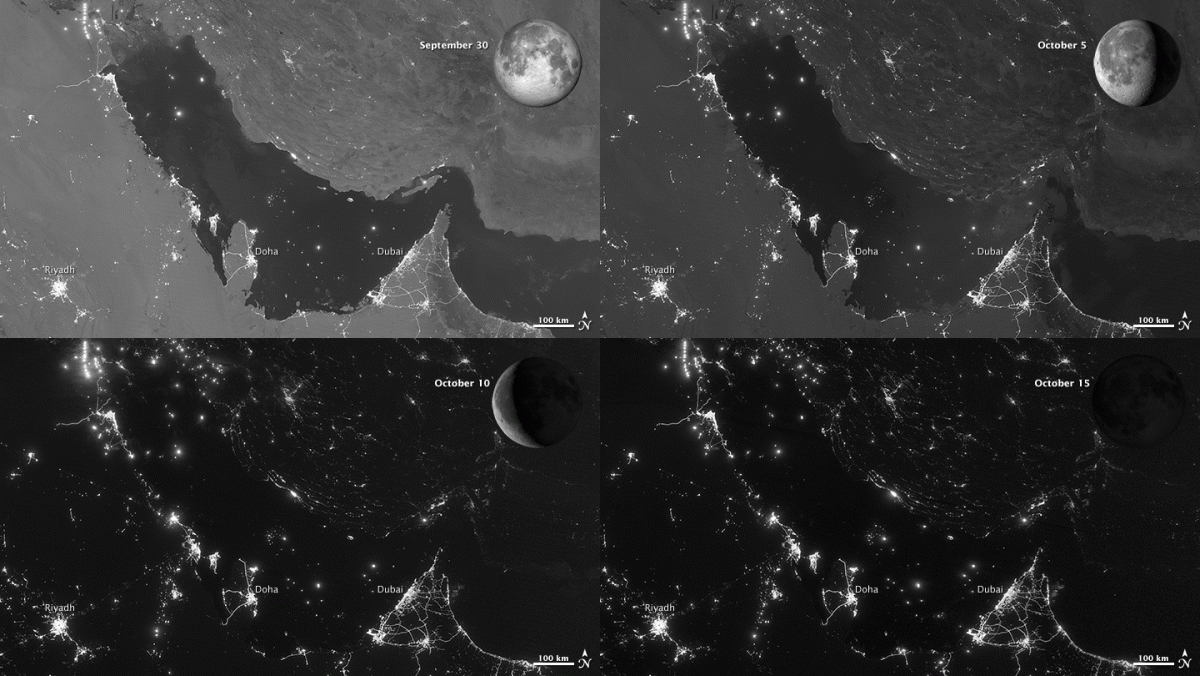
Check it out. Here are four separate nighttime images from space looking down at the same place, but taken under differing amounts of moonlight.
I am not sure what is going on between Riyadh and Doha as there is some apparent motion of the lights, but the overall effect here is that with moonlight it is pretty easy to see the physical features of the Gulf region. The city lights are pretty constant throughout.
For those who haven't noticed, moonlight is indeed pretty bright and the human eye does very nicely under moonlight levels of illumination. It is a shame that we light our cities at the intensity levels that we do, as in many cases it is much more light than we really need.
Check out the full-resolution of the images and learn more from NASA here.
![]() |
| Images from NASA's Earth Observatory via the Suomi NPP Satellite |
For those who haven't noticed, moonlight is indeed pretty bright and the human eye does very nicely under moonlight levels of illumination. It is a shame that we light our cities at the intensity levels that we do, as in many cases it is much more light than we really need.
Check out the full-resolution of the images and learn more from NASA here.
Sunday, December 9, 2012
The Black Marble and GLOBE at Night
Did you happen to catch the "Black Marble" images that were released last week?
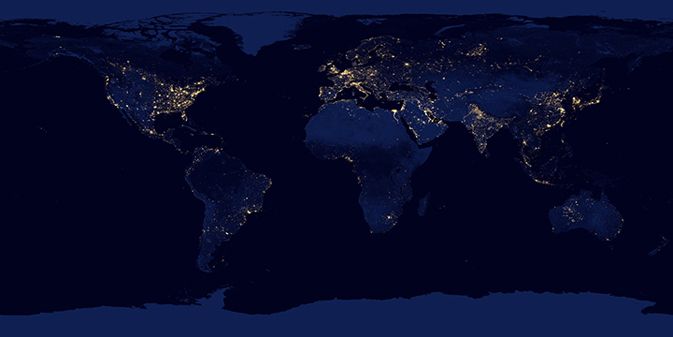
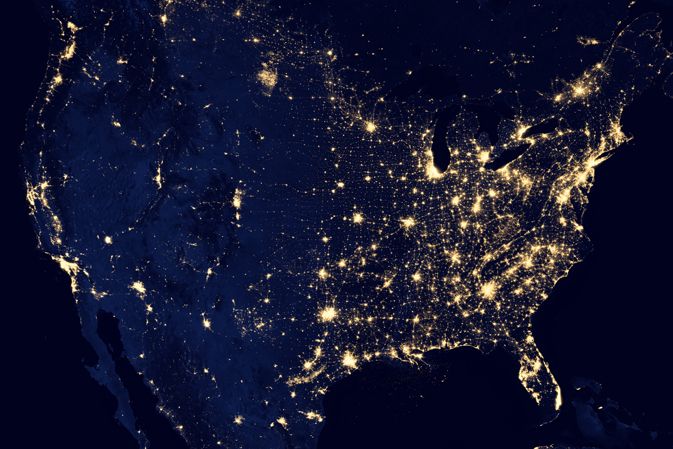
The images came from the Suomi National Polar-orbiting Partnership satellite and they represent our most detailed look at Earth at night. Chances are you'll be able to spot your home town in these new images wherever it happens to be.
Here's a look at the whole globe:
And here is much of North America:
Most of this represents poorly directed, upward pointing light. It is essentially wasted energy.
These images do not document sky glow - that brightening of the night sky that keeps most of us from seeing faint stars and other sky phenomena. The best way to study sky glow is to measure it from down here on the ground. Thankfully it is easy to measure and document sky glow. A great and easy way for anyone to do so is to participate in the GLOBE at Night program. Be sure to check out their website to see how to get involved. Their first 2013 campaign begins on January 3rd!
Night sky brightness measurements from GLOBE at Night and other programs are an essential tool in documenting light pollution and I urge you to get out there and make some measurements.
The Black Marble - not so black, is it?
The images came from the Suomi National Polar-orbiting Partnership satellite and they represent our most detailed look at Earth at night. Chances are you'll be able to spot your home town in these new images wherever it happens to be.
Here's a look at the whole globe:
And here is much of North America:

Most of this represents poorly directed, upward pointing light. It is essentially wasted energy.
These images do not document sky glow - that brightening of the night sky that keeps most of us from seeing faint stars and other sky phenomena. The best way to study sky glow is to measure it from down here on the ground. Thankfully it is easy to measure and document sky glow. A great and easy way for anyone to do so is to participate in the GLOBE at Night program. Be sure to check out their website to see how to get involved. Their first 2013 campaign begins on January 3rd!
Night sky brightness measurements from GLOBE at Night and other programs are an essential tool in documenting light pollution and I urge you to get out there and make some measurements.
The Black Marble - not so black, is it?
Friday, January 13, 2012
Measure Light Pollution with GLOBE at Night
It is almost time to get outside and start measuring light pollution. GLOBE at Night starts tomorrow night and runs through January 23rd. It is a very easy & fun citizen science campaign. All of the details are on their website.
What is the whole point? To get outside under the stars and raise public awareness of the impact of light pollution. From their website:
I will be observing and reporting nightly. How about you?
What is the whole point? To get outside under the stars and raise public awareness of the impact of light pollution. From their website:
Light pollution threatens not only our “right to starlight”, but can affect energy consumption, wildlife and health. The GLOBE at Night campaign has run for two weeks each winter/spring for the last six years. People in 115 countries have contributed 66,000 measurements, making GLOBE at Night one of the most successful light pollution awareness campaigns.
I will be observing and reporting nightly. How about you?
Subscribe to:
Posts (Atom)