Saturday, December 22, 2012

Star Trek: Where No Man Has Gone Before


Star Trek's second pilot episode, Where No Man Has Gone Before can be summarized with the following quote:
"Power tends to corrupt, and absolute power corrupts absolutely." - John Emerich Edward Dalberg Acton, 1887

The pilot, which follows The Cage, has only one returning cast member - Leonard Nimoy as Mr. Spock. The episode introduces the character of Captain Kirk. Mr. Sulu and Scotty also make their first appearance.

Dr. McCoy is yet to appear in the show even though Star Trek creator Gene Roddenberry cast a doctor in each of the two pilot episodes. The Cage featured Dr. Boyce who was very nicely played by John Hoyt. Where No Man Has Gone Before features the lifeless Dr. Piper (played by Paul Fix).
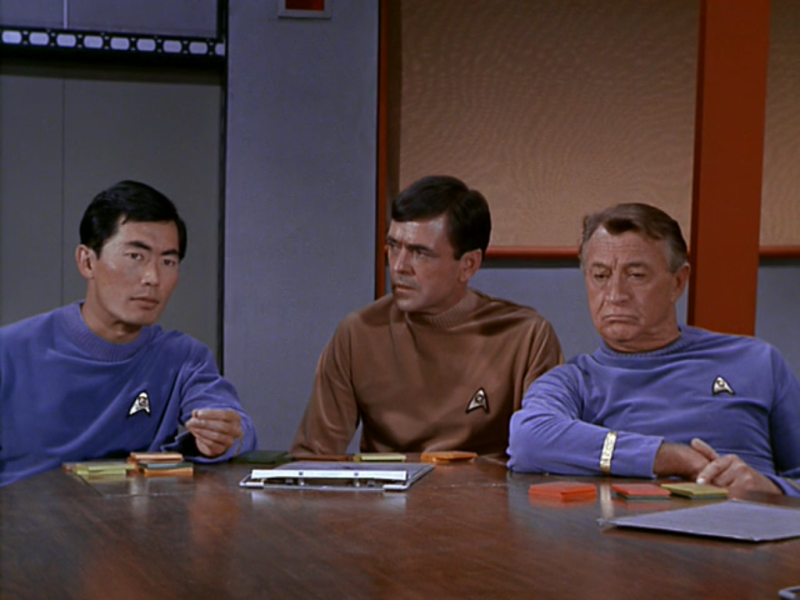
Sulu, Scotty, and the lifeless Dr. Piper
It is amazing that Dr. Piper is given so little to do here, especially since there is major medical trauma to a major character. Ultimately all of Trekdom is probably better off that almost all of the medical stuff was given to guest star Sally Kellerman who did a fine job playing psychiatrist Dr. Elizabeth Dehner. Since she does not survive the episode it paves the way for Dr. McCoy to come on as a regular when the series is launched.


Which brings us to the plot. The Enterprise recovers a badly damaged recorder from the S.S. Valiant, a ship that went missing almost 200 years ago. Spock reveals that the Valiant was swept off course and out of the galaxy. The ship encountered an unknown force. Its crew was desperately seeking information on ESP before the captain gave an order to destroy the ship.


 Kirk decides that other ships will be heading this way someday so the Enterprise should head out of the galaxy. Strangely enough (at least by actual science) the Milky Way has some sort of energy barrier on its outer edge. Sure enough they encounter the same phenomenon. Helmsman Gary Mitchell and Dr. Dehner are zapped by the effect and Mitchell is transformed and developing new powers.


The Enterprise is badly damaged and makes for the planet Delta Vega which has an automated lithium cracking facility. There they hope to maroon Mitchell before he grows too powerful to cope with.

Here is a passage of dialog from on Delta Vega that helps to define Spock for the audience as an emotionless alien being:
Kirk: Doctor Dehner feels he [Mitchell] isn't that dangerous. What makes you right and a trained psychiatrist wrong? 
Spock: Because she feels. I don't. All I know is logic. In my opinion we'll be lucky if we can repair this ship and get away in time.
It is just one of a few exchanges in the episode that brings out Spock and what he is all about.
Before there were Red Shirts, there was Lt. Kelso
The Enterprise is repaired but before they can flee Mitchell uses kills powers to kill Lt. Kelso and escapes. Mitchell brings Dehner along and gives powers to her as well.


Kirk pursues Mitchell and in for the first time (don't worry, folks it wont be the last) unleashes an argument about humanity, wisdom, etc. in an attempt to convince Dr. Dehner to help him.
Kirk: What will Mitchell learn in getting there? Will he know what to do with his power? Will he acquire the wisdom?
Dehner: Please go back while you still can.
Kirk: Did you hear him joke about compassion? Above all else, a god needs compassion.
Dehner: What do you know about gods?
Kirk: Then let's talk about humans, about our frailties. As powerful as he gets, he'll have all that inside him.
Dehner: Go back.
Kirk: You were a psychiatrist once. You know the ugly, savage things we all keep buried, that none of us dare expose. But he'll dare. Who's to stop him? He doesn't need to care. Be a psychiatrist for one minute longer. What do you see happening to him? What's your prognosis, Doctor?
Mitchell returns and Dehner turns on him. Que the Force lightning:


The episode works and lays the foundation of a lot of Trek to come. We get a basic understanding of both Kirk (see dialog above) and Spock and fine performances all around from the players who matter.

Alexander Courage scored this episode. The music for the episode, along with all the music for the original series, is available on the massive 15-CD release by La-La Land Records. There's nearly 28 minutes of music for this episode. You can get a preview of one track, "Power Mad/Situation Grave/Epilog", from this episode here. His music here give a sense of emptiness and longing for deep space as well as solid action cues for the, well, action. It is a great score - working well both in the episode and standing on its own on the CD.

As the second pilot to Star Trek, Where No Man Has Gone Before, successfully launch of what ultimately became a huge SF franchise in TV, movies, novels and more. If you haven't watched it in a while, go back and re-discover this early episode of Trek. 

Next up here on Visible Suns will be The Corbomite Maneuver.

Wednesday, December 19, 2012

Support the IDA!

Just a short post today. Take a look at this short video (with me narrating) about the International Dark-Sky Association.


For those that are interested the next Star Trek review, Where No Man Has Gone Before, will be posted this weekend.

Tuesday, December 18, 2012

Celestial Holiday Treats!

The solstice is almost here and it is time for some holiday treats.

First up is this amazing image of Saturn from the Cassini imaging team:


The image was taken from within Saturn's shadow looking back toward the sun. This does not show Saturn in "true color", but rather the color is enhanced here.  Read all about the image here.

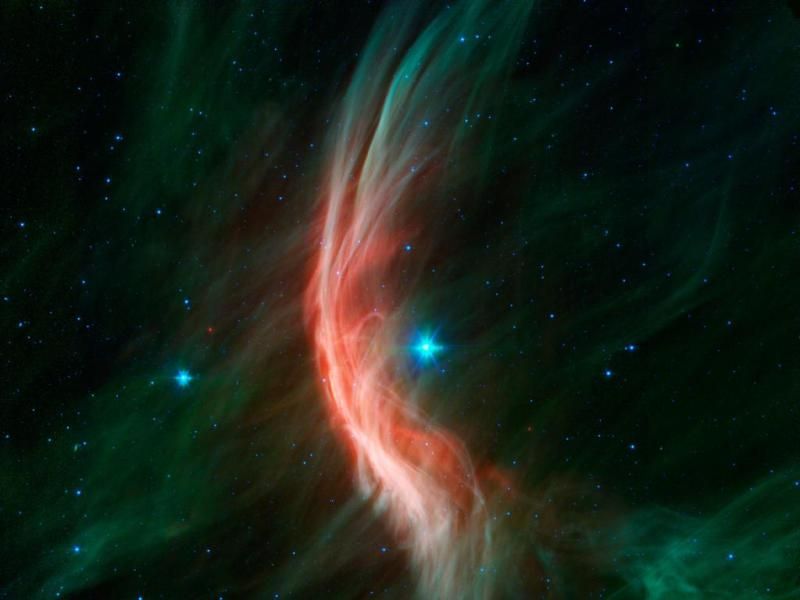
The next treat comes from the Spitzer Space Telescope:


It is an infrared image showing the star known as Zeta Ophiuchi and a cloud of dust. Stellar winds are creating a sort of bow shock in the dust cloud as the star moves through space. Like all infrared images, this one is false color too as we can't see infrared light.  Read more about it here.

Beautiful, aren't they?

Saturday, December 15, 2012

Star Trek: The Cage

As promised, I am starting to review both the episodes and the music of the original Star Trek series in production order beginning with The Cage, the first pilot episode. As an aside, I know that the entire series has been "remastered" with new effects and other visuals - many of those changes have radically altered the look of the show. In the reviews I am writing, I'll be using the DVD release of the series as my reference.
The Cage never aired during the first run of the series, but much of it was incorporated into a two part-episode that appeared later in the series. It really is a great introduction to Trek and a first rate science fiction story in its own right.

The look and feel of the ship, the crew and their gadgets is a bit different from what was to come later in the series, yet the basic elements are there.
That's the Pinwheel Galaxy (M101) on the wall of the transporter room.
 The shot of the transporter room shows the start of the racial harmony for which the show became famous. For me a large part of the appeal of the show was the positive message for the future. (Of course, the flying through space part is also a big draw.) Star Trek shows us that is it possible for humans to work through our problems and grow up. Decades after its inception there are still times when we all need to be reminded that a better future lies ahead.

The story follows the crew of the Enterprise under the command of Christopher Pike as they look for survivors of a spaceship, the S.S. Columbia, which went missing in the Talos Star Group some 18 years prior.
Apparently the Talos Star Group is none other than the Pleiades (also known as the Seven Sisters), a group of stars that is easily visible in the nighttime sky here on Earth. The crew tracks down metal wreckage on the world known as Talos IV, which you aren't supposed to notice is really the Moon.
Talos IV (left), the Moon (right)
Pike and the crew find the survivors - a "collection of aging scientists" and Vina, who was apparently born as they crashed.
Unbeknownst to Pike and the crew, none of this is real. The crash site is a fake and Pike is imprisoned by the Talosians. We learn later that the Talosians live underground because the surface of their world was decimated by war. The Talosians have developed great mental powers and can create realistic illusions.
Pike, always with Vina, is taken through a series of illusions - places and events from his past as the Talosians enjoy the show. As Vina explains "You're better than the theater to them. They create an illusion for you. They watch you react, feel your emotions."

One of the illusions takes Pike back to Rigel VII - a planet where Pike had a "recent death struggle."  Nice view, if you can get it. Seriously, who wouldn't want to live in a castle with that view out the window? Unfortunately this big ugly guy ruins the experience:
Pike defeats him, rescues Vina. They are taken to other fantasies: a nice domestic picnic and the famous palace scene where Pike and others are watching Vina dance in the guise of a green Orion slave girl:

Of course Pike isn't playing along and wants nothing to do with her or any fantasy that the Talosians create for him. Vina later explains the problem with how the Talosians are living:
"Because when dreams become more important than reality, you give up travel, building, creating. You even forget how to repair the machines left behind by your ancestors. You just sit, living and reliving other lives left behind in the thought record."

Ultimately Pike manages to break free and the Talosians are convinced that holding humans captive isn't a good idea because they are "too violent and dangerous a species" for their needs. Pike and two others later brought down are free to go.  But what of Vina?
Vina wasn't really born at the time of the crash. She was a badly injured survivor. The Talosians had no medical guide for putting her back together. Vina chooses to remain with the Talosians as they give her the illusion of health, beauty and even the company of Pike.

And they fly off for another adventure:


All of this works not only because of performances given by the actors and the technical crew, but also because of the masterful musical score written by Alexander Courage. Courage wrote just over 32 minutes of music for the episode. In it he created not only the iconic Star Trek musical theme but also two themes that are used often here - one for the Talosians and one for Vina.

The theme for the Talosians is a played on an electronic guitar giving an undeniably creepy vibe for the aliens. You can hear a sample of it here.

Vina's theme is used in a variety of ways. It is at times haunting and longing. It is also used as the pulsing theme as Vina dances as an Orion slave girl. Play the clip below and you'll hear it used for both the quiet picnic scene and then as she dances.


All-in-all the score works very well. Courage's music for this first episode of Star Trek sets the tone (get it?) for what is to follow in the entire series and it listens well in isolation too.

Friday, December 14, 2012

Boldly Going

It is time for me to start posting more often on this blog and expand its content a bit. Two of my interests beyond astronomy are reading/watching science fiction and listening to movie soundtracks.

My interest in music started somewhere around the time that Flandrau Planetarium opened to the public in 1975. They used to give out a list of what music was used in their shows and I started tracking down the various pieces of classical music that had been incorporated into the shows. By 1977 the soundtrack to Star Wars by John Williams came on the scene and for me there was no turning back.

Early influences in getting me into science fiction were the Apollo Moon landings; my 5th grade teacher, who read aloud Robert Heinlein's Red Planet and Have Spacesuit--Will Travel; and the original Star Trek TV series. I have been watching Star Trek for so long, that I have no memory of seeing any of the 79 episodes for the first time. They have just always been there.


Given my interest in movie soundtracks, I guess it should be of no surprise that I had to order this massive 15-cd box set of music from the original Star Trek released by La-La Land Records that just came out. The limited edition set contains all of the music recorded for the series - some of it was never even used.

The set arrived here at Visible Suns earlier this week and I thought that it might be fun to work my way through both re-watching the episodes and listening to the music while posting reviews of each here on the blog.


I will still be posting cool things about astronomy, the war on light pollution and the like, but I hope that this expansion will be enjoyable for those that visit the blog.

Look for a review of the first pilot for Star Trek, The Cage, to appear sometime this weekend.

Thursday, December 13, 2012

Weather domes

I had the chance to go to Kitt Peak National Observatory today to prepare to install a night sky brightness meter. While on the roof of one of the buildings there I took this shot of the dome of the 84-inch (2.1 meter) telescope:


The view reminded me of one of my favorite old Palomar pics:


 I know, my shot doesn't really compare to the vintage one, but that's the best you'll get out of me today.

Sunday, December 9, 2012

The Black Marble and GLOBE at Night

Did you happen to catch the "Black Marble" images that were released last week?

The images came from the Suomi National Polar-orbiting Partnership satellite and they represent our most detailed look at Earth at night. Chances are you'll be able to spot your home town in these new images wherever it happens to be.

Here's a look at the whole globe:


And here is much of North America:


Most of this represents poorly directed, upward pointing light.  It is essentially wasted energy.

These images do not document sky glow - that brightening of the night sky that keeps most of us from seeing faint stars and other sky phenomena. The best way to study sky glow is to measure it from down here on the ground.  Thankfully it is easy to measure and document sky glow. A great and easy way for anyone to do so is to participate in the GLOBE at Night program. Be sure to check out their website to see how to get involved.  Their first 2013 campaign begins on January 3rd!

Night sky brightness measurements from GLOBE at Night and other programs are an essential tool in documenting light pollution and I urge you to get out there and make some measurements.


The Black Marble - not so black, is it?