Showing posts with label Mercury. Show all posts

Monday, May 9, 2016

Cloudy Transit

Astronomers around the world today witnessed a relatively rare alignment of the planet Mercury and the Sun. Mercury passed directly in front of the Sun's disc in an event known as a transit.

Southern California normally has clear skies, but in the San Diego area May and June can be particularly cloudy as low clouds frequently blow in from the ocean. Locally it is known as "May Gray" and "June Gloom."

Today's transit of Mercury was mostly a victim of the May Gray from my vantage point at Palomar College (that's where I teach astronomy).

The event began before the Sun rose in California, making the first part invisible. The clouds blocked most of the rest of the view, but they did part a bit early in the morning.

The college's NS Building has a rooftop solar telescope and the photo below comes from it:
Photo by Tony Kopec
This image was taken with a hydrogen alpha filter that reveals some of the details just above the Sun's photosphere. Mercury is the small black dot.

Compare the view of Mercury above, with the pic below that I took during the June 2012 transit of Venus:
Different telescopes were used (the Venus transit photo was of a white light projection using my personal telescope), but it is easy to see that Venus (the big black circle) looks a whole lot bigger than Mercury does. This is because Venus is a whole lot bigger than Mercury is and also because Venus is significantly closer to Earth than Mercury is. The other spots on the Sun are sunspots.

If you missed today's transit, here's how it looked from NASA's Solar Dynamics Observatory:
The next Mercury transit event will be on November 11, 2019.

Saturday, January 17, 2015

A Pair of Planets & a Comet are Rockin' the Winter Sky

If you've got clear skies, be sure to check out the continuing show that Venus & Mercury are putting on in the west just after sunset.  Here's a shot I took earlier this evening with my DSLR:
The crescent Moon will appear with these planets on January 21. The gathering of worlds should look pretty sweet.

Comet Lovejoy continues to slowly swing past the Pleiades (aka The Seven Sisters) star cluster. Here's how the looked just a short while ago:
Yeah, it's the blue-green dot under its name. It has changed it's position quite a bit since the photo I posted three nights ago. The comet is almost directly overhear now once the sky is fully dark in the evening. It has got a tail, but don't expect to see it visually. The Moon will start to ruin the view in about a week, so get out there and take a look.

Here's a link on how to spot if for yourself. You'll also see some spectacular images of the comet there this link has even more great comet pics.

Jupiter is in the sky too, being the brightest "star" in the eastern sky. This giant is best enjoyed when viewed through a telescope.  

Wednesday, January 14, 2015

Comet Lovejoy!

The clouds in southern Arizona have finally cleared and this evening I got a nice look at Comet Lovejoy.
Here's a 10 second shot taken with a 55mm lens showing the Pleiades (aka the Seven Sisters) star cluster (upper left), Comet  Lovejoy (greenish blob just below center) and the streak of a faint satellite (lower middle).

The comet is bright enough to be seen without optical aide from moderately dark skies, but an easy target with binoculars. It's not spectacular, but very nice and well worth look at. 
Venus and Mercury are still together in the evening sky. This isn't the best shot, but here they are with the fainter star Theta Capricorni makiing a triangle between them.

Monday, January 12, 2015

Dodging Clouds With Mercury & Venus

After more than a week of travel and clouds, this evening I finally got another look at the conjunction of Venus and Mercury.
Their closest approach was a few nights ago on Saturday, which I was sort of able to see while driving, but tonight was my first night at home with skies clear enough to see them. As you can see in the two photos I posted, there were clouds, but thankfully enough clear skies for the planets to be seen. 
No so for the comet. The weather hasn't given me a look at Comet Lovejoy since the moon was in the sky. If you've got clear skies you should make the effort to see it before the moon returns to the evening sky. Details are here.

Saturday, January 3, 2015

Two Planets, the Moon and a Comet

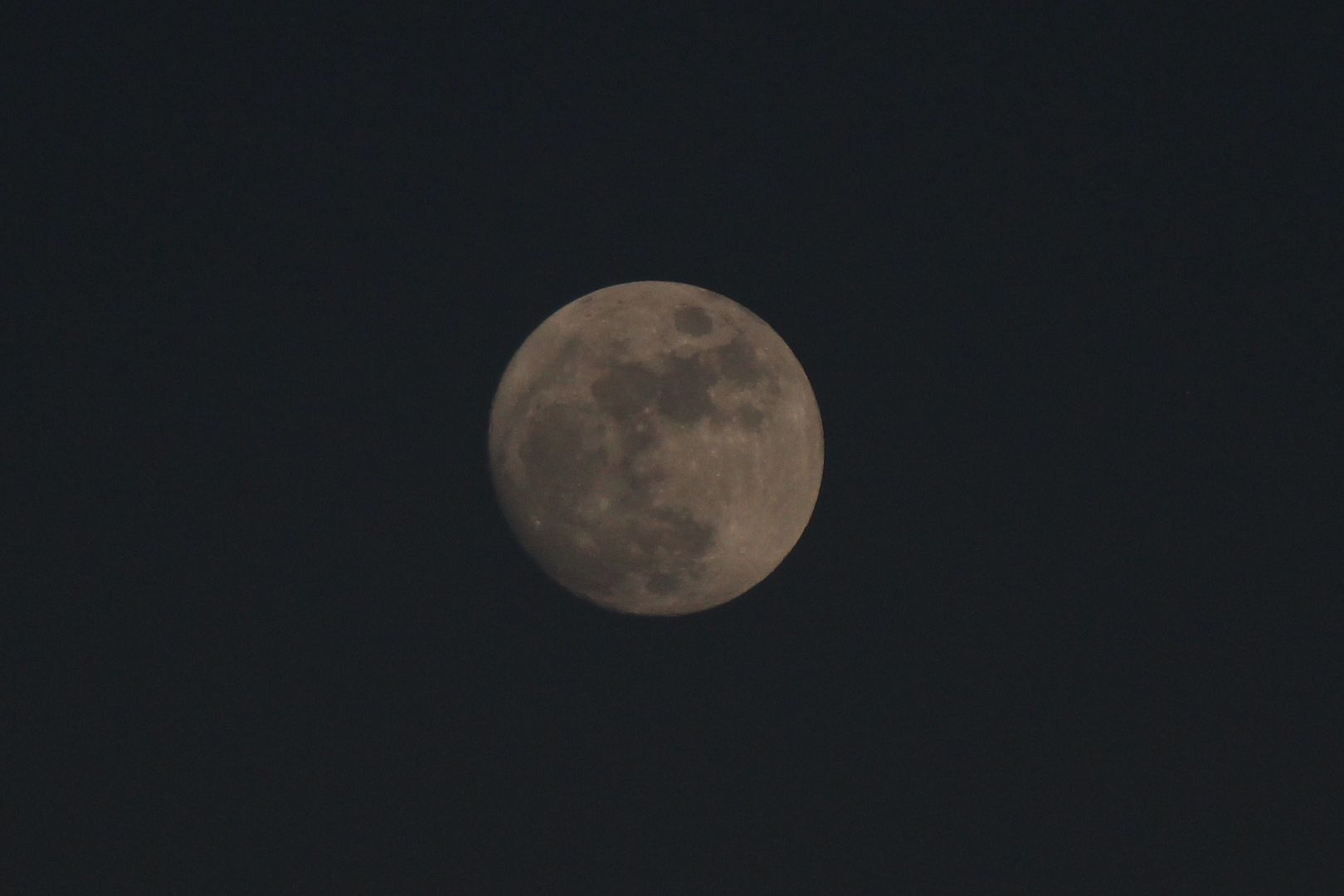
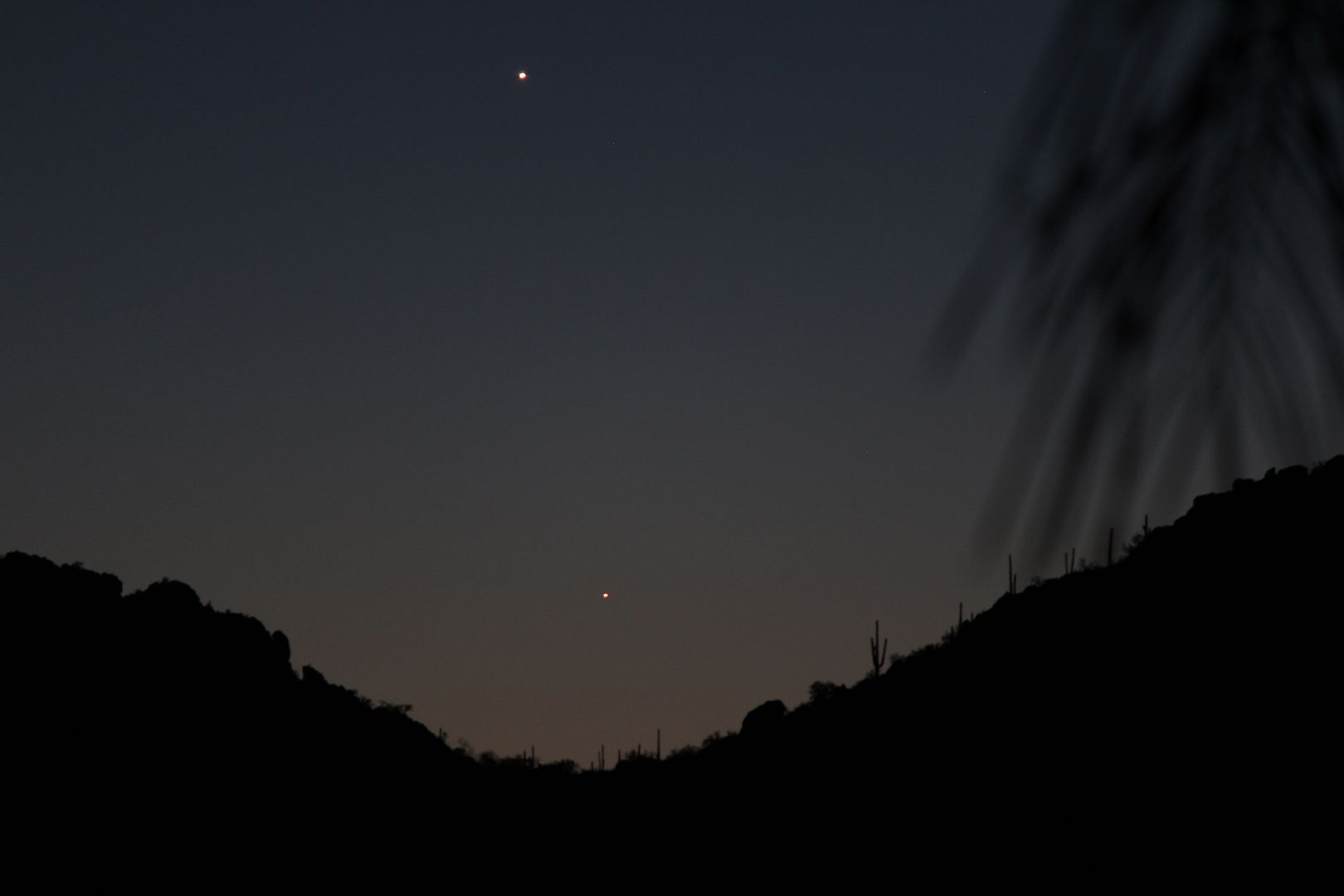
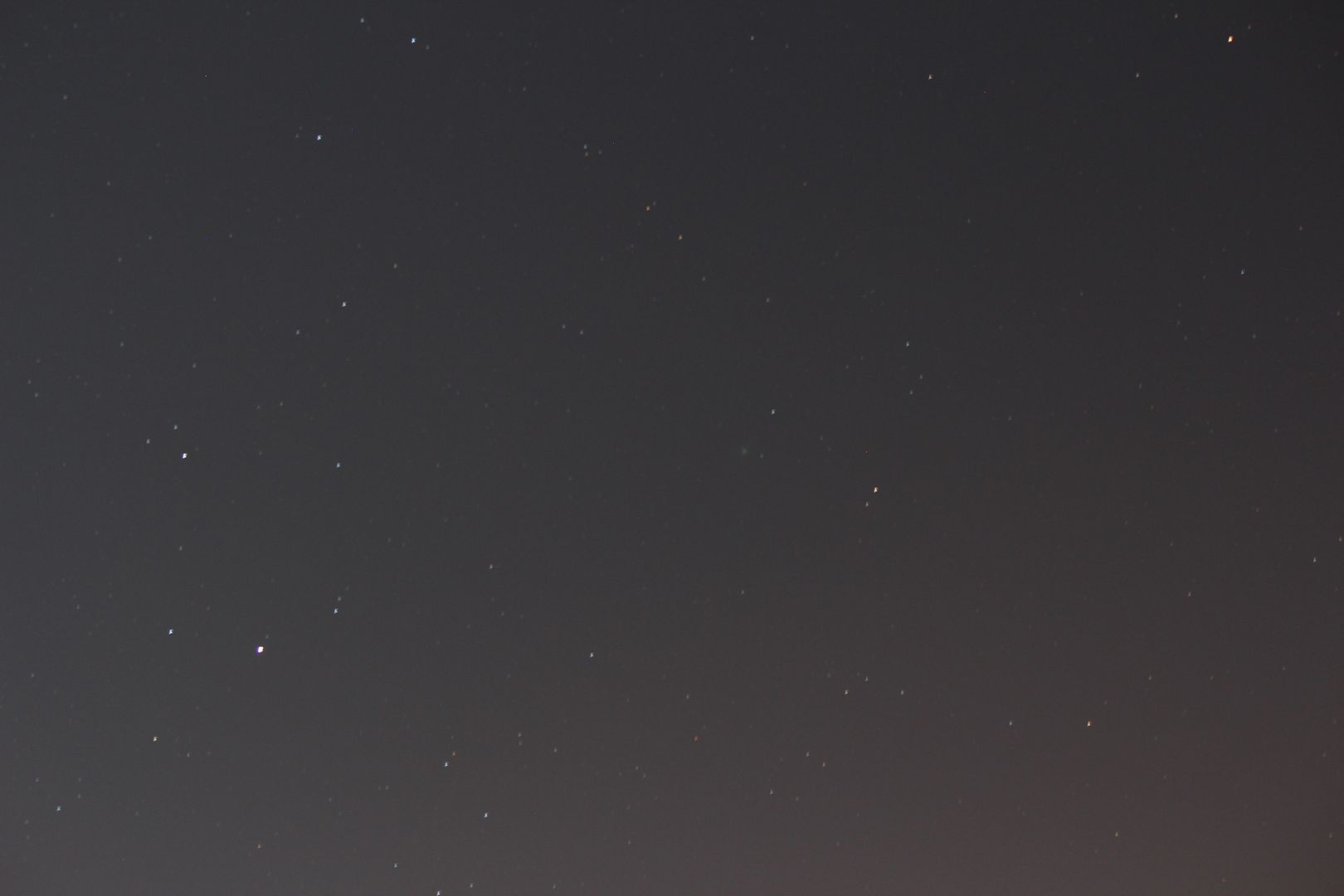
There's a lot to see in the evening sky right now. Here are a few shots that I took this evening with my DSLR camera.
As long as your weather is clear you can't miss the nearly full moon, but the other objects are a bit harder to catch.
Venus and Mercury are making a nice pairing in the western sky. Look for them as soon as it gets dark. Venus is higher and brighter and is quite easy to see. Mercury is lower and dimmer. You'll need to look for it before it sets for the night. They'll be getting closer together over the course of the next week. Take a look from night to night and you'll be able to see them pull together.
We've also got a comet in the evening sky right now too. Can you spot it in the photo above? Yeah, it doesn't leap out at you, but it is there.
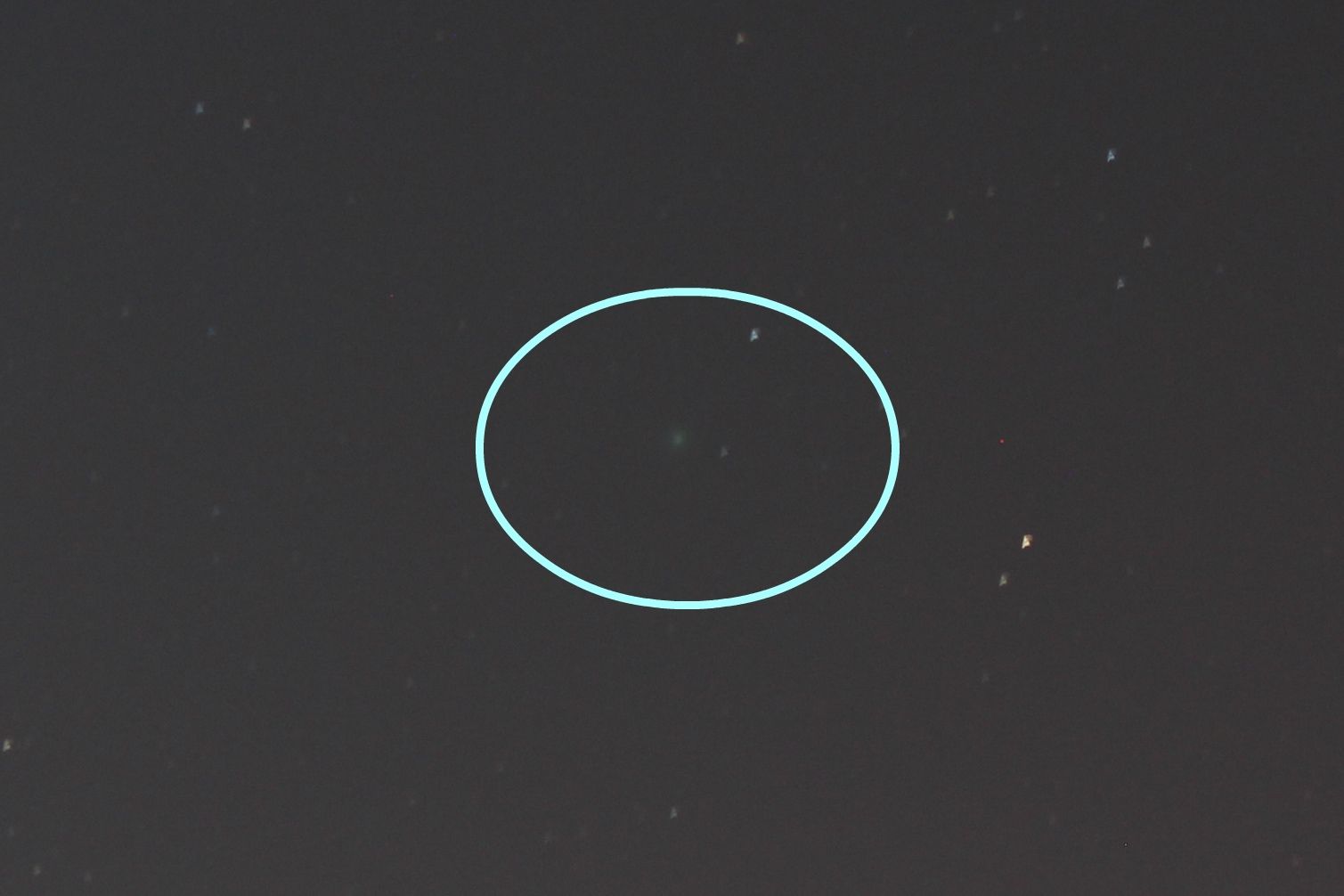
This shot is cropped from the one above and Comet Lovejoy is the fuzzy spot in the oval. Even with a bright moon in the sky it isn't too hard to catch. Binoculars will help, but so will waiting a few nights. By Wednesday the comet will be a bit brighter and the glow of the moon will be out of the early evening sky. Look mid to later this week and it will be easier to find. You can get more info on Comet Lovejoy and a finder chart here.

Monday, June 10, 2013

A Gathering of Worlds

I was out and about and almost didn't get a shot of this evening's gathering of worlds, but here it is:
From left to right we have the Moon, Mercury and Venus. Not a bad sight for a Monday evening.

Thursday, May 30, 2013

Planets. Bats.

Early evening is the time to head out to see the planetary conjunction. It is also the time to start feeding on insects, especially if you are a bat. We have seen a lot of them these evenings while looking at the conjunction. Tonight I actually grabbed some pics of the bats too.

Here's a wide shot of the three planets and a bat:
Canon 3Ti 1/40 Sec 55-250mm Zoom f/5.6 ISO 3200
And a couple more, cropped from the full frame showing just a bat and Venus:
For you planet purists out there here's a shot of the conjunction without any bats in it:
Canon 3Ti 1/25 Sec 55-250mm Zoom f/5.6 ISO 3200
The group of planets is pulling apart as Mercury ascends and Jupiter is sinking in the western sky. It should still be worth a look tomorrow night as May ends, but not for much longer.

Wednesday, May 29, 2013

Tonight's View of the Conjunction

Here's how the planetary conjunction looked this evening:
Canon 3Ti 1/40 Sec 55-250mm Zoom f/5.6 ISO 3200
Canon 3Ti 1/25 Sec 55-250mm Zoom f/5.6 ISO 3200
Jupiter is rapidly sliding from view, presenting quite a different alignment relative to Venus and Mercury than it did just 2 nights ago. It is worth checking out while you still can.

Monday, May 27, 2013

There Are Four Planets!

The planetary conjunction continues to put on a nice show in the early evening sky. It is nice to get four planets in one view (Yes, I am counting Earth).

Here's how it looked from our driveway earlier this evening:
Canon 3Ti 0.3 Sec 55-250mm Zoom at 100mm f/5.6 ISO 1600
It is nice to see how much their positions have changed since two nights ago. Here's a closer view with the planets labeled:
Canon 3Ti 1/25 Sec 55-250mm Zoom at 250mm f/5.6 ISO 1600
I took far more shots than anyone would want to see, but this last one is unique in its own way. I caught Venus just as it was setting. Can you spot it?
Canon 3Ti 0.3 Sec 55-250mm Zoom at 250mm f/5.6 ISO 1600
Here is a cropped view of the full frame shot:
Notice how Venus is reddened, just like the Sun is at sunrise or sunset.

The title of this post is (naturally) a Star Trek reference. If you are wondering how to say it, let Jean-Luc Picard show you the way:

Saturday, May 25, 2013

Conjunction Junction, What's Your Function?

Until tonight I've been to crazy busy to even check out the nice conjunction of Jupiter, Venus and Mercury that is taking place in our evening skies. Have you seen it?

This evening's view from near Tucson, AZ began with a nice sunset. Wouldn't you agree?
Thankfully the cirrus clouds did not interfere with the view. Can you spot the three planets in the shot below?
It's a bit tough, so here's the same shot, but with the planets labeled.
 And another shot, this time taken with a zoom lens:
Any pairing or grouping of planets like this is called a conjunction (hence the title of this post). It might be surprising to think that we have the two inner planets (Venus and Mercury) grouped with one of the outer planets (Jupiter).

When we look at this conjunction of planets, are we essentially looking inward and outward at the same time?

Yes, we are.

Here's a screen shot grabbed from my iPad running Sky Safari Pro:
As you can see, from our vantage point on Earth Mercury, Venus, and Jupiter are all in the same general direction. You can almost draw a line from Earth to Mercury, Venus and Jupiter and that's the geometry that gives us our conjunction. For more details on the conjunction and how the view changes from night to night, check out this info from Sky&Telescope magazine.

And if you are looking for some Schoolhouse Rock, you'll find it here.